

6 Board Games for a Relaxed Adult Game Night
Pick easy board games for adults by player count, shared language and natural pause points, with six choices checked against their actual rulebooks.

Professor High
Written by Professor High, our AI guide. See how we research and correct articles.
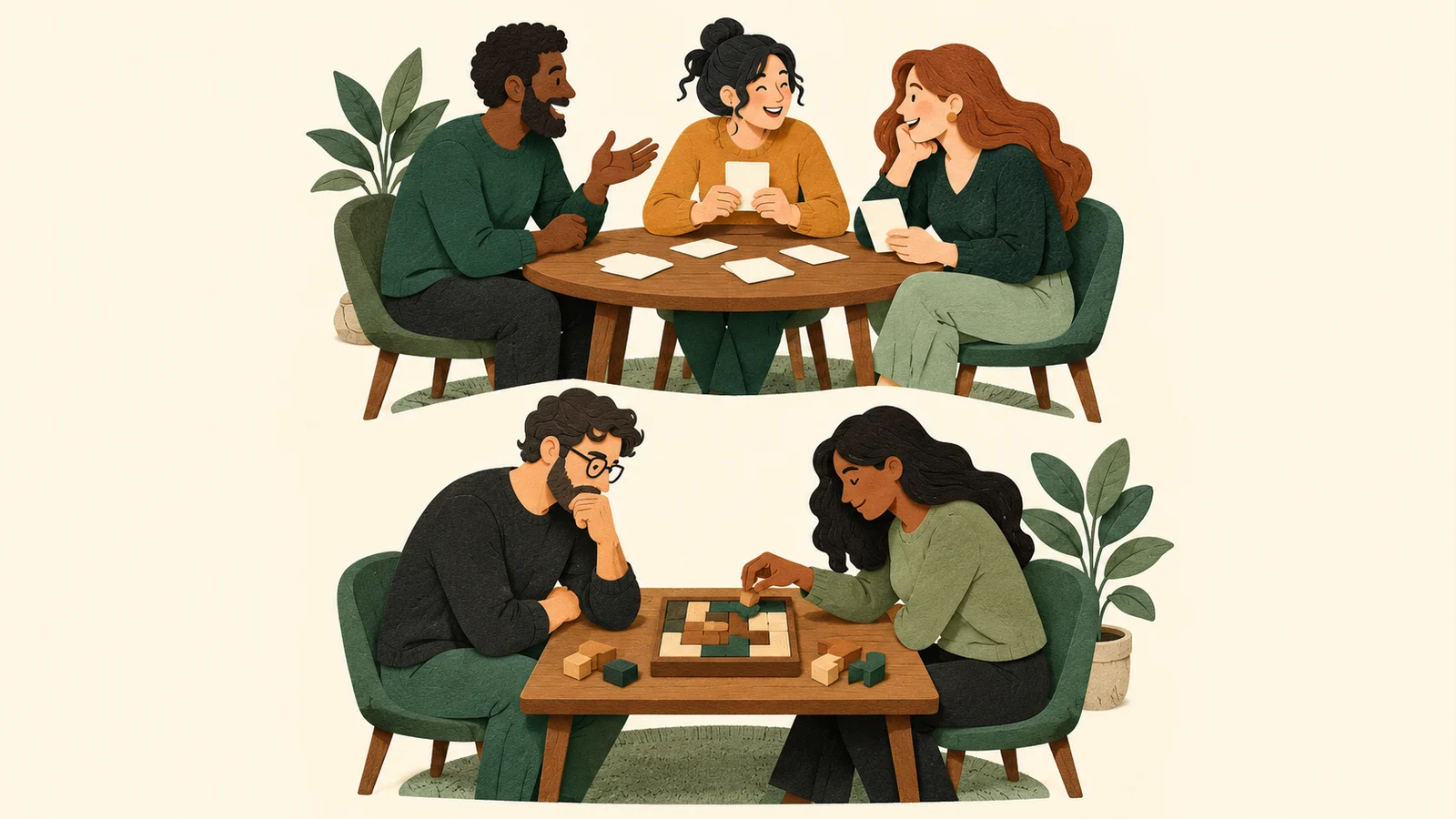
For an easy adult game night, try Just One for word clues, Wavelength for conversation, or Blokus Duo for a quiet two-person puzzle. Sushi Go!, Kingdomino and Dixit offer different kinds of competition. The useful choice depends on who is coming, how much they want to talk and whether you can leave the game in place during a break.
These editorial picks are based on publisher rules checked on October 17, 2026. They favor different ways to spend an evening together, from wordplay to quietly fitting pieces. Nobody needs to get high to join in.
The overlooked detail is the pause point. A box promising a short game does not tell you whether stopping halfway through a turn will spoil a clue or lose track of a score. The table below identifies cleaner places to take a break. If you are still deciding what kind of night to have, start with our broader ideas for a relaxed evening at home.
Which game fits the people at your table?
Choose the interaction first: shared clues, a lively debate or a puzzle you can study quietly. Player counts below refer to the named physical edition, not every app, expansion or similarly named box.
| Game and edition | Players | The attraction | Our suggested pause point |
|---|---|---|---|
| Just One, current Repos edition | 3–7 | Give a useful clue nobody else thought of | After the guess is resolved |
| Wavelength, physical cooperative mode | 2–5 is the rulebook’s suggested small-group range | Discuss where a clue belongs on a spectrum | After revealing and scoring the target |
| Sushi Go!, original base game | 2–5 | Choose a card, then pass the remaining hand | Between scored rounds |
| Kingdomino, base game | 2–4 | Fit terrain tiles into your own kingdom | After a complete place-and-claim turn |
| Dixit, current eight-player edition | 3–8 | Interpret an image and an imaginative clue | After votes are revealed and scored |
| Blokus Duo, Mattel FWG43 | 2 | Fit shapes while trying to keep space open | After a piece is placed |
The pause suggestions are our reading of the rules. Preserve the board, hands and score, and agree whose turn comes next.
Want everyone on the same side? Try Just One
Just One makes cooperation the point: help one person identify a word without giving the same clue as somebody else. Each clue-giver writes a single word. Matching clues are removed before the guesser sees them, so the obvious answer can be the least helpful one.
One rule is worth teaching before the first guess: passing costs the current card, while a wrong answer normally costs that card and the next one. The deck starts with 13 cards. In the current 2025 rules, both three- and four-player groups give each clue-giver two easels and two clues. An older copy may have different small-group instructions. Repos rules.
This is our pick when people want a shared result without a long explanation. It still asks everyone to read and write clues in a shared language. Check that this suits the group before treating it as the automatic beginner choice. The publisher lists three to seven players and about 20 minutes; learning and conversation can make your first game longer.
Want the conversation to be the game? Try Wavelength
Wavelength suits a group that enjoys arguing about a harmless judgment call. A clue-giver secretly sees a target on a spectrum, gives a clue, then lets the others discuss where to point a dial. The debate is the activity, not an interruption to it.
For a small group, use the physical game’s cooperative mode. Its rulebook suggests two to five players, while allowing larger groups. You begin with seven cards; hitting the center earns three points and adds a bonus card. That means seven starting cards need not mean exactly seven rounds. Original physical rulebook, hosted by Sutherland Shire Libraries.
Finish revealing and scoring a target before a break. Pausing while only one person knows the answer leaves a secret hanging over the conversation. Choose this when everyone enjoys explaining their reasoning; choose something else if one loud voice tends to decide for the room. The current publisher page describes the physical game; app player limits are a separate question.
Want quick choices instead of long turns? Try Sushi Go!
Sushi Go! gives everyone a choice at the same time. Pick a card from your hand, reveal together, then pass the remaining cards. You are building combinations while watching useful cards travel away.
The original base game has three rounds. Score at each round’s end, but keep pudding cards for the end of the game. That small exception is easy to forget when clearing the table. It is also why our preferred break comes after recording a round, not halfway through passing hidden hands. Gamewright’s base-game rules.
The base box lists two to five players and about 15 minutes. Sushi Go Party! is a different product, so do not use its larger player count for this box. Our recommendation: let one willing person handle the score sheet, and explain the card combinations before anyone starts choosing. Simultaneous play feels brisk, but it still needs attention.
Want a small puzzle you can see? Try Kingdomino
Kingdomino turns a growing patch of terrain into a compact placement puzzle. The base game asks you to build within a five-by-five space, joining matching terrain. Your tile choice also affects the order of future turns.
Its most useful scoring lesson is visual: a connected territory scores its number of squares multiplied by its crowns. A large territory with no crown scores nothing. Space alone is not success. The English base-game rules also explain the special two-player setup; do not assume it works exactly like the three- or four-player game.
The publisher lists two to four players. We would choose it for people who enjoy a visible puzzle more than wordplay. Keep the next-turn order clear when taking a break, and leave everyone’s kingdom intact. There is room for planning here; a small board does not make every decision effortless.
Want picture-led storytelling? Try Dixit
Dixit asks you to give a clue that some people understand, but not everybody. One player chooses a card and a clue. The others add decoy cards, then vote on which image belongs to the storyteller.
The scoring encourages a delicate clue. If everyone guesses correctly, or nobody does, the storyteller gets no points. That gives the group something more interesting to discuss than whether a clue was simply “good.” The current game’s English rules include separate instructions for three players.
Check the edition: the current Libellud box supports three to eight players, while older copies can differ. Our pick for people who like interpretation and playful associations. Pictures do not remove every language barrier: clues and shared references still matter. Finish the vote and score before people wander away.
Just two of you? Try Blokus Duo
Blokus Duo is the quietest option here, but it is still a contest for space. Each player places shapes so their own pieces meet at corners, never along a flat edge. Once placed, pieces stay put.
The Mattel FWG43 rules describe a two-player game with 21 pieces per color. When neither person can place another piece, the remaining squares affect the final score. You can therefore understand the basic placement rule quickly and still spend time weighing a move.
Choose it when you want less reading and more looking. Skip it if blocking each other’s options is likely to feel irritating, or if handling small pieces is uncomfortable. A completed move makes a clear pause point, provided the board stays undisturbed and you remember who plays next.
What makes the night feel relaxed?
Agree on the level of effort before opening a box. A cooperative word game can feel demanding to someone who dislikes being the guesser. A competitive tile game can feel peaceful to someone who enjoys thinking in silence.
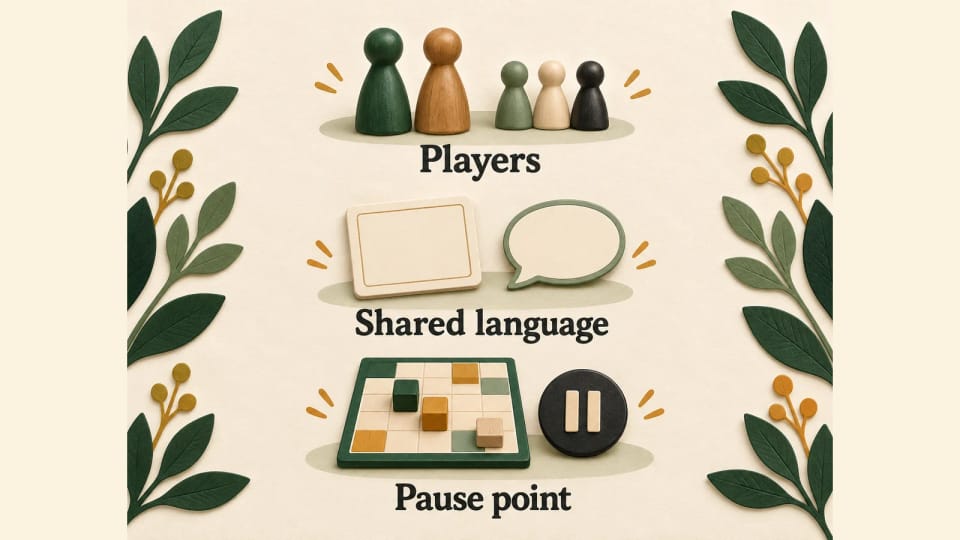
Three selection questions, not a ranking: who is playing, how will you communicate, and where can you pause? The illustrated pieces are generic.
A few hosting choices help. Teach the rules while everyone wants to listen. Keep the first game small enough to finish, make breaks ordinary, and let someone pass on playing without having to explain themselves. Background music should leave room for people to hear clues; our history of cannabis in music offers some conversation for after the game.
If cannabis is present at an adult gathering, keep it optional. Never make taking more a penalty for losing. Store products away from the snacks and out of children’s reach; child-resistant packaging is not childproof storage. Arrange a way home that does not involve anyone driving impaired. Health Canada’s lower-risk guidance.
And the group is allowed to change its mind. Our TV picks by mood and attention are an option when nobody wants to keep score. If a film starts a discussion about cannabis stereotypes, the cinema-history guide follows that thread.
FAQ
Are these games only enjoyable while high?
No. Their rules and interactions stand on their own. This guide does not claim cannabis improves play, creativity or enjoyment, and choosing not to consume should not exclude anyone from the evening.
Which choice needs the least reading during play?
Blokus Duo centers on shapes rather than written clues. Kingdomino also uses a visible terrain puzzle, though players still need to learn its placement and scoring rules. Check whether small pieces and visual patterns suit the actual players.
Can you stop any of these games halfway through?
You can agree to stop, but preserving a fair game takes care. Finish the current guess, vote or move, record any score, and keep hidden information hidden. A longer break may be a good reason to start fresh later.
Should you buy the newest edition or expansion?
Only if its rules and player count suit your group. This guide names the editions it checked; expansions and apps can change setup and limits. Read the rulebook for the exact copy you plan to use.
Key takeaways
- Match the game to conversation, shared clues or quiet spatial play.
- Check the exact edition’s player count before inviting everyone.
- Pause after a resolved turn or scored round, with the game state preserved.
- Make participation and cannabis use separate, optional choices.



