

California Cannabis Origin Labels vs. Appellations
A California county name is an origin claim, not an approved appellation. Compare the production rules, approval evidence, and current program status.

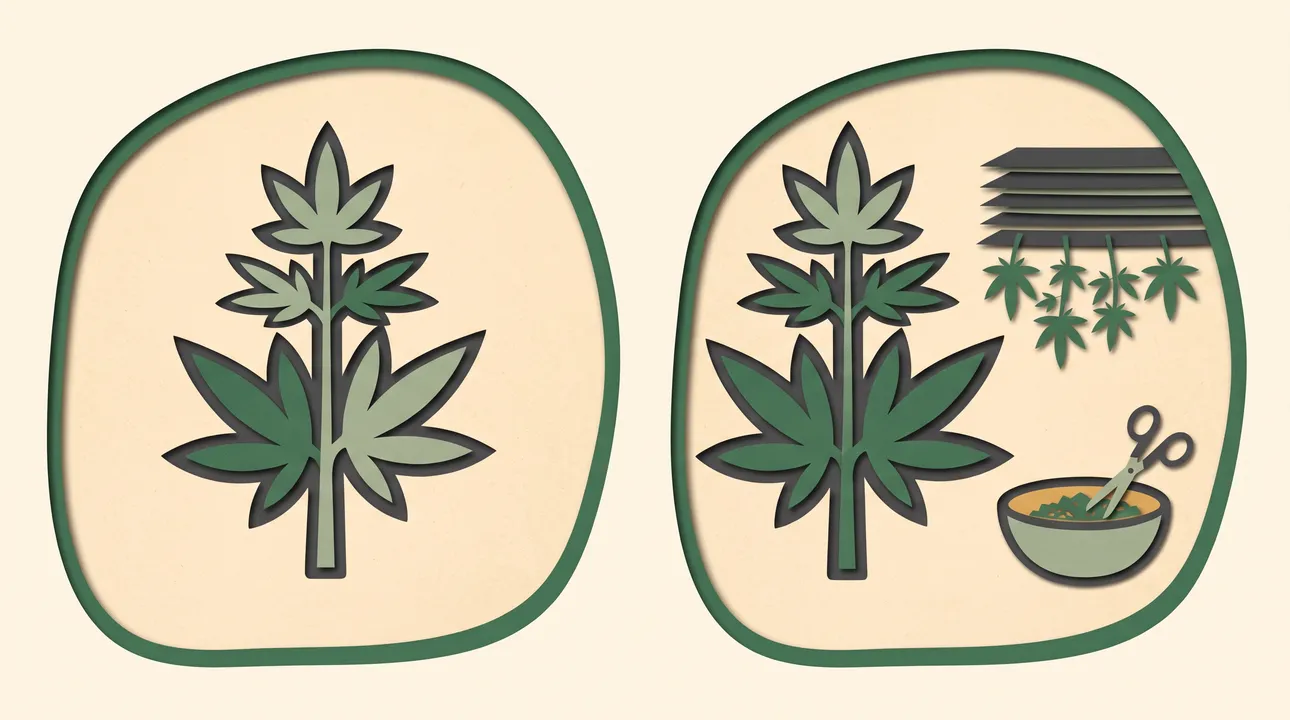
A California county, city or city-and-county name does not establish an approved cannabis appellation. Both claims have conditions. An approved appellation adds its own production rules. More of the work must happen within its area. BPC §26063, 3 CCR §9000
Here in High School, ask what the place name tells you. A county name and an approved appellation are different claims. Both concern where the cannabis was produced, but they follow different rules.
The hero is a conceptual comparison. Its outlines are fictional, and its objects represent selected production stages. It shows no approved region or actual package.
What does a California county or city name require?
One hundred percent of the cannabis in the product must have been produced within the named jurisdiction. The rule covers counties, cities and cities-and-counties. It also covers similar names likely to mislead about origin. It is not enough for only part of a blend to come from the place named on the label. BPC §26063(a)
DCC is the Department of Cannabis Control. Its label rule adds a size threshold. The plant must have been cultivated within the boundary starting from the time it was no taller or wider than 18 inches. That is the size threshold in the rule. It does not require every plant to have begun as a seed there. 4 CCR §17408(a)(1)
This county-and-city rule does not add the appellation program’s ground-planting, canopy-light, structure or local-curing conditions. A county name also does not show CDFA approval. Other label rules still apply. A particular brand or trademark dispute needs its own review.
What does an approved cannabis appellation add?
An appellation has an area name and production requirements approved by the California Department of Food and Agriculture. That agency is CDFA. A regional nickname or marketing phrase does not show that approval. Neither does a proposed boundary. 3 CCR §9000(a)
The local production chain includes:
- Cultivation within the area from the same 18-inch threshold.
- Planting, growing and harvesting within the area.
- Drying, curing, grading and trimming within the area.
Those last steps are easy to miss. For an appellation, the location rule continues beyond the living plant. All cannabis carrying the appellation name must also meet its specific rules. That means its standards, practices and any required cultivars. 3 CCR §§9000(h), 9301(a)
The framework requires planting in the ground in the canopy area. Structures cannot cover the plant or change its natural light there. Artificial light in the canopy area is also excluded. These are appellation conditions. The county-origin rule does not add these conditions. BPC §26063(c), 3 CCR §9102(j)
How do the two origin claims compare?
| Label claim | What the origin rule requires |
|---|---|
| County, city or city-and-county origin | All cannabis must meet the origin condition within that political boundary. Local cultivation starts from the time the plant was no taller or wider than 18 inches. This definition does not require local drying, curing, grading or trimming. It does not require CDFA appellation approval. It does not add the ground, structure and canopy-light rules for appellations. |
| Approved appellation | All cannabis must meet the origin condition within the approved area. It must also meet that appellation’s rules. The same cultivation threshold applies. Planting, growing, harvesting, drying, curing, grading and trimming must take place there. Ground, structure and canopy-light rules also apply. |
Sources: BPC §26063, 4 CCR §17408, 3 CCR §9000.
This answers a question about origin. Read the other parts of the package too. Our THC packaging-symbol lesson explains the different job of a warning mark; a place name does not replace that mark or the rest of the label.
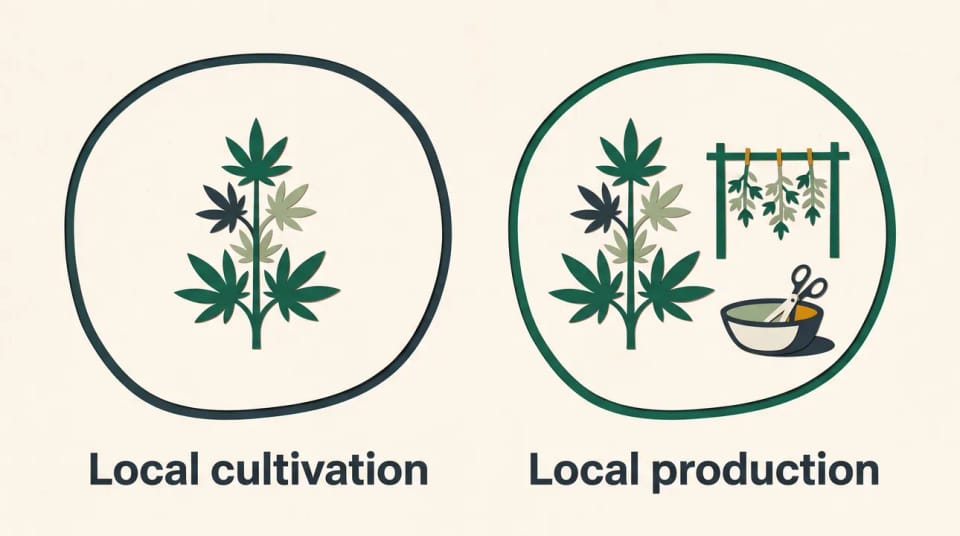
County or city origin uses the local-cultivation definition. An approved appellation also requires the specified local production chain and its own requirements. These are fictional outlines, not approved regions.
Does a notice of use prove appellation compliance?
No. Filing a notice of use is not evidence that the cannabis meets the appellation’s requirements. Section 9302 says this directly. Sending a notice and meeting the rules are separate steps. 3 CCR §9302(d)
Cultivators must keep records of the local production chain. They must also show how the cannabis meets the appellation’s standards, practices and cultivar requirements. Section 9301 allows track-and-trace information to show where production took place. That covers the location component. Location data alone does not prove that every other requirement was met. 3 CCR §9301
For the broader distinction between an identity record and a test result, see cannabis chain of custody. Keep a lab report tied to the product through package and COA batch matching.
Is California accepting appellation petitions now?
Status checked October 11, 2026: CDFA’s program page displays Closed and says it is not accepting petitions. It anticipates opening in late 2026. That is a forecast, not a confirmed opening date or approval of a particular name. CDFA program status
Adopting program rules is different from approving a named appellation. CDFA’s framework calls for posting a final decision on an individual petition. A proposal or forecast is not that decision. The closed program page alone does not establish whether a particular name is approved. 3 CCR §9202
The official CCR sections checked for this guide are current through September 25, 2026. DCC’s October 1, 2026 copy agrees with the origin-label rule. DCC labels that copy unofficial. Use the linked official text and current CDFA page when checking later changes.
What should you ask about a place name on a package?
Start with the exact claim: county or city origin, or an approved appellation? For an appellation claim, look for the named final decision. Read its requirements. A general program announcement does not settle the status of a name. A label claim still needs product records to support it.
Read chemistry information as a separate task. Our HPLC and gas-chromatography lesson explains what lab methods measure. The measurement uncertainty lesson explains limits around a reported number. Neither task is settled by reading a place name.
FAQs
Does a county name mean the cannabis has an appellation?
No. California’s county-and-city origin rule is separate from CDFA’s appellation framework. A county name does not show that an appellation has been approved.
Can greenhouse flower carry a county-origin claim?
The county-and-city origin rule does not exclude greenhouse cultivation. All cannabis must still meet the local-origin condition and size threshold. Appellations have separate structure restrictions. Other label rules still apply.
Does filing a notice of use certify the cannabis?
No. Section 9302 says the filing is not evidence that appellation requirements were met. Cultivators must keep separate production and compliance records.
Is the late-2026 opening a confirmed approval date?
No. As checked on October 11, CDFA forecasts an opening for petitions while displaying Closed. Receiving petitions and approving a named appellation are different events.
Key takeaways
- A county or city origin name does not establish an approved appellation.
- Both claims cover all the cannabis in the product. Appellations add their own local production chain and rules.
- A notice of use is not compliance proof, and an opening forecast is not approval.
Sources
- California Legislature. Business and Professions Code §26063.
- Barclays Official California Code of Regulations. 3 CCR §9000: Definitions.
- Barclays Official California Code of Regulations. 3 CCR §9102: Petition to Establish an Appellation of Origin.
- Barclays Official California Code of Regulations. 3 CCR §9202: Notice of Final Decision.
- Barclays Official California Code of Regulations. 3 CCR §9301: Recordkeeping and §9302: Notice of Use.
- Barclays Official California Code of Regulations. 4 CCR §17408: Labeling Restrictions.
- CDFA. Cannabis Appellations Program status.
- DCC. Unofficial transcription, including rules in effect October 1, 2026. Corroboration only; the official CCR is linked above.


