HPLC vs Gas Chromatography: Why Can Cannabis THC Results Differ?
HPLC vs gas chromatography can change a cannabis THC result. Learn why heat, overlapping peaks, and calibration matter more than the instrument name.

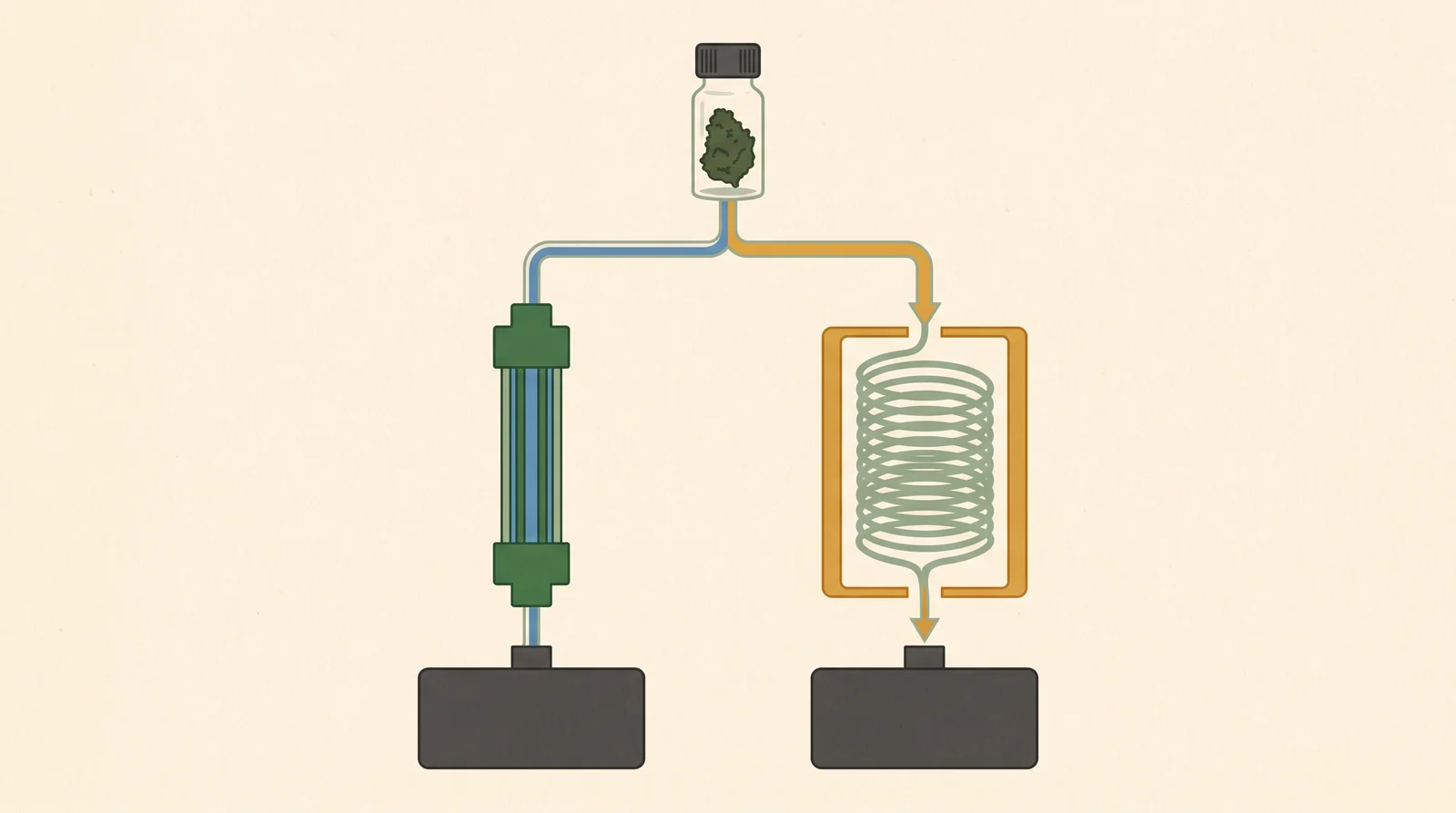
HPLC and gas chromatography can give different cannabis THC results because sample preparation, heat, separation, and calibration affect what gets measured. Both can produce useful results. Neither instrument name guarantees accuracy. Two 2025 NIST studies show why the method behind the number matters [Mulloor et al., 2025; Wilson et al., 2025].
Here in High School, the useful question is what a test actually measured. Before choosing the bigger percentage, check whether both reports even mean the same thing by “THC.” Our guide to reading a cannabis COA covers the rest of the report.
What is the difference between HPLC and gas chromatography?
Both methods separate a mixture so a detector can measure its parts. HPLC means high-performance liquid chromatography. A liquid carries the dissolved sample through a column. Gas chromatography, or GC, uses a gas and a heated inlet [Jackson et al., 2026].
That heat matters for THCA, the acidic precursor of delta-9 THC. Heating can remove part of the THCA molecule through decarboxylation. Ordinary HPLC cannabinoid analysis can measure THCA and delta-9 THC separately without that conversion. GC methods need an explicit plan for the acids: convert them or chemically protect them before analysis [Jackson et al., 2026; Yarberry et al., 2024].
| Question | HPLC | Gas chromatography |
|---|---|---|
| What carries the sample? | Liquid | Gas |
| What happens to THCA? | Can be measured separately from THC | Heated analysis can convert it; protective sample chemistry can preserve it |
| Does the abbreviation prove accuracy? | No | No |
| What else must be checked? | Separation, detector, calibration, preparation | Conversion or protection strategy, detector, calibration, preparation |
“MS” means mass spectrometry, a detector. “UV” and “PDA” refer to light-based detection. A report saying GC–MS or LC–PDA gives more information than “chromatography,” but still does not describe every part of the method [Yarberry et al., 2024].
Is delta-9 THC the same as total THC?
No. Delta-9 THC is one measured compound. A delta-9-based total also accounts for delta-9 THCA, with a mass correction: delta-9 THC + (delta-9 THCA × 0.877).
For a clearly hypothetical sample with no delta-8 forms present, 1% delta-9 THC plus 20% delta-9 THCA gives 18.54% total THC. Comparing that 1% directly with another report’s 18.54% would create an enormous apparent disagreement where none exists.
Check the report’s definition too. California’s current §15700 total-THC equation includes both delta-8 and delta-9 THC, plus their acid forms multiplied by 0.877. Section 15724 gives the acid-plus-neutral reporting calculation. The simple example above is not the complete California equation when delta-8 forms are present [California DCC, §§15700, 15724].
The calculation estimates THC equivalent from those compounds. It is not a measurement of the amount your body will absorb. Keep that distinction when comparing a raw flower report with a concentrate or edible label.
Does the GC inlet always convert THCA accurately?
No. Assuming that heat settles the measurement is the mistake. In NIST’s 2025 GC–MS study, plant extracts and clean calibration solutions behaved differently at active inlet surfaces. The researchers traced positive bias to these matrix and surface interactions. Adding analyte protectants and using appropriate calibration brought GC results close to liquid-chromatography results [Mulloor et al., 2025].
Here is one concrete example from their Table 2. All entries are mean total-THC mass fractions for the same plant extract, Sample A:
| Analytical condition | Total THC |
|---|---|
| GC–MS, no protectant mixture or internal standard | 0.457% |
| GC–MS, protectant mixture, no internal standard | 0.264% |
| LC–PDA comparison | 0.271% |
The same extract gave 0.457% or 0.264% with different GC conditions. That is a method lesson, not evidence that every GC report overstates potency. The comparison involved three plant extracts; it was not a survey of every retail lab or high-THC product [Mulloor et al., 2025].
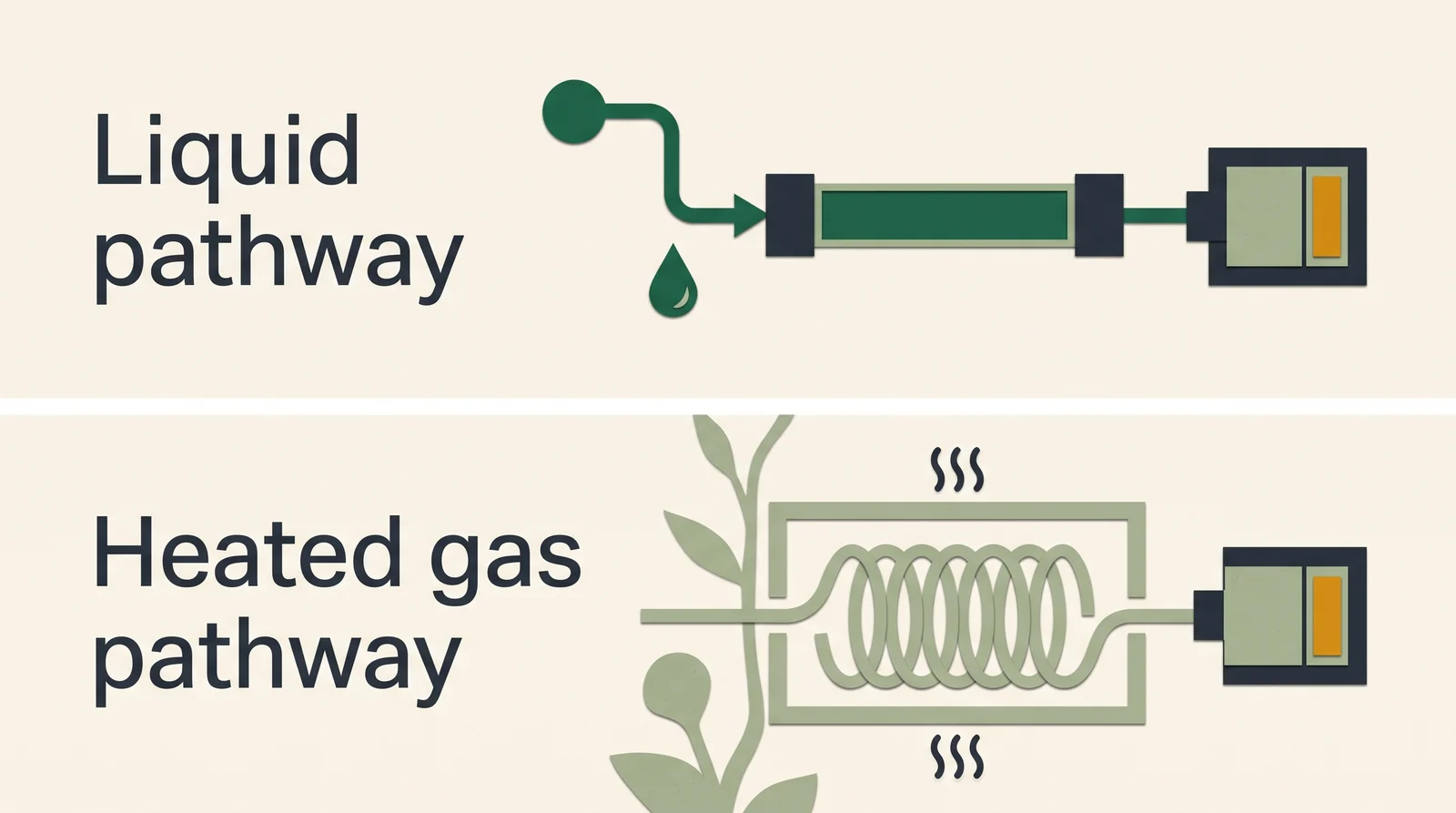
Different measurement paths need different controls. Neither pathway is an automatic accuracy badge.
Can HPLC overstate THC too?
Yes. Preserving THCA does not guarantee that every detected peak belongs only to the intended compound. Two substances can travel through the column together. This is called co-elution [Wilson et al., 2025].
NIST’s second 2025 paper identified interferences from CBNA and by-products associated with synthetic delta-8 THC in liquid-chromatography analysis. It examined 16 commercial hemp samples and 20 seized samples, plus a Denver laboratory dataset of 7,448 plant samples. Changes to separation, selective detection, and signal analysis helped distinguish overlapping compounds [Wilson et al., 2025].
The lesson is not “HPLC is unreliable.” It is “measuring THCA separately” and “measuring THC without interference” are two different jobs. Those findings do not establish that all products in the laboratory dataset had inaccurate labels. The seized samples also had years of storage, which limits direct comparisons with fresh retail flower [Wilson et al., 2025].
Why can two labs still disagree when they use the same method?
A shared acronym leaves much unspecified. Extraction, dilution, calibration range, moisture correction, and separating similar compounds can still differ. NIST’s CannaQAP report compares laboratories against common materials and reference values for this reason [Yarberry et al., 2024].
It also discusses protecting THCA before GC analysis through derivatization. Think of this as changing its chemical form for measurement, rather than heating it away. The report’s older discussion emphasizes incomplete conversion; the 2025 GC study adds a more specific account of matrix and surface effects. Do not reduce that evolving evidence to “GC always reads low” [Yarberry et al., 2024; Mulloor et al., 2025].
For the wider chain, see why batches of the same strain test differently. For the range around a reported number, see measurement uncertainty on cannabis lab reports.
What should you check when two THC reports disagree?
Treat these as questions for the report issuer, not a way to diagnose lab failure from a package:
- Same material? Match the COA to the package and batch.
- Same measurement? Compare delta-9 with delta-9, or total with total.
- Same units and basis? Check percent versus mg/g and dry-weight versus as-received reporting.
- Same method details? Ask what was measured separately, what was calculated, and how interference was controlled.
- Comparable uncertainty? A tiny difference may not support a meaningful ranking.
California illustrates why method details belong on a report: §15726 requires analytical methods and instrumentation on the COA. Its rules also specify an HPLC method for dried flower and non-infused pre-roll compliance testing, with laboratory verification before use. That is a jurisdiction-specific requirement, not a global declaration that GC is invalid [California DCC, §§15712.1–15712.2, 15726].
Use our product comparison worksheet to keep a disputed potency number from swallowing the whole decision. High Families is our product classification; it does not certify a lab method or guarantee a personal effect.
FAQ
Does HPLC measure THC and THCA separately?
It can, with an appropriate cannabinoid method. That separation lets a laboratory report the individual compounds and calculate total THC. It does not remove the need to check other compounds for interference [Jackson et al., 2026].
Is GC–MS less accurate than HPLC?
Not inherently. NIST demonstrated GC conditions that produced results close to LC for its tested extracts. That agreement depends on the method and samples; it is not a guarantee for every laboratory [Mulloor et al., 2025].
Does an HPLC result tell me how strong a high will feel?
A potency analysis reports chemical concentration. It does not measure your response, dose, or absorption. Use it as product information rather than a promise about how you will feel.
Should I choose the product with the higher lab result?
First establish that the reports compare the same measurement and material. A bigger number does not resolve mismatched units, uncertain sampling, or method bias. The comparison guide helps you assess the rest of the product.
Key takeaways
- HPLC can separate THCA from THC; GC must address what heat does to the sample.
- NIST found method-specific bias in both gas and liquid chromatography.
- Total THC and delta-9 THC are different report fields.
- Compare batch, units, reporting basis, method, and uncertainty before comparing percentages.
Sources
- Mulloor, J., Wilson, W. B., & Sander, L. C. (2025). New perspectives on THCA decarboxylation and accurate GC–MS quantitation of Total THC in Cannabis using analyte protectants. Forensic Chemistry, 44, 100668. Full paper. DOI.
- Wilson, W. B., Yarberry, A. J., & Goldman, S. (2025). Chromatographic interferences potentially inflating the levels of Δ9-THC in Cannabis Sativa plant samples and possible solutions. Journal of Chromatography A, 1748, 465871. Full paper. DOI.
- Yarberry, A. J., Phillips, M. M., & Wilson, W. B. (2024). Cannabis Laboratory Quality Assurance Program: Exercise 2 Cannabinoid Final Report. NIST IR 8519. Report.
- Jackson, D. L., Lessl, J., Coolong, T., & Joy, N. (2026 revision). An Introduction to Hemp Chemistry and Lab Results. University of Georgia Extension, Circular 1209. University guide.
- California Department of Cannabis Control. Current regulations, §§15700, 15712.1–15712.2, 15724, 15726. Accessed October 10, 2026. Regulation text.

