Cannabis and Eye Health: Beyond the Glaucoma Myth
Can cannabis treat glaucoma? We break down the 50-year myth, what THC actually does to your eyes, and where real eye research is headed.

Professor High
Your friendly cannabis educator, bringing science-backed knowledge to the community.

Few claims in cannabis culture have persisted as long as the idea that weed is good for your eyes. The reality is far more nuanced. While THC may temporarily lower eye pressure, that effect falls well short of actual treatment. Meanwhile, newer research into cannabinoid receptors across the eye is opening doors that go well beyond glaucoma. Here is what you need to know.
The Most Famous Eye Fact in Cannabis History
Here’s a question that’s been floating around since the 1970s: Can cannabis cure glaucoma? If you’ve spent any time in cannabis culture, you’ve probably heard someone claim that weed is great for your eyes. It’s one of the oldest and most repeated “medical facts” about cannabis—and it’s also one of the most misunderstood.
The story starts in 1971, when researcher Robert Hepler at UCLA discovered that smoking cannabis reduced intraocular pressure (IOP)—the fluid pressure inside your eyes that, when chronically elevated, can damage the optic nerve and lead to glaucoma [Hepler & Frank, 1971]. That finding made headlines and became a cornerstone argument for medical cannabis advocacy for decades.
But here’s the thing: reducing eye pressure for a few hours isn’t the same as treating a complex, progressive disease. And in the 50-plus years since that landmark study, the science has gotten a lot more nuanced—and a lot more interesting.
In this article, we’re going beyond the glaucoma myth to explore what researchers actually know about cannabis and eye health. We’ll look at what happens to your eyes when you consume cannabis, what the latest research suggests about both risks and potential benefits, and what it all means for you as a mindful consumer. Whether you’ve got a family history of eye conditions or you’re just curious about those red eyes staring back at you in the mirror, this one’s for you.
The Science Explained
How Cannabis Affects Your Eyes
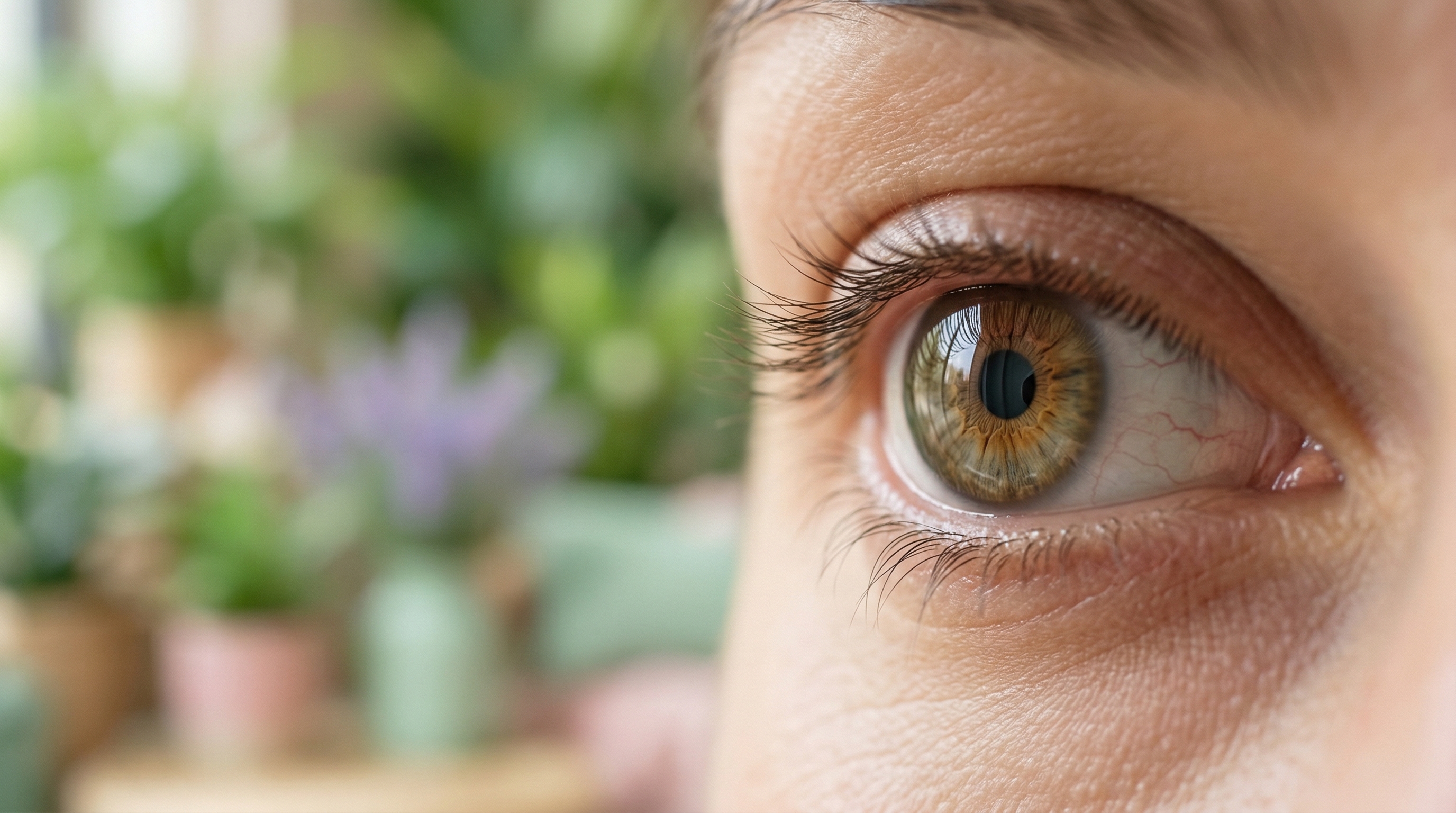
To understand the cannabis-eye connection, let’s start with the basics. Your eyes contain cannabinoid receptors—specifically CB1 receptors—that are part of your body’s endocannabinoid system (ECS). Think of the ECS as a vast communication network that helps regulate everything from mood and appetite to, yes, eye function. When you consume cannabis, compounds like THC interact with these receptors throughout your body, including in the tissues of your eyes [Straiker et al., 1999].
Here’s what happens when THC reaches your eyes:
- Blood vessels dilate. This is why your eyes turn red. THC causes the tiny blood vessels in your eyes (and elsewhere) to relax and expand, increasing blood flow. It’s not irritation from smoke—even edibles cause red eyes.
- Intraocular pressure drops. That same vasodilation reduces the pressure of the fluid (called aqueous humor) inside your eyeball. This is the effect Hepler discovered in 1971, and it’s real—IOP can drop by 25-30% after cannabis use [Hepler & Frank, 1971].
- Tear production may change. Some research suggests cannabinoids may influence the glands responsible for tear production, which could affect dry eye symptoms [Thapa et al., 2018].
Imagine your eye like a sink with a faucet and a drain. Intraocular pressure is determined by how much fluid flows in versus how much drains out. Cannabis appears to turn down the faucet slightly, reducing the amount of fluid produced. The result? Lower pressure, at least temporarily.
What the Research Actually Shows
Here’s where the glaucoma myth starts to crumble—not because the pressure-lowering effect isn’t real, but because of how it works in practice.
The IOP reduction from cannabis lasts only 3-4 hours [Green, 1998]. Glaucoma requires consistent, around-the-clock pressure management. To maintain therapeutic IOP levels with cannabis alone, a person would need to consume it 6-8 times per day—a dosing schedule that would impair daily functioning and carry significant side effects.
The American Academy of Ophthalmology and the American Glaucoma Society have both stated that cannabis is not a recommended treatment for glaucoma, citing the short duration of effect and the availability of far more effective, targeted medications. As of 2026, neither organization has changed this position. A 2025 study in International Ophthalmology found that cannabis use in eye clinic patients can actually confound IOP measurements, potentially leading to missed glaucoma diagnoses or a false sense of effective treatment [Springer Nature, 2025].
But the story doesn’t end there. Emerging research has uncovered a potentially concerning finding: cannabis may actually reduce blood flow to the optic nerve [Plange et al., 2007]. Since glaucoma damages the optic nerve, anything that reduces its blood supply could theoretically make things worse—even while lowering IOP. This is still being studied, but it’s an important reason why self-treating glaucoma with cannabis is not advisable.

On the more hopeful side, researchers are investigating whether cannabinoid-based eye drops could deliver localized IOP reduction without systemic side effects. Early studies on synthetic cannabinoid formulations have shown some promise in animal models [Oltmanns et al., 2008], though getting cannabinoids to penetrate the eye’s surface effectively remains a significant pharmaceutical challenge.
There’s also growing interest in the neuroprotective properties of cannabinoids—particularly CBD. Some preclinical research suggests CBD may help protect retinal ganglion cells (the neurons that connect your eye to your brain) from damage caused by conditions like glaucoma and diabetic retinopathy [El-Remessy et al., 2003]. However, one animal study found that CBD might actually increase IOP in some cases [Miller et al., 2018], highlighting how much we still don’t know.
A landmark 2025 review in Frontiers in Medicine mapped the entire endocannabinoid system across ocular tissues, confirming CB1 receptors in retinal ganglion cells, photoreceptors, bipolar cells, and amacrine cells, while CB2 receptors are expressed in retinal pigmented epithelium and ganglion cells. The review noted promising findings for diabetic retinopathy—where blocking CB1 receptors reduced retinal cell death and oxidative stress—and for age-related macular degeneration (AMD)—where CB1 inhibition protected retinal pigment epithelium cells from oxidative damage. A separate 2025 study published in the European Journal of Pharmacology demonstrated that CBD reversed AMPA-induced retinal damage in an in vivo model, restoring amacrine cell integrity. These findings suggest that the future of cannabinoid eye therapy may lie in receptor-specific targeting rather than whole-plant consumption.
Important note: None of this research has reached the stage where cannabis or cannabinoid products are clinically recommended for any eye condition. If you have glaucoma or another eye health concern, please work with your ophthalmologist.
Practical Implications
What This Means for Your Cannabis Experience
So if cannabis isn’t an eye treatment, what should you actually take away from all this science? Quite a bit, actually.
Red eyes are normal—and harmless. That vasodilation effect is cosmetically annoying but not dangerous. If red eyes bother you, over-the-counter eye drops with vasoconstrictors can help. Staying hydrated may also reduce the intensity.
Dry eyes deserve attention. A 2024 narrative review in Clinical Ophthalmology documented several adverse ocular effects of cannabis including dry eyes, reduced corneal endothelial cell density, eyelid tremor, and neuro-retinal dysfunction [Tandfonline, 2024]. If you notice persistent dry eyes after cannabis use, consider keeping lubricating eye drops (artificial tears) handy. This is especially relevant if you’re consuming strains from the Relaxing High family, which tend to have higher myrcene content and stronger physical effects that may amplify the sensation of dryness.
Don’t self-treat eye conditions with cannabis. This is the big one. Despite what you may read online, smoking more weed is not a substitute for prescribed glaucoma medication. The science is clear that the effect is too short-lived and potentially counterproductive.
Watch for future developments. The research into cannabinoid eye drops and neuroprotective applications is genuinely exciting. As the science matures, we may see targeted ophthalmic cannabinoid therapies—but we’re not there yet.
If you’re a wellness-focused consumer interested in strains that may support overall comfort without excessive eye dryness, strains in the Balancing High family—known for gentler, more moderate effects—may be worth exploring. And if you’re curious about strains rich in caryophyllene (a terpene that interacts with CB2 receptors and may support anti-inflammatory pathways), check out the Relieving High family.

Key Takeaways
- Cannabis does lower intraocular pressure, but only for 3-4 hours—far too short to effectively manage glaucoma, which requires 24/7 pressure control.
- Red eyes from cannabis are caused by vasodilation, not smoke irritation, and are harmless. Even edibles cause them.
- Major ophthalmology organizations do not recommend cannabis for glaucoma due to its short duration, systemic side effects, and potential to reduce optic nerve blood flow.
- Emerging research on cannabinoid eye drops and CBD’s neuroprotective potential is promising but still in early stages—don’t make treatment decisions based on preclinical data.
- Mindful consumers should keep artificial tears handy, stay hydrated, and never substitute cannabis for prescribed eye treatments.
FAQs
Does cannabis actually help with glaucoma?
Cannabis temporarily reduces intraocular pressure, but the effect lasts only 3-4 hours. Effective glaucoma management requires consistent, around-the-clock treatment, making cannabis impractical and potentially risky as a standalone therapy. Ophthalmologists recommend proven prescription treatments instead.
Why do my eyes get red when I use cannabis?
THC causes blood vessels throughout your body to dilate, including the tiny capillaries in your eyes. This increases blood flow to the eye’s surface, creating that characteristic redness. It happens with all consumption methods—not just smoking—and is completely harmless.
Can CBD help with eye health?
Some early preclinical research suggests CBD may have neuroprotective properties that could benefit retinal cells. However, at least one animal study found CBD might increase eye pressure in certain cases [Miller et al., 2018]. Much more research is needed before any conclusions can be drawn.
Should I be worried about long-term eye damage from cannabis?
Current research has not established that cannabis causes long-term eye damage in healthy individuals. However, if you have an existing eye condition, it’s important to discuss your cannabis use with your eye doctor, as cannabinoids may interact with your condition or treatment in ways that aren’t fully understood yet.
Sources
- Hepler, R.S. & Frank, I.M. (1971). “Marihuana smoking and intraocular pressure.” JAMA, 217(10), 1392. PMID: 5109652
- Straiker, A.J. et al. (1999). “Cannabinoid CB1 receptors and ligands in vertebrate retina.” Proceedings of the National Academy of Sciences, 96(25), 14565-14570. PMID: 10588743
- Green, K. (1998). “Marijuana smoking vs cannabinoids for glaucoma therapy.” Archives of Ophthalmology, 116(11), 1433-1437. PMID: 9823341
- American Academy of Ophthalmology. “Does Marijuana Help Treat Glaucoma or Other Eye Conditions?” aao.org
- Plange, N. et al. (2007). “Acute effects of marijuana smoking on optic nerve head blood flow.” Investigative Ophthalmology & Visual Science, 48(13), 1913.
- El-Remessy, A.B. et al. (2003). “Neuroprotective effect of cannabidiol in an experimental model of diabetes.” Neuropharmacology, 45(7), 1086-1094. PMID: 14573390
- Miller, S. et al. (2018). “Differentially Regulate Intraocular Pressure.” Investigative Ophthalmology & Visual Science, 59(15), 5904-5911. PMID: 30550613
- Oltmanns, M.H. et al. (2008). “Topical WIN55,212-2 alleviates intraocular hypertension in rats.” Journal of Glaucoma, 17(7), 519-528. PMID: 18854727
- Thapa, D. et al. (2018). “The Cannabinoids Act via Distinct Receptors to Reduce Corneal Pain and Inflammation.” Cannabis and Cannabinoid Research, 3(1), 11-20. PMID: 29450258
- Pescosolido, N. et al. (2024). “Adverse Ocular Impact and Emerging Therapeutic Potential of Cannabis and Cannabinoids: A Narrative Review.” Clinical Ophthalmology, 18, 3547-3567. doi
- Aboushaar, S. et al. (2025). “An assessment of the prevalence of cannabis use in eye clinic patients and its implications on glaucoma diagnosis and management.” International Ophthalmology, 45, 146. doi
- The endocannabinoid system and ophthalmic pathologies (2025). Frontiers in Medicine, 12, 1500179. doi
- Rebattu, S. et al. (2025). “Retinal pharmacodynamic and pharmacokinetic profile of cannabidiol in an in vivo model of retinal excitotoxicity.” European Journal of Pharmacology. doi


