Cannabis and Sleep Apnea: What the Dronabinol Trials Found
Cannabis is not an established sleep apnea treatment. See what dronabinol trials found, which outcomes stayed unchanged, and why products differ.

Dronabinol trials found fewer obstructive sleep-apnea events, but they did not establish retail cannabis as a treatment. In the six-week PACE trial, apnea counts improved while overnight oxygen levels and an objective wakefulness test did not. The American Academy of Sleep Medicine’s position statement advises against using cannabis or its synthetic extracts to treat obstructive sleep apnea. Carley et al., 2018; Ramar et al., 2018
Here in High School, the useful lesson is how to read those outcomes together. A promising drug result, a report of deeper sleep, and a claim that an airway disorder is treated are different things.
Is sleep apnea the same problem as insomnia?
No. Obstructive sleep apnea, or OSA, involves repeated partial or complete blockage of the upper airway during sleep. Insomnia concerns trouble sleeping; it does not by itself describe those breathing events. A sleep study can measure breathing problems that a bedtime feeling cannot. AASM position statement
That is why our cannabis and insomnia trial review answers a separate question. Evidence about falling asleep cannot stand in for evidence about breathing while asleep.
What did the dronabinol trials actually test?
They tested an oral pharmaceutical form of THC under study supervision.
A 2013 pilot enrolled 17 adults for three weeks. It had no placebo comparison. Fifteen completed the protocol, and their apnea–hypopnea index, or AHI, fell from baseline. Oxygen measures did not improve. One participant withdrew with palpitations; another was withdrawn after severe low oxygen appeared during a sleep study. Pier Pharmaceuticals funded the work, and investigator David Carley disclosed a prior board role there. Prasad et al., 2013
PACE then randomized 73 adults with moderate or severe OSA to placebo or two dronabinol arms. Treatment lasted up to six weeks. The trial selected medically stable adults and excluded several higher-risk groups. It compared the drug with placebo, not with CPAP. Carley et al., 2018
Neither trial tested a dispensary flower, CBD oil, or a CBN sleep gummy. Sharing a cannabinoid or a route of use does not make a retail product the tested medicine. Our capsules and pills guide explains the product format; format alone cannot establish a treatment claim.
What improved in PACE, and what stayed unchanged?
The breathing-event count improved, but the results were mixed across measures.
AHI counts apneas and hypopneas per hour of sleep: pauses and marked reductions in breathing. The modeled difference in AHI change between the active arms and placebo was about 11 and 13 events per hour. That comparison does not mean each participant’s breathing became normal. PACE results
| Measure | What PACE found | What it cannot establish |
|---|---|---|
| AHI | Lower event counts with dronabinol versus placebo | Elimination of OSA or equivalence to CPAP |
| Reported daytime sleepiness | Improvement in the higher-dose arm | A proven gain in objective alertness |
| Maintenance of Wakefulness Test | No significant improvement | That feeling less sleepy means safer driving |
| Overnight oxygen measures | No significant improvement | A demonstrated oxygen benefit in this trial |
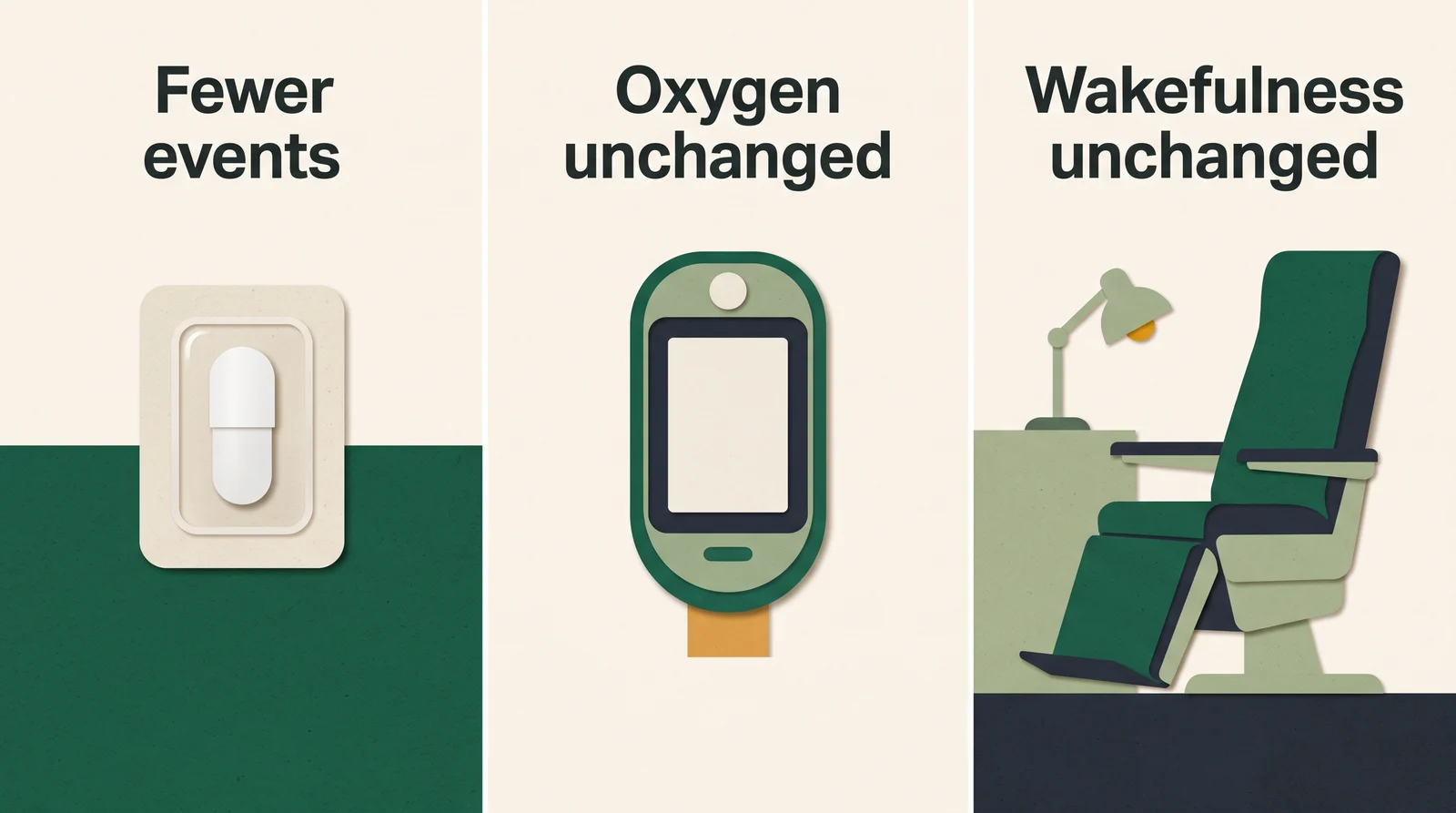
PACE found fewer apnea events, but no significant improvement in overnight oxygen measures or objective wakefulness. These are outcomes from that trial, not a verdict on every cannabinoid formulation.
A lower AHI is a signal worth testing, not proof that every important problem has resolved. A null result in a small trial also does not prove the drug can never affect that measure. It tells us what this experiment demonstrated.
PACE received NIH funding. Carley also disclosed cannabinoid-treatment patents licensed to RespireRx and shares in that company. Those interests do not erase the findings, but they belong beside them. PACE funding and disclosures
Were there side effects?
Yes. PACE reported similar adverse-event frequency and severity across groups, but that is not the same as no adverse events.
Seven participants stopped before completing the protocol because of adverse events; not all were attributed to the drug. One hospital stay for vomiting and diarrhea was judged possibly related to study medication. The participant recovered and completed the study. A short trial cannot settle uncommon or long-term harms. PACE safety results
The current dronabinol capsule label also warns about impaired mental or physical abilities. Its listed indications do not include OSA. An approval for other conditions does not establish approval for apnea. DailyMed prescribing information, revised April 2026
PACE’s unchanged wakefulness test offers no basis for declaring a driver safe. Our oral-versus-inhaled trial comparison shows why a tested preparation, population and outcome must stay attached to a finding.
Has there been research since those early trials?
Yes. Later work includes a drug combination and observational studies. It should not be collapsed into one cannabis result.
A trial published online in 2024 and in a 2025 Sleep issue tested dronabinol plus acetazolamide. Its full results analyzed nine participants, with each condition lasting about one week. Active-dose order was randomized, but placebo always came first. AHI improved at all tested doses. An oxygen-desaturation index improved at the middle dose, while reported sleepiness and mood did not. No serious adverse events occurred, though side effects were reported. Incannex funded the trial; two authors were employee-shareholders. Without separate single-drug arms, the benefit cannot be assigned to dronabinol alone. Walsh et al., 2025
A 2024 sleep-lab record study included 6,958 adults, 71 reporting cannabis use. Its fuller adjustment used a smaller subset with only eight users and found no significant association with OSA severity. An exploratory moderate-to-severe subgroup had just seven users. It linked use to sleep-stage differences and greater reported sleepiness, not a demonstrated treatment effect. Veitch et al., 2024
A 2026 U.S. survey paper’s abstract reports an association between cannabis use and greater odds of reported snoring and witnessed apnea. Those were self-reported signs, not a drug trial or a sleep-study diagnosis. The association does not prove cannabis caused them. Gallagher et al., 2026, abstract
Sleep stages also answer a different question from airway events. Our REM sleep and dreams lesson explains that distinction in the broader sleep context.
Does this support choosing a cannabis product for apnea?
No. These findings do not supply a tested strain, gummy, CBD dose, or retail substitute for apnea care.
The AASM’s 2018 position is that cannabis and its synthetic extracts should not be used to treat OSA. That is stronger than merely saying cannabis should not replace CPAP. If CPAP is difficult to use, discuss treatment options with a sleep clinician. Do not use these trial protocols as a reason to stop prescribed treatment. AASM position statement
Claims about CBN and sleep do not establish an OSA indication either. Nor does a label in High Families, TIWIH’s product classification. A reported relaxing experience cannot verify that an airway stayed open.
FAQ
Did dronabinol cure sleep apnea in PACE?
No cure was established. Event counts improved, while oxygen measures and objective wakefulness did not. The trial did not demonstrate that dronabinol works as well as CPAP.
Can I copy the trial with an edible?
The trials do not establish that substitution. Their pharmaceutical products, selected participants, monitoring, and study conditions differ from retail use. They do not provide an edible dosing plan for OSA.
Does the later combination trial prove THC was responsible?
No. It tested dronabinol together with acetazolamide and lacked separate single-drug comparison arms. The reported benefit belongs to that combination and trial design.
If I sleep deeply, does that mean my apnea is controlled?
That feeling cannot establish control. Breathing events, oxygen measures, sleep stages, and daytime function are different outcomes. Discuss persistent snoring, witnessed pauses, or daytime sleepiness with a clinician.
Key takeaways
- PACE’s AHI result was promising, but its oxygen and objective wakefulness results were unchanged.
- Dronabinol alone, a two-drug combination, and retail cannabis are different exposures.
- Small, short trials leave questions about long-term benefit and harm.
- AASM advises against cannabis as an OSA treatment; trouble with CPAP needs a clinical discussion.
Sources
- Prasad, B., Radulovacki, M. G., & Carley, D. W. (2013). Proof of Concept Trial of Dronabinol in Obstructive Sleep Apnea. Frontiers in Psychiatry, 4, 1. DOI.
- Carley, D. W., Prasad, B., Reid, K. J., et al. (2018). Pharmacotherapy of Apnea by Cannabimimetic Enhancement, the PACE Clinical Trial: Effects of Dronabinol in Obstructive Sleep Apnea. Sleep, 41(1), zsx184. DOI.
- Ramar, K., Rosen, I. M., Kirsch, D. B., et al.; AASM Board of Directors. (2018). Medical Cannabis and the Treatment of Obstructive Sleep Apnea: An American Academy of Sleep Medicine Position Statement. Journal of Clinical Sleep Medicine, 14(4), 679–681. DOI.
- Walsh, J., Rankin, T., Mehra, S., et al. (2025; online 2024). A randomized dose finding study of combination dronabinol and acetazolamide for the treatment of obstructive sleep apnea. Sleep, 48(4), zsae276. DOI.
- Veitch, M. R., Jairam, S., Gurges, P., et al. (2024). Cannabinoid Use and Obstructive Sleep Apnea: A Retrospective Cohort Study. Canadian Journal of Neurological Sciences, 51(6), 828–835. DOI.
- Gallagher, T. J., Lin, M. E., Kim, I., Cooper, Z. D., Jara, S. M., & Kezirian, E. J. (2026). Cannabis use and associated sleep-disordered breathing among US adults. Sleep Health, 12(5), 786–792. DOI. Abstract-level use only.
- Camber Pharmaceuticals. Dronabinol capsule prescribing information, revised April 2026. DailyMed.

