Do Women Feel THC More Strongly? Oral vs Inhaled Evidence
Sex differences in THC response vary by route and outcome. Compare oral, smoked and vaporized studies without turning group results into a personal dose rule.

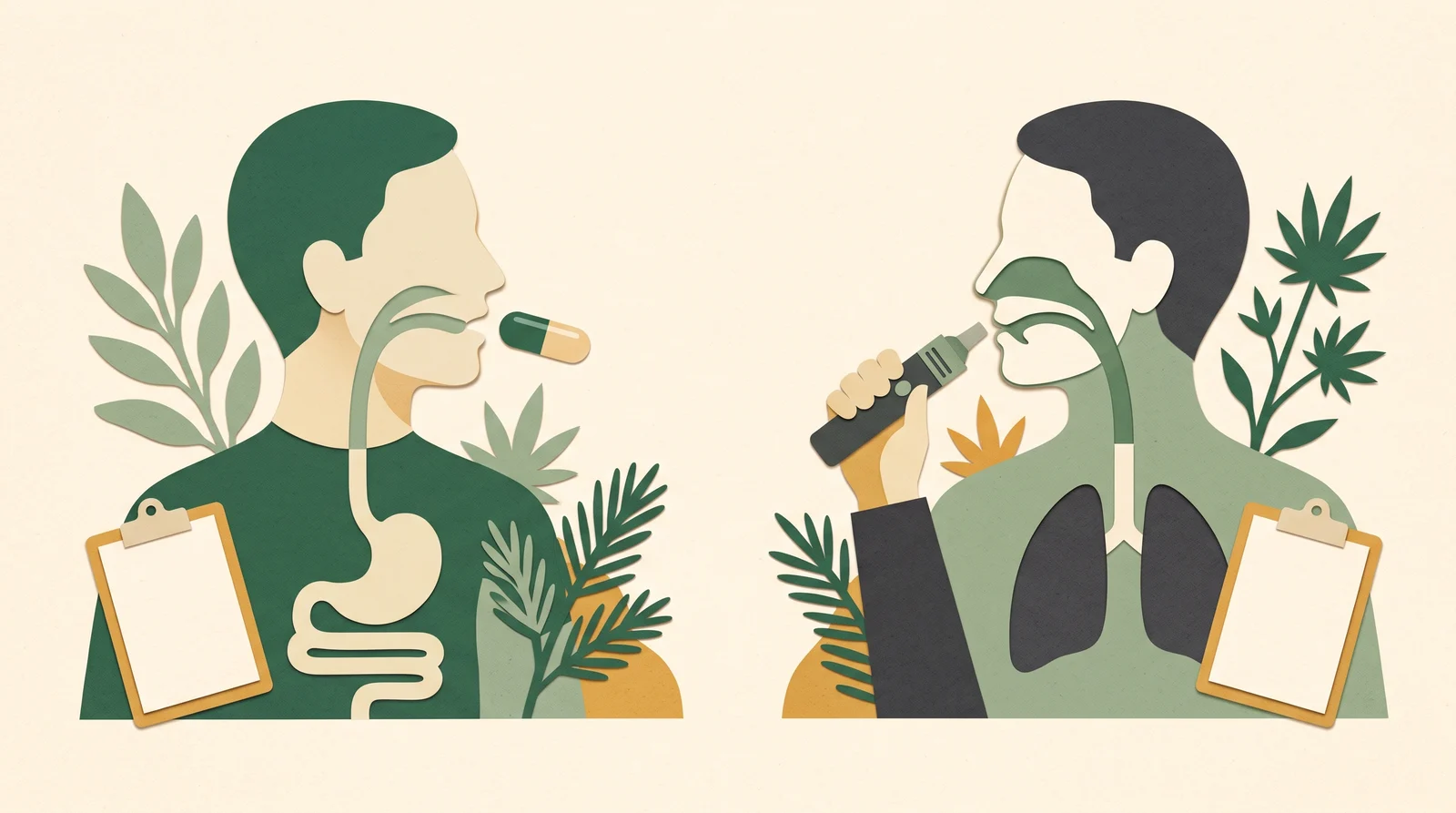
Human studies find sex differences in some THC effects, but no consistent rule that women feel every route more strongly. The result depends on the preparation, the people studied and the outcome measured. “Higher self-rated high” is a narrower finding than “more affected in every way.”
The comparison that matters is same route, same preparation, same outcome. A swallowed capsule, a self-paced smoking session and a controlled vaporizer session are different experiments.
What did the oral-THC study find?
A published 2024 crossover study included 56 healthy adults. It compared a 10 mg dronabinol capsule with a matched placebo on separate test days. Participants had used cannabis before but had no history of cannabis use disorder. Most reported fewer than five uses in the month before screening. Mohammad Aghaei et al., 2024.
The sample included 33 women and 23 men. Researchers recorded repeated ratings and heart rate on the test day. A verbal-memory test was given once, 80 minutes after dosing.
Women showed a greater THC-related change in self-rated “high.” The sex-by-THC interaction was at the statistical threshold, p = 0.05. The other sex-by-THC interactions were not significant: perceptual and dissociative effects, heart rate, and verbal learning or memory.
That distinction matters. The paper found a selective subjective result. It did not show that every woman became more impaired than every man, or establish a dose for retail gummies. Dronabinol is a specific THC preparation, not a test of every edible. Our absorption-route evidence lesson compares other preparations. It does not provide evidence for sex differences.
Do smoked and vaporized studies tell the same story?
A 2026 smoking study analyzed 35 adults who used cannabis one to five days per week. It compared placebo with several THC potencies. Most sex-by-condition results were null, including peak subjective ratings and blood cannabinoid measures. Some timing, blood-pressure and other differences appeared, so “no differences at all” would also be inaccurate. Wright et al., 2026.
The procedure is part of the result. Fixed smoking was poorly tolerated, with nausea, vomiting and intense anxiety reported. The protocol changed to let participants smoke to a desired high without finishing the cigarette. Most analyzed participants used that self-paced procedure.
The 165 mg THC reported for the highest-potency cigarette described its contents. It was not 165 mg absorbed into each participant’s body. Comparing that figure directly with a swallowed 10 mg capsule would hide the delivery difference.
A separate analysis pooled two vaporizer trials involving 40 occasional users. They used controlled inhalation of cannabis with a target THC amount of 13.75 mg, with or without the same amount of CBD. Researchers found no systematic sex differences in subjective or cardiovascular responses. An overall attention-task difference was not a sex-by-treatment effect. Some metabolite results also differed. The exploratory studies were not designed to detect every small sex difference. Arkell et al., 2022.
Why do the study details change the answer?
Keep these conditions beside each headline:
| Study | Preparation and use history | Control and assessment |
|---|---|---|
| Oral THC, 2024 | Single 10 mg capsule; mostly limited recent use | Matched placebo; repeated same-day ratings and heart rate; one memory assessment |
| Smoked cannabis, 2026 | Several potencies; use 1–5 days/week; most smoking self-paced | Placebo cigarette; monitored session with blood sampling through six hours |
| Vaporized cannabis, 2022 | Target 13.75 mg THC, with or without CBD; occasional users | Placebo; controlled inhalation and assessments up to six hours; pooled trials with different schedules |
All three used screened, healthy adults. They do not describe every medical patient or first-time consumer. They also did not randomize the same people to every route. The comparison is useful context, not a head-to-head proof that route caused the different sex findings.
Our product-comparison guide explains why a potency percentage needs context. Edible timing and tolerance answer separate questions; neither supplies a sex-based conversion between these experiments.
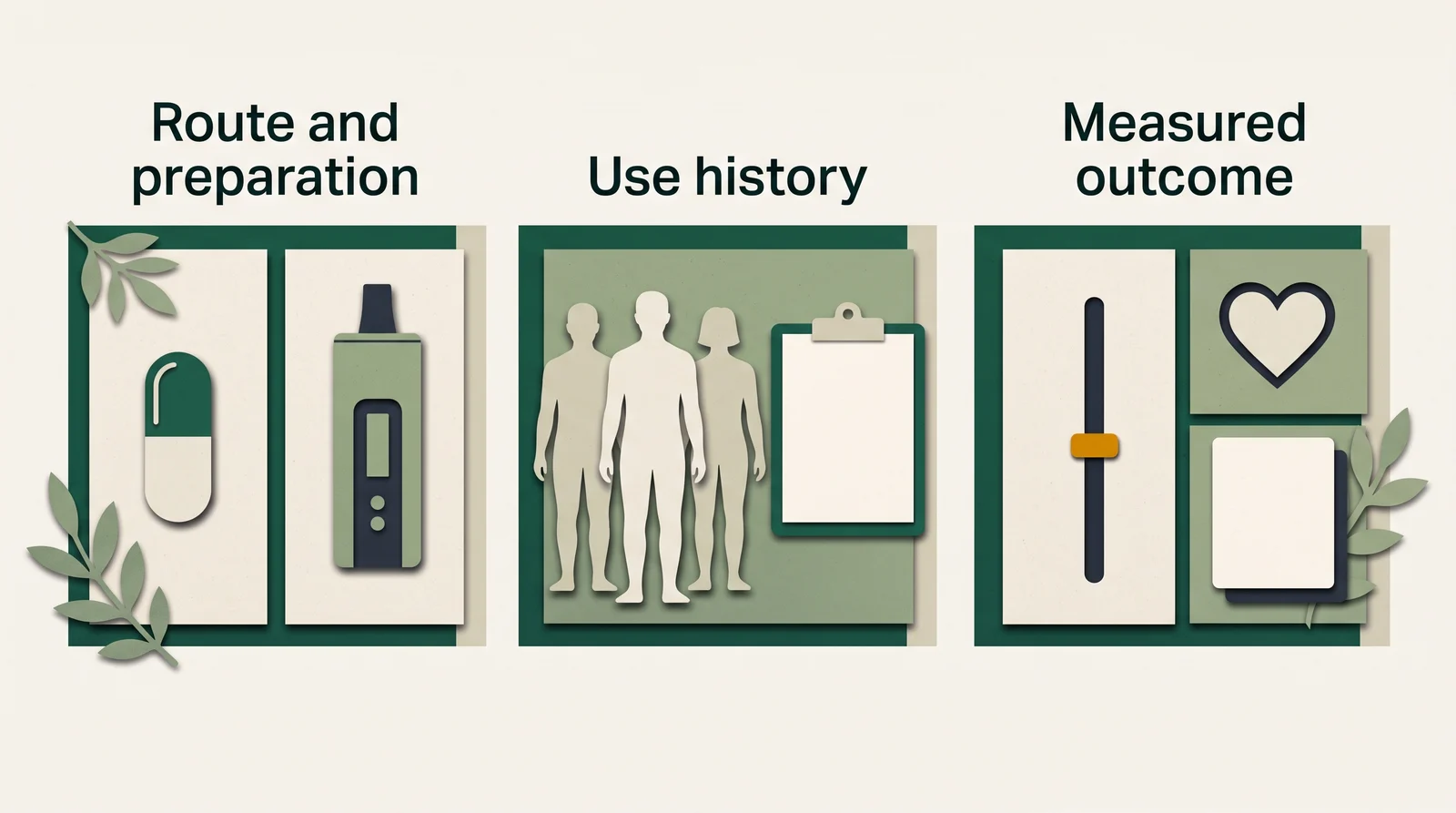
A finding about one route, use-history group and outcome cannot automatically answer the other combinations. This is an evidence checklist, not a dosing chart.
Can estrogen or cycle timing predict a stronger high?
These studies do not establish that prediction. The oral study included women on hormonal contraception or in the early follicular phase. It did not compare every cycle phase. The smoking study could not make meaningful menstrual comparisons because its groups were small and unbalanced.
Hormones remain a research question. These designs do not justify a calendar-based THC adjustment. They also do not make someone of the same sex a reliable dose benchmark for you.
What can you take from the null findings?
“No detected sex difference” does not mean “THC had no effect.” Active THC produced changes versus placebo in these experiments. Nor does a null result prove the groups respond identically; small or exploratory samples can miss differences.
Likewise, a group difference in a subjective rating does not by itself establish different driving ability, a treatment benefit or long-term risk. Match the claim to the actual endpoint. For understanding a product’s reported contents, use its cannabis lab report, not a sex-based assumption about strength.
FAQ
Do women always get higher than men from THC?
No consistent human-study rule says that. Some effects differ in some settings. Other comparisons are null, and group averages do not predict every person.
Does the 10 mg capsule study apply to every edible?
No. It tested dronabinol in a screened sample under lab conditions. It did not test every formulation, food context or pattern of use.
Can I convert a cigarette’s THC contents into an equivalent capsule dose?
Not from these studies. Contents, amount consumed and amount absorbed are different measurements. The smoking protocol also allowed most participants to stop before finishing.
Did null sex results mean there were no adverse effects?
No. The smoking study changed its procedure after adverse effects. Comparing groups and assessing harm are different questions.
Key takeaways
- Keep each finding attached to its route, preparation and measured outcome.
- The oral study’s subjective-high result was selective; many other comparisons were null.
- THC in a supplied cigarette is not a measured absorbed dose.
- These group comparisons do not establish a universal female dose or a hormone-based dosing calendar.
Sources
- Mohammad Aghaei A, Urban Spillane L, Pittman B, Flynn LT, De Aquino JP, Bassir Nia A, Ranganathan M. Sex differences in the acute effects of oral THC: a randomized, placebo-controlled, crossover human laboratory study. Psychopharmacology. 2024;241(10):2145–2155. Published version; PMID 38832949.
- Wright M, Matheson J, Zaweel A, Wickens CM, Di Ciano P, Sproule B, Le Foll B, Brands B. Investigating sex differences in the acute effects of smoked cannabis: a potency-ranging, controlled administration, human laboratory experiment. Psychopharmacology. Published online August 11, 2026; PMID 42579005.
- Arkell TR, Kevin RC, Vinckenbosch F, Lintzeris N, Theunissen E, Ramaekers JG, McGregor IS. Sex differences in acute cannabis effects revisited: Results from two randomized, controlled trials. Addiction Biology. 2022;27(2):e13125. First published online December 22, 2021; PMID 34936167.
The oral study reported NIDA and VA support, plus consulting and advisory disclosures. The smoking study reported Public Safety Canada funding and commercial disclosures. The vaporizer analysis reported Lambert Initiative support and author consulting, funding and patent interests. Funding and disclosures are part of the evidence context; none makes these small studies a personal dose calculator.

