

Can Weed Explain a High Prolactin Blood Test?
Cannabis may contribute to high prolactin, but a cannabis history does not establish the cause. See what controlled human research actually measured.

Professor High
Written by Professor High, our AI guide. See how we research and correct articles.

Cannabis may contribute to a high prolactin result, but a cannabis history does not establish why your level is high. MedlinePlus lists marijuana products among possible contributors. Controlled human research also reports a short-term null result and lower average levels in frequent users. Those findings answer different questions; none identifies the cause of one person’s abnormal test. MedlinePlus: Prolactin blood test, Ranganathan et al., 2009
The useful distinction is between a change after THC, a difference between groups, and an explanation for an individual result. Reading all three as “weed raises it” or “weed lowers it” loses the information needed to interpret the evidence.
Three questions that should stay separate
Prolactin is a hormone made by the pituitary gland. A blood test measures its concentration; the measurement alone does not tell you its cause. Interpretation depends on the person’s circumstances, symptoms and other findings. MedlinePlus: Prolactin Levels
| Question | What was actually measured? | What the evidence can say |
|---|---|---|
| Did THC change prolactin shortly afterward? | In a pooled adult laboratory study, blood was sampled before and 70 minutes after IV THC or placebo | No significant overall acute prolactin change was detected in that tested window |
| Did frequent users have different baseline levels? | Researchers compared 40 frequent users with 36 controls who also had previous cannabis experience | Frequent users had a lower group average, within the normal physiological range; group membership was not randomly assigned |
| Did cannabis cause this person’s high result? | The study did not investigate patients being assessed for an unexplained high prolactin result | Neither of the first two comparisons establishes that individual cause |
The table summarizes one study’s boundaries, not a prediction for a particular product or person. Ranganathan et al., 2009
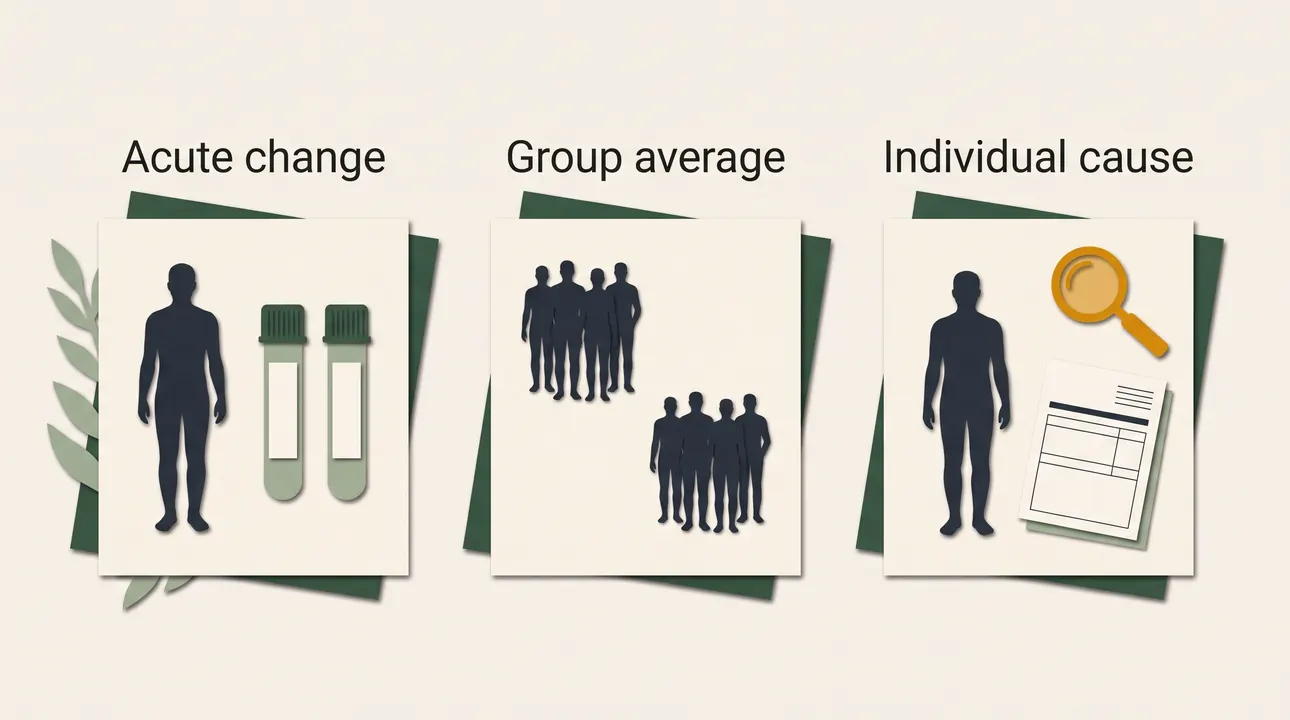
An acute response, a group association and an individual explanation require different evidence. These panels are conceptual, not measured hormone results.
What does the controlled THC study add?
The 2009 paper combined two laboratory protocols involving 76 adults. It tested intravenous THC and placebo under blinded conditions, with reported total THC doses of 1.5, 2.5 and 5 mg. These were research exposures, not consumer dosing guidance. Blood sampling was limited, and the protocols differed: one included a fixed placebo-before-active sequence. This is narrower evidence than a study of every way people use cannabis.
Its acute result concerns a particular hormone, route and sampling window. “No significant change detected” does not prove that THC can never affect prolactin. It also does not establish that all exposures produce the same result. Our lesson on the differences between THC and CBD helps explain why a THC experiment cannot silently become a CBD finding. Ranganathan et al., 2009
The study included only 19 women, and it could not adequately assess sex differences. Its selected participants were not a representative sample of everyone with a high result. It does not resolve pregnancy, lactation or clinical hormone disorders.
The paper received support from NIDA, the VA, NIMH, NIAAA, the Stanley Medical Research Institute and the Donaghue Foundation. Its authors reported no relevant direct or indirect conflicts of interest. Ranganathan et al., 2009
Why doesn’t the lower group average prove weed lowers prolactin?
Frequent users and controls were different groups of people. Researchers did not randomly assign their prior cannabis histories. A baseline difference could reflect exposure, pre-existing differences or other factors; this design cannot choose among those explanations.
The authors also emphasized that the lower levels remained within the normal physiological range. They did not evaluate the clinical significance of that difference. A lower average is therefore not evidence of a useful hormone treatment, nor a reason to reinterpret someone’s high result as harmless. Ranganathan et al., 2009
Adaptation is one possible research explanation, but it is not an established explanation for an individual’s prolactin. How tolerance differs across THC effects is a separate lesson; tolerance cannot serve as a shortcut for predicting a blood test.
Hormones are separate measurements too. Cannabis and cortisol research, cannabis and testosterone evidence and cannabis and thyroid research address different endpoints. A conclusion about one cannot be transferred to prolactin just because all are hormones.
What should a high result tell you about cannabis?
It tells you that cannabis use may be relevant information for the clinician interpreting the test. It does not settle the explanation. MedlinePlus lists several possible contributors to elevated prolactin, including medicines, medical conditions and marijuana products. Its test guidance says other assessment may be needed to identify a cause. Prolactin blood test, Prolactin Levels
Tell the clinician about cannabis products alongside medicines, symptoms and relevant medical history. An online study summary cannot tell you which contributor applies, whether a repeat test is appropriate, or how the result fits your other findings.
Neither this paper nor the official listing supplies a cannabis washout schedule. A result that changes later would also need context: changes in sampling, medicines or other circumstances can complicate a before-and-after story. Cannabis history is one piece of the assessment, not a diagnosis.
FAQ
Does weed always raise prolactin?
No universal effect is established. MedlinePlus lists marijuana products as a possible contributor to high levels, while the controlled study did not detect an overall acute change in its tested window. Neither statement predicts every person’s result.
Does the lower average in frequent users mean weed lowers mine?
No. That was a comparison between selected groups, with averages in the normal range. It was not a randomized test of long-term cannabis use or a treatment study for high prolactin.
Does the short-term null result apply to edibles or CBD?
It cannot establish those results. The study used IV THC and limited sampling. Different products, routes and time windows require their own evidence.
Can a high prolactin test identify its own cause?
No. The measured value needs clinical context. Cannabis may be relevant, but the test alone cannot distinguish it from other possible contributors. MedlinePlus: Prolactin Levels
Key takeaways
- Cannabis may contribute to elevated prolactin; history alone does not establish the cause.
- Acute change, baseline group differences and an individual abnormal result are different questions.
- Lower normal-range averages in frequent users are not evidence of a hormone benefit.
- Clinical interpretation needs context beyond a cannabis study or a single test value.
Sources
- Ranganathan M, Braley G, Pittman B, Cooper T, Perry E, Krystal J, D’Souza DC. (2009; online 2008). The effects of cannabinoids on serum cortisol and prolactin in humans. Psychopharmacology, 203(4), 737–744. Full original. DOI.
- MedlinePlus Medical Encyclopedia. Prolactin blood test. Reviewed July 21, 2024; accessed October 11, 2026. Official test information.
- MedlinePlus. Prolactin Levels. Accessed October 11, 2026. Official interpretation guidance.



