THC Tolerance: Why Feeling Less High Is Only One Measure
THC tolerance can differ by effect. Feeling less high does not establish that heart rate or blood pressure has adapted in the same way.


THC tolerance can differ by effect: feeling less high does not establish that heart rate or blood pressure has adapted equally. Gorelick and colleagues
The useful question is “tolerance to which response?” Here in High School, separate what a person reports from what an instrument measures. That distinction helps explain why “I barely feel it” cannot settle every question about THC.
What does tolerance to THC actually mean?
Tolerance describes a smaller response after repeated exposure. To make that statement useful, name the response, the exposure and the comparison. “Less high than before” and “a smaller heart-rate change than before” are two different claims.
Think of a fictional research visit. An adult marks how high they feel on a line, then has their pulse and blood pressure measured. The rating answers a question about experience. The instruments answer questions about circulation. None is a substitute for the others.
This is a measurement distinction, not a way to diagnose the reason for a racing heart. It also differs from the receptor-recovery question in our tolerance-break lesson.
Did feeling high and cardiovascular responses adapt together?
A six-day study gave 13 male daily cannabis smokers oral dronabinol: 20-mg capsules every 3.5–6 hours, totaling 40 mg on day one, 100 mg daily on days two–four and 120 mg daily on days five–six. Ten completed it. Gorelick et al.
| Endpoint | Oral regimen above: result | Main limit |
|---|---|---|
| Subjective intoxication | Pattern consistent with tolerance | Several individual comparisons were only trends |
| Morning pulse and blood pressure | Pulse remained elevated; pressure lower | Readings across days, not each capsule’s acute effect |
| Acute diastolic pressure (lower number) | Reduction persisted without detected tolerance | Small sample, three morning challenges |
| Acute pulse and systolic pressure (upper number) | No significant day-two response | Acute tolerance could not be evaluated |
Plasma THC and active-metabolite exposure rose over five days. Sedation and stimulation ratings had no overall change. No placebo; selected healthy users. Three withdrew: one for personal reasons, two after cardiovascular or psychological reactions. Full study
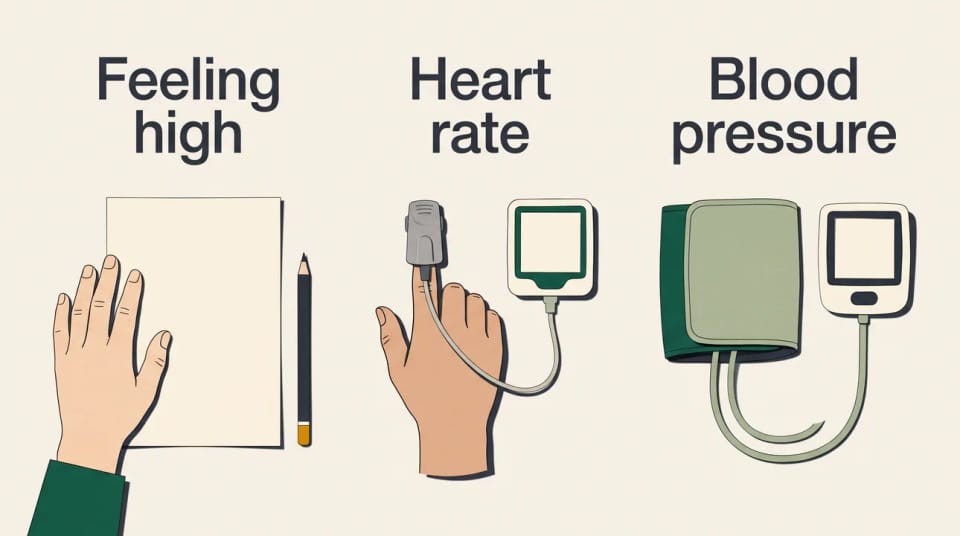
Three endpoints need three answers. These instruments illustrate the questions, not the study’s numerical results.
Can cardiovascular tolerance happen in other studies?
Yes. A different result is a reason to narrow the claim, rather than pick the study that agrees with a preferred conclusion.
A 1991 experiment followed six men through 13 days of smoking one low-potency research cigarette daily. Tests before and afterward combined smoked cannabis with intravenous THC. The heart-rate time course changed, but subjective high ratings did not differ significantly. Peak heart rate, time to peak and total heart-rate response also had no significant before–after differences. Calling this “the heart became completely tolerant” would overstate it. Perez-Reyes and colleagues
An older supervised study of 30 people, spanning 94 days with drug-free periods, reported decreases in both mean heart rate and subjective high. Its accessible abstract supplies that broad result, not enough detail to reconstruct individual dose schedules or decide which response changed first. Nowlan and Cohen
The lesson is not that the subjective response always adapts first. It is that the endpoint and regimen matter. Our consumption-method and absorption comparison explains why route belongs beside a dose, rather than buried in a footnote.
Do frequent users always have a smaller heart-rate response?
A 2017 placebo comparison tested smoked, vaporized and oral research cannabis containing about 54 mg THC in frequent and occasional users. Subjective ratings rose after both inhaled routes in both groups. After oral cannabis, significant subjective increases were reported only for occasional users. Heart-rate increases were greater than placebo, with no detected difference between the user groups. Newmeyer and colleagues
This supports another separation between reported experience and measured pulse. It does not demonstrate identical heart-rate responses in all frequent and occasional users. A study that finds no group difference has not proved the groups equal. Comparing existing user groups also cannot track how one person developed tolerance.
The indexed primary abstract is accessible. The full article is restricted. That limits what we can verify about its participants, adverse events and tolerance timeline.
What can feeling less high tell you?
It tells you about the experience you noticed. On its own, it cannot identify which other endpoints changed, whether a particular symptom has another cause, or what a physiological reading means for an individual’s health.
Avoid turning the studies into a personal dose rule. They were research regimens and comparisons, not instructions to increase THC until the desired feeling returns. A statement about one endpoint should keep that endpoint attached.
Likewise, receptor adaptation is a possible explanation to investigate, not a measurement made by these rating scales. Our CB1 and CB2 lesson introduces receptor locations. Our endocannabinoid-system guide supplies the broader background. Neither replaces a direct comparison of outcomes.
For cardiovascular disease evidence, use the separate heart-health lesson. A pulse or pressure endpoint in a small tolerance experiment cannot estimate heart-attack risk.
Key takeaways
- Ask “tolerance to which response?” before calling someone THC-tolerant.
- Keep route, regimen and measurement beside the result.
- Distinguish an unchanged acute response from an endpoint that could not support a tolerance comparison.
- Neither subjective high nor one cardiovascular reading describes every effect.
FAQ
Can I feel less high while THC still affects my heart rate?
The studies support treating those as separate questions. Less subjective intoxication does not establish an equally reduced pulse response. They cannot diagnose the reason for any particular person’s symptoms.
Does THC tolerance always develop faster for feeling high?
No universal order follows from these studies. Different regimens and different analyses produced different patterns. Even “heart-rate tolerance” needs a named measure: time course, peak or total response.
Does no significant difference mean an effect is absent?
No. It means the analysis did not detect that difference. Proving two responses equal needs a study designed to test that question. An ordinary null result does not supply that proof.
Do these studies tell me how long a tolerance break should last?
No. Comparing responses during repeated exposure does not establish a break duration or a recovery schedule for every endpoint.
Sources
- Gorelick et al., 2013. Journal of Analytical Toxicology, 37:11–16. DOI: 10.1093/jat/bks081. Full text; online publication in 2012.
- Perez-Reyes, White, McDonald et al., 1991. Pharmacology Biochemistry and Behavior, 40:691–694. DOI: 10.1016/0091-3057(91)90384-E. Full original paper.
- Nowlan and Cohen, 1977. Clinical Pharmacology & Therapeutics, 22:550–556. DOI: 10.1002/cpt1977225part1550. Publisher abstract.
- Newmeyer et al., 2017. Drug and Alcohol Dependence, 175:67–76. DOI: 10.1016/j.drugalcdep.2017.02.003. Indexed primary abstract; full text restricted.