Cannabis Topical Salves: DIY Recipes for Pain Relief
Make cannabis-infused topical salves at home with step-by-step decarb, oil infusion, and beeswax recipes for targeted muscle and joint relief.

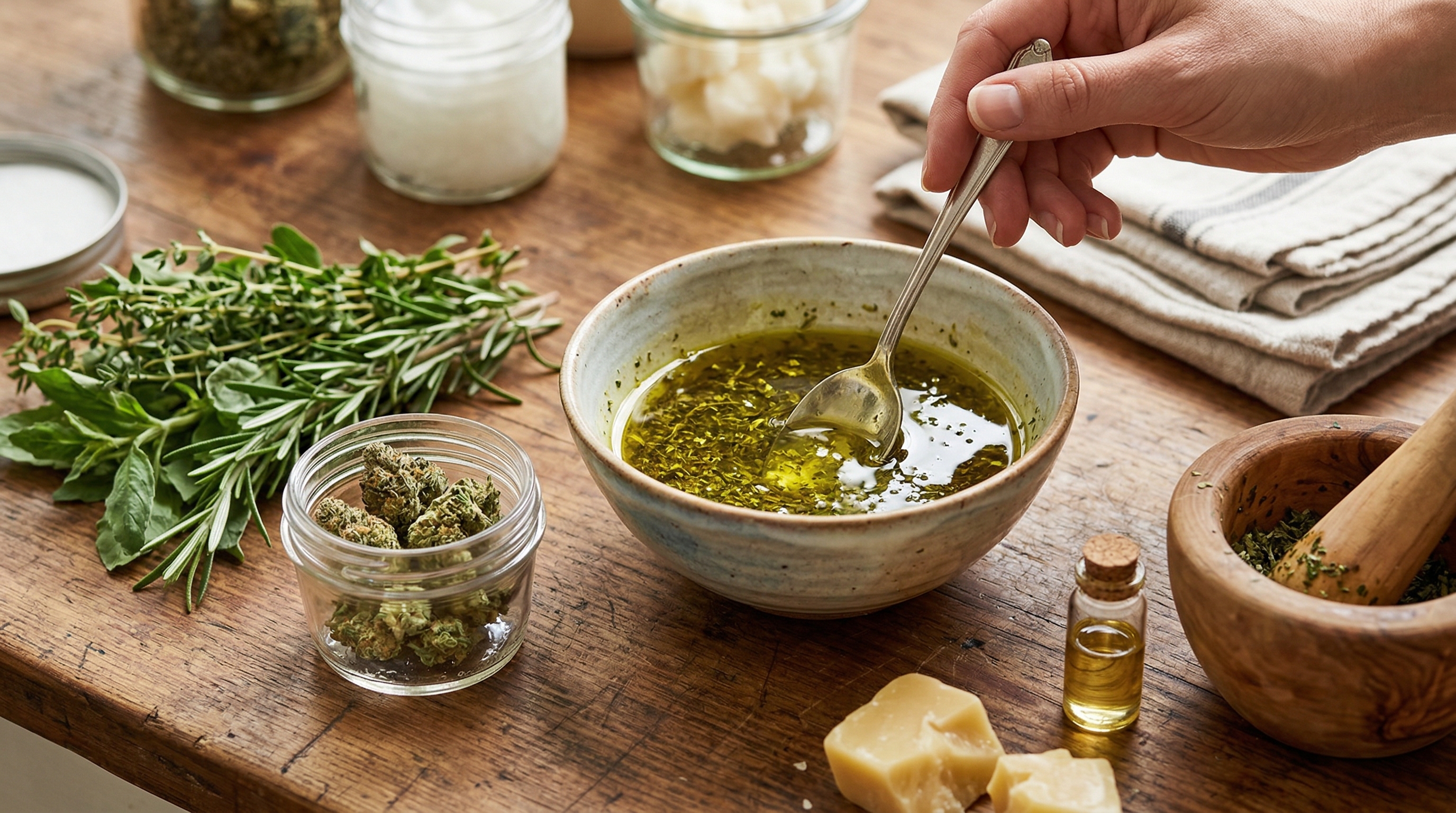
Cannabis topicals are one of the most approachable ways to explore the plant’s potential benefits without any psychoactive effects. A homemade salve puts you in full control of the ingredients, the potency, and the terpene profile — and the process is far simpler than most people expect. Whether you are managing post-workout soreness or simply want a soothing balm for everyday aches, this guide walks you through everything from decarboxylation to pouring your finished product into jars.
Goal & Overview
By the end of this tutorial, you’ll have a jar of homemade cannabis-infused topical salve — a balm you apply directly to your skin for localized, targeted comfort. Topicals don’t produce a traditional “high” because cannabinoids applied to the skin generally don’t reach the bloodstream in significant amounts [Stinchcomb et al., 2004]. Instead, they interact with cannabinoid receptors in your skin and underlying tissue, which is why many people find them useful for sore muscles, stiff joints, and general physical discomfort.
- Estimated time: 3–4 hours (mostly hands-off infusion time)
- Difficulty level: Beginner-friendly
- Yield: Approximately 8 oz (about 16 tablespoons) of salve
Important disclaimer: This salve is for external use only. Cannabis topicals are not FDA-approved treatments. If you have a serious medical condition, consult a healthcare professional before use.
What You’ll Need
Required
- 7 grams of cannabis flower — Strains from the Relieving High family, rich in caryophyllene and humulene, are a popular choice for body-focused topicals. Research suggests caryophyllene may interact with CB2 receptors associated with inflammation response [Gertsch et al., 2008].
- 1 cup coconut oil (unrefined, organic preferred) — Coconut oil is rich in saturated fats that bind well to cannabinoids
- 1/3 cup beeswax pastilles (or soy wax for a vegan option)
- Baking sheet and parchment paper (for decarboxylation)
- Double boiler or a heatproof glass bowl over a saucepan
- Cheesecloth or fine mesh strainer
- Clean glass jars or tins for storage (4 oz tins work great)
- Kitchen thermometer
- Stirring spoon or spatula
Optional
- 15–20 drops essential oils — Lavender (linalool), peppermint (menthol), or eucalyptus add aroma and may complement the terpene profile
- 1 tablespoon vitamin E oil — Acts as a natural preservative and skin conditioner
- 1 teaspoon arnica oil — A popular herbal addition in topical preparations
- Lecithin granules (1 teaspoon) — May help with cannabinoid absorption
Safety Equipment
- Oven mitts — You’ll be handling hot oil
- Well-ventilated kitchen — Decarboxylation produces a strong odor
- Heat-resistant gloves for straining hot oil
Step-by-Step Instructions
Step 1: Decarboxylate Your Cannabis (40 minutes)
Raw cannabis contains THCA and CBDA — the acidic precursors to THC and CBD. Heat converts them into their active forms through a process called decarboxylation. Even for topicals, this step matters because decarboxylated cannabinoids interact more effectively with skin receptors.
- Preheat your oven to 240°F (115°C).
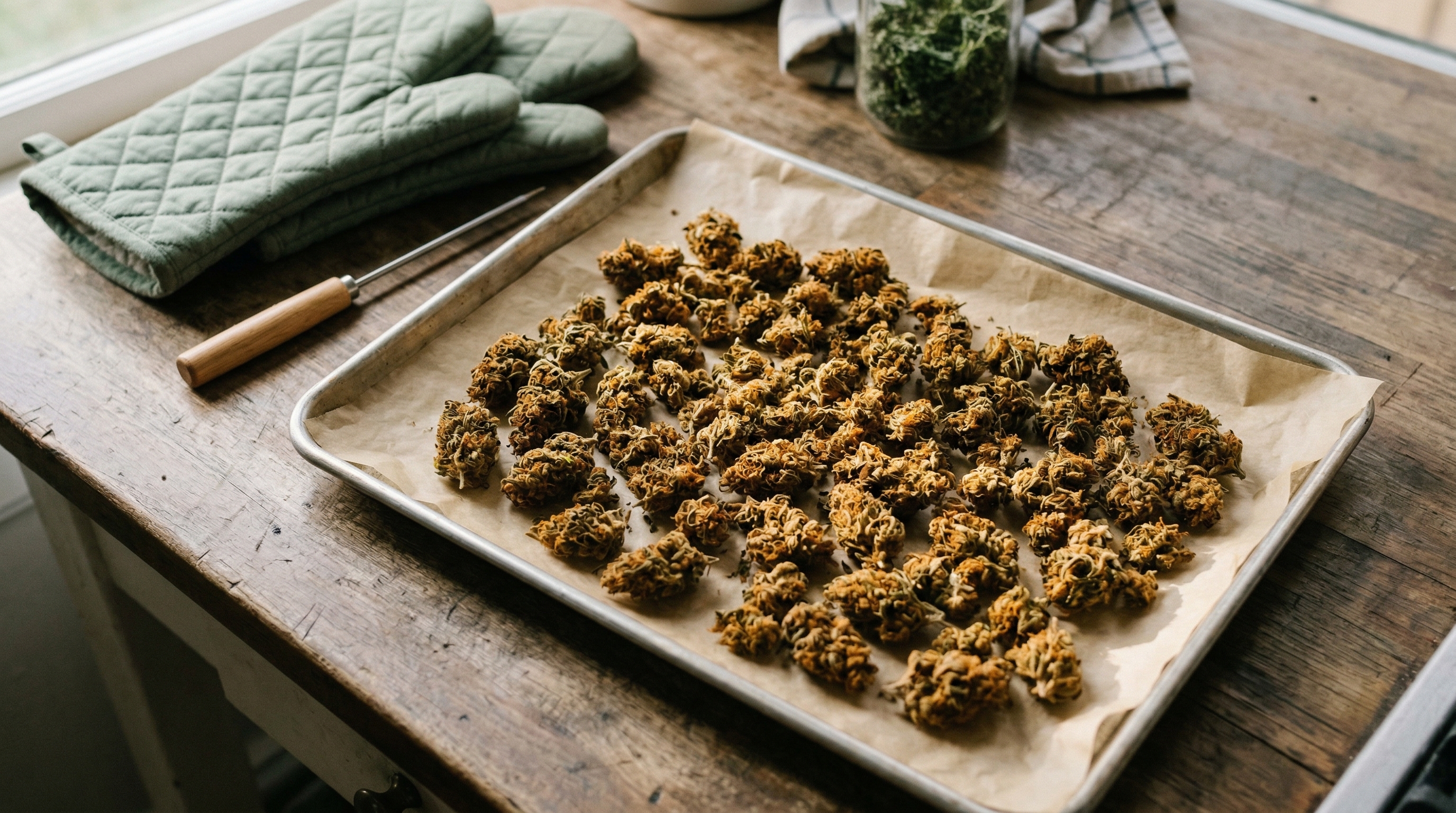
- Break your cannabis into pea-sized pieces — don’t grind it to powder, as this makes straining harder later.
- Spread evenly on a parchment-lined baking sheet.
- Bake for 35–40 minutes, gently shaking the tray halfway through.
- The cannabis should look lightly toasted and golden-brown when done.
Tip: If your cannabis turns dark brown or smells burnt, your oven may run hot. Use an oven thermometer to verify the temperature next time.
Step 2: Infuse the Coconut Oil (2–3 hours)
This is where the magic happens. You’re extracting cannabinoids and terpenes into a fat-soluble carrier oil.
- Set up your double boiler: fill the bottom pot with 2–3 inches of water, place the top pot or glass bowl on top.
- Add 1 cup of coconut oil to the top vessel and melt over low heat.
- Once melted, add your decarboxylated cannabis.
- Maintain a temperature between 160–180°F (70–82°C) for 2–3 hours. Stir every 20–30 minutes.
- Never let it boil. Excessive heat destroys cannabinoids and terpenes.
Tip: Lower and slower is better. If you see bubbles forming in the oil, reduce the heat immediately.
Step 3: Strain the Infused Oil (15 minutes)
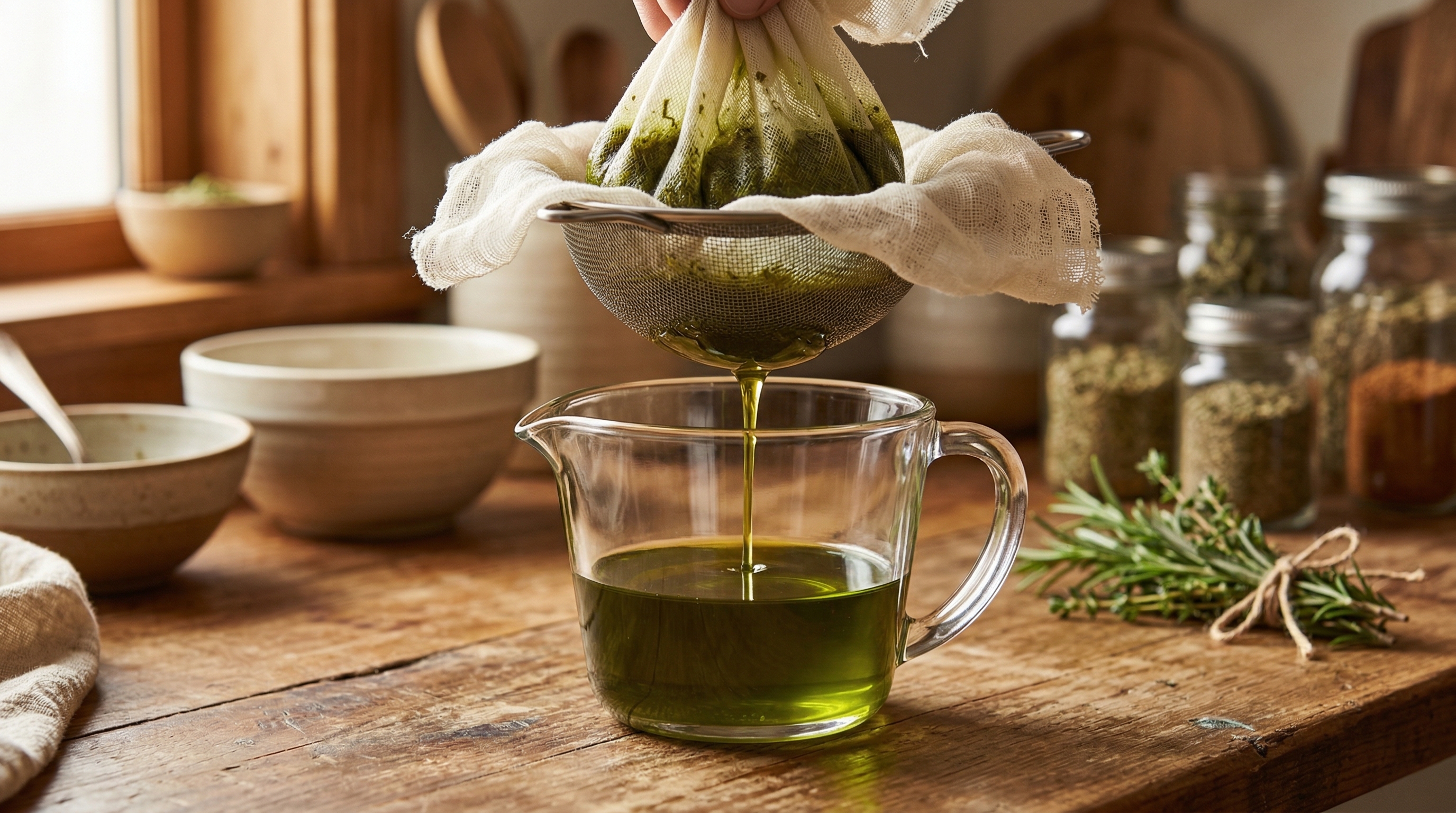
- Place a cheesecloth (doubled over) or fine mesh strainer over a clean glass bowl or measuring cup.
- Carefully pour the hot oil mixture through the strainer.
- Let gravity do the work — don’t squeeze the cheesecloth aggressively, as this pushes plant material through and creates a gritty salve.
- Discard the spent plant material.
You should have roughly ¾ to 1 cup of beautifully green-tinted infused coconut oil.
Step 4: Melt and Combine with Beeswax (15 minutes)
- Clean your double boiler and set it up again.
- Add your strained cannabis oil to the top vessel.
- Add 1/3 cup beeswax pastilles and stir gently until fully melted and combined.
- To test consistency, dip a spoon in the mixture and place it in the freezer for 2 minutes. If it’s too soft, add more beeswax (1 tablespoon at a time). If it’s too hard, add a splash more coconut oil.
Step 5: Add Extras and Pour (10 minutes)
- Remove from heat and let cool for 2–3 minutes (but don’t let it solidify).
- Stir in your optional additions: essential oils, vitamin E oil, or arnica oil.
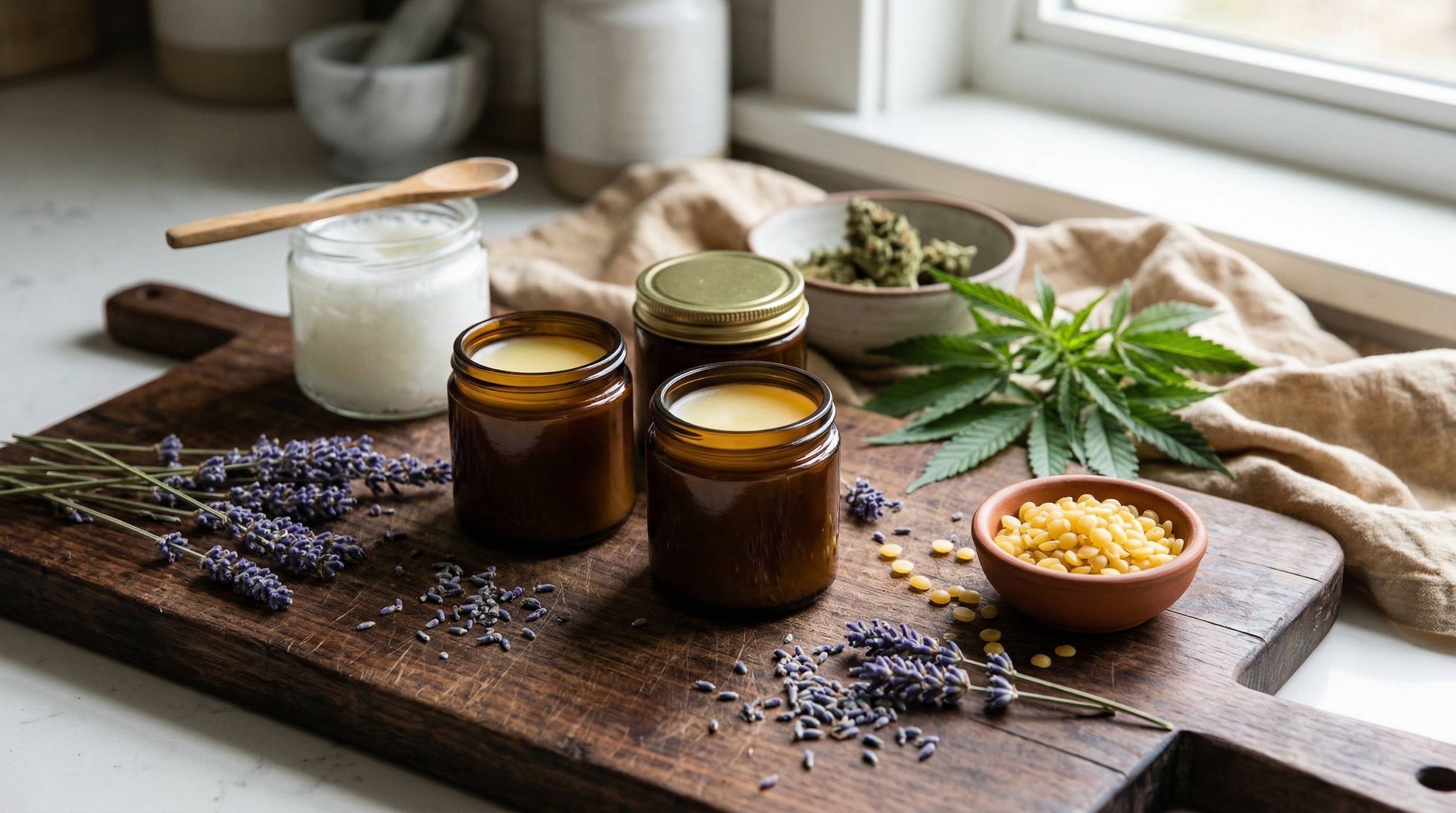
- Pour immediately into your clean glass jars or tins.
- Let sit undisturbed at room temperature for 1–2 hours until fully set.
Tip: If you’re using essential oils, adding them off-heat preserves their volatile aromatic compounds.
Pro Tips
Choose your strain intentionally. The terpene profile of your flower carries into the salve. Strains from the Relieving High family — high in caryophyllene — are the most popular choice for body-focused topicals. Some people also blend in strains from the Relaxing High family for their myrcene content, which some users find soothing on the skin.
Consider a CBD-dominant or 1:1 flower. Since topicals don’t typically produce psychoactive effects, many people prefer high-CBD strains. CBD has been studied for its potential interaction with skin receptors [Baswan et al., 2020], and using it in a topical means you’re not “wasting” THC that might be better enjoyed another way.
Label everything. Write the strain used, date made, and approximate potency on each jar. A salve made with 7 grams of flower testing at 20% THC yields roughly 1,400 mg total THC across the batch — that’s about 87 mg per tablespoon. Topical absorption varies widely, but labeling helps you track what works for you.
Shelf life matters. Stored in a cool, dark place, your salve should last 6–12 months. Adding vitamin E extends this. If it develops an off smell or changes color significantly, it’s time to make a fresh batch.
Troubleshooting
| Problem | Likely Cause | Solution |
|---|---|---|
| Salve is too soft/oily | Not enough beeswax | Remelt and add beeswax, 1 tablespoon at a time |
| Salve is too hard/waxy | Too much beeswax | Remelt and add 1–2 tablespoons more coconut oil |
| Gritty texture | Plant material passed through strainer | Use finer cheesecloth or double-layer next time |
| Weak effects | Incomplete decarboxylation or low-potency flower | Ensure oven accuracy; use higher-potency flower |
| Oil smells burnt | Infusion temperature too high | Keep below 180°F; use a thermometer consistently |
| Salve separates or sweats | Temperature fluctuations during storage | Store at consistent room temperature, away from sunlight |
Variations
- Cooling muscle rub: Add 20 drops of peppermint essential oil and 10 drops of eucalyptus for a menthol-like cooling sensation.
- Calming lavender balm: Use a Relaxing High strain and add 15 drops of lavender essential oil for an evening wind-down rub.
- Extra-firm balm stick: Increase beeswax to ½ cup and pour into push-up tubes for a portable, mess-free application.
- Vegan version: Substitute beeswax with candelilla wax (use about half the amount, as it’s harder) or soy wax.
- Smaller batch: Halve all ingredients for a test run before committing to a full batch.
Remember: Start with a small amount applied to a patch of skin and wait 30 minutes to check for any irritation before applying generously. Everyone’s skin chemistry is different.
Now go enjoy the satisfying ritual of making something genuinely useful with your own hands — and your own flower.
Key Takeaways
- Topicals stay local. Cannabis salves interact with cannabinoid receptors in your skin without producing a systemic high, making them beginner-friendly and daytime-safe.
- Decarboxylation is non-negotiable. Even for topicals, heating your flower at 240 degrees F for 35-40 minutes activates the cannabinoids that engage with skin receptors.
- Low and slow wins the infusion. Keep your oil between 160-180 degrees F for 2-3 hours. Higher heat destroys the very compounds you are trying to extract.
- Terpenes matter in topicals too. Caryophyllene-rich strains are a popular choice for body-focused salves because of their affinity for CB2 receptors.
- Customize freely. Essential oils, arnica, vitamin E, and different wax ratios let you dial in texture, scent, and firmness to match your preferences.
Sources
- Stinchcomb, A.L. et al. (2004). “Human skin permeation of Δ8-tetrahydrocannabinol, cannabidiol and cannabinol.” Journal of Pharmacy and Pharmacology. PMID: 15231036
- Gertsch, J. et al. (2008). “Beta-caryophyllene is a dietary cannabinoid.” Proceedings of the National Academy of Sciences. PMID: 18574142
- Baswan, S.M. et al. (2020). “Therapeutic Potential of Cannabidiol (CBD) for Skin Health and Disorders.” Clinical, Cosmetic and Investigational Dermatology. PMID: 32581476
- Russo, E.B. (2011). “Taming THC: potential cannabis synergy and phytocannabinoid-terpenoid entourage effects.” British Journal of Pharmacology. PMID: 21749363


