Cannabis Growing Problems: How to Diagnose and Fix Them
Learn to identify and fix the most common cannabis growing problems, from nutrient deficiencies to pest infestations, with this step-by-step guide.


There’s nothing quite like watching your cannabis plants thrive—lush green canopies reaching toward the light, sticky trichomes glistening, and that unmistakable aroma filling the grow space. But when something goes wrong, it can feel like watching a mystery unfold in slow motion. Yellow leaves? Curling tips? Strange spots? Every symptom is your plant trying to tell you something.
Whether you’re growing your first plant on a windowsill or managing a multi-light indoor garden, problems are inevitable. The good news? Most cannabis growing issues are fixable once you know what to look for. This guide will walk you through the most common problems, how to diagnose them accurately, and—most importantly—how to bring your plants back to health.
Goal & Overview
What you’ll accomplish: You’ll learn to identify, diagnose, and fix the 10 most common cannabis growing problems, including nutrient deficiencies, pH imbalances, overwatering, light stress, pest infestations, and environmental issues.
Estimated time: Diagnosis takes 5–15 minutes per plant. Most fixes show improvement within 3–10 days depending on the issue.
Difficulty level: Beginner to Intermediate — no advanced equipment or expertise required.
Key takeaway: The single most important diagnostic skill is observation. Check your plants daily, and you’ll catch problems before they become catastrophic.
What You’ll Need
Required
- pH meter or pH test drops (accuracy to 0.1 is ideal)
- pH Up and pH Down solutions (for adjusting water/nutrient solution)
- Thermometer and hygrometer (to monitor temperature and humidity)
- Measuring cups or syringes (for precise nutrient dosing)
- Clean water source (filtered or dechlorinated tap water)
- A magnifying glass or jeweler’s loupe (30x–60x magnification for pest identification)
Optional
- TDS/EC meter (measures total dissolved solids and electrical conductivity in your water)
- Soil moisture meter (takes the guesswork out of watering)
- Neem oil or insecticidal soap (organic pest management)
- CalMag supplement (calcium and magnesium, the most common secondary deficiencies)
- Oscillating fan (improves airflow and strengthens stems)
- Grow journal or app (tracking changes helps identify patterns)
Safety Equipment
- Nitrile gloves (when handling nutrients and pest treatments)
- Eye protection (when mixing concentrated nutrient solutions)
- Respirator or mask (if applying any foliar sprays in enclosed spaces)
Step-by-Step Instructions: Diagnosing and Fixing Common Problems
Step 1: Check Your pH First (Always)
Before you do anything else, test your water and runoff pH. An incorrect pH is the single most common cause of cannabis growing problems because it locks out nutrients even when they’re present in the soil.
- Ideal pH for soil: 6.0–7.0 (sweet spot is 6.3–6.8)
- Ideal pH for hydroponics/coco coir: 5.5–6.5 (sweet spot is 5.8–6.2)
How to test:
- Mix your nutrient solution as normal
- Test the pH of the solution before feeding
- After watering, collect the runoff from the bottom of the pot
- Test the runoff pH — if it’s dramatically different from what you put in, your root zone pH is off
The fix: Use pH Up (potassium hydroxide) or pH Down (phosphoric acid) to adjust your water. Add in small increments (a few drops at a time), stir, and retest.
Tip: Many “nutrient deficiencies” are actually pH problems in disguise. Fix pH first and wait 3–5 days before adding extra supplements.
Time estimate: 5 minutes per feeding session.
Step 2: Identify Nutrient Deficiencies by Leaf Symptoms
Once you’ve confirmed your pH is correct, leaf symptoms become much more reliable diagnostic tools. Here’s how to read what your plants are telling you:
Nitrogen (N) Deficiency — the most common
- Symptoms: Lower (older) leaves turn uniformly pale green, then yellow, then fall off. Progresses upward.
- When it happens: Mid-to-late vegetative growth, or when plants outgrow their soil’s nutrient supply.
- Fix: Increase nitrogen in your feeding schedule. If using organic soil, top-dress with worm castings or blood meal.
Phosphorus (P) Deficiency
- Symptoms: Dark green or bluish-green leaves with purple/red stems. Lower leaves may develop dark spots.
- When it happens: Often during the transition to flowering.
- Fix: Switch to a bloom-phase nutrient formula. Ensure pH is in range (phosphorus locks out below 6.0 in soil).
Potassium (K) Deficiency
- Symptoms: Brown, crispy edges on leaves (leaf margin burn), starting on older leaves.
- When it happens: Mid-to-late flowering when potassium demand is highest.
- Fix: Increase potassium supplementation. Kelp extract is a good organic source.
Calcium/Magnesium Deficiency
- Symptoms: Brown/rust-colored spots on middle leaves (calcium). Interveinal yellowing—veins stay green but tissue between them yellows (magnesium).
- When it happens: Extremely common in coco coir, filtered water, or RO water setups.
- Fix: Add a CalMag supplement at 1–2 mL per liter. This is often needed throughout the entire grow cycle.
Important: Nutrient problems rarely exist in isolation. If you see multiple deficiency symptoms at once, suspect pH lockout or root zone issues rather than actual nutrient shortages.
Step 3: Diagnose Watering Problems
Overwatering and underwatering look surprisingly similar at first glance—both cause drooping. Here’s how to tell them apart:
Overwatering
- Leaves droop and curl downward, looking heavy and swollen
- Soil stays wet for days
- May develop a musty smell (root rot beginning)
- Growth slows significantly
Underwatering
- Leaves droop and look thin, papery, almost wilted
- Soil is bone dry, pulling away from pot edges
- Plant perks up quickly (within hours) after watering
- Leaves may feel crispy
The fix for overwatering:
- Stop watering immediately
- Ensure drainage holes are clear and functional
- Wait until the top 1–2 inches of soil are dry before watering again
- Consider transplanting to a better-draining medium if the problem persists
- Use the “lift test” — pick up the pot. A dry pot feels noticeably lighter than a wet one.
The fix for underwatering:
- Water slowly and thoroughly until 10–20% runoff appears
- If soil is very dry, water in stages — a little, wait 10 minutes, then more
- Consider adding perlite to your soil mix to improve water retention balance
Tip: The #1 beginner mistake is overwatering. Cannabis roots need oxygen. Let the soil dry out between waterings — your plants will thank you.
Time estimate: Watering adjustments show results within 24–48 hours.

Step 4: Address Light Stress
Cannabis plants can suffer from both too much and too little light.
Light burn (too much light)
- Symptoms: Upper leaves (closest to the light) bleach white or turn pale yellow. Leaf tips may curl upward. This happens even when temperatures are fine.
- Fix: Raise your grow light 6–12 inches higher. Reduce intensity if using dimmable LEDs. Follow the manufacturer’s recommended hanging distance for your growth stage.
Light deprivation (not enough light)
- Symptoms: Stretchy, lanky growth with long internodes. Thin stems. Lower leaves drop off. Slow flowering.
- Fix: Lower your light (while monitoring for heat/burn). Upgrade to a more powerful light if needed. Outdoors, move plants to a sunnier location.
Light cycle stress
- Symptoms: Hermaphroditism (male pollen sacs appearing on female plants), reverted growth, or failure to flower.
- Cause: Light leaks during the dark period, inconsistent timers, or interrupted dark cycles.
- Fix: Seal all light leaks in your grow space. Use a reliable timer. During the 12/12 flowering cycle, the dark period must be completely uninterrupted.
Tip: The “hand test” for heat — hold your hand at canopy level under the light for 30 seconds. If it’s uncomfortable for your hand, it’s too hot for your plants.
Step 5: Control Temperature and Humidity
Environmental conditions affect everything from nutrient uptake to pest susceptibility.
Ideal ranges:
| Growth Stage | Temperature | Humidity |
|---|---|---|
| Seedling | 68–77°F (20–25°C) | 65–70% |
| Vegetative | 70–85°F (21–29°C) | 40–60% |
| Flowering | 65–80°F (18–26°C) | 40–50% |
| Late Flowering | 65–75°F (18–24°C) | 30–40% |
High temperature stress:
- Leaves taco/curl upward, edges dry out, foxtailing during flower
- Fix: Improve ventilation, add AC or intake fans, raise lights
Low temperature stress:
- Purple stems (not genetic), slow growth, increased susceptibility to mold
- Fix: Add a small heater, insulate the grow space, raise pots off cold floors
High humidity (the silent killer):
- Leads to bud rot (Botrytis), powdery mildew, and root issues
- Fix: Add a dehumidifier, improve airflow with oscillating fans, defoliate dense canopies to improve air circulation
Step 6: Identify and Eliminate Pests
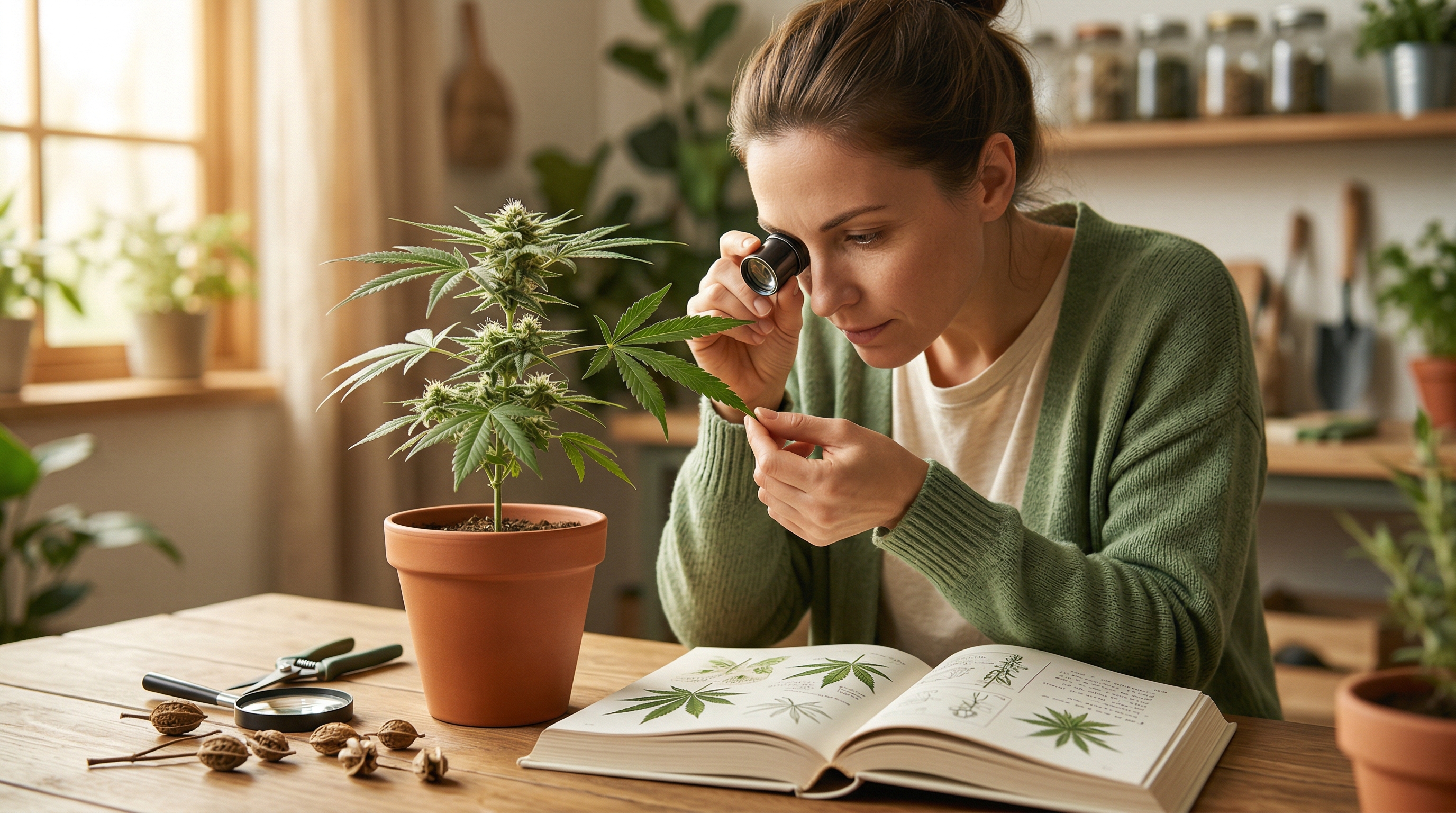
Grab your magnifying glass — many cannabis pests are nearly invisible to the naked eye.
Spider mites
- Signs: Tiny yellow/white dots (stippling) on upper leaf surfaces. Fine webbing on undersides of leaves and between branches.
- Fix: Spray undersides of leaves with neem oil solution (1 tsp neem oil + 1 tsp liquid soap per liter of warm water). Repeat every 3 days for 2 weeks. Increase airflow and lower temperatures (mites thrive in hot, dry conditions).
Fungus gnats
- Signs: Tiny black flies hovering around the soil surface. Larvae in the top inch of soil.
- Fix: Let the top layer of soil dry out completely between waterings. Apply a layer of diatomaceous earth on the soil surface. Use yellow sticky traps to catch adults.
Aphids
- Signs: Clusters of small green, white, or black insects on new growth. Sticky residue (honeydew) on leaves.
- Fix: Blast with water to knock them off. Apply insecticidal soap. Introduce ladybugs for biological control.
Thrips
- Signs: Silver/bronze streaks on leaf surfaces. Tiny, slender insects visible with magnification.
- Fix: Blue sticky traps (thrips are attracted to blue). Neem oil or spinosad-based organic sprays.
Tip: Prevention beats treatment every time. Inspect new clones before introducing them to your grow space. Keep a clean growing environment. A small oscillating fan makes it harder for flying pests to land.
Time estimate: Pest treatment is an ongoing process — expect 2–3 weeks of consistent treatment to fully eliminate an infestation.
Pro Tips
1. Keep a grow journal. This is the single most underrated tool in a grower’s arsenal. Record your watering schedule, nutrient concentrations, pH readings, temperature, humidity, and any changes you notice. When a problem appears, you can look back and pinpoint exactly when conditions changed. Patterns become obvious over time.
2. Less is more with nutrients. It’s far easier to fix an underfed plant than an overfed one. Start at 50% of the manufacturer’s recommended dose and increase gradually. Nutrient burn (brown, crispy leaf tips) is one of the most common beginner problems, and it’s entirely preventable.
3. Flush when in doubt. If you suspect nutrient lockout or salt buildup, run 2–3 times the pot volume of pH-balanced water through the soil. This “flush” resets the root zone. Wait a day, then resume feeding at a reduced concentration.
4. Don’t panic-fix. When you spot a problem, make one change at a time and wait 3–5 days to see results. Stacking multiple fixes simultaneously makes it impossible to know what worked — and you risk creating new problems.
5. Understand your water source. Tap water varies wildly by location. Some tap water is already 400+ PPM with calcium and chlorine. Get a baseline reading of your water’s pH and TDS before adding anything. If your tap water is above 200 PPM, consider using filtered or RO water with CalMag added back in.
6. Airflow is non-negotiable. A gentle breeze across your canopy strengthens stems, discourages pests, prevents mold, and helps leaves transpire properly. Every grow space needs at least one oscillating fan, even small ones.
Troubleshooting Quick Reference
| Problem | Likely Cause | Solution |
|---|---|---|
| Yellow lower leaves | Nitrogen deficiency or natural aging | Increase N in feeds; remove dead leaves |
| Yellow upper leaves | Light burn or iron deficiency | Raise lights; check pH (iron locks out above 7.0) |
| Brown leaf tips | Nutrient burn (too much fertilizer) | Flush soil; reduce nutrient concentration by 25–50% |
| Brown spots on mid-leaves | Calcium deficiency | Add CalMag; verify pH is 6.2–6.5 in soil |
| Drooping (heavy leaves) | Overwatering | Let soil dry; improve drainage |
| Drooping (thin, papery) | Underwatering | Water slowly and thoroughly |
| Curling leaves (taco shape) | Heat stress | Lower temperature; raise lights; increase airflow |
| White pow |


