Full-Spectrum vs Broad-Spectrum vs Isolate CBD: Which Is Right for You?
Full-spectrum, broad-spectrum, or isolate CBD—each works differently. Learn the science behind all three and find out which one fits your needs.


The Decision: Choosing Your CBD Type
There is no single right CBD type: full-spectrum keeps trace THC with the rest of the hemp profile, broad-spectrum removes the THC, and isolate is pure CBD. You’ve decided to try CBD. Maybe a friend recommended it, or you’ve been reading about how cannabidiol may support relaxation, comfort, or general wellness. You open a browser, search for CBD products, and immediately hit a wall of terminology: full-spectrum, broad-spectrum, isolate. Three labels. Three different products. Three different price points. And absolutely zero clarity about which one you actually need.
This isn’t just a marketing distinction—it’s a meaningful difference in chemical composition that directly affects how the product interacts with your body. Each type contains a different combination of cannabinoids, terpenes, and other hemp-derived compounds, and those combinations influence the overall experience through mechanisms researchers are still working to fully understand.
The good news? Once you understand what’s actually in each type and how those compounds work together (or don’t), the choice becomes surprisingly straightforward. In this guide, we’ll break down the science behind all three CBD types, compare them head-to-head across the factors that matter most, and help you identify which one aligns with your priorities—whether that’s maximizing potential benefits, avoiding THC entirely, or finding the best value for your budget.
Let’s get into the chemistry.
Quick Comparison
Before we dive deep, here’s a snapshot of how full-spectrum, broad-spectrum, and isolate CBD stack up:
| Factor | Full-Spectrum | Broad-Spectrum | Isolate |
|---|---|---|---|
| CBD present | Yes | Yes | Yes |
| Other cannabinoids | CBG, CBN, CBC, and more | CBG, CBN, CBC, and more | None |
| THC content | Up to 0.3% (legal limit) | Non-detectable / removed | None |
| Terpenes | Full natural profile | Often retained | None |
| Entourage effect | Full potential | Partial | None |
| Taste/smell | Earthy, herbaceous | Milder than full-spectrum | Tasteless, odorless |
| Drug test risk | Low but possible | Very low | Virtually none |
| Best for | Maximum benefit seekers | THC-sensitive users wanting synergy | Precision dosing, zero-THC needs |
| Avoid if | You are drug tested regularly | You want the complete plant profile | You want the entourage effect |
| Typical cost | $$ to $$$ | $$ to $$$ | $ to $$ |
The main differences come down to THC content and the presence of supporting compounds. More compounds generally means more potential for synergistic effects—but also more variables to manage.
Understanding the Source: How Hemp Becomes CBD
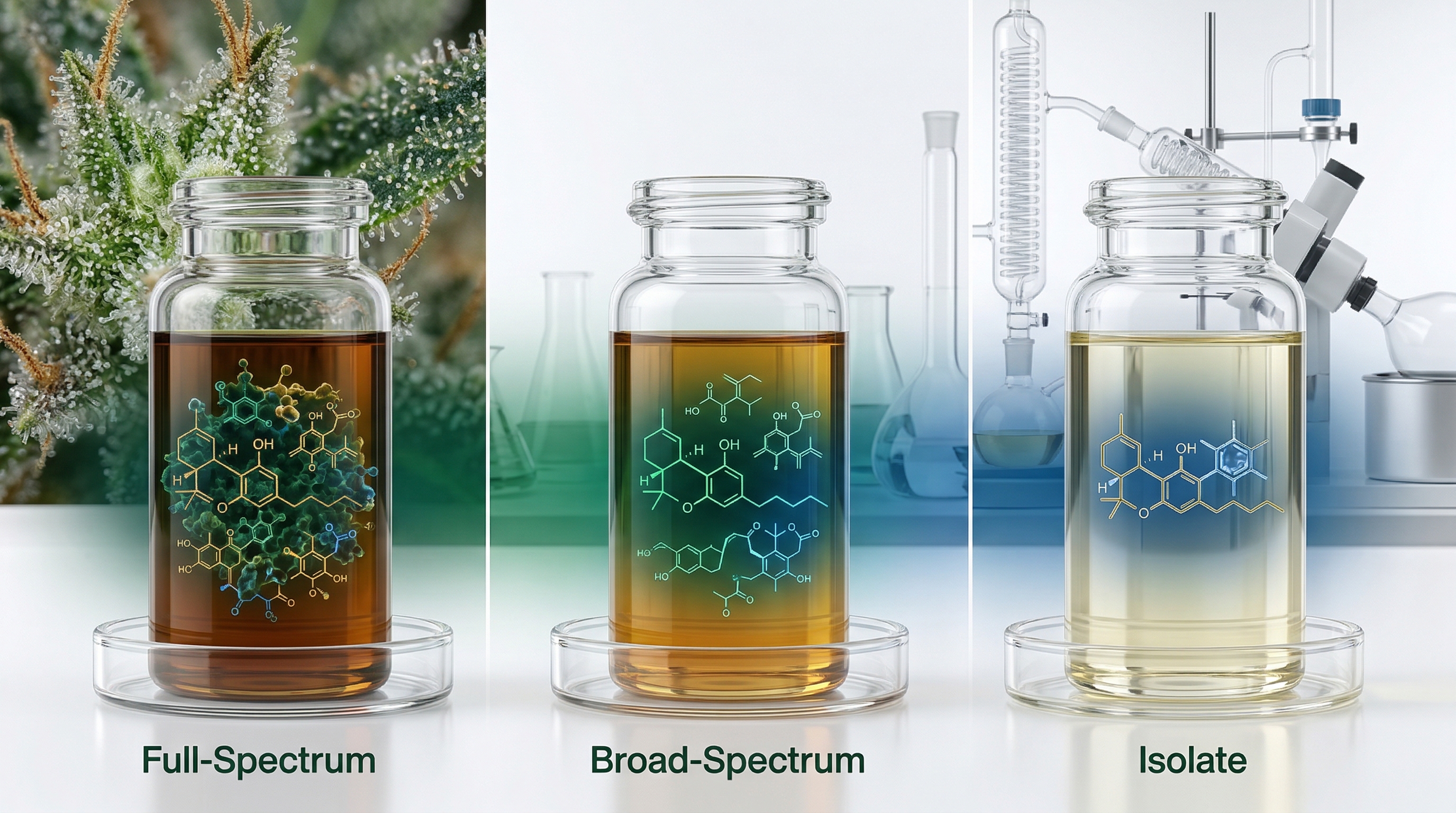
All three CBD types start from the same place: the hemp plant (Cannabis sativa L.), specifically varieties bred to contain less than 0.3% THC by dry weight. The hemp plant naturally produces over 100 cannabinoids, dozens of terpenes, flavonoids, fatty acids, and other phytochemicals. What distinguishes full-spectrum, broad-spectrum, and isolate is how much of that complexity is preserved—or stripped away—during extraction and processing.
The gold standard for modern hemp extraction is supercritical CO2 extraction, which uses carbon dioxide under precise pressure and temperature conditions to pull cannabinoids and terpenes from the plant material without leaving solvent residues. The European Industrial Hemp Association considers it the cleanest method available, and most premium CBD brands use it.
What comes out of CO2 extraction is a raw full-spectrum hemp extract—the complete mixture of compounds from the plant. From that point forward, the extract is either kept mostly intact (full-spectrum), put through additional processing to remove THC (broad-spectrum), or refined down to a single compound through further isolation techniques (isolate).
Understanding this continuum matters because every step of additional processing carries a cost: some terpenes are volatile and degrade with heat; additional chromatography steps can strip minor cannabinoids along with the THC target. The question for each product type is how well the manufacturer preserves beneficial compounds while achieving the desired purity level.
Deep Dive: Full-Spectrum CBD
What It Is
Full-spectrum CBD is the closest you can get to the whole hemp plant in extract form. It contains CBD alongside the full range of naturally occurring cannabinoids—including trace amounts of THC at or below 0.3%—plus terpenes, flavonoids, and other phytochemicals found in Cannabis sativa.
Think of it like fresh-squeezed orange juice versus vitamin C tablets. The juice contains the vitamin C you’re after, but it also brings along a constellation of other nutrients—fiber, potassium, flavonoids—that may enhance overall absorption and effect. Full-spectrum CBD works on a similar principle: a 2020 review in Frontiers in Pharmacology found that whole-plant cannabis extracts showed stronger anti-inflammatory properties than purified cannabinoids alone [Blasco-Benito et al., 2018].
The Entourage Effect
The defining mechanism behind full-spectrum CBD is the entourage effect, a concept first proposed by Raphael Mechoulam in 1998 and later expanded by Ethan Russo in a landmark 2011 paper in the British Journal of Pharmacology. The theory holds that cannabinoids, terpenes, and other plant compounds work synergistically—each amplifying or modulating the effects of the others—producing therapeutic outcomes that none of the compounds could achieve in isolation [Russo, 2011].
This is one of the most compelling reasons to choose full-spectrum. For a detailed breakdown of how the entourage effect works at the molecular level, see our guide to the entourage effect and cannabis science.
The terpene beta-caryophyllene, for example, acts as a dietary cannabinoid itself, binding directly to CB2 receptors without producing any psychoactive effect [Gertsch et al., 2008]. When these compounds are present together with CBD, the resulting experience may be more nuanced and effective than CBD alone.
A key 2015 study by Gallily et al. at the Hebrew University of Jerusalem provided direct experimental evidence: full-spectrum extracts showed dose-dependent anti-inflammatory effects, while purified CBD showed a bell-shaped dose-response curve—effective at a narrow dose range, then losing effectiveness at higher doses [Gallily et al., 2015]. This has major practical implications for product selection and dosing.
The trace THC in full-spectrum products is well below intoxicating levels. In a 30ml bottle of 1000mg CBD oil at 0.3% THC, that’s roughly 3mg of THC total. You won’t feel high. But it may contribute to the entourage effect by occupying CB1 receptors and modulating the response to other cannabinoids.
Pros
- Maximum entourage effect potential from the complete compound profile
- Most CBD studies showing broad efficacy use full-spectrum or whole-plant extracts [Gallily et al., 2015]
- Lower doses may be effective due to synergistic compound interactions
- Rich terpene profile contributes to both effects and flavor
- Least processed form—fewer refinement steps means fewer opportunities for compound degradation
Cons
- Contains trace THC (up to 0.3%), which can accumulate with very heavy daily use
- Drug test risk: while unlikely at normal doses, it is not zero
- Stronger taste: the earthy, herbaceous flavor from terpenes and chlorophyll is not for everyone
- More variables: more compounds means more potential interactions with medications
Ideal Use Cases
- You want the broadest potential benefit from hemp’s compound profile
- Drug testing is not a concern in your life
- You are comfortable with trace amounts of THC
- You prefer products close to natural plant chemistry
- You’re exploring CBD for chronic discomfort, inflammation, or sleep support
Deep Dive: Broad-Spectrum CBD
What It Is
Broad-spectrum CBD occupies the middle ground. It retains most of the cannabinoids, terpenes, and flavonoids found in full-spectrum extracts, but with one key difference: the THC has been selectively removed or reduced to non-detectable levels.
This is achieved through additional processing steps after the initial extraction—typically liquid chromatography, short-path distillation, or a combination of refinement techniques that target THC molecules while leaving other compounds intact. The goal is to preserve as much of the entourage effect as possible while eliminating the one compound many people want to avoid.
Quality varies significantly between manufacturers. A well-produced broad-spectrum extract retains a diverse minor cannabinoid and terpene profile. A poorly produced one is essentially CBD isolate with a few terpenes added back. Third-party Certificates of Analysis (CoAs) are your best tool for evaluating what you’re actually getting.
How It Works
Broad-spectrum CBD still leverages the entourage effect, just with a slightly reduced cast of characters. You’re still getting the interplay between CBD and minor cannabinoids like CBG (cannabigerol), CBN (cannabinol), and CBC (cannabichromene), along with whatever terpenes survive the refinement process.
Research on CBG suggests it may interact with both CB1 and CB2 receptors as well as serotonin receptors, potentially contributing to mood and comfort [Navarro et al., 2020]. CBC has shown preliminary interest in preclinical studies for its potential anti-inflammatory properties [Izzo et al., 2012]. These minor cannabinoids are increasingly recognized as important contributors to the hemp compound ecosystem.
The central open question is how much the removal of THC diminishes the entourage effect. Some evidence suggests that even trace amounts of THC play a meaningful modulatory role through CB1 receptor activity [Russo, 2011]. Other research indicates that the remaining cannabinoid and terpene compounds still provide significant synergistic benefits without it [Blasco-Benito et al., 2018]. The honest answer is that the science is still catching up to the marketing claims on both sides.
Pros
- No THC (or non-detectable levels), dramatically reducing drug test risk
- Retains synergistic compounds for a partial entourage effect
- Good compromise between purity and compound complexity
- Milder flavor than full-spectrum, more palatable for many users
- Widely available in a diverse range of product formats
Cons
- Entourage effect may be reduced without THC’s modulatory contribution
- More processed than full-spectrum, which can degrade volatile terpenes
- Quality varies widely—some “broad-spectrum” products have minimal compound diversity
- Comparable or higher cost than full-spectrum due to the additional THC removal step
Ideal Use Cases
- You are subject to drug testing but still want synergistic benefits
- You have personal, professional, or medical reasons to avoid any THC
- You are sensitive to THC and want to eliminate even trace amounts
- You live in a jurisdiction with strict THC regulations
- You want more complexity than isolate without introducing THC
Deep Dive: CBD Isolate
What It Is
CBD isolate is exactly what it sounds like: pure, isolated cannabidiol. Through extensive extraction and refinement—including winterization, distillation, and crystallization—all other cannabinoids, terpenes, flavonoids, and plant materials are removed, leaving behind a crystalline powder or solid that’s typically 99%+ pure CBD.
It’s the most processed form of CBD, and it’s the simplest. One compound. One mechanism. No variables. This purity has genuine advantages for certain use cases, but it also comes with documented trade-offs.
How It Works
Without the supporting cast of cannabinoids and terpenes, isolate CBD interacts with your endocannabinoid system through CBD’s own mechanisms. CBD doesn’t bind strongly to CB1 or CB2 receptors directly; instead, it works through multiple indirect pathways—modulating receptor activity, inhibiting the breakdown of endocannabinoids like anandamide, and interacting with serotonin (5-HT1A) and vanilloid (TRPV1) receptors [Pertwee, 2008].
For a deeper understanding of how CBD and THC interact with these receptor systems differently, our article on THC vs CBD: understanding the differences covers the mechanisms in detail.
The bell-shaped dose-response curve is the most important pharmacological characteristic of CBD isolate that consumers need to understand. The Gallily et al. 2015 study showed that purified CBD has a therapeutic window—too little does nothing, too much also does nothing, and effectiveness peaks in a relatively narrow range. Full-spectrum extracts did not show this limitation. This means isolate users need to be more careful about finding and staying within their effective dose range.
That said, isolate has clear advantages where precision matters. The purity makes it ideal for exact dosing protocols—you know precisely how much CBD you’re administering, milligram for milligram.
Pros
- Zero THC, period—safest option for drug testing and zero-tolerance policies
- Precise, consistent dosing with no compound variability
- Tasteless and odorless—easy to add to foods, beverages, or skincare
- Lowest potential for interactions with medications (always consult your physician)
- Often the most affordable per milligram of CBD
- Ideal for cooking and formulating custom products
Cons
- No entourage effect—you’re working with a single compound
- Bell-shaped dose response may limit effectiveness and require more careful calibration [Gallily et al., 2015]
- May require higher doses to achieve effects comparable to full-spectrum for some users
- Less nuanced experience without terpene-mediated effects, according to available research
- Loses the natural compound diversity that may contribute to broader wellness benefits
Ideal Use Cases
- You undergo regular, zero-tolerance drug testing
- You’re taking multiple medications and want to minimize compound interactions
- You need precise, consistent dosing for a specific protocol
- You want to add CBD to recipes or products without altering their flavor
- You have sensitivities to terpenes or other plant compounds

Head-to-Head Analysis
Effect Profile and Research Evidence
Full-spectrum has the strongest experimental backing for synergistic effects. The Gallily et al. 2015 study remains the most-cited direct comparison: whole-plant extracts continued to show dose-dependent effectiveness at higher doses while purified CBD plateaued and declined. A 2020 Frontiers in Pharmacology review corroborated this, finding consistent evidence that whole-plant extracts outperform isolated cannabinoids in anti-inflammatory models [Blasco-Benito et al., 2018].
Broad-spectrum occupies a practical middle position. Survey-based consumer data consistently shows broad-spectrum outperforming isolate for most applications, but falling somewhat short of full-spectrum for pain and sleep—both areas where THC’s modulatory role may be most significant [Corroon & Phillips, 2018].
Isolate is best for applications where precision matters more than compound synergy. For well-defined protocols where you need to know exactly what you’re administering and control for all variables, isolate is the appropriate choice.
The Drug Test Question
This is often the deciding factor, so let’s be precise. Standard urine drug tests don’t screen for CBD—they screen for THC metabolites (specifically THC-COOH). The risk hierarchy:
- Full-spectrum: Low but non-zero risk. A 2019 case report documented positive drug tests from CBD products containing legal THC levels. Heavy consumers of potent full-spectrum products are at the greatest risk.
- Broad-spectrum: Very low risk if THC is genuinely at non-detectable levels and confirmed by third-party testing. The risk isn’t zero because “non-detectable” depends on the sensitivity of the assay being used.
- Isolate: Effectively no risk from THC if the product is what it claims to be. However, a 2017 JAMA study found significant CBD product mislabeling rates—some isolate products contained detectable THC [Bonn-Miller et al., 2017]. This reinforces the critical importance of third-party CoAs regardless of which type you choose.
Dosing Considerations
The type of CBD product you choose has real implications for how you should approach dosing:
Full-spectrum: More forgiving dose-response curve. Research suggests benefits scale with dose without hitting the isolate ceiling. Start low (10–15mg CBD), increase gradually, and look for your minimum effective dose.
Broad-spectrum: Similar to full-spectrum dosing principles. Minor cannabinoid content varies by product, so CoA review helps set expectations before starting.
Isolate: Requires more careful calibration due to the bell-shaped dose-response curve. Finding the effective window—often reported between 25–75mg CBD depending on application and individual—is important before assuming that higher is better.
Cost and Value
Isolate is generally the least expensive per milligram of CBD because the refinement process produces a standardized commodity product. Full-spectrum extracts can command a moderate premium. Broad-spectrum often sits at or above full-spectrum pricing because of the additional THC removal step—10–20% more is common.
However, cost per milligram doesn’t tell the whole story. If full-spectrum is effective at lower doses due to the entourage effect, your cost per effective dose may actually be lower with full-spectrum despite a higher sticker price.
Taste and User Experience
Full-spectrum CBD has a distinctly earthy, sometimes bitter flavor from terpenes and chlorophyll—some people appreciate this as a marker of whole-plant quality; others find it challenging, especially in tincture form. Broad-spectrum is typically milder. Isolate is a blank slate: no flavor, no aroma.
For people who want to cook with CBD, blend it into smoothies, or add it to skincare formulations, isolate’s neutrality is a genuine practical advantage. For those who appreciate the complexity of a full plant extract, full-spectrum delivers a richer sensory experience.
How to Read a CBD Label
Regardless of which type you choose, product quality within each category varies enormously. Here is what to look for:
Certificate of Analysis (CoA): A third-party lab report that should show cannabinoid content (CBD, THC, CBG, CBN, and others), terpene profile (for full and broad-spectrum), and contaminant testing (pesticides, heavy metals, residual solvents). If a brand doesn’t publish CoAs, move on.
What the CoA should show for each type:
- Full-spectrum: CBD as the dominant cannabinoid with trace THC under 0.3%, plus several minor cannabinoids and a named terpene profile
- Broad-spectrum: CBD plus minor cannabinoids, with THC listed as “ND” (non-detect) or below 0.01%
- Isolate: CBD at 99%+ with all other cannabinoids and terpenes at ND
Watch for these red flags:
- THC listed as exactly “0%” on full-spectrum (legally it must be under 0.3%, but an exact zero on a plant-derived extract is a marketing claim, not chemistry)
- Broad-spectrum with no minor cannabinoids or terpenes listed (likely isolate rebranded with marketing language)
- No third-party CoA available, or a CoA that only shows CBD content without a full cannabinoid and contaminant panel
- Significant discrepancy between labeled CBD content and CoA-measured CBD content—the 2017 JAMA study found 26% of products contained less CBD than labeled [Bonn-Miller et al., 2017]
The Verdict
Choose Full-Spectrum If…
- You want the most complete expression of hemp’s compound profile
- Drug testing is not a concern in your professional or personal life
- You’re comfortable with trace THC (up to 0.3%)
- You’re exploring CBD for chronic discomfort, inflammation, or sleep where research most strongly supports whole-plant benefits
- You appreciate the complexity of a full terpene profile and natural plant chemistry
Choose Broad-Spectrum If…
- You’re subject to workplace or legal drug testing and cannot risk any THC exposure
- You have personal, professional, or religious reasons to avoid THC entirely
- You still want more than just isolated CBD and believe in the synergistic benefits of multiple cannabinoids
- You’re sensitive to THC and even trace amounts cause unwanted effects
- You want the middle-ground approach: more complexity than isolate, no THC concern
Choose Isolate If…
- You undergo regular zero-tolerance drug testing (law enforcement, DOT, federal employment)
- You’re taking multiple medications and need to minimize plant compound interactions—consult your physician
- You need absolute precision in dosing for a specific therapeutic protocol
- You want to cook with CBD or add it to products without altering flavor
- You have terpene sensitivities or allergies to plant compounds
- You’re just starting out and want the simplest, most controlled introduction to CBD
The Honest Summary
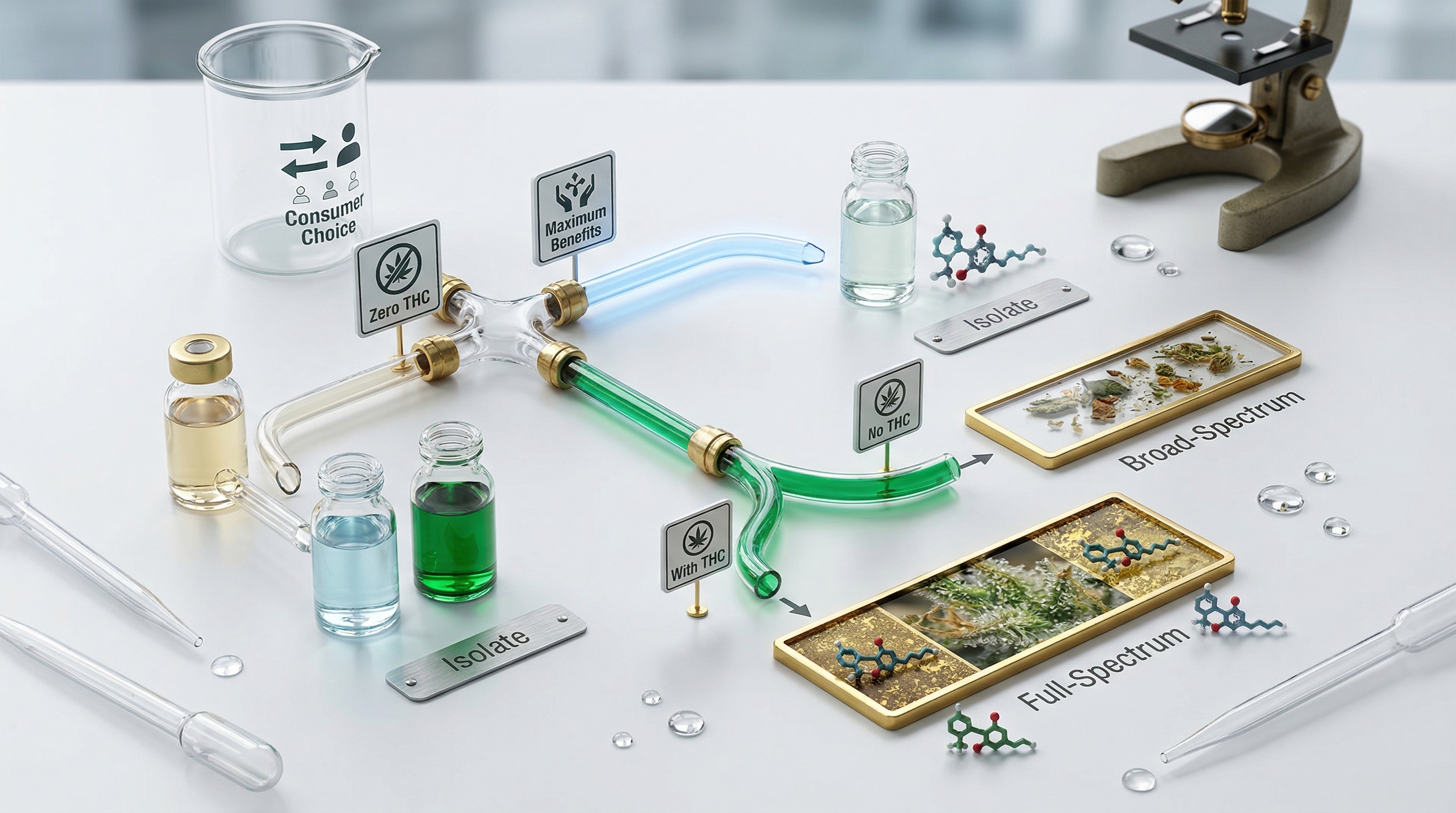
There is no universally “best” CBD type. Full-spectrum has the strongest research support for the broadest range of applications. Broad-spectrum makes a reasonable compromise for those with THC concerns. Isolate is the right tool for specific precision-dosing and zero-THC applications.
The most important variable after choosing your type is finding a reputable manufacturer with transparent, third-party CoAs. A high-quality broad-spectrum product from a rigorous manufacturer will outperform a poorly made full-spectrum product every time.
Start with the type that fits your life circumstances, buy from a brand with published CoAs, start at a low dose, and give it at least two to three weeks before drawing conclusions. Your endocannabinoid system is unique—what works well for someone else may not be what works best for you.
If you want to go deeper on how THC and CBD interact differently with your body, our article on THC vs CBD: understanding the differences covers the receptor science in detail. And if you’re curious about why the compounds found in full-spectrum work so well together, our guide to the entourage effect is the right next read. Once you’ve settled on a type, our THC to CBD ratio guide can help you fine-tune your dosing approach further—useful for full-spectrum users in particular.
Spectrum language only matters if the bottle is CBD. How hemp seed oil differs from CBD oil on the label is the mix-up that comes before that choice.
Key Takeaways
Choosing between full-spectrum, broad-spectrum, and isolate CBD comes down to three questions: How important is the entourage effect to you? Can you tolerate any trace of THC? How much control do you need over exactly what you’re consuming?
- Full-spectrum retains the complete hemp compound profile—including trace THC—and has the strongest research backing for synergistic effects via the entourage effect. It’s the best starting point for most wellness-focused users who aren’t subject to drug testing.
- Broad-spectrum removes THC while keeping other cannabinoids and terpenes, making it a reasonable middle ground for those who need to avoid THC but still want more than isolated CBD.
- Isolate is pure CBD with no other compounds. It’s the safest option for drug testing, the most precise for dosing, and the most neutral for culinary or topical applications—but research suggests it may have a narrower effective dose window than whole-plant extracts.
- Third-party CoAs are non-negotiable regardless of which type you choose. Mislabeling in the CBD market is well-documented; lab testing is the only reliable verification.
- Cost per milligram isn’t the right metric. If full-spectrum is effective at lower doses, its cost per effective dose may be lower than an isolate product with a cheaper sticker price.
- Start low and track your experience. Your endocannabinoid system is unique. What research says works best on average may not be what works best for you.
FAQ
What is the difference between full-spectrum, broad-spectrum, and isolate CBD?
Full-spectrum CBD keeps CBD plus other cannabinoids, terpenes, flavonoids, and trace THC at or below 0.3%. Broad-spectrum keeps most of those other compounds, but the THC is removed to non-detectable levels. Isolate is typically 99% or higher pure CBD, with the other cannabinoids and terpenes taken out.
Will full-spectrum CBD show up on a drug test?
Standard urine tests look for THC metabolites, not CBD, so full-spectrum products carry a low but real risk because they can contain up to 0.3% THC. Broad-spectrum risk is very low when a third-party certificate of analysis lists THC as non-detect. Isolate has effectively no THC risk if the bottle matches its lab report, though a 2017 JAMA study found some CBD products were mislabeled.
Does CBD isolate have the entourage effect?
Isolate does not have the entourage effect, because it is a single compound without the other cannabinoids and terpenes. A 2015 study by Gallily and colleagues found purified CBD followed a bell-shaped dose-response, while full-spectrum extracts kept showing effects as the dose rose. Broad-spectrum still offers a partial entourage effect from the compounds that remain after THC removal.
Which CBD type should you choose?
Choose full-spectrum when you want the complete hemp profile and drug testing is not a concern. Choose broad-spectrum when you need to avoid THC but still want other cannabinoids and terpenes. Choose isolate when you need zero THC, a precise milligram dose, or a product with no taste or smell.
Sources
Blasco-Benito, S., Seijo-Vila, M., Caro-Villalobos, M., Tundidor, I., Andradas, C., Garcia-Taboada, E., & Sanchez, C. (2018). “Appraising the ‘entourage effect’: Antitumor action of a pure cannabinoid versus a botanical drug preparation in preclinical models of breast cancer.” Biochemical Pharmacology, 157, 285–293. DOI: 10.1016/j.bcp.2018.06.025
Bonn-Miller, M.O., Loflin, M.J.E., Thomas, B.F., Marcu, J.P., Hyke, T., & Vandrey, R. (2017). “Labeling accuracy of cannabidiol extracts sold online.” JAMA, 318(17), 1708–1709. DOI: 10.1001/jama.2017.11909
Corroon, J., & Phillips, J.A. (2018). “A cross-sectional study of cannabidiol users.” Cannabis and Cannabinoid Research, 3(1), 152–161. DOI: 10.1089/can.2018.0006
Gallily, R., Yekhtin, Z., & Hanus, L.O. (2015). “Overcoming the bell-shaped dose-response of cannabidiol by using cannabis extract enriched in cannabidiol.” Pharmacology & Pharmacy, 6(2), 75–85. DOI: 10.4236/pp.2015.62010
Gertsch, J., Leonti, M., Raduner, S., Racz, I., Chen, J.Z., Xie, X.Q., & Zimmer, A. (2008). “Beta-caryophyllene is a dietary cannabinoid.” Proceedings of the National Academy of Sciences, 105(26), 9099–9104. DOI: 10.1073/pnas.0803601105
Izzo, A.A., Borrelli, F., Capasso, R., Di Marzo, V., & Mechoulam, R. (2012). “Non-psychotropic plant cannabinoids: new therapeutic opportunities from an ancient herb.” Trends in Pharmacological Sciences, 30(10), 515–527. DOI: 10.1016/j.tips.2009.07.006
Navarro, G., Varani, K., Reyes-Resina, I., Sanchez de Medina, V., Rivas-Santisteban, R., Sanchez-Carnerero Callado, C., & Franco, R. (2020). “Cannabigerol action at cannabinoid CB1 and CB2 receptors and at CB1-CB2 heteroreceptor complexes.” Frontiers in Pharmacology, 9, 632. DOI: 10.3389/fphar.2018.00632
Pertwee, R.G. (2008). “The diverse CB1 and CB2 receptor pharmacology of three plant cannabinoids: delta9-tetrahydrocannabinol, cannabidiol and delta9-tetrahydrocannabivarin.” British Journal of Pharmacology, 153(2), 199–215. DOI: 10.1038/sj.bjp.0707442
Russo, E.B. (2011). “Taming THC: Potential cannabis synergy and phytocannabinoid-terpenoid entourage effects.” British Journal of Pharmacology, 163(7), 1344–1364. DOI: 10.1111/j.1476-5381.2011.01238.x


