

Hawaii Medical Cannabis for Visitors: How to Register
Hawaii medical cannabis visitors need an approved 329 registration before buying. Check eligible cards, the current fee, timing and island travel limits.

Professor High
Written by Professor High, our AI guide. See how we research and correct articles.

An eligible visiting medical patient must obtain an active Hawaii 329 registration before buying cannabis from a licensed Hawaii dispensary. Your home medical card lets you apply; it does not replace Hawaii’s approval. The visitor route also requires a government-issued home card, ID from the same jurisdiction and a condition that qualifies under Hawaii’s debilitating-condition rules. Hawaii DOH visitor instructions
Here is the timing detail to save: you may apply up to 60 days before your requested start, but the registration itself lasts no more than 60 days from its effective date. If your home medical card expires sooner, the Hawaii registration ends sooner too. Paying for the application is a separate step from getting approved.
This guide follows the public visitor instructions checked October 17, 2026, including the portal introduced September 30. The steps below are for adults applying for themselves. Allow time for review before planning a dispensary visit.
| Before you apply | What to check |
|---|---|
| Home medical card | Government-issued, unexpired and showing an expiration date |
| Identity document | Valid photo ID or driver license from the same jurisdiction that issued the medical card |
| Medical condition | The condition approved at home must meet Hawaii’s debilitating-condition rule |
| Dates | Requested start, home-card expiry and available registration term |
| Destination | Licensed dispensary access on the island you will visit; patients cannot carry cannabis between islands |
Does your home medical card qualify?
Hawaii requires a medical cannabis card issued by a government program, rather than a private clinic’s recommendation alone. The covered home jurisdictions are another US state, a US territory or the District of Columbia. The statute also requires a valid photo ID or driver license from the same issuing jurisdiction. An unrelated passport is not the adult visitor checklist’s substitute for that matching ID. HRS §329-123.5
That distinction matters when a service advertises an instant “medical card.” A doctor’s recommendation and a state-government registration are different documents. DOH specifically says cards issued by private entities do not meet its out-of-state requirement. If your home government registers patients but does not issue cards, DOH tells you to contact the program for guidance. Ask before paying rather than guessing that a prescription, screenshot or provider certificate will be accepted. DOH credential FAQ
Your home approval must also be for a Hawaii-qualifying debilitating condition. Examples include cancer, glaucoma, epilepsy, multiple sclerosis, rheumatoid arthritis, PTSD and ALS. A chronic or debilitating condition, or its treatment, can qualify through specified symptoms such as severe pain or severe nausea. Check the full categories rather than assuming any condition accepted at home will qualify. Official condition list
Hawaii also has a broader certification route involving a Hawaii primary treating medical provider. That is a different route. It does not erase the debilitating-condition requirement in the out-of-state registration statute.
For a minor, DOH requires a parent or legal-guardian caregiver and additional documents; up to two qualifying caregivers may register. The visitor route does not add a caregiver for an adult. A medical card from outside the United States does not qualify for this out-of-state route, though DOH describes a separate Hawaii-provider application path for international visitors. Contact the program about these situations rather than using the adult steps below unchanged. DOH visitor FAQ
How do you apply through the current Hawaii portal?
Use the current DOH portal instructions and wait for an issued card before shopping. The program moved to a new registry website on September 30, 2026. Some older guides and agency links still point to the previous system. Start from the official new-registry notice and its current portal link.
1. Check your home documents and condition
Prepare clear images of your government-issued home medical card and matching-jurisdiction ID. Check their names and expiry dates. Have your medical provider’s details available too: the September official application guide shows fields for the provider’s name, license number and contact information.
Read the eligibility questions before paying. The form includes an attestation about the qualifying condition and consent for the department to verify information with the issuing authority and medical provider. Official visitor application guide
2. Choose your requested start date
You may file no earlier than 60 days before your desired effective date. Check the expiry of your home medical card before choosing that start. A nearly expired home card cannot support a full 60-day Hawaii term.
Use the dates on the card DOH actually issues. The rule measures the term from the effective date established by the department, rather than automatically from the day you land or pay. HAR §§11-160-43.01 and 43.08
3. Use the current official visitor application
The public September guide shows the “60-Day Out-of-State Registration” choice. Follow the current form, enter your requested start and home-card details, complete the attestations and upload the requested documents. Review the information before submitting.
As checked October 17, DOH’s visitor FAQ publishes a nonrefundable $47.41 application fee. Some official tutorial screenshots show a different sample total. Check the charge before submitting payment, and ask the program if it is unclear. Current published fee, official application guide
4. Wait for approval and check your card
Monitor the application status and your email, including requests for corrections. A successful payment message means the payment went through; it does not mean DOH approved your application. The official guide states that distinction explicitly.
After approval, download the digital Hawaii 329 card and check its effective and expiry dates. DOH accepts a digital copy; printing is optional. Bring the valid card and your photo ID when you visit a dispensary. Official visitor guide, DOH entry and card FAQ
How long does review take, and can you renew?
Allow time for review rather than planning around an instant card. The registry homepage currently gives a goal of 3–5 business days. Its September tutorial gives a different estimate. Neither promises your application’s decision date, especially if information needs correction. Check the program’s current processing update before making a dispensary plan.
Once issued, the registration lasts up to 60 days from its effective date, limited by earlier home-card expiry. DOH describes one renewal for another term of up to 60 days. It allows a maximum of two registrations in a calendar year. Under the rule, the first term and renewal must have effective dates in the same calendar year. Each registration or renewal has a fee. Visitor FAQ, HAR §§11-160-43.02 and 43.08–43.09
Do not treat that as a prepaid 120-day card or assume unused days carry over. The statute also sets a 12-month bound on when the additional period begins. If your trips cross calendar years or your home card is being renewed, ask DOH which registration dates apply. HRS §329-123.5(a)
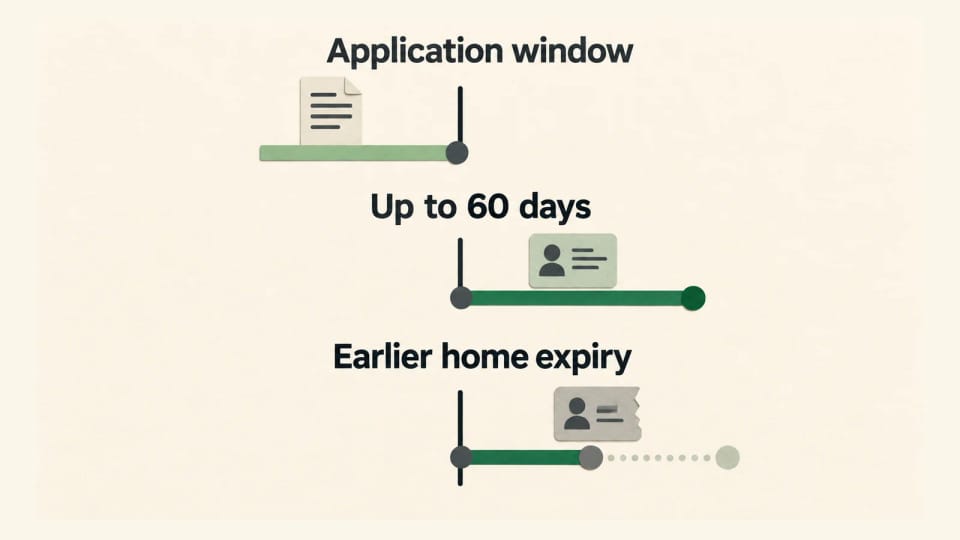
The filing window can open 60 days before your desired start. The active term is at most 60 days from the effective date DOH establishes. Earlier home-card expiry shortens that term; payment alone starts neither permission nor a guaranteed full term.
What can you buy and possess after approval?
Bring your active Hawaii card and valid government photo ID, then ask the dispensary to check your remaining purchase allowance. The law separates cannabis-equivalent sales windows from the amount you may possess at one time. HRS §329D-7
| Rule | Visitor limit | What the number means |
|---|---|---|
| Possession at any given time | No more than 4 ounces of usable cannabis | Includes the usable-cannabis calculation for manufactured products; no live plants |
| Sales during 15 consecutive days | No more than 4 ounces of cannabis equivalent | Combined cannabis and manufactured products |
| Sales during 30 consecutive days | No more than 8 ounces of cannabis equivalent | A second sales window, not permission to possess 8 ounces at once |
The possession amount must also be no more than reasonably necessary for the medical purpose. These are cannabis-weight or equivalent-weight rules, not ounces of THC or the finished weight of a bag of gummies. Ask how a manufactured product counts before purchasing. Visitor adequate-supply definition, HRS §329-121
Purchases are tracked across the system. Visiting a second shop does not create a new allowance. Use the official dispensary directory to check licensed businesses on your destination island. It lists dispensaries on Hawaii Island, Maui, Oahu and Kauai. Confirm hours and product availability with the shop. Tracking requirements, HRS §329D-6
At an unfamiliar counter, our dispensary red-flags checklist helps you check the seller and transaction. If you ask for test results, match the COA to the package’s batch or lot; a familiar strain name does not identify the tested batch. Those shopping checks do not replace the dispensary’s Hawaii-specific allowance calculation.
Can you take cannabis between islands or use it on a beach?
No: patients cannot transport cannabis between Hawaiian islands, and public use is prohibited. The interisland rule applies to patient transport by any means. It is not just an airline’s baggage policy, and a sealed bag does not create an exception. The statute’s narrow licensed-business and laboratory exceptions do not authorize a visitor to island-hop with a purchase. HRS §329-122(e)–(f)
For travel within an island, the statute allows specified medical transport through public places only with cannabis in a sealed container, out of public view, without removing or using it there. That is different from consuming on a public beach, in a park or in a moving vehicle. Check a property’s smoking and vaping policy too; a medical card does not override a smoke-free property. Do not drive impaired. DOH use restrictions
Leave cannabis out of the luggage you bring from home. DOH warns that traveling with it passes through federal jurisdiction and can expose you to delay or arrest. A Hawaii registration is not permission to import your supply or take it home. Plan any multi-island visit around the ban on patient interisland transport, rather than buying a larger amount on the first island. DOH travel FAQ
The visitor registration also does not authorize cultivation or sharing cannabis with another person. Its medical-use definition excludes cultivation and distribution. HRS §329-121
Other visitor programs need separate planning. Oklahoma’s temporary patient license, Arkansas visiting-patient registration and Utah’s nonresident medical card have different document, timing and purchase procedures. None replaces a Hawaii registration.
Key takeaways
- Check the actual card issuer, matching-jurisdiction ID and Hawaii condition eligibility before paying.
- Apply up to 60 days ahead; check the issued card’s effective and expiry dates.
- The currently published visitor fee is $47.41 and is nonrefundable. Verify the charge shown before submitting.
- Payment and submission are not approval. Download the active Hawaii card before shopping.
- Keep possession, purchase windows and island travel rules separate.
FAQ
Does Hawaii accept a doctor’s recommendation instead of a government medical card?
Not through the ordinary out-of-state checklist. DOH requires a government-issued medical cannabis card and says private-entity cards do not qualify. If your home government registers patients without issuing cards, ask DOH for guidance before paying.
Does the 60-day registration start when I land in Hawaii?
No. The rule measures it from the effective date established by DOH. Check the dates on the issued card, and remember that earlier home-card expiry shortens the Hawaii term.
Can I show the payment receipt at a dispensary?
A receipt alone is not the required active Hawaii 329 card. The official application guide says a successful payment does not mean application approval. Wait for the card and bring your valid photo ID.
Can I carry my Hawaii purchase on an interisland ferry?
No. The patient interisland prohibition is not limited to flights. The sealed-container transport provision does not authorize patients to move cannabis between islands.



