Heavy Metals in Cannabis Vapes: Why the Hardware Matters
Can cannabis vape hardware release metals? Learn what aerosol studies found, what lab reports can miss, and which testing questions to ask.

Professor High
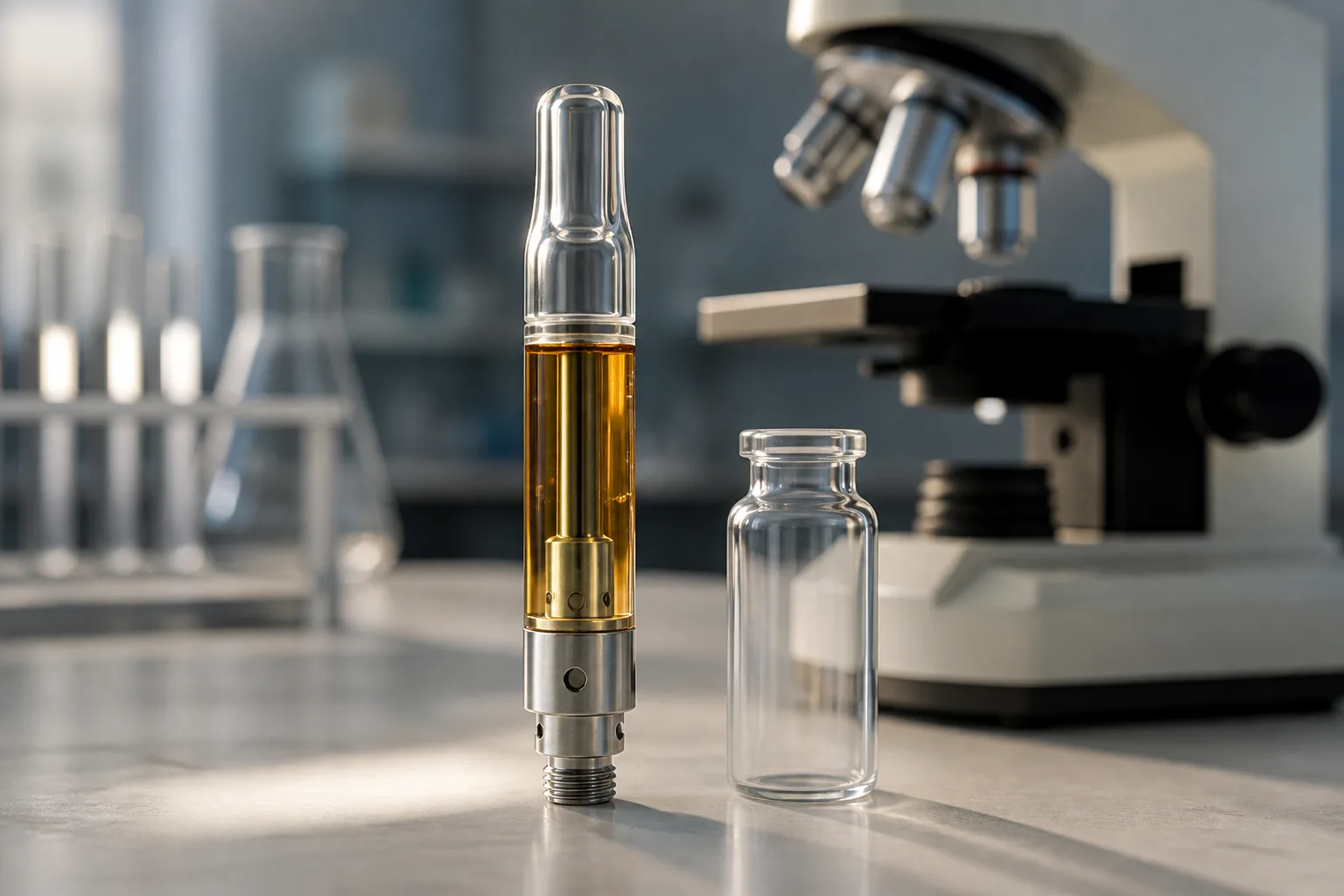
You scan a vape cartridge’s lab report. The oil passed. The batch number matches. You have done more homework than most shoppers.
Then a headline says cannabis vapes contain heavy metals. Does that mean the report was fake? Did the grower miss something? Should the little metal tube running through the oil have been part of the conversation all along?
Cannabis vape hardware can contribute metals to the liquid and aerosol. Researchers have documented that pathway in laboratory studies. Those findings justify questions about the finished device, but they do not establish that every cartridge delivers a harmful dose or quantify your personal risk. McDaniel et al., 2021.
The useful question is specific: what was tested—the oil, the filled cartridge, or what comes out during use?
This is a guide to that distinction. It is not a brand ranking, and you will not need to take a cartridge apart to use it.
A vape is a product and a machine
Think about how you shop for a cartridge. You might compare the extract, cannabinoid percentage, flavor, price, and producer. The device can become background scenery: the container that holds the thing you actually bought.
That shopping model leaves something out. In a 2021 laboratory study, researchers tested components and collected aerosol from 13 commercial cannabis cartridges purchased in Washington State. Their findings implicated the heating hardware as a source of metal contamination. Chromium, copper, and nickel were among the metals identified moving into oil and aerosol. This was product chemistry research, not a clinical study measuring disease in people who used those cartridges. McDaniel et al., 2021.
That means an extract’s story and a device’s story belong in the same purchase decision. A description of how carefully the oil was made does not, by itself, answer what happens once it is inside its delivery system.
It also helps to be precise about the product category. This article concerns oil cartridges and related liquid vaping systems. A dry-herb vaporizer has a different setup. Our dry-herb versus oil vaporizer comparison explains those differences without treating the word “vape” as one uniform technology.
The evidence: three findings worth separating
Metals can be present before the first puff
In 2022, Gajdosechova and colleagues examined 12 metals in 20 legal and 21 illegal cannabis vape liquids. They found metal-containing particles in unused devices, as well as differences between two devices holding liquid from the same product lot. Their microscopy and elemental analysis showed particles containing metals used in common hardware alloys.
The important boundary: these were liquid measurements. Finding material in the tank does not tell you how much reaches someone through inhalation. The study also raised a sampling problem: unevenly distributed particles can make repeated measurements disagree. Gajdosechova et al., 2022.
Researchers have followed particles into aerosol
A 2025 study of legal Canadian products examined liquids, collected machine-generated aerosol, and analyzed device components. The hardware’s elemental makeup matched detected particles, supporting a device contribution. Microscopy also found cracking on an unused connector pin.
Nickel and zinc particles were detected in every aerosol sample; other metals appeared less consistently. Crucially, the emitted particle numbers were below the study’s quantitation limit. The researchers could identify a signal but could not report particle counts with the reliability required for quantitation. It was not a measurement of injury rates or a safe-versus-dangerous verdict on individual products. Gajdosechova et al., 2025.
Another aerosol study mostly found nonreportable levels
The evidence is not a stack of identical alarming results. A separate 2021 study analyzed aerosols from 50 vaping products associated with a lung-injury investigation. Among cannabinoid-based products, measured metals were below reportable levels except for copper in one sample.
The investigators described challenges with collecting and measuring these aerosols, including background metals and differences between liquid formulations. The devices were not a representative survey of all retail products. Gonzalez-Jimenez et al., 2021.
That result belongs in the conversation. A fair account includes low or nonreportable findings alongside detections, rather than choosing the study that produces the loudest headline.
“Detected” and “dangerous” answer different questions
A lab result can be useful without settling every question a shopper has.
Detection asks whether a signal can be distinguished from background. Quantitation asks whether its amount can be measured reliably. Risk assessment asks what a particular exposure could mean for health. These are separate steps; moving from one to the next requires more evidence.
The practical reading rule is to look for the noun after the number. A concentration in oil is not automatically a dose in inhaled aerosol. A measurement per laboratory puff does not automatically describe every person’s puff. A measurement from one product does not automatically describe a shelf full of other products.
This distinction also works in the reassuring direction. “Below reportable levels” is a statement about a test and its reporting boundary. It should not be rewritten as “absolutely nothing was present.”
You do not need to decide that laboratory methods are untrustworthy. You need to keep the result attached to the question the method actually answered.
What three kinds of testing can tell you
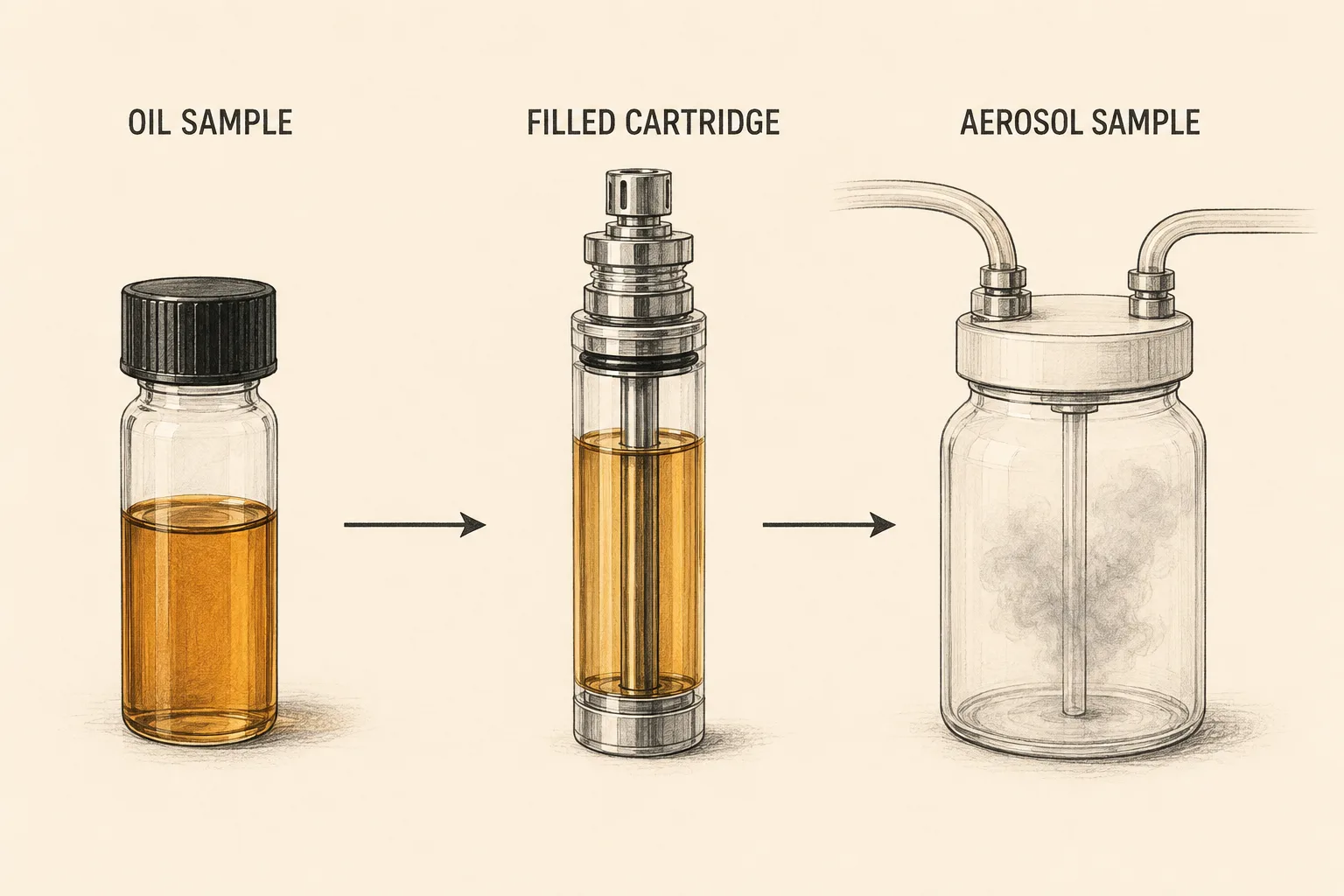
Illustrative testing stages, not a technical laboratory setup or a measurement of contamination.
Here is a useful way to organize the documents a producer might provide:
| Evidence provided | Question it can address | Question to ask next |
|---|---|---|
| Oil analysis before filling | What was measured in the sampled oil? | Was contact with the final hardware evaluated? |
| Analysis of oil from filled cartridges | What was measured after oil entered those devices? | At what point after filling was sampling done? |
| Aerosol analysis | What was collected under the stated operating conditions? | Which conditions, devices, and metals were included? |
| Hardware materials report | What are the examined components made from? | Is there also evidence about release during use? |
This table is a reading framework, not a statement that all jurisdictions require all four documents.
California’s Department of Cannabis Control, for example, lists heavy metals among required testing categories and explains that a certificate of analysis reports whether a batch passes or fails tests for each substance. That is a meaningful, defined role. The phrase “lab tested” still needs the actual report behind it. California DCC testing guidance.
For the report’s basic layout, use our guide to reading cannabis lab results. Before interpreting any finding, also match the COA to your package’s batch or lot number. A highly detailed report for another product cannot answer your question.
Five questions to send a vape producer
These are questions to request evidence, not a home certification checklist. A retailer may need to pass them to the manufacturer or laboratory.
1. Was the sample taken from the finished cartridge?
Ask what the sample description means. “Cannabis extract” could be too broad to settle your question. You want to understand where in production the sample came from and whether the final hardware was involved.
A useful reply describes the actual sampling stage. A repeated assurance that the oil is premium does not supply that missing detail.
2. Which metals were included?
Ask for the names, measured results, units, and reporting limits. Avoid treating a headline panel name as an exhaustive inventory of what a laboratory can measure.
If a report uses abbreviations, ask the laboratory to explain them. “ND,” “LOQ,” and “pass” do different jobs. Your goal is to understand the document, not become an analytical chemist overnight.
3. Do you have aerosol testing for this device and formulation?
Ask whether the evidence applies to the specific product you are considering. If a company sends a hardware supplier’s report, check whether it identifies the same device and explains the material used during testing.
The strongest response is a document with enough detail to follow the connection. “Our supplier tests everything” is a starting point for a follow-up, not the follow-up’s answer.
4. What conditions did the test cover?
Ask about the operating settings, sampling schedule, and the stage of device life examined. If a report discusses storage, ask what temperatures and duration were evaluated.
There is no universal answer you should demand from every company. You are checking the scope of its claim. One clearly described test can be more informative than a broad promise with no conditions attached.
5. Who can explain the result or investigate a concern?
Keep the product name, lot number, receipt, and the report together. Ask for a contact who can address a technical question, rather than cycling through promotional FAQs.
If you are comparing two products, keep a small note with the same fields for both. Otherwise, a beautiful PDF from one brand and a short email from another can feel like comparable evidence when they contain very different information.
What this means when you are standing at the counter
You should not need a graduate degree to buy a product responsibly. Nor should the burden of checking hardware design land entirely on shoppers.
Still, you can make a more informed conversation happen. Start with a traceable product and the matching report. Then ask whether “tested” includes the finished device or aerosol. If that answer is unavailable, write down “unknown.” Do not silently promote it to “safe,” and do not turn it into proof of contamination.
Keep this issue separate from authenticity. Our counterfeit vape cart guide addresses product provenance; this article asks about the scope of evidence even when a product is authentic.
Dates deserve their own attention, too. If the report and package timeline is confusing, our guide to COA test dates versus package dates can help you formulate the follow-up. A date without a description of what was sampled leaves part of the story untold.
And resist turning a purchase question into a repair project. Disassembling a cartridge will not produce an aerosol test. A material that looks shiny, clean, or ceramic cannot give you the missing measurements.
FAQs
Do all cannabis vapes contain dangerous levels of heavy metals?
The studies discussed here cannot establish that. They examined selected products under specific conditions. Detection is evidence to investigate; it is not a universal diagnosis of harmful exposure.
Does a passed heavy-metals panel mean the aerosol was tested?
You need to check the sample type and method. Ask explicitly whether the laboratory examined oil, a filled product, or collected aerosol. The pass result applies to the reported test.
Are ceramic cartridges automatically metal-free?
A ceramic label does not describe every component. Request materials information for the whole device and relevant testing. Avoid inferring the complete construction from one advertised feature.
Can I tell from taste or oil color?
Those observations do not supply a laboratory measurement. None of the research summarized here validates a taste or color test for metal exposure. Do not taste-test a product to investigate this concern.
Is there a voltage that guarantees no metal exposure?
These studies do not establish a universal setting with that guarantee. Follow the device’s instructions, and do not mistake a lower setting for a verified contaminant test.
Give the hardware a place in the conversation
The next time someone says a cartridge is lab tested, ask one extra question: “What part of the finished product did that test evaluate?”
It is a fair question. It invites a concrete answer. And it gives you more useful information than either a frightening headline or an unqualified reassurance.
Sources
- McDaniel, C., Mallampati, S. R., & Wise, A. (2021). Metals in Cannabis Vaporizer Aerosols: Sources, Possible Mechanisms, and Exposure Profiles. Chemical Research in Toxicology, 34(11), 2331–2342. DOI.
- Gajdosechova, Z., et al. (2022). Evidence That Metal Particles in Cannabis Vape Liquids Limit Measurement Reproducibility. ACS Omega, 7(47), 42783–42792. DOI.
- Gajdosechova, Z., et al. (2025). Tracking metal presence in cannabis vaping products from source to inhalation. Scientific Reports, 15, 31939. DOI.
- Gonzalez-Jimenez, N., et al. (2021). Analysis of Toxic Metals in Aerosols from Devices Associated with Electronic Cigarette, or Vaping, Product Use Associated Lung Injury. Toxics, 9(10), 240. DOI.
- California Department of Cannabis Control. Testing laboratories. Required testing and COA guidance. Accessed September 6, 2026.
