Hemp vs Cannabis: The Confusing 2026 Regulatory Landscape
The 2018 Farm Bill loophole is closing. Here's what the federal hemp ban, delta-8 controversy, and state-level chaos means for consumers in 2026.

Professor High
Your friendly cannabis educator, bringing science-backed knowledge to the community.

The News
The line between “hemp” and “cannabis” has never been more contested — or more consequential. In November 2025, President Trump signed legislation that fundamentally rewrote the federal definition of hemp, setting a ticking clock on a near-total ban of the intoxicating hemp-derived cannabinoid market. The deadline: November 12, 2026.
What that means in practice is that products like delta-8 THC gummies, THCA flower, HHC vapes, and thousands of other hemp-derived items currently sold openly at gas stations, smoke shops, and online retailers will be reclassified as federally illegal controlled substances — unless Congress acts before then.
Meanwhile, states aren’t waiting. Ohio enacted a ban that took effect March 20, 2026. (For a full picture of where cannabis stands state by state, see our 2026 legalization guide.) Missouri’s House is moving to align with the federal changes. Minnesota’s existing regulatory model is being cited as a possible national template. And a cascade of local ordinances — including a proposed Chicago ban — is reshaping what consumers can actually buy right now, state by state, city by city.
The short version: the legal hemp market as most consumers know it is scheduled to disappear by the end of 2026. Whether that actually happens depends on Congress, the courts, and a fierce industry lobbying fight playing out right now.
Context & Background
To understand how we got here, you need to go back to the 2018 Agriculture Improvement Act — the Farm Bill that removed hemp from the Controlled Substances Act. Congress defined hemp as cannabis containing no more than 0.3% delta-9 THC on a dry weight basis. The intent was practical: let farmers grow industrial hemp for fiber, seed oil, and CBD extraction without DEA scrutiny.
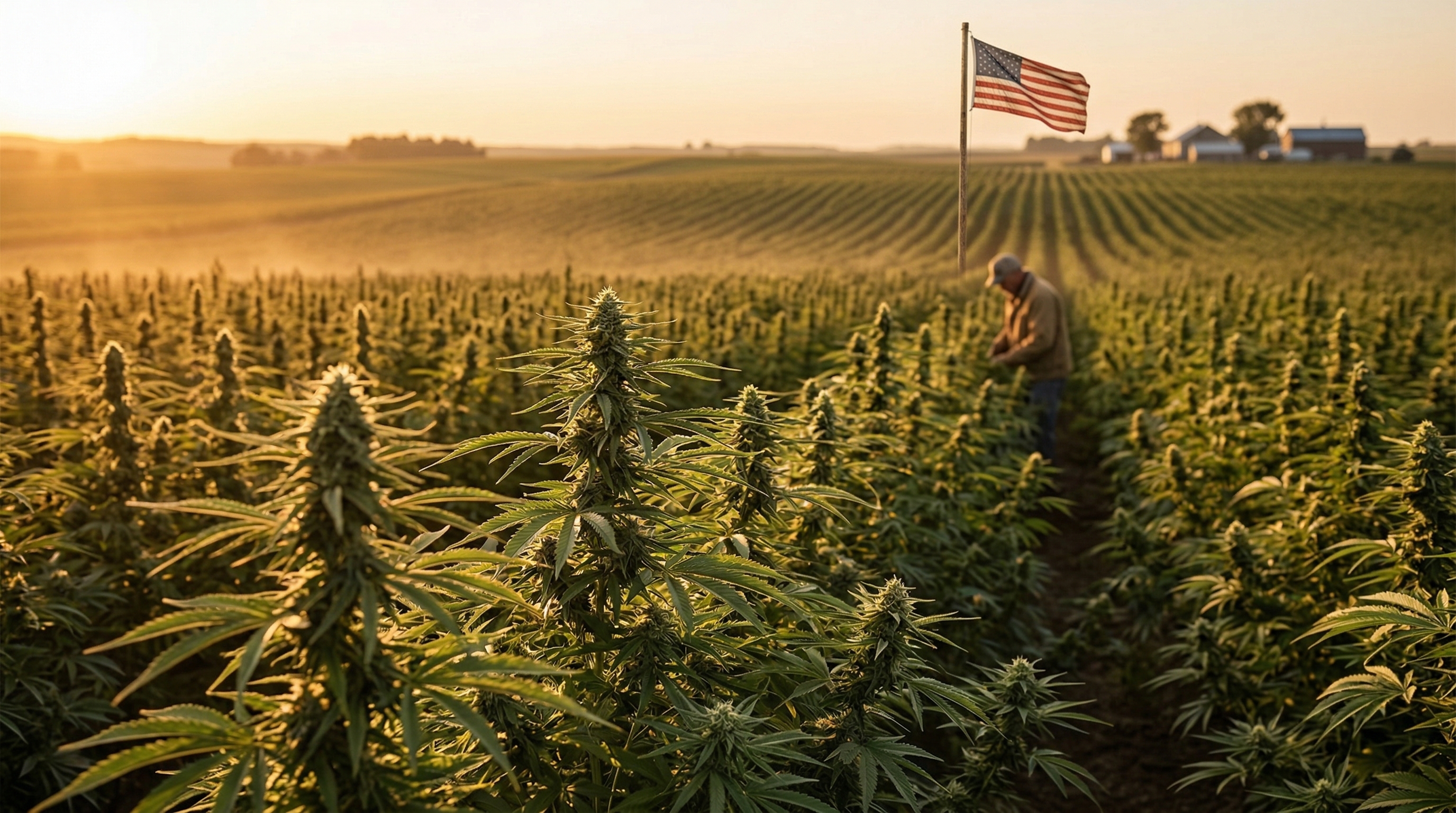
What Congress didn’t anticipate was the loophole. Chemists quickly discovered they could convert legal CBD into delta-8 THC, delta-10 THC, HHC, THC-O, and other intoxicating cannabinoids through a process called isomerization. Because those compounds were derived from legal hemp plants, they technically fell within the 2018 definition. By 2025, this so-called “intoxicating hemp” sector had grown to an estimated $28.4 billion in annual sales.
The most contentious category: THCA flower. Raw cannabis that tests below 0.3% delta-9 THC but converts to intoxicating THC when heated was being sold openly as “legal hemp” — essentially selling marijuana through a regulatory technicality. A coalition of 39 state attorneys general sent Congress a letter arguing that state-level regulation was impractical given interstate commerce, and the licensed cannabis industry lobbied hard for federal action.
Congress responded — quietly, buried in a government shutdown deal. The Continuing Appropriations and Extensions Act, 2026 (P.L. 119-37), signed November 12, 2025, made three sweeping changes to federal hemp law:
- Total THC standard: Hemp is now defined by total THC concentration — including THCA and delta-8 THC — at no more than 0.3% on a dry weight basis. The old delta-9-only threshold is gone.
- Container cap: Finished hemp-derived consumer products are limited to no more than 0.4 milligrams of total THC per container. A single standard gummy often contains 5–25 mg. This limit makes nearly all commercially sold hemp edibles federally non-compliant.
- Synthetic cannabinoid ban: Any cannabinoid synthesized or isomerized outside the plant — including delta-8 derived through CBD conversion — is explicitly excluded from the definition of hemp.
The U.S. Hemp Roundtable estimates these changes would eliminate approximately 95% of existing hemp-derived cannabinoid products, with corresponding losses of over 300,000 jobs and $1.5 billion in state tax revenue. The effective date: November 12, 2026 — giving the industry one year to adapt, pivot, or close.
What’s Happening Right Now
The 2026 Farm Bill Won’t Save Them (Yet)
Industry hopes that the 2026 Farm Bill might delay or reverse the November ban took a hit on March 5, 2026, when the House Agriculture Committee advanced its bill in a 34-17 vote. Committee Chairman Glenn “GT” Thompson (R-PA) made his position clear: the Farm Bill deals with agricultural hemp plants, not finished consumer products. The bill’s draft language would actually codify the new total-THC standard for cultivation, while staying silent on the consumer product ban.
Separately, Rep. Nancy Mace (R-SC) introduced the American Hemp Protection Act of 2025, which would repeal the Section 781 prohibition outright. Senators Wyden and Merkley (D-OR) proposed the Cannabinoid Safety and Regulation Act — an 84-page framework that would replace the ban with a regulatory structure allowing up to 5 mg THC per serving and 50 mg per container, with mandatory age verification, third-party testing, and federal minimum purchase age of 21. Neither bill has advanced out of committee.
States Are Writing Their Own Rules
The federal silence has produced a chaotic patchwork of state responses:
- Ohio: Senate Bill 56 took effect March 20, 2026, banning hemp products with more than 0.4 mg THC per container and all synthetic cannabinoids. Lawsuits were filed the same week seeking a temporary restraining order.
- Missouri: The House is moving legislation to align state hemp laws with the federal ban, mirroring the November 2026 timeline.
- Minnesota: Already has a regulatory model with licensing, age-gating, labeling standards, and per-serving THC limits — cited by federal lawmakers as evidence that regulation, not prohibition, is workable.
- New Jersey: Has advanced legislation requiring liquidation of non-compliant inventory and channeling THC beverages into the licensed cannabis framework post-November 2026.
- Chicago: A proposed city ordinance would mirror the federal ban, with a potential carve-out for beverages.
- Wisconsin: Governor Tony Evers called on the state’s Congressional delegation to delay the federal ban, calling it harmful to farmers and small businesses.

The Enforcement Question
Even if the November 2026 deadline holds, enforcement is far from certain. A nonpartisan Congressional Research Service report published in December 2025 questioned whether the FDA and DEA have the resources to broadly enforce the ban. Neither agency moved aggressively against the $28 billion intoxicating hemp market when it was in a legal gray zone — policing it after November 12 will require substantially greater capacity.
The 0.4 mg per container cap also creates legal uncertainty: the FDA was directed to define “container” within 90 days of enactment. As of late March 2026, that definition has not been published, leaving businesses without clear compliance targets.
What This Means For Consumers
If you’re currently purchasing hemp-derived products — delta-8 gummies, THCA flower, CBD edibles, hemp THC beverages — the 2026 landscape requires attention to where you are, what you’re buying, and how that may change before year’s end.
In states with existing bans (Ohio, and potentially others by mid-2026), products you’ve been buying legally are now unavailable or illegal to possess. Online retailers shipping across state lines face compounding legal risk, and consumers who order from out-of-state vendors may unknowingly violate local law. If you travel between states with cannabis products, our state-by-state travel guide covers what to know.
In states without specific regulations, the current federal gray zone still applies — but November 12 is the national hard deadline for federally legal hemp products to meet the new 0.4 mg container standard. After that date, products exceeding it are reclassified as Schedule I controlled substances under federal law, regardless of state rules.
Practical advice:
- Check your state’s current hemp regulations before purchasing, and check again in six months — the landscape is changing weekly
- Prioritize products that provide third-party Certificates of Analysis (COAs) showing total THC, not just delta-9
- Understand that a product labeled “hemp” at a gas station today may be federally illegal by November 2026
- If you use hemp-derived products for wellness purposes (sleep, pain, anxiety), now is a good time to explore dispensary-regulated alternatives in your state
The Bigger Picture
The hemp-cannabis regulatory mess exposes a deeper problem with American drug policy: the 0.3% delta-9 THC threshold was never a pharmacological benchmark. It was an agricultural classification line drawn in the 1970s, adopted without serious consideration of what would happen if chemists started working around it. The 2018 Farm Bill applied it to a commercial market, and the result was predictable in hindsight.
The real question the country hasn’t answered yet is whether cannabis — all of it — should be regulated based on actual consumer effects and product safety, rather than which molecule is dominant on lab day. A delta-8 gummy and a dispensary edible can produce nearly identical experiences. One has been third-party tested, age-verified, and taxed. The other has been sold next to beef jerky with no oversight whatsoever.
The licensed cannabis industry has largely welcomed stricter hemp regulations — not from principle, but because unregulated hemp-derived intoxicants represent billions in market share lost to competitors operating without the same compliance burdens. That dynamic is uncomfortable but important: much of the political momentum behind the November ban came from licensed cannabis operators, not anti-drug crusaders.
What’s clear is that a reckoning is arriving. The question is whether it takes the form of a thoughtful federal regulatory framework — one that protects consumers, supports farmers, and sets rational potency standards — or an enforcement cliff that simply pushes a large market underground.
Key Takeaways
- The federal clock is ticking: A new law signed November 12, 2025 will ban most hemp-derived intoxicating products under federal law on November 12, 2026. This includes delta-8, THCA flower, HHC, and nearly all commercially sold hemp edibles.
- The 0.4 mg container limit is the critical threshold: Products exceeding this total THC cap are federally non-compliant after the deadline — and the 0.3%-per-dry-weight rule now counts THCA and delta-8 toward the total.
- States are not waiting: Ohio banned intoxicating hemp products in March 2026. Missouri, New Jersey, and others are following. Minnesota’s regulatory model may become a federal template.
- Congress may still act: The American Hemp Protection Act and the Cannabinoid Safety and Regulation Act both offer legislative alternatives. Neither has advanced. The 2026 Farm Bill markup offered no delay.
- Consumers should verify now: If hemp-derived products are part of your routine, check your state’s current laws, look for COAs showing total THC levels, and explore licensed dispensary alternatives.


