Live Resin vs Live Rosin: What's the Difference?
Live resin vs live rosin: what's the real difference? Learn how each is made, how terpenes are preserved, and which is right for your experience.

The Two Crowns of the Concentrate World
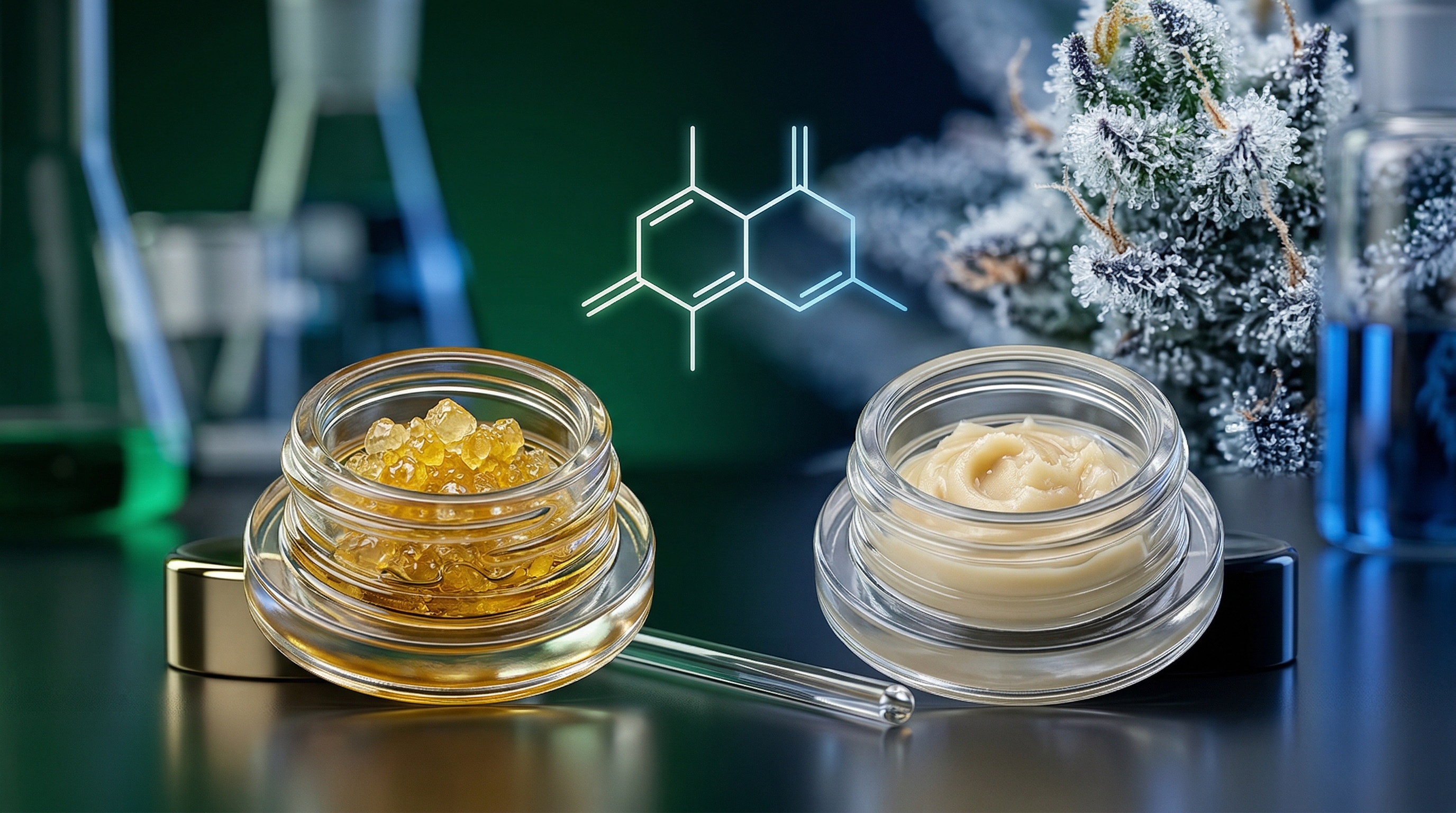
Live resin is a solvent extract of flash-frozen cannabis, while live rosin is made without solvents using ice water, heat, and pressure. Walk into any well-stocked dispensary and you’ll find them side by side — two small glass jars with high price tags and nearly identical descriptions. Live resin. Live rosin. Both use the word “live.” Both claim great terpene preservation. Both cost a lot.
So what’s the real difference? Does it matter enough to pay $60, $80, or even $100 for a gram?
The short answer: yes. The difference is real, and knowing it will change how you shop for concentrates. The longer answer involves some chemistry, a lot of craft, and one key question: what happens to your terpenes along the way?
This guide explains how each product is made, what that means for your experience, and how to decide which one is right for you.
The “Live” Distinction: Why It Matters
Before diving into the resin vs. rosin split, you need to understand what “live” means. It’s the foundation everything else is built on.
Traditional concentrates are made from dried and cured cannabis. After harvest, the plant dries and cures for weeks. This preserves some terpenes — but it also degrades many of them. Heat, time, and oxidation are the enemies of terpenes. The drying process involves all three.
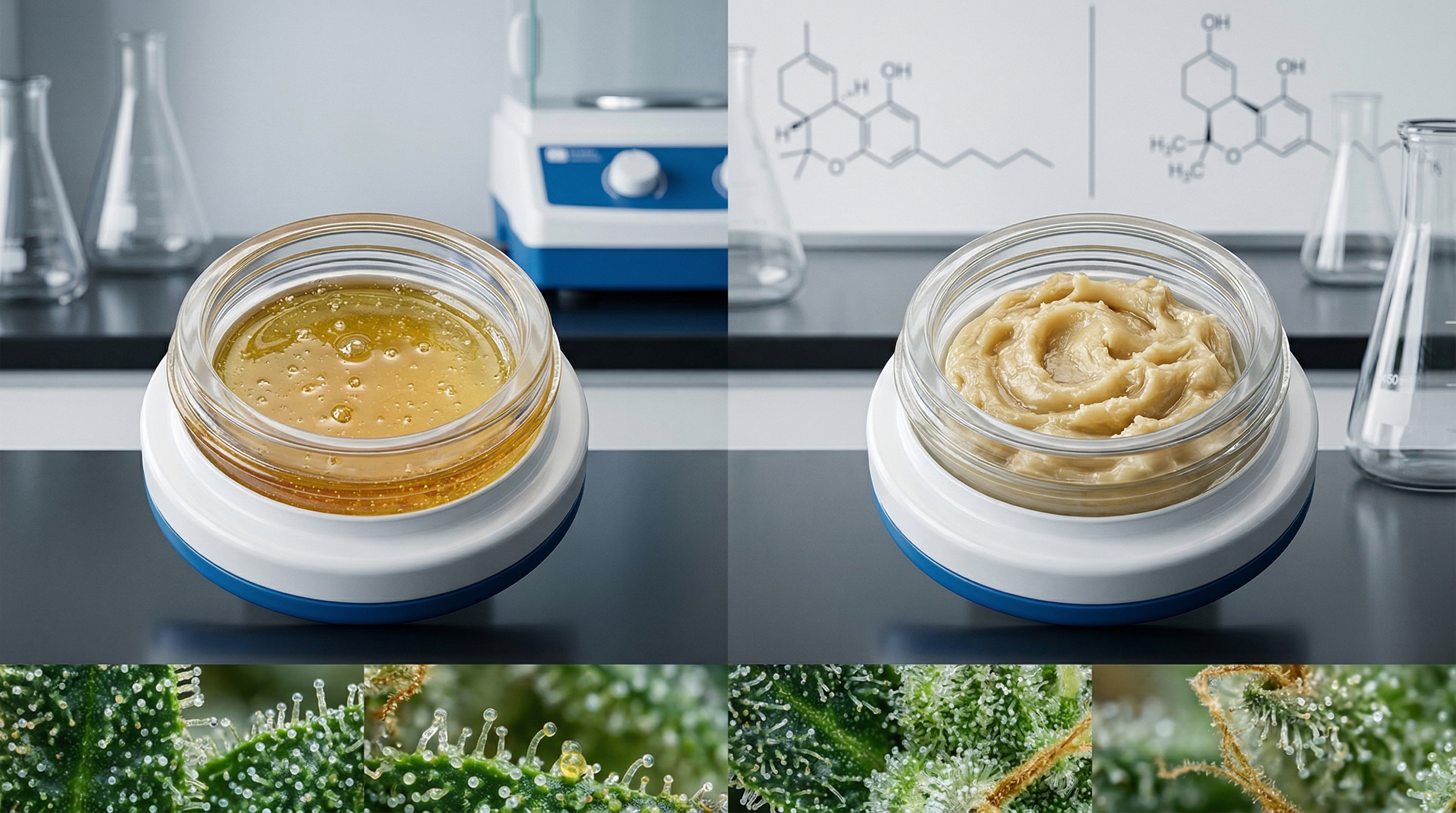
“Live” concentrates skip drying and curing entirely. The plant is harvested and immediately flash-frozen — often within hours — at temperatures below -20°C (-4°F). This locks the terpene profile in place, capturing the full range of aromatic compounds exactly as they existed on the living plant.
The result is a concentrate that smells and tastes remarkably close to fresh-cut cannabis. If you’ve ever smelled a cannabis plant at peak flowering — that intense, complex aroma — live concentrates come closer to that experience than anything else you can buy.
Research shows that fresh-frozen cannabis retains much higher terpene levels than dried and cured material. Some terpene classes are preserved at two to three times the rate [Booth, 2019]. This isn’t a marketing claim — it’s measurable chemistry.
Both live resin and live rosin start from this same flash-frozen starting point. Where they diverge is in everything that happens next.
Live Resin: Solvent-Based, Flash-Frozen Excellence
How Live Resin Is Made
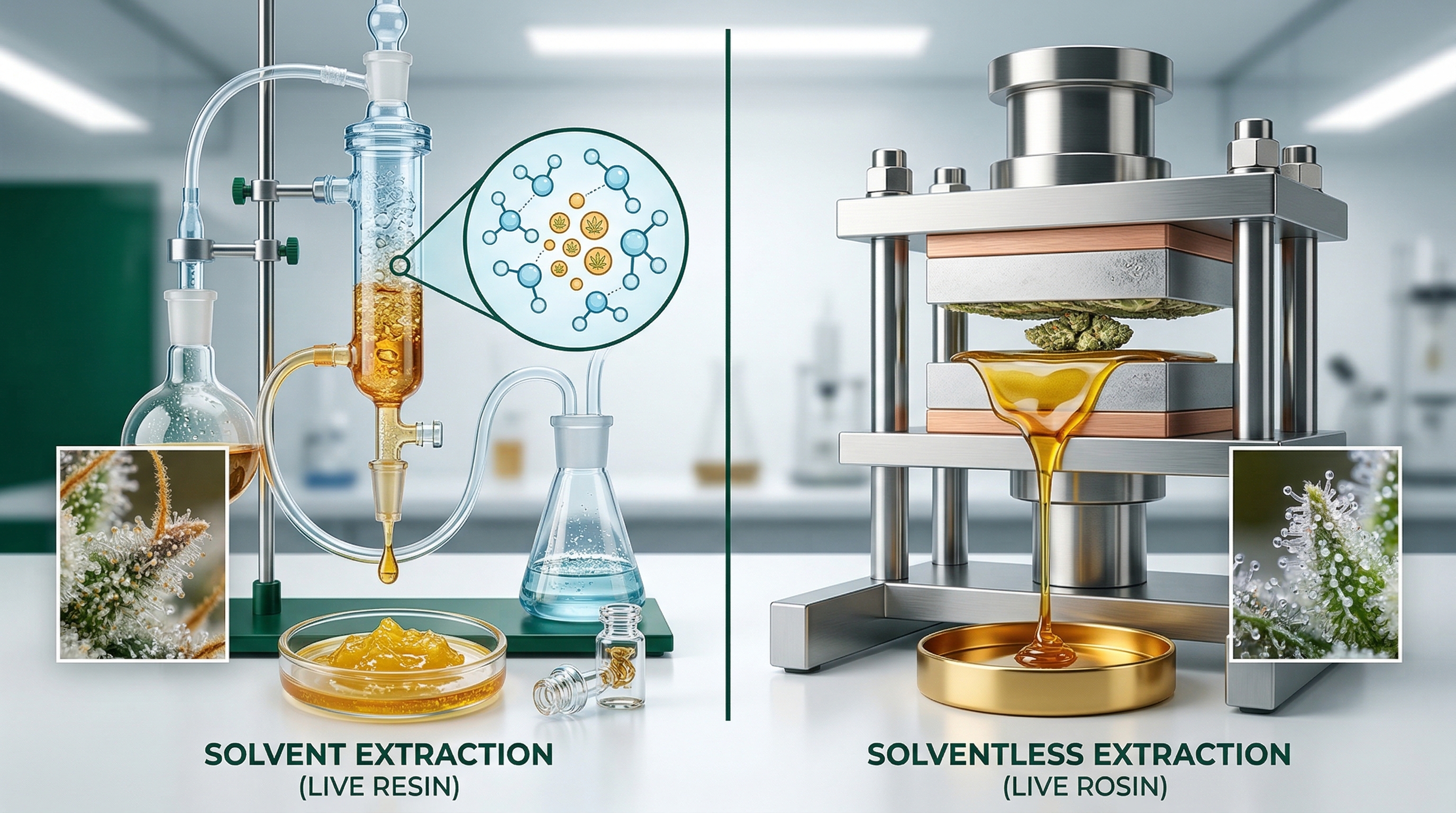
Live resin uses a hydrocarbon solvent — typically butane, propane, or a blend of both — to extract cannabinoids and terpenes from flash-frozen cannabis. This process requires specialized closed-loop equipment. It’s done by licensed professionals in controlled facilities, not at home.
Here’s the extraction flow:
- Harvest and flash-freeze — Fresh cannabis is harvested and immediately frozen, preserving the complete terpene profile
- Solvent wash — The frozen material is washed with cold hydrocarbon solvent, which dissolves cannabinoids and terpenes out of the plant
- Collection — The solvent-cannabinoid-terpene solution is collected and separated from the plant biomass
- Purging — Residual solvents are removed through controlled low-temperature vacuum ovens, leaving behind only the extracted compounds
- Post-processing — The extract may be whipped, heated, or manipulated to achieve specific textures (sauce, sugar, badder, etc.)
Because the extraction happens at very low temperatures, live resin retains an exceptional terpene profile. The solvent captures the full range of aromatic compounds, including lighter, more volatile terpenes that would otherwise evaporate.
What Live Resin Looks and Smells Like
Live resin typically presents as a golden to amber, saucy or “wet” concentrate with a strong, often complex aroma. You may see it labeled as “live resin sauce,” “live resin sugar,” or “live resin badder” — these are all live resin, just with different post-processing treatments that affect texture.
The aroma is usually the first thing you notice: pungent, layered, and distinctly plant-forward. If you’ve smelled a concentrated, fruity, gassy, or floral cannabis strain before, live resin from that same cultivar should smell like a heightened version of that same profile.
- Typical THC potency: 65–85%
- Terpene content: 3–8% (significantly higher than most dried-and-cured concentrates)
- Texture: Saucy, wet, sometimes with visible crystalline THCA structures
- Color: Golden to deep amber
The Solvent Question
The most common concern people have about live resin is residual solvents. This is a legitimate question — but in licensed, regulated markets, it has a well-established answer.
When produced by a licensed extractor, live resin is purged until residual solvents fall below state testing thresholds — typically below 500 parts per million for total hydrocarbons. Reputable dispensaries only carry products that have passed this testing.
Lab-tested live resin from a licensed producer is a completely different product from unregulated extracts. The latter may not be purged properly. Always buy from licensed dispensaries with verified lab results.
Live Rosin: Solventless, Labor-Intensive, Chemical-Free
How Live Rosin Is Made
Live rosin takes a completely different approach. No solvents, no chemicals — just water, ice, heat, and pressure. It’s a multi-step process that takes much more time and labor. That’s why live rosin costs more than live resin.
Here’s the production sequence:
- Harvest and flash-freeze — Same as live resin: fresh cannabis is immediately frozen to preserve terpenes
- Ice water extraction (bubble hash) — The frozen material is agitated in ice water. This causes the trichome heads — the resin glands that hold cannabinoids and terpenes — to break off. The mixture is filtered through fine mesh bags, separating trichomes by size and quality
- Drying the hash — The collected trichome material (now called bubble hash or ice water hash) is carefully dried at low temperatures to preserve terpenes
- Rosin pressing — The dried bubble hash is placed in small mesh filter bags and pressed at 60–80°C (140–176°F). The heat and pressure squeeze the oil out, producing a terpene-rich, solventless extract
- Collection and refinement — The pressed oil is collected and may be whipped, cold-cured, or processed into various textures
This process is entirely mechanical. There are no chemicals that need to be purged, no risk of residual solvents, and no need for specialized gas-handling equipment. The tradeoff is that it’s slower, more hands-on, and produces lower yields than solvent extraction — which is why it costs more.
What Live Rosin Looks and Smells Like
Live rosin typically appears as a light gold to white, creamy, or pale yellow concentrate, often with a smooth, badder-like consistency. The color is lighter than live resin because without solvents, fewer plant pigments and extra compounds end up in the final product.
The aroma is extraordinary. Many fans argue that live rosin gives the most accurate picture of the original plant’s terpene profile — especially its lighter, more delicate aromatic notes that can get masked in solvent extractions.
- Typical THC potency: 60–80%
- Terpene content: 3–8% (comparable to live resin)
- Texture: Creamy, smooth, badder to cake batter consistency
- Color: Light gold, white, or pale cream
Why the Yield Is Lower (And Why That Raises the Price)
A skilled live rosin producer might extract 10–20% of the starting material as final product. Solvent-based extracts can achieve 15–25% or more, with fewer steps. Every gram of live rosin represents serious labor, specialized equipment (quality rosin presses run $1,000–$10,000+), and top-tier starting material.
You’re not just paying for the product — you’re paying for the craft.
Head-to-Head: The Key Differences
| Feature | Live Resin | Live Rosin |
|---|---|---|
| Starting material | Flash-frozen cannabis | Flash-frozen cannabis |
| Extraction method | Hydrocarbon solvents (BHO/PHO) | Ice water + heat/pressure (mechanical) |
| Solvent use | Yes (purged to safe levels) | None |
| Typical THC potency | 65–85% | 60–80% |
| Terpene content | 3–8% | 3–8% |
| Texture | Saucy, wet, sugar, badder | Creamy, smooth, badder |
| Color | Golden to amber | Light gold, white, pale cream |
| Typical price per gram | $40–$70 | $60–$100+ |
| Equipment required | Commercial closed-loop | Rosin press (DIY possible) |
| “Chemical-free” | No (solvents purged) | Yes |
| Lab-tested safety | Yes (licensed market) | Yes |
| Best for | Flavor chasers, value-conscious premium | Solventless purists, connoisseurs |
Terpenes: The Real Reason Both Products Exist
The whole point of live concentrates — the flash-freezing, the careful extraction, the premium price — comes down to one thing: terpene preservation.
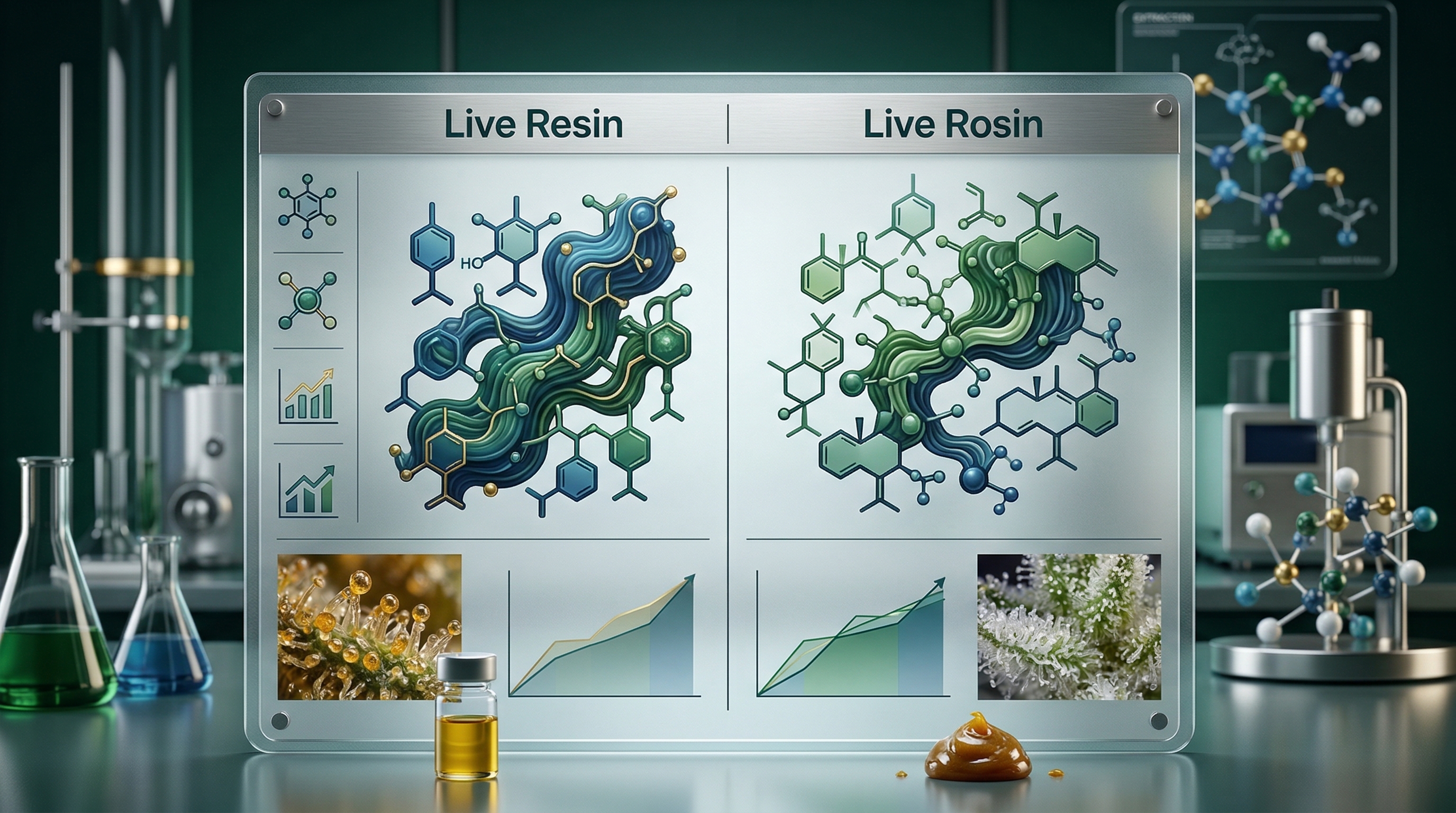
Terpenes give each strain its smell, flavor, and experiential character [Sommano, 2020]. They’re also why two strains with the same THC level can feel completely different. This is the foundation of High Families — our system for understanding cannabis beyond just THC percentage.
Terpene boiling points also determine how they survive the extraction process. Some are very volatile and break down quickly [Booth, 2019]. Live processing preserves them before they can evaporate.
Here’s why terpene preservation connects directly to your experience:
| Terpene | Boiling Point | High Family Connection | Notes on Preservation |
|---|---|---|---|
| Myrcene | 168°C (334°F) | Relaxing High | Preserved well in both methods |
| Limonene | 176°C (349°F) | Uplifting High | Volatile — benefits most from live processing |
| Linalool | 198°C (388°F) | Uplifting High | Preserved well in both methods |
| Caryophyllene | 130°C (266°F) | Relieving High | Very volatile — live processing critical |
| Terpinolene | 186°C (367°F) | Energetic High | Highly volatile, degrades quickly when dried |
| Ocimene | 100°C (212°F) | Energetic High | Extremely volatile — almost exclusively found in live products |
Choosing between a Relaxing High after a long day or an Energetic High for a creative afternoon? The terpene profile of your concentrate is what makes the difference. A live concentrate from a terpinolene-dominant strain will feel very different from one led by myrcene — and a live product will express that difference far more clearly than a standard dried-and-cured extract.
Always read the lab results, not just the strain name. Ask your budtender for the terpene breakdown. A live rosin with 5% total terpenes and a linalool-dominant profile will feel very different from one with the same THC level but a myrcene-heavy profile. The first leans Uplifting High; the second leans Relaxing High.
Which One Should You Choose?
There’s no universal right answer — but these decision points should help:
Choose live resin if:
- You want premium terpene quality at a more accessible price point
- You prioritize flavor and aroma but don’t have a specific preference for solventless products
- You’re exploring concentrates for the first time and want an approachable premium option
- You want the widest variety of textures and consistencies (sauces, sugars, budders)
- You’re pairing with a specific High Family experience and want to taste the full terpene expression
Choose live rosin if:
- You prefer products made without any chemical solvents — for personal, philosophical, or sensitivity reasons
- You want the purest possible expression of the plant’s terpene profile
- You’re a concentrates connoisseur seeking the craft tier of the market
- You want to support the artisanal, small-batch side of the industry
- Budget allows for premium pricing and you value the solventless difference
Consider both if:
- You use concentrates regularly and want to compare experiences across the same cultivar produced both ways — it’s one of the most instructive experiments in the concentrate world
Consumption Tips for Live Concentrates
Both products share the same best practices at the consumption stage. Getting the most out of premium concentrates requires one thing above all else: temperature control.
Terpenes are volatile. Many begin breaking down well below 230°C (446°F), and most of the most delicate aromatic terpenes — the ones that make live concentrates worth the price — can be destroyed by high-temperature dabbing [Meehan-Atrash et al., 2019].
Optimal temperature range for live concentrates: 350–430°F (175–220°C)
At this range, you’re maximizing terpene flavor and preserving the entourage effect — the synergy between cannabinoids and terpenes that shapes your experience [Russo, 2011] — while still vaporizing cannabinoids effectively. High-temp dabs above 500°F (260°C) will char the terpenes before you can taste them, producing harsh vapor and wasting what you paid for.
For equipment, an electronic dab rig (e-rig) — such as the Puffco Peak, Focus V Carta, or Dr. Dabber Switch — is strongly recommended. These devices hit precise temperatures every time. Torch-and-nail setups require more experience to stay consistent. For more on vaporization temperature science, see our vaping vs. smoking comparison.
Storage: Keep live concentrates in airtight glass jars in the refrigerator. Heat, light, and air all degrade terpenes. Cold storage can maintain quality for several months. Never use plastic containers — terpenes leach into plastic over time, hurting flavor and potentially introducing unwanted compounds.
A Note on Labels: Avoiding Confusion at the Dispensary
The concentrate market is full of confusing terminology. A few things to watch for:
- “Live” does not mean solventless. Live resin uses solvents. Always check the product description.
- “Rosin” is not the same as “live rosin.” Standard rosin is pressed from dried and cured flower. It lacks the full terpene range of live rosin. Look for the word “live” on the label.
- “Full-spectrum” applies to both. Both live resin and live rosin are full-spectrum products. The term alone doesn’t tell you which one you’re buying.
- “Sauce” is a live resin texture. It refers to a specific consistency — terpene-rich oil with visible THCA crystals — not a separate product type.
When in doubt, ask your budtender for the lab results. A good dispensary will have a certificate of analysis (COA) for every product. This shows cannabinoid potency and — most importantly — the full terpene breakdown. See our complete concentrates guide for help reading COAs and understanding all the concentrate types you’ll come across.
Key Takeaways
- “Live” means flash-frozen. Both products start with cannabis frozen right after harvest. This locks in the full terpene profile before drying can degrade it.
- Live resin uses solvents (butane/propane) to extract from flash-frozen material. In licensed products, solvents are purged to safe levels. Always buy lab-tested.
- Live rosin uses no solvents. Ice water extracts the trichomes, then heat and pressure press them into rosin. Zero chemicals involved.
- Both preserve terpenes far better than concentrates made from dried and cured cannabis.
- Terpene profiles shape your experience. Choosing a concentrate based on its High Family terpene signature matters as much as THC percentage.
- Low-temperature dabbing (350–430°F) is essential. High-heat dabs destroy terpenes before you can taste them.
- Live rosin costs more because of lower yields, more labor, and specialized gear — but it’s the only fully solventless option.
- Read the COA. The terpene breakdown tells you more about how a concentrate will feel than any strain name ever could.
Premium concentrates sit at the intersection of science and craft. Whether you choose live resin for its value and variety, or live rosin for its solventless purity, the key is knowing what’s in the jar and why it matters.
Note: Cannabis affects everyone differently based on individual biology, tolerance, and consumption method. All potency figures are typical ranges observed in the licensed market and may vary by producer and batch. Always purchase from licensed dispensaries with verified lab testing. Check applicable local laws before purchasing or consuming cannabis products.
FAQ
What is the difference between live resin and live rosin?
Live resin uses a hydrocarbon solvent, usually butane or propane, to pull cannabinoids and terpenes from flash-frozen cannabis, then purges that solvent. Live rosin uses no solvents: ice water knocks the trichomes loose, and heat plus pressure press that hash into oil. Both start from the same frozen plant, and both commonly land around 3–8% terpenes.
Does “live” mean a concentrate is solventless?
No. “Live” means the plant was flash-frozen after harvest instead of dried and cured, which keeps more of the original terpene profile. Live resin still uses solvents. Only live rosin is made with water, ice, heat, and pressure and no chemical solvent.
Is live rosin stronger than live resin?
Not by default. This guide’s typical THC ranges are 65–85% for live resin and 60–80% for live rosin, with similar terpene totals. How a jar feels depends more on that terpene profile than on which process made it, so the lab report matters more than the name.
Why does live rosin cost more than live resin?
It yields less and takes more labor. A skilled live rosin producer might turn 10–20% of the starting material into finished oil, while solvent extracts can reach 15–25% or more in fewer steps. Presses and top frozen flower add cost, which is why live rosin often runs about $60–$100+ per gram against about $40–$70 for live resin.
Sources
Booth, J.K., & Bohlmann, J. (2019). Terpenes in cannabis sativa – from plant genome to humans. Plant Science, 284, 67–72.
Meehan-Atrash, J., Luo, W., & Strongin, R.M. (2019). Toxicant formation in dabbing: the terpene story. ACS Omega, 4(9), 16111–16120.
Russo, E.B. (2011). Taming THC: potential cannabis synergy and phytocannabinoid-terpenoid entourage effects. British Journal of Pharmacology, 163(7), 1344–1364.
Sommano, S.R., Chittasupho, C., Ruksiriwanich, W., & Jantrawut, P. (2020). The cannabis terpenes. Molecules, 25(24), 5845.


