The 0.5% Myrcene Rule: The Cannabis Myth That Won't Die
One lab's throwaway classification became a dispensary gospel. Here's why the 0.5% myrcene rule has no clinical evidence—and what actually predicts sedation.

Professor High
Your friendly cannabis educator, bringing science-backed knowledge to the community.
Walk into almost any dispensary and you’ll hear it: “If myrcene is above 0.5%, it’s more of an indica—sedating, couch-lock, great for nighttime. Below that? More of a sativa vibe.” It shows up in cannabis media, educational pamphlets, and terpene explainers everywhere.
There’s just one problem: there is no clinical evidence that this rule is real.
The 0.5% myrcene threshold is one of the most confidently repeated myths in cannabis. It started as an informal note from a single testing lab. It spread through cannabis culture without any peer-reviewed research behind it. Now it’s dispensary gospel—and millions of consumers use it to make buying decisions.
This article traces where the rule came from, what the science actually shows, and what does a better job of predicting sedation.
Where Did the 0.5% Rule Come From?
The claim traces directly to Steep Hill Laboratory, a cannabis testing lab in Berkeley, California. In the early days of legal testing, Steep Hill shared an informal guideline: cannabis with more than 0.5% myrcene by weight tended to produce “indica” effects—sedating, relaxing, heavy-bodied. Below that line: “sativa” territory.
To be fair, Steep Hill was working in an information vacuum. In 2010–2015, almost no peer-reviewed research existed on how terpenes shaped human cannabis experiences. Labs were trying to give consumers something useful. The 0.5% figure was a rough pattern observation—not a scientific finding.
The problem: the cannabis industry repeated the claim until the caveats fell away. “Steep Hill noticed a rough trend” became “science says this is true.” And once a rule gets baked into budtender training scripts and cannabis blogs, it’s very hard to remove—even when research says it’s wrong.
What the Data Actually Shows
Myrcene is Everywhere—and Not in the Way the Rule Predicts
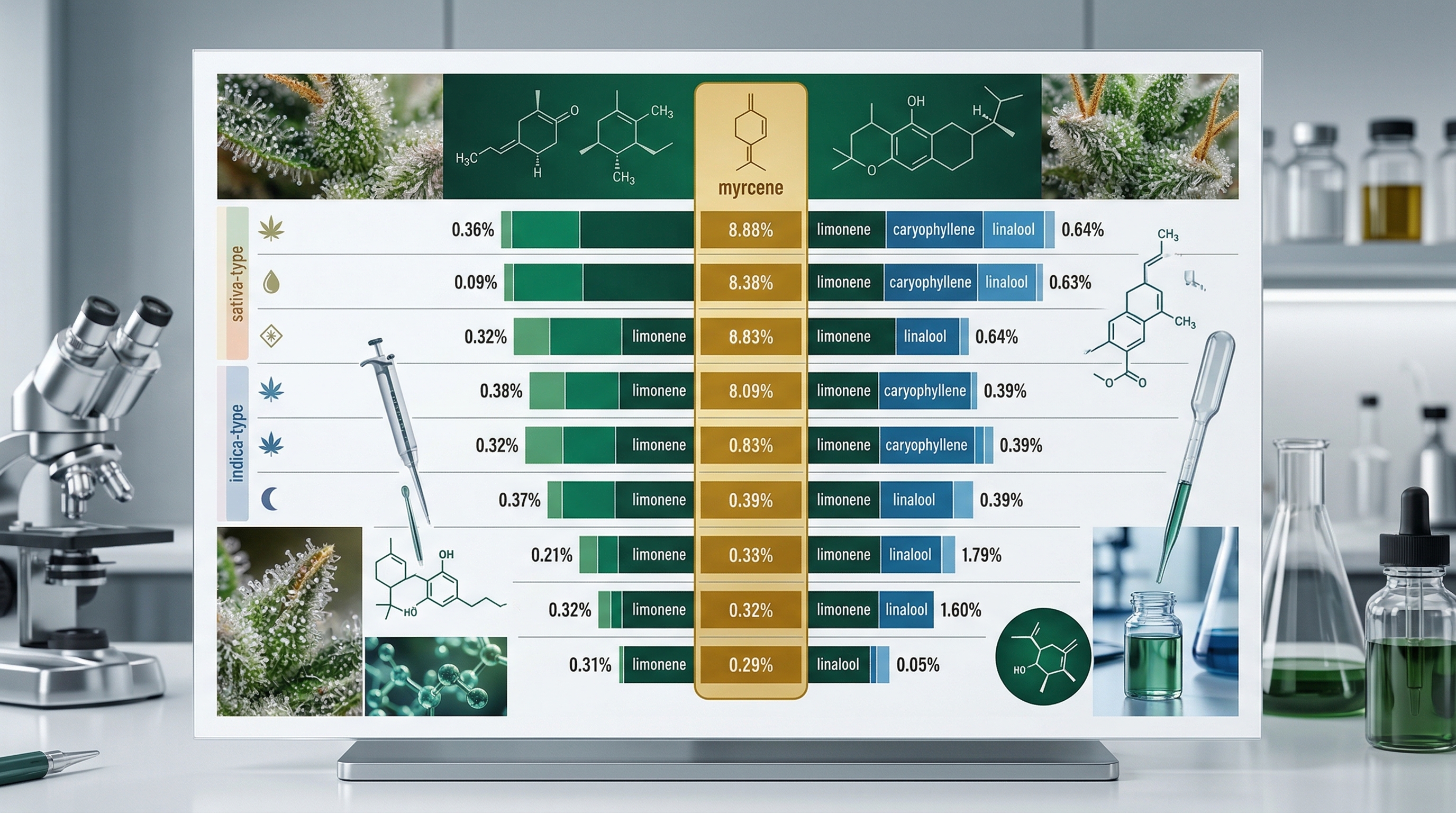
Here’s the foundational problem with the 0.5% rule: myrcene is the most abundant terpene in cannabis across virtually all strain categories. When researchers analyze large-scale terpene data from legal market products, the distribution of myrcene simply does not cleave neatly at 0.5% between sedating and energizing strains.
Multiple independent analyses of dispensary product data have reached the same conclusion:
“On average, flower products tend to have similar myrcene levels across indicas, hybrids, and sativas. There is no clear indication from the data to support a general rule such as ‘more than 0.5% myrcene = indica.’”
That’s not a fringe finding. Popular sativa-leaning strains like Tangie and Blue Dream routinely test with high myrcene. Many products marketed as indica-dominant test well below 0.5%. The entire premise—that myrcene separates sedating strains from stimulating ones at a tidy decimal threshold—doesn’t survive contact with real lab data.
The Indica/Sativa Labels Aren’t Helping Either
The 0.5% rule is a symptom of a deeper problem: it assumes the indica and sativa labels are a reliable reference point for “sedating” versus “energizing.” They’re not. A landmark study published in Nature Plants analyzed over 100 cannabis samples and found that sativa- and indica-labeled products were genetically indistinct on a genome-wide scale [McPartland et al., 2021]. The labels don’t reflect meaningful genetic differences.
The most relevant finding for the myrcene debate: myrcene concentration explained only 21.2% of the variation in how products were labeled sativa or indica [McPartland et al., 2021]. Myrcene does correlate with how the industry applies these labels—but correlation with a flawed label system is not the same as being a reliable predictor of your experience.
A 2025 German study analyzing 140 pharmaceutical-grade cannabis strains via gas chromatography-mass spectrometry (GC-MS) confirmed this with statistical rigor: ANOVA demonstrated no correlation between terpene profiles and sativa/indica genetics (p > 0.05) [Herwig et al., 2025]. You cannot reliably predict effects from the indica/sativa label—which means you also cannot validate the 0.5% myrcene rule by pointing to indica strains as evidence.
What Does Myrcene Actually Do?
None of this means myrcene is unimportant. It’s one of the most pharmacologically interesting terpenes in cannabis. The issue isn’t that myrcene has no effects—it’s that the 0.5% threshold is a gross oversimplification of a genuinely complex molecule.
The Animal Research Is Real, but Limited
The foundational animal studies on myrcene are worth knowing. Research demonstrated dose-dependent sedation in rodent models at 200 mg/kg, and myrcene potentiated barbiturate-induced sleep by roughly 2.6x in mice [do Vale et al., 2002]. These are real effects. The problem is extrapolating from “massive doses of isolated myrcene in mice” to “0.5% total weight in a cannabis flower consumed by a human.”
The dose and delivery context are entirely different. Animal studies on isolated terpenes are a starting point for hypothesis formation, not a license to write consumer-facing classification rules.
The Human Clinical Research Is Thin
A pilot study provided preliminary evidence that 15 mg of isolated beta-myrcene can impair simulated driving performance in humans—a real sedative signal [Kamal et al., 2023]. But 15 mg of pure myrcene is not remotely comparable to the trace amounts present in a cannabis flower in the context of everything else in that flower.
No peer-reviewed human clinical trial has established a myrcene threshold—let alone 0.5%—that reliably predicts sedation in cannabis consumers.
This is a critical gap. The entire 0.5% rule asks consumers to treat an animal-model extrapolation as a shopping heuristic, when the human evidence specifically testing for this threshold simply does not exist.
The Blood-Brain Barrier Claims Need Nuance
Another popular claim: myrcene increases blood-brain barrier permeability, letting THC hit faster and harder. This mechanism is widely cited as the explanation for “couch lock.” The idea has some theoretical backing—myrcene may influence cell membrane dynamics in ways that could affect how quickly THC crosses into the brain.
But one careful review of this claim found: “perusal of claimed references in the popular literature shows a lack of hard data regarding brain transport.” The BBB permeability idea is biologically plausible—but it has not been shown in controlled human studies. In other words, we don’t know if myrcene at real-world cannabis doses actually speeds up or amplifies your THC experience.
What Actually Predicts Sedation?
If the 0.5% myrcene rule doesn’t reliably predict whether a strain will put you on the couch, what does?
It’s a Network, Not a Single Variable
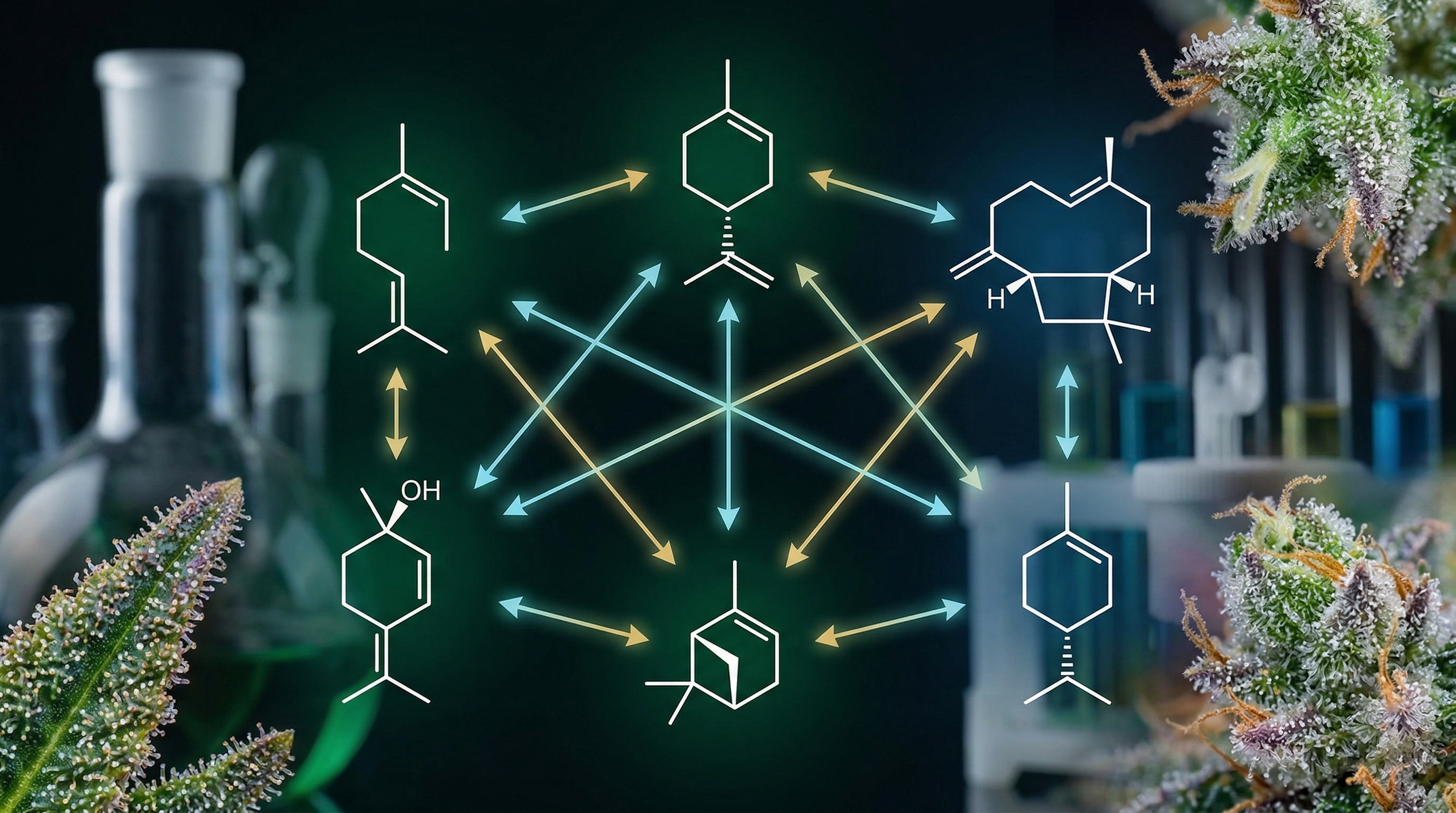
The honest answer is that cannabis sedation is a team effort. Multiple terpenes, cannabinoids, and your own biology all interact at the same time. Think of it less like a light switch and more like a mixing board with a dozen faders—each one contributing to the final sound.
Key factors with genuine evidence behind them:
| Factor | What Research Suggests |
|---|---|
| THC:CBD ratio | Higher CBD tends to moderate THC’s sedating and anxiogenic effects |
| Myrcene concentration | Probable contributor to body-heaviness, but not at a defined threshold |
| Linalool presence | Associated with GABAergic calming effects (the lavender terpene) |
| Beta-caryophyllene | CB2 receptor agonist; linked to physical relaxation and pain relief |
| Total terpene content | Richer terpene profiles tend to produce more complex, nuanced effects |
| Consumption dose | How much you consume matters more than which terpene is marginally above a line |
| Individual biology | Endocannabinoid system density and tolerance vary enormously between people |
None of these factors can be reduced to a single binary threshold. A high-myrcene strain with abundant limonene and no linalool will not hit the same as a high-myrcene strain with abundant linalool and caryophyllene—even if both blow past 0.5%.
The Entourage Effect Is Real, Even If Poorly Understood
Dr. Ethan Russo’s influential work on phytocannabinoid-terpenoid synergy remains the conceptual foundation here: terpenes modulate cannabinoid effects in ways that cannot be predicted by looking at any single compound in isolation [Russo, 2011]. This directly undermines the logic of the 0.5% rule, which asks one terpene to explain what is demonstrably a multi-compound phenomenon.
The 2025 German study reinforced this: 9 terpenes together explained 86% of the chemical variation between strains [Herwig et al., 2025]. The variation requiring explanation is complex enough that no single terpene threshold is going to carve it cleanly into “sedating” and “not sedating.”
A Better Framework: High Families
The 0.5% rule persists because consumers genuinely need a way to predict cannabis effects. That need is real, even if the solution is wrong. If indica/sativa labels don’t work and the myrcene rule has no clinical backing, what should you use instead?
This is exactly what the High Families system is built to solve. Instead of two vague labels or one misleading cutoff, High Families classifies strains by their full terpene chemical fingerprint. It reflects the same 6-cluster framework found in the 2025 German pharmaceutical study [Herwig et al., 2025].
Here’s how the dominant terpene clusters actually map to experiences:
| High Family | Dominant Chemistry | Likely Experience |
|---|---|---|
| Relaxing High | Myrcene + elevated CBD | Deep body relaxation, sleep support |
| Uplifting High | Limonene, Linalool | Mood elevation, social energy |
| Energetic High | Terpinolene, Ocimene | Focus, creativity, uplifting |
| Relieving High | Caryophyllene, Humulene | Physical comfort, anti-inflammatory |
| Balancing High | Low overall terpenes, mild CBD | Gentle, approachable, beginner-friendly |
| Entourage High | Multi-terpene complex | Full-spectrum, layered, potent |
Notice that high-myrcene strains map to the Relaxing High family—but myrcene works alongside elevated CBD in that cluster. It is not myrcene alone doing the job. The science consistently points to terpene profiles as a whole, not a single terpene threshold as a binary on/off switch.
Why This Myth Persists (And Why It Matters)
Myths like the 0.5% rule survive because people need shortcuts. When dispensaries lack a solid classification system and consumers have no vocabulary beyond “indica vs. sativa,” a simple rule fills the gap—even a wrong one.
The real harm is false confidence. A consumer looking for sleep support who sees “myrcene 0.6%—indica” on a label thinks they’ve found what they need. Maybe they have. Or maybe they’re missing a strain with 0.4% myrcene plus strong linalool, caryophyllene, and elevated CBD that would work much better. The threshold rule made their choice feel scientific. It wasn’t.
As cannabis education grows up, the industry needs to move away from feel-good heuristics and toward evidence-based tools. Full terpene profiles, cannabinoid ratios, and systems like High Families are what that looks like.
The 0.5% myrcene rule doesn’t need defending. It needs retiring.
Key Takeaways
-
The 0.5% myrcene rule originated from Steep Hill Laboratory’s informal classification, not peer-reviewed clinical research. It was never validated as a threshold in human studies.
-
Large-scale lab data shows similar myrcene distributions across sativa- and indica-labeled products. The 0.5% line does not reliably separate sedating from energizing strains.
-
No human clinical trial has established a myrcene percentage threshold that predicts sedation in cannabis consumers. Animal research uses isolated compounds at doses orders of magnitude above typical consumption.
-
Sedation is a multi-compound phenomenon shaped by the interaction of myrcene, linalool, caryophyllene, CBD, THC, and individual biology—not a single terpene above an arbitrary line.
-
High Families offers a better framework: classification by full terpene chemical profile, grounded in the same 6-cluster science that pharmaceutical cannabis research has validated.
Continue Learning
- The German Chemovar Study Explained — The peer-reviewed research that dismantled sativa/indica genetics
- Myrcene: The Sedating Terpene Behind Couch Lock — What myrcene actually does and doesn’t do
- THC Percentage Is a Terrible Way to Choose Cannabis — The other great cannabis shopping myth
- The Entourage Effect Explained — Why compound interactions matter more than individual molecules
- Explore All Terpenes — The full terpene library with effects and strain associations
Sources
-
Steep Hill Laboratory (Berkeley, CA). Informal terpene classification guidelines, c. 2011–2015. Referenced via cannabis industry secondary sources; not a peer-reviewed publication.
-
Piomelli D & Russo EB. The Cannabis sativa Versus Cannabis indica Debate: An Interview with Ethan Russo, MD. Cannabis and Cannabinoid Research 2016;1(1):44-46. DOI: 10.1089/can.2015.29003.ebr
-
Mudge EM, Murch SJ, Brown PN. Chemometric Analysis of Cannabinoids: Chemotaxonomy and Domestication Syndrome. Scientific Reports 2018;8:13090. DOI: 10.1038/s41598-018-31120-2
-
McPartland JM & Russo EB. Cannabis and Cannabis Extracts: Greater Than the Sum of Their Parts? Journal of Cannabis Therapeutics 2001;1(3-4):103-132.
-
Russo EB. Taming THC: Potential cannabis synergy and phytocannabinoid-terpenoid entourage effects. British Journal of Pharmacology 2011;163(7):1344-1364. DOI: 10.1111/j.1476-5381.2011.01238.x
-
McPartland JM, MacDougall ME, Russo EB. Cannabis labelling is associated with genetic variation in terpene synthase genes. Nature Plants 2021;7:1311-1326. DOI: 10.1038/s41477-021-01003-y
-
Herwig N, et al. Classification of Cannabis Strains Based on their Chemical Fingerprint—A Broad Analysis of Chemovars in the German Market. Cannabis and Cannabinoid Research 2025;10(3):409-419. DOI: 10.1089/can.2024.0127
-
Kamal BS, Kamal F, Lantela DE. A systematic review of the effects of major cannabis terpenes on simulated driving and divided attention. Cannabis 2023;6(1). PMC10212270
-
do Vale TG, et al. Central effects of citral, myrcene and limonene, constituents of essential oil chemotypes from Lippia alba. Phytomedicine 2002;9(8):709-714.
-
Elsohly MA, et al. Trends in the Content of Major Cannabinoids and Terpenes in Cannabis sold in US Dispensaries. Frontiers in Psychiatry 2021;12:729720.


