Myrcene: The Sedating Terpene Behind the 'Couch Lock' Effect
Learn how myrcene creates the 'couch lock' effect through GABA receptors. Science-backed research on sleep, pain, and why the 0.5% myth is wrong.

Why Some Cannabis Makes You Sink Into the Couch
You’ve experienced it. That wave of deep relaxation that starts in your shoulders and slowly spreads through your entire body. Your eyelids get heavy. The couch feels like it’s made of clouds. Moving seems… optional.
This phenomenon—affectionately known as “couch lock”—has been blamed on indica strains for decades. But the real architect of that full-body sedation is often a tiny molecule called myrcene.
Myrcene is the most abundant terpene in cannabis. It can make up 40-65% of a strain’s total terpene content. It’s that earthy, musky, slightly fruity note you smell in strains like Granddaddy Purple, OG Kush, and Blue Dream. Unlike many cannabis claims that lack proof, myrcene’s sedative effects have real research behind them.
In this guide, we’ll explore how myrcene creates that heavy, relaxed feeling. We’ll look at the specific receptors in your brain it affects. We’ll cover the latest 2024-2025 research, debunk common myths, and help you know when myrcene-rich strains are right for you.
The Science of Sedation
How Myrcene Calms Your Brain
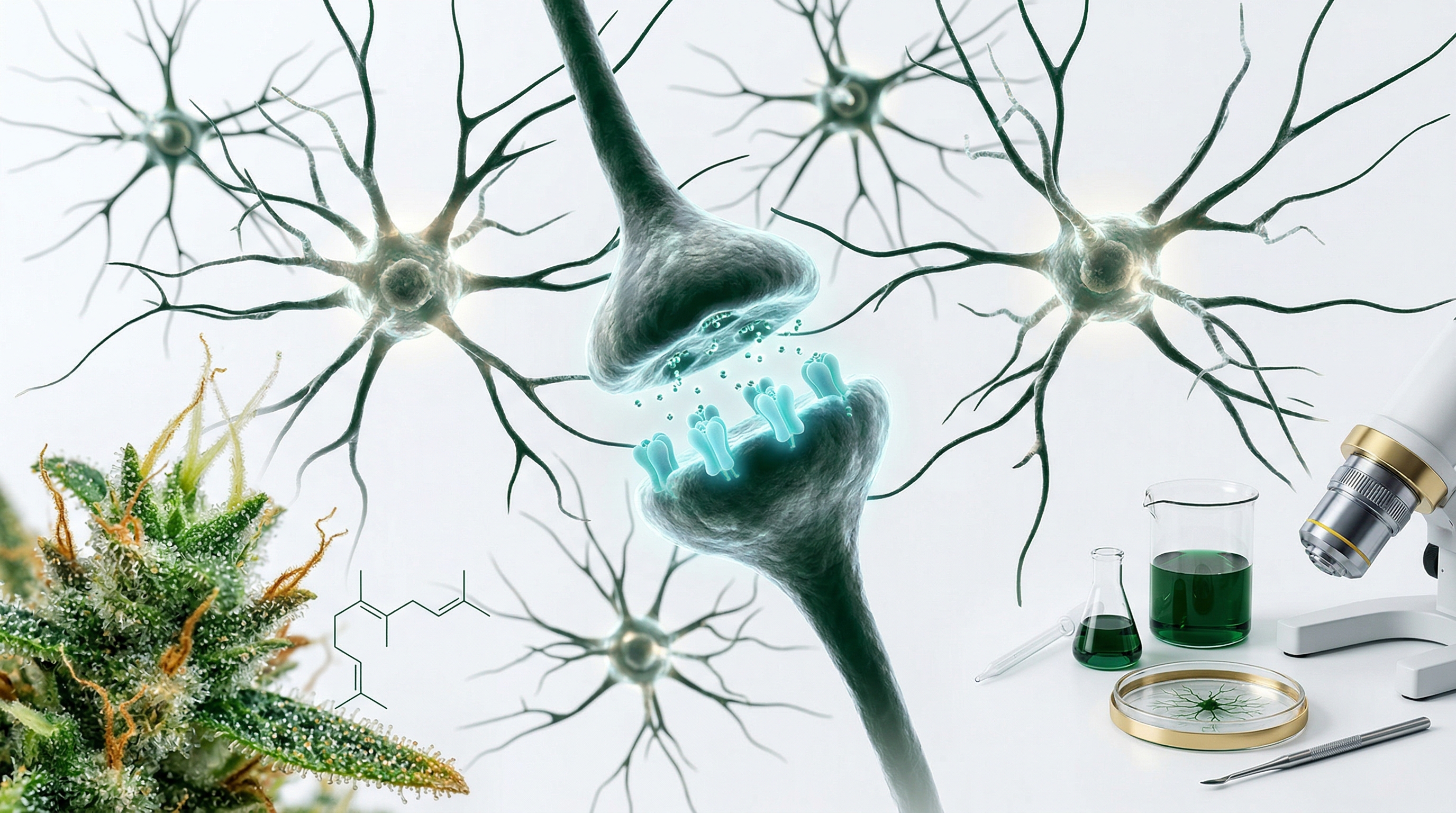
Unlike THC, which binds directly to cannabinoid receptors in your endocannabinoid system, myrcene works through several pathways at once. Think of it as a dimmer switch that slowly turns down your nervous system’s activity.
The GABA connection: The biggest finding about myrcene involves GABA—your brain’s main “calm down” signal. A 2024 study in Pharmaceuticals found that beta-myrcene boosts GABA-A receptors [Xiao et al., 2024]. When these receptors become more active, they slow down nerve signals in your brain. This is the same system that sedatives like Valium target—though myrcene works more gently.
The study measured GABA levels in mice. Myrcene treatment raised GABA levels in both the blood and brain. More GABA receptors plus more GABA equals more calm. That’s the “everything is slowing down” feeling you know.
The serotonin pathway: The same 2024 study showed that myrcene also boosts serotonin activity. Serotonin helps regulate mood, relaxation, and sleep. By enhancing both GABA and serotonin at once, myrcene creates a calming effect greater than either alone.
TRPV1 activation: Here’s where pain relief comes in. A 2019 study in Channels found that myrcene activates TRPV1 receptors [Heblinski et al., 2019]. These are the same receptors that sense heat and spicy food. When myrcene hits them, it may help with muscle relaxation and pain.
The CB1 mystery: A March 2025 study in PAIN found something strange [Wilkerson et al., 2025]. Myrcene relieves pain through CB1 receptors—but it doesn’t bind to them directly. When researchers blocked CB1, the pain relief vanished. But in lab tests, myrcene didn’t activate CB1 at all. This hints that myrcene works indirectly on your endocannabinoid system, perhaps by changing how your body makes or breaks down its own cannabinoids.
What the Research Actually Shows
Let’s move beyond mechanism theories to concrete experimental results.
The 2024 Insomnia Study: Researchers gave myrcene to mice that couldn’t sleep [Xiao et al., 2024]. The results were clear:
- Prolonged sleep duration (p<0.001)
- Decreased sleep latency (how long it takes to fall asleep)
- Increased rate of falling asleep when combined with barbiturates
Myrcene also turned on genes linked to sleep. This gives hard evidence for what folk medicine has claimed for years.
The Human Driving Study: This one matters most for you. A 2023 study gave people 15mg of pure myrcene and put them in a driving simulator [Wilson et al., 2023]. No THC—just myrcene. Here’s what happened:
- Speed control significantly impaired (p=.049)—participants showed increased deviations from target speed
- Divided attention errors increased (p=.006)—participants struggled to multitask
That 15mg dose is about what you’d get from a high-myrcene strain. The takeaway? Myrcene alone—no THC needed—can slow your reactions and split your focus.
The Pain Relief Research: The 2025 PAIN study found that myrcene reduced pain in mice. The more they gave, the more pain relief the mice felt. One surprise: female mice needed smaller doses than males. This is one of the first times we’ve seen sex differences in how terpenes work. And unlike strong painkillers, myrcene didn’t cause extra drowsiness or temperature drops.
The 0.5% Myth: Debunked
You may have heard that strains with more than 0.5% myrcene are “indicas” while those below 0.5% are “sativas.” This claim, originally from Steep Hill Labs, has been widely repeated—and it’s largely wrong.
The data says otherwise: A 2015 analysis of Cannabis Cup strains found that sativa-dominant plants were actually 1.5 times more likely to have higher myrcene content than the average indica [High Times]. Some sativas contained double the myrcene of many indicas.
Genetics vs. chemistry: A 2021 Nature Plants study looked at the data [Watts et al., 2021]. Yes, myrcene explains about 21% of why strains get labeled indica or sativa. But that means 79% comes from something else. The genes that make myrcene don’t match up with the plant shapes we call “indica” or “sativa.”
Dr. Ethan Russo’s take: In a famous 2016 interview, cannabis researcher Dr. Ethan Russo said it plainly [Russo, 2016]. The sleepy feeling blamed on “indica” strains? It comes from myrcene. The indica/sativa labels, he said, tell you almost nothing about how a strain will feel.
The bottom line: Don’t choose cannabis by indica/sativa labels. Choose by terpene profile. If you want sedation, look for high myrcene content regardless of what category the strain falls into.

The Blood-Brain Barrier Myth
Here’s a claim you’ve probably encountered: “Myrcene lowers resistance at the blood-brain barrier, allowing THC to enter the brain more easily.”
This sounds scientific. It would elegantly explain why mangoes supposedly intensify your high (mangoes contain myrcene). But there’s a problem: no peer-reviewed studies support this claim.
A 2021 review searched for proof and found nothing [Plant Family, 2021]. Yes, one study said myrcene helps things absorb through skin. But skin is not your brain. The blood-brain barrier is a special filter that doesn’t open just because a molecule is fat-soluble.
The mango myth likely persists because:
- Myrcene genuinely enhances sedation through GABA mechanisms
- Eating mangoes before cannabis may increase absorption of all compounds (fiber, sugars affecting metabolism)
- Placebo effects are powerful when you expect enhancement
What we do know: Myrcene can reach your brain on its own, like most terpenes. What it doesn’t do is “open the gates” for THC or other compounds to follow.
Practical Applications
Finding High-Myrcene Strains
If sedation, relaxation, or sleep support is your goal, here’s how to identify myrcene-dominant cannabis:
Check COA results: Lab reports typically list terpenes. Look for myrcene (or β-myrcene) as the dominant terpene, ideally above 0.5% of total weight. Some potent strains exceed 1%.
Use your nose: Myrcene has a distinctive earthy, musky, slightly herbal scent—sometimes compared to cloves, hops, or overripe fruit. If a strain smells “dank” and earthy rather than citrusy or piney, myrcene is likely dominant.
Explore the Relax High family: At This Is Why I’m High, we classify strains by their terpene profiles and expected effects. The Relax High family features myrcene-dominant strains specifically selected for deep relaxation and sedation. This is your starting point for couch-lock experiences.
Classic high-myrcene strains include:
- Granddaddy Purple
- OG Kush
- Blue Dream
- Mango Kush
- Grape Ape
- Northern Lights
When Myrcene Is (and Isn’t) Right for You
Myrcene-rich strains may be ideal for:
- Evening wind-down after a long day
- Sleep support (consume 1-2 hours before bed)
- Muscle tension and physical relaxation
- Anxiety reduction when you can fully relax
- Pain management, particularly when rest is possible
Consider lower-myrcene strains when:
- You need to drive (remember the 15mg impairment study)
- Work or focus is required
- You want energetic social experiences
- Daytime functionality is important
Dosing Considerations
The human driving study used 15mg of pure myrcene—roughly equivalent to consuming a high-myrcene cannabis strain. Effects became apparent within 20-30 minutes. If you’re new to high-myrcene strains:
- Start with a small amount and wait at least an hour
- Effects tend to build gradually, peaking around 60-90 minutes
- Combining with myrcene-rich foods (mango, hops) may intensify effects
- Don’t plan to drive or operate machinery
The Entourage Effect in Action
Myrcene doesn’t work in isolation. When combined with THC, CBD, and other terpenes, its effects become part of a larger symphony.
With THC: Myrcene may enhance THC’s sedative qualities while potentially tempering anxiety. The combination often produces deeper body relaxation than THC alone.
With linalool: Both terpenes enhance GABA activity. Strains high in myrcene AND linalool (like Lavender or Granddaddy Purple) tend to be particularly sedating.
With limonene: This is an interesting pairing. Limonene’s energizing effects may offset myrcene’s sedation. Strains with both tend to relax the body while keeping the mind clearer.
Understanding these patterns is part of the entourage effect—how cannabis compounds work together. It’s another reason why terpene profiles beat indica/sativa labels.

Key Takeaways
Myrcene is legitimately sedating. It’s not placebo—this terpene upregulates GABA-A receptors, increases GABA and serotonin levels, and activates TRPV1 channels. Multiple pathways create genuine sedation.
The research is catching up. 2024-2025 studies have provided concrete evidence: myrcene improves sleep metrics in animal models and impairs driving performance in humans at realistic doses.
Forget indica vs. sativa. The 0.5% myrcene rule doesn’t hold up to scrutiny. Sativas can be myrcene-dominant, and indicas can be myrcene-light. Test results and your nose are better guides.
The blood-brain barrier claim is unsupported. Myrcene crosses the BBB on its own but doesn’t “open the gates” for THC. Its effects come from receptor interactions, not transport enhancement.
Context matters. Myrcene is excellent for relaxation, sleep, and pain relief—and problematic for driving, focus, or daytime productivity. Choose wisely based on your situation.
Sources
-
Xiao, Y., et al. (2024). “Beta-Myrcene as a Sedative-Hypnotic Component from Lavender Essential Oil in DL-4-Chlorophenylalanine-Induced-Insomnia Mice.” Pharmaceuticals, 17(9), 1161. [PubMed: 39338324]
-
Wilson, M., et al. (2023). “The Effects of β-myrcene on Simulated Driving and Divided Attention: A Double-Blind, Placebo-Controlled, Crossover Pilot Study.” Cannabis, 6(1). [PMC10212270]
-
Wilkerson, J.L., et al. (2025). “Elucidating interplay between myrcene and cannabinoid receptor 1 receptors to produce antinociception in mouse models of neuropathic pain.” PAIN. [PubMed: 40839768]
-
Heblinski, M., et al. (2019). “Myrcene and terpene regulation of TRPV1.” Channels, 13(1), 344-366. [PMC6768052]
-
Watts, S., et al. (2021). “Cannabis labelling is associated with genetic variation in terpene synthase genes.” Nature Plants, 7, 1330-1334.
-
Russo, E.B. (2016). “The Cannabis sativa Versus Cannabis indica Debate: An Interview with Ethan Russo, MD.” Cannabis and Cannabinoid Research, 1(1), 44-46.
-
Surendran, S., et al. (2021). “Myrcene—What Are the Potential Health Benefits of This Flavouring and Aroma Agent?” Frontiers in Nutrition, 8, 699666. [PMC8326332]


