Netherlands Cannabis Laws 2026: Gedoogbeleid Explained
Cannabis is illegal in the Netherlands, yet tolerated. Inside gedoogbeleid, the back-door paradox, and the 2025 wietexperiment legalizing supply.


Here is the question that trips up almost everyone who has bought a joint in an Amsterdam coffeeshop: was that legal? The honest answer is no. Not technically. Not under the letter of Dutch law. Cannabis in the Netherlands is, and has been since 1928, a controlled substance. What you bought was not legalization. It was something stranger. You met gedoogbeleid — the Dutch tolerance policy. It is a decades-old compromise where the government openly chooses not to prosecute something it has declared illegal.
If that sounds like a contradiction, that is because it is one. And in 2026, that contradiction is finally being put to the test by a government experiment that could rewrite how the world’s most famous cannabis culture actually works. Let me walk you through the whole tangled, fascinating structure — the law, the loophole, and the experiment trying to close the loop.
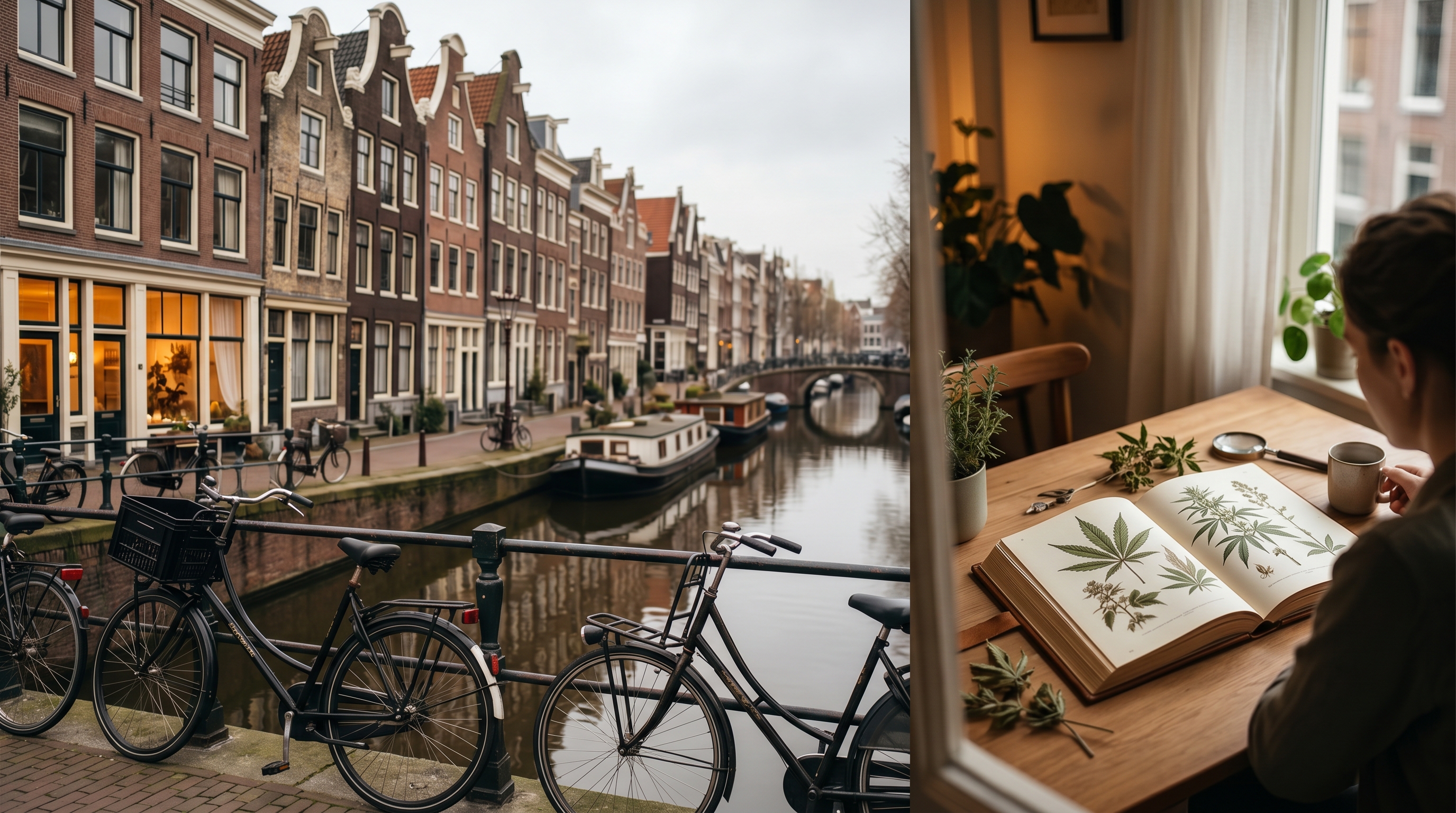
Quick facts: Dutch cannabis law at a glance
| Question | The 2026 answer |
|---|---|
| Is cannabis legal? | No. It is illegal under the Opium Act, but tolerated under policy. |
| Personal possession | Up to 5 grams is not prosecuted (adults 18+). |
| Coffeeshop purchase | Up to 5 grams per transaction at licensed shops. |
| Home cultivation | Up to 5 plants tolerated, but plants are confiscated. |
| Soft vs. hard drugs | Cannabis = soft (List II); heroin, cocaine, MDMA = hard (List I). |
| The supply paradox | Sale is tolerated; growing and wholesale supply are not. |
| The 2025 reform | Wietexperiment: ~10 legal growers supply ~80 coffeeshops in 10+ cities. |
| Tourist access (nationally) | Coffeeshops may legally serve residents only; enforcement varies by city. |
Gedoogbeleid: tolerating what you outlaw
To understand Dutch cannabis policy, you have to throw out the binary your brain wants to use. In most of the world, a substance is either legal or illegal. The Netherlands invented a third category, and it has a name: gedogen, meaning “to tolerate” or “to permit by looking the other way.”
The legal foundation is the Opium Act (Opiumwet), passed in 1928 and substantially amended in 1976. That 1976 amendment did something quietly radical. It split controlled substances into two lists based on the harm they cause. List I covers drugs deemed to carry “unacceptable risk” — heroin, cocaine, amphetamine, LSD, and MDMA. List II covers substances judged less dangerous, and that is where cannabis — both marijuana and hash — sits. This is the famous soft drug versus hard drug distinction, and it is the philosophical hinge of the entire system.
Crucially, the 1976 reform did not legalize anything. Cannabis stayed illegal. What changed was priority. Dutch authorities decided that chasing personal cannabis users was a poor use of police and courts. They also wanted to split the cannabis market from the hard drug market. The goal was to keep young users away from dealers who pushed heroin alongside hash. The coffeeshop was born as a harm-reduction firewall, not as a celebration.
So when you read that cannabis is “legal in the Netherlands,” correct the record gently. It is tolerated. The Dutch government can, in principle, end that tolerance at any time without passing a single new law — because the prohibition never went away. If you have read our Portugal cannabis laws guide, you will recognize a cousin of this logic: decriminalization and tolerance both keep a substance technically illegal while declining to punish the user. The Dutch simply added a retail layer on top.
The 5-gram rule and the AHOJ-G criteria
Tolerance is not a free-for-all. It comes wrapped in conditions, and the conditions are precise.
For personal possession, the threshold is 5 grams. Carry up to 5 grams of cannabis as an adult (18 or older) and you will not be prosecuted. The police may still confiscate it, but you will not be charged. Step over that line and you have moved from “tolerated user” to “subject of the Opium Act.”
For the coffeeshops themselves, the rulebook is summarized by a Dutch acronym, AHOJ-G, which lays out what a tolerated shop must not do:
- A — Affichering: no advertising.
- H — Harddrugs: no hard drugs on the premises, ever.
- O — Overlast: no nuisance to the surrounding neighborhood.
- J — Jeugd / Jongeren: no sales to minors, and no minors allowed inside (the age floor is 18).
- G — Grote hoeveelheden: no large quantities — a maximum of 5 grams per customer per transaction, and a shop stock capped at 500 grams at any time.
Break any of these and the municipality can revoke the shop’s tolerance and shut it down. Some cities have added a further letter — an “I” for the Ingezetenencriterium, the residence criterion — but more on that complication shortly.
This is why the experience inside a Dutch coffeeshop feels so orderly. The tidy menus, the ID checks, the cash-only counters, the 5-gram ceiling — none of that is corporate branding. It is the visible surface of a tolerance contract that the shop must keep flawlessly or lose.

The back-door problem: the paradox at the heart of it all
Now we arrive at the flaw that has haunted Dutch policy for fifty years, and the single most important thing to understand about how the system really works.
Picture a coffeeshop as a building with two doors. The front door is where customers walk in and legally — well, tolerably — buy their 5 grams. The back door is where the shop’s supply arrives: the kilos of flower and hash that stock those tidy menus. Here is the catch. The front door is tolerated. The back door is not.
Coffeeshops may sell cannabis. They have no legal way to buy or produce it. Cultivation, wholesale, and transport above personal limits stay fully criminal under the Opium Act. So every gram sold legally at the counter was grown and supplied illegally somewhere upstream. This is the back-door problem (achterdeurprobleem), and it is not a small technicality. The tidy, ID-checked retail front has always been fed by a criminal supply chain — the very organized crime the policy was meant to undermine.
It also means there has never been any quality control on what reaches the shelf. No mandated lab testing for pesticides or mold. No verified potency. No standardized labeling of the kind you would find in a legal market like the one described in our Canada cannabis laws guide. For decades, Dutch cannabis was simultaneously the most visible and one of the least transparent products in the legal-adjacent world. Understanding why terpenes and cannabinoid ratios matter for the effects you feel is hard when nobody is measuring them.
The wietexperiment: closing the back door
In April 2025, the Netherlands started doing something it had refused to do for half a century. It made the back door legal — on a trial basis.
The Controlled Cannabis Supply Chain Experiment (Gesloten Coffeeshopketen), known to everyone as the wietexperiment or “weed experiment,” entered its full experimental phase on 7 April 2025. The design is simple in concept. Connect a small group of licensed growers — a maximum of 10 — directly to participating coffeeshops. Then require those shops to sell only this legal, tracked, tested product. No more back-door sourcing. The illegal supply chain is cut out entirely.
The trial runs in 10 municipalities chosen for geographic and demographic spread — Breda, Tilburg, Almere, Arnhem, Groningen, Heerlen, Hellevoetsluis, Maastricht, Nijmegen, and Zaanstad — with a district of Amsterdam (Amsterdam Oost) joining later to add a big-city dimension. Roughly 80 coffeeshops participate. The experimental phase lasts four years, with the option of an 18-month extension, and a formal evaluation is built in before it concludes.
The mechanics are where it gets serious. Every product is tracked and traced from grower to shelf. The Netherlands Food and Consumer Product Safety Authority (NVWA) monitors product quality and packaging standards. Enforcement officers verify that no illegal cannabis sneaks into the system and that no legal product leaks out. For the first time in Dutch history, a joint sold in a participating shop has a documented, lawful origin and a tested potency.
There were growing pains, and they are instructive. Hash turned out to be the hard part. Traditional coffeeshop hash was largely imported Moroccan product — impossible to source legally — so the ban on selling tolerated (illegal) hash was delayed until 1 September 2025 to give domestic growers time to ramp up. The Dutch-made hash that resulted has been reported as stronger, pricier, and lower in CBD than the Moroccan hash regulars were used to. It is a small detail with a big lesson: a regulated market does not just legalize the old product, it changes the product.
What the experiment is really testing
The wietexperiment is not, formally, a step toward national legalization. The Dutch government is careful about this. It is a research project with a specific question: is it actually possible to regulate the production, distribution, and sale of cannabis through a closed chain — and what happens to crime, public safety, and public health when you do?
That framing matters. The outcomes — measured by independent researchers in annual reports — will shape whether the Netherlands scales the model nationally, modifies it, or abandons it. The world is watching, because the Dutch are stress-testing the exact promise that every legalization debate makes: that bringing supply into the open undercuts the illicit market and protects consumers. If you want to track what works for your own body across these shifting product realities, that is precisely the kind of pattern the High IQ app is built to help you log.
Home growing: tolerated, then taken away
What about growing your own? Here the gedoogbeleid does something almost poetic in its contradiction.
Dutch policy tolerates the cultivation of up to 5 cannabis plants for personal use, in the sense that growing five or fewer plants is generally not prosecuted. But — and this is the twist — the plants are still confiscated if discovered. You will likely not be charged, yet you will not keep your garden either. Grow more than five, use professional equipment like high-intensity lamps, or show any sign of commercial intent, and you cross into criminal cultivation territory under the Opium Act, with real penalties.
So the home grower occupies the same liminal space as the coffeeshop customer: tolerated as a person, but never granted a property right in the plant itself. It is decriminalization without ownership — a very Dutch solution.
National law, local enforcement
One more layer, because it explains a lot of the confusion travelers feel. Dutch cannabis policy is national in its law but local in its enforcement.
The Opium Act is federal. The 5-gram threshold and the AHOJ-G criteria are national guidelines. But the application — how many coffeeshop licenses a city grants, whether it enforces the residence criterion, how aggressively it polices nuisance — is decided municipally, by mayors and local triangles of mayor, police, and prosecutor.
The clearest example is the residence criterion (Ingezetenencriterium), sometimes nicknamed the “weed pass.” Since 2013, national rules permit coffeeshops to serve only residents of the Netherlands. But cities choose whether to enforce it. Border cities in the southern provinces — Maastricht prominent among them — enforce it strictly to curb drug tourism. Amsterdam has historically declined to, which is why tourists still buy freely there. The result is a patchwork: the same national rule produces opposite realities depending on which city you stand in. This is the legal backdrop behind our practical, on-the-ground Amsterdam coffeeshop visitor’s guide — the law sets the frame, but the city you visit fills in the picture.

The genetics the Netherlands gave the world
You cannot talk about Dutch cannabis policy without acknowledging what that tolerant climate produced. The Netherlands became the breeding capital of the cannabis world precisely because tolerance gave growers and seed banks room to work that prohibition elsewhere did not. The strains that emerged from Dutch gardens form the genetic backbone of modern cannabis everywhere.
The hazes alone are a legacy: Amnesia Haze, Super Silver Haze, and the original sativa-leaning Haze lineage defined the energetic, citrus-forward end of the spectrum — profiles often rich in the terpene limonene and associated with uplifting, euphoric experiences. On the indica side, Dutch breeders stabilized Northern Lights, White Widow, and Hindu Kush — heavier, relaxing cultivars where myrcene often dominates.
Then there are the workhorses that crossed oceans: Skunk #1, Cheese, Blueberry, AK-47, White Russian, G13, Power Plant, and the Cup-winning Jack Herer, named for the legalization activist himself. Many of these lean toward the Energy and Uplift High Families, while the kush-derived lines anchor the Relax family. The point is bigger than any single strain: a tolerant legal climate did not just sell cannabis — it cultivated knowledge, and that knowledge is in nearly every joint rolled on Earth today.
What 2026 means for the Netherlands
So where does this leave the famously laid-back Dutch system? In the middle of its most consequential decade.
The old model — tolerated front door, criminal back door — was a fifty-year compromise that worked well enough to make Amsterdam a global byword for cannabis while quietly funneling money to organized crime. The wietexperiment is the Netherlands finally trying to fix the original sin of its own policy: the supply. Whether it succeeds or stumbles, the data it generates will inform legalization debates from Berlin to Bogotá. Compare it to the fully legal, federally regulated approach in our Germany cannabis legalization update and you see two neighbors taking very different roads toward the same destination.
For now, the practical reality holds. Cannabis remains illegal on paper. Up to 5 grams is tolerated. Coffeeshops operate under AHOJ-G. Growers in 10 cities are, for the first time, supplying legal product through the front door and the back. And the rest of the country waits to see what the experiment proves.
Key takeaways
- Cannabis is illegal, not legal. Under the 1928 Opium Act, it stays a controlled substance. The Dutch simply choose not to prosecute.
- Gedoogbeleid is tolerance, not legalization. Up to 5 grams of possession and 5 home plants are tolerated. Plants are still confiscated.
- AHOJ-G governs every coffeeshop. No ads, no hard drugs, no nuisance, no minors, and no more than 5 grams per sale or 500 grams in stock.
- The back-door problem is the core flaw. Sale is tolerated, but supply stays criminal — so legal counters were fed by an illegal chain.
- The wietexperiment is trying to fix that. Since April 2025, about 10 licensed growers supply roughly 80 shops in 10-plus cities, with tracked, tested product.
- Enforcement is local. One national law produces different realities city by city, especially on the residence rule.
Professor High’s takeaway: The Netherlands did not legalize cannabis — it perfected the art of not enforcing its own prohibition. Gedoogbeleid is a tightrope walk between law and reality, and in 2026 the Dutch are finally building a net under it. Tolerance got the world hooked on Dutch genetics; regulation may be what finally makes the supply behind them honest.
Educational note: This article explains Dutch cannabis policy for general understanding and is not legal advice. Laws and enforcement change, and they vary by municipality. Always verify current rules with official Dutch government sources before relying on them.
Sources
- Government of the Netherlands — Toleration policy regarding soft drugs and coffee shops
- Government of the Netherlands — Controlled Cannabis Supply Chain Experiment: background and experiment design
- Government of the Netherlands — Experimental phase of the ‘weed experiment’ starts on 7 April
- Business.gov.nl — Sale of cannabis in coffeeshops
- Wikipedia — Drug policy of the Netherlands
- StratCann — Dutch cannabis coffeeshop trial moves to next phase with local hash supply


