Cannabis Laws in Portugal 2026: Decrim 25 Years On
Cannabis is decriminalized in Portugal, not legal. 25 years on from the 2001 reform: the 25g limit, medical access, and what tourists need to know.


If you have heard that Portugal “legalized weed,” I have bad news and good news. The bad news: it did not. The good news: what Portugal actually did 25 years ago is arguably more interesting than legalization, and it quietly reshaped how the world thinks about drug policy. Here is what is really going on in 2026.
The Quick Answer
Cannabis in Portugal is decriminalized, not legalized. Since 2001, holding a small amount for personal use (up to 25 grams of flower or 5 grams of hashish) is treated as an administrative matter, not a crime. You will not get a criminal record for it.
But here is the part that trips up nearly everyone. There is no legal way to buy recreational cannabis in Portugal. No dispensaries. No Amsterdam-style coffeeshops. No licensed retail. Buying, selling, and even growing your own plant all stay illegal. Medical cannabis exists, but only through pharmacies with a prescription. And access is narrow.
So Portugal is famous for being chill about weed. Yet it has never had a legal weed store. That contradiction is the whole story.
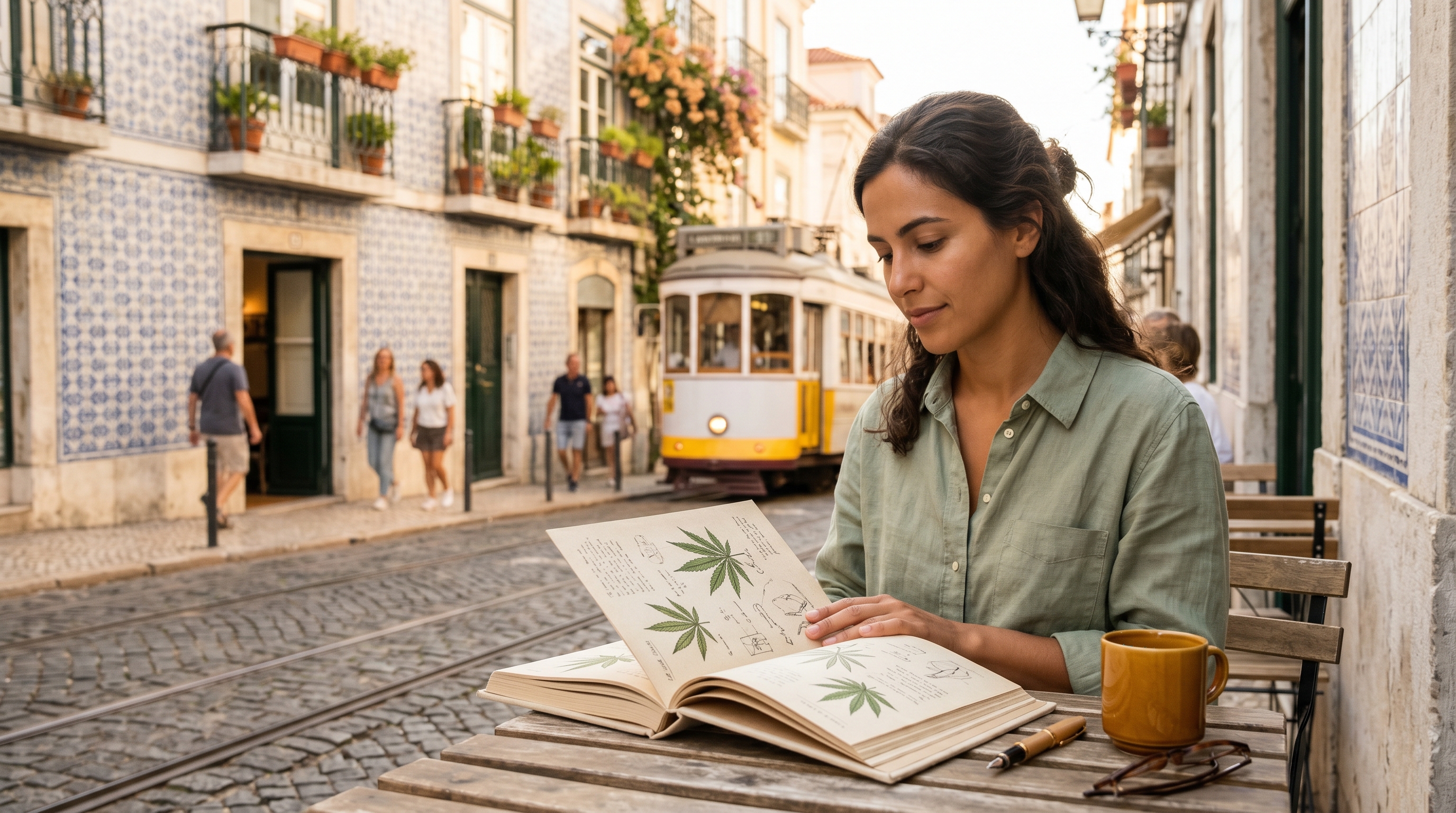
Decriminalization vs. Legalization: The Distinction That Matters
This is the concept people get wrong, so let me be precise.
Legalization means a substance can be legally produced, sold, and bought under government regulation, like alcohol or tobacco, as in Germany and many US states.
Decriminalization means possessing a small amount is no longer a crime, but the supply chain stays illegal. No legal store, no taxed product, no regulated potency. You simply will not be arrested for carrying a personal stash.
Portugal chose the second path. In November 2000, it passed Law 30/2000. The law took effect in July 2001. It decriminalized the personal use and possession of all drugs, not just cannabis. Portugal was the first country in Europe to do this. For context on how cannabis went from prohibition to a public-health issue, see our history of cannabis.
The driving force was not a love of getting high. In the 1990s, Portugal faced one of Europe’s worst heroin crises. An estimated 1% of the population was addicted, and HIV infections spiked. The reform treated addiction as a health issue, not a crime.
The trafficking law (Law 15/93) was left untouched. Selling and growing cannabis stayed crimes. Trafficking can bring up to 12 years in prison, and more in serious cases. Decriminalization carved out the user, not the market.
Personal Possession Thresholds
Portugal defines personal use by a “10-day supply” rule. The headline numbers:
- Cannabis flower: up to 25 grams
- Hashish (resin): up to 5 grams
Stay at or below those amounts, and your case is handled administratively. Police confiscate the cannabis and refer you to a regional commission (more on that below). Exceed them, and things change fast.
A 2008 Supreme Court ruling (Judgment No. 8/2008) made the stakes clear. Possession above the 10-day threshold can be charged as a crime, even trafficking. The burden then falls on you to prove personal use. That is a hard argument when you hold more than the law presumes one person needs.
A 2023 reform, Law 55/2023, tried to fix this. It clarified that going over the limit should not automatically count as trafficking. But reporters note some police still lean on the older daily-dose table (0.5 grams per day) [Ramos, 2026]. So minor cases occasionally still land in court.
For a sense of what these amounts look like, our visual guide to cannabis quantities breaks down grams, eighths, and ounces.
The Dissuasion Commissions: Portugal’s Secret Ingredient
Here is the piece that makes Portugal’s model different from simply “looking the other way.”
When police catch someone with a personal-use amount, they refer that person to a Commission for the Dissuasion of Drug Addiction (in Portuguese, Comissao para a Dissuasao da Toxicodependencia). Today 22 of these commissions serve a country of about 10 million people [Keeler, 2026]. Each panel includes legal, health, and social-service staff.
The commission looks at the person’s relationship with drugs. For a casual user, the outcome is usually a warning or some basic information about risks. For someone with signs of a real problem, the panel can offer guidance or point them toward voluntary treatment. It can also apply small sanctions like fines or community service. But sanctions are rarely the main event.
The only required step is showing up after the first notice. Treatment itself stays voluntary. The genius is catching problems early. People get routed toward help instead of a courtroom. These commissions sit under the health ministry. That is why experts call Portugal’s approach “health-led,” not just softer. It is harm reduction built into the law itself, the same idea in our harm reduction tips.

The Medical Cannabis Program
Portugal legalized medical cannabis in 2018 under Law 33/2018, with the framework defined by Decree-Law 8/2019. The program is overseen by INFARMED, the national medicines authority.
Here is how it works:
- Any licensed doctor can prescribe cannabis-based products, but only for approved indications and only as a treatment of last resort, when conventional medicines have failed or caused serious side effects.
- Approved conditions include spasticity from multiple sclerosis or spinal cord injury, chemotherapy-related nausea and vomiting, and appetite loss in palliative care for cancer or AIDS patients, among others.
- Products require Market Placing Authorisation (ACM) from INFARMED before they can be prescribed, a process that is slow, expensive, and bureaucratic.
- Cannabis is dispensed only in pharmacies, with a special prescription and ID verification.
- There is no public reimbursement, so patients pay out of pocket.
The result is a program that exists more on paper than in practice. Prescriptions climbed from about 460 in 2021 to roughly 1,157 in 2023. Then they slowed in 2024 [Dale, 2025]. The barriers are the same: a narrow condition list, limited doctor training on the endocannabinoid system, and red tape. Domestic access stays small even as Portugal has become a major export hub, shipping tens of tonnes of medical cannabis to markets like Germany.
Curious how a doctor weighs cannabinoid ratios? Our pieces on finding your THC-to-CBD ratio and the THC vs CBD breakdown cover the basics, though both are educational, not a substitute for a Portuguese physician.
Tourists: What Is Legal and What Is Not
Portugal draws a lot of cannabis-curious travelers, and a lot of them arrive with the wrong mental model. So let me be blunt, because this matters.
What you can do without criminal risk:
- Carry up to 25 grams of flower (or 5 grams of hash) for personal use. Tourists are subject to the exact same thresholds as residents.
- Consume privately and discreetly.
What you cannot do:
- Buy cannabis legally. There are no dispensaries or coffeeshops. The “Cannabis Store Amsterdam” shops you see in Lisbon and Porto sell CBD and hemp products only (under 0.2% THC), not the real thing. Amsterdam-style cafes were actually banned in Portugal back in 2013.
- Buy from a street dealer without risk. Selling is a crime, product quality is unknown, and foreign nationals can face fines, passport issues, or even deportation in worse-case encounters.
- Consume in public. Public use can still draw fines.
- Grow your own. Cultivation is a criminal offense, full stop, even for personal use.
So here is the honest tourist reality. Portugal is not a buy-and-smoke spot like Amsterdam used to be. If you already have a small amount, you will not be treated as a criminal. But there is no legal front door to buy it [Herb, 2026].
Weighing destinations? Our cannabis tourism guide compares the legal options. How cannabis culture differs around the world adds global context. And our travel guide explains why crossing borders with cannabis is always risky.
Portugal also stands apart from two cautionary tales. One is Thailand’s cannabis reversal, a fast opening that was partly rolled back. The other is the European cannabis social club model that fills the retail gap in places like Spain.
25 Years On: What the Data Shows

A quarter-century is long enough to judge results, and Portugal’s are striking.
- Overdose deaths fell sharply. Portugal now records fewer than 100 drug-related deaths a year, among the lowest in Europe [Keeler, 2026].
- Drug-related HIV diagnoses plummeted, from over 1,000 cases in 2001 to a small fraction of that today [Laurin, 2026].
- The prison population for drug offenses dropped sharply. That freed up courts and cells.
- Cannabis use itself did not explode. A 2026 ICAD report found last-year cannabis use in the population fell to around 2%. That interrupted a decade-long rise, with notable drops in youth experimentation [Ramos, 2026].
Experts keep repeating one lesson: decriminalization alone did not do this. Portugal paired it with big, coordinated investment in treatment, housing, harm reduction, and social support. And it applied that system the same way across the whole country. Oregon decriminalized all drugs in 2020, citing Portugal. But it reversed course in 2024 [France 24, 2025]. Part of the reason: it copied the language without building the support system underneath. The model is the whole system, not just a lighter penalty.
What Is Next?
Recreational legalization keeps stalling. Adult-use bills came up around 2021 and 2023, from parties like Iniciativa Liberal and the Left Bloc. None passed, even during years of left-leaning majorities. One government after another collapsed and pushed the issue aside. As of 2025-26, there is no clear majority to push full legalization through.
So the near-term picture is steady. Decriminalization stays. The dissuasion commissions keep working. The medical program slowly matures. And the export industry keeps booming. A regulated recreational market is possible someday. But it is not on the immediate horizon.
For the bigger global trajectory, see our look at cannabis legalization in the United States, the state-by-state US landscape, and what US federal rescheduling means.
Frequently Asked Questions
Is cannabis legal in Portugal in 2026? No. It is decriminalized for personal possession (up to 25g flower / 5g hash), but buying, selling, and growing remain illegal. There is no legal recreational market.
Can tourists smoke weed in Portugal? You will not face criminal charges for possessing a small personal amount, and the thresholds apply to everyone. But there is no legal place to buy it, public consumption can draw fines, and buying from dealers carries real risk.
Are there cannabis coffeeshops like in Amsterdam? No. Amsterdam-style cafes were banned in 2013. The “Cannabis Store” shops sell only legal CBD/hemp products under 0.2% THC.
Can I get medical cannabis as a visitor? The medical program requires a prescription from a Portuguese physician for approved conditions, dispensed in pharmacies. It is designed for residents under medical care, not tourists, and access is limited even for locals.
Is growing my own plant allowed? No. Home cultivation is a criminal offense in Portugal, even for personal use. This is one of the model’s notable gaps.
Key Takeaways
Portugal’s 25-year experiment proves a simple point. How you treat cannabis users matters more than the label on the law. The country chose care over punishment. It never opened a legal store. And the public-health results speak for themselves.
But “decriminalized” is not “legal.” Confusing the two can get a traveler in trouble. Know the difference. Keep it small and private. And respect that the success rests on the whole health-led system, not just a relaxed attitude.
Wherever you consume, the same principle applies: the more you understand why a given cannabis experience affects you the way it does, the better your choices get. Effects come from a strain’s chemistry, not its name, which is why we argue your ideal high is not a strain name and why the old indica vs. sativa labels fall short. That is exactly what we built High IQ to help you do, by tracking what actually works for your body instead of trusting a label.
Sources
- [France 24, 2025] “Portugal’s approach to drug decriminalisation: A model for the rest of the world?” France 24 (Jan 2025)
- [Keeler, 2026] Alexandra Keeler, “How Portugal’s dissuasion commissions discourage drug use,” Canadian Affairs (Jan 2026)
- [Laurin, 2026] Olivier Laurin, “UVic researchers discuss why B.C. couldn’t replicate Portugal’s drug strategy,” Victoria News (Apr 2026)
- [Ramos, 2026] Laura Ramos, “Enhanced decriminalization, unchanged police practice” and “Official ICAD report reveals drop in cannabis consumption,” CannaReporter (Jan 2026)
- [Dale, 2025] Rob Dale, “Portugal Medical Cannabis Market Overview 2025,” Prohibition Partners (Sep 2025)
- [Herb, 2026] “How to Buy Weed in Lisbon,” Herb (Apr 2026)
- INFARMED, “Canabis para fins medicinais” (official medical cannabis page); Law 33/2018; Decree-Law 8/2019
- LegalClarity, “Is Marijuana Legal in Portugal? Decriminalized, Not Legal” (Apr 2026)
- GrowerIQ, “Weed in Portugal: Laws, Where to Buy & Cannabis Cafes (2026 Guide)” and “Portugal’s Cannabis Exports Triple” (Apr 2026)
- Portuguese law texts: Law 30/2000, Law 15/93, Law 55/2023, Supreme Court Judgment No. 8/2008
This article is for educational purposes only and is not legal advice. Cannabis laws change and enforcement varies. Always verify current Portuguese regulations with official government sources or a qualified local attorney before relying on any information here.


