Cannabis Laws in Canada 2026: Seven Years Post-Legalization
Canada legalized cannabis in 2018. Seven years on, here is the 2026 picture: age limits, possession, home growing, and the big province-by-province rules.


Canada flipped the switch on recreational cannabis on October 17, 2018 [Health Canada, 2018]. It became the second country in the world to legalize it nationwide. It was also the first major industrialized economy to do so. That was a long time ago in policy years. We now have most of a decade of real data. We have a sweeping federal review. And we have a Supreme Court ruling that reshaped how much power provinces hold.
So if your mental model of Canadian weed law is still “it’s all legal, coast to coast,” it is time for an update. The truth in 2026 is more interesting, and more uneven, than the headlines suggested back in 2018.
Let me walk you through what is actually true today.
The quick answer
Here is the whole national picture in one breath:
- Recreational cannabis is legal nationwide for adults under the federal Cannabis Act, in force since October 17, 2018.
- The legal age is 18 or 19 depending on the province, except Quebec, which set it at 21.
- Adults can possess up to 30 grams of dried cannabis (or its equivalent) in public.
- Households may grow up to four plants for personal use, except in Quebec and Manitoba, which banned home cultivation.
- Each province runs its own retail system, from government monopolies to private stores, so where and how you buy varies a lot.
- Edibles are capped at 10 milligrams of THC per package, and driving with THC in your blood is a criminal offence.
So Canada is genuinely legal in a way the United States still is not at the federal level. But it is not a single uniform market. The federal government set a floor, and the provinces built wildly different structures on top of it. That tension, federal baseline versus provincial control, is the whole story.
The federal floor: what the Cannabis Act actually does
The Cannabis Act (Bill C-45) is the law that legalized non-medical cannabis. It does a handful of things at the national level, and then it deliberately hands the rest to the provinces.
Federally, every adult in Canada can:
- Possess up to 30 grams of legal dried cannabis, or the equivalent in other forms, in public.
- Share up to 30 grams with other adults.
- Buy cannabis from a provincially licensed retailer.
- Grow up to four plants per household from licensed seed or seedlings, for personal use.
- Make edibles and other products at home, as long as no dangerous solvents are used.
The Act also sets the categories of legal products. They include dried flower, oils, capsules, edibles, extracts, and topicals. So-called “Cannabis 2.0” products, the edibles, vapes, and concentrates, became legal a year after flower, in October 2019. Crucially, the federal government capped edibles at 10 milligrams of THC per package. That is a deliberately low dose. It is meant to protect new and infrequent consumers from overconsumption. If you have ever read about someone eating “one gummy” and having a rough night, this 10 mg ceiling is Canada’s structural answer to that problem.
The Act layers on serious criminal penalties too. Growing more than four plants, selling without a licence, or giving cannabis to a minor can carry penalties up to 14 years in prison. Legalization did not mean a free-for-all. It meant a tightly regulated legal lane running alongside a still-illegal everything-else.
The legal age: 18, 19, or 21
The Cannabis Act set a federal minimum age of 18, but explicitly let provinces raise it. Almost all of them did, and the result is a small patchwork:
- Alberta and Quebec are the outliers. Alberta kept the federal minimum at 18. Quebec went the other direction and raised it to 21 in 2020, the highest in the country.
- Every other province and territory set the legal age at 19, aligning it with most provincial drinking ages.
This matters more than it sounds. A 19-year-old in Ottawa who can legally buy a pre-roll becomes a criminal the moment they cross into Quebec, where they are two years under the line. Age, possession, home growing, retail: all of it can change at a provincial border.
Home growing: the four-plant rule, and the two provinces that said no
Federally, households can grow up to four cannabis plants for personal use. But two provinces used their authority to ban home cultivation entirely.
Quebec and Manitoba prohibit growing cannabis at home for personal use. (Manitoba allows it only with a medical authorization.) When recreational gardeners challenged Quebec’s ban as an unconstitutional intrusion on federal jurisdiction, the case went all the way to the Supreme Court of Canada.
In Murray-Hall v. Quebec (Attorney General), 2023 SCC 10, the Court ruled unanimously that Quebec’s home-growing ban is constitutionally valid [Wagner, 2023]. The Chief Justice, writing for the Court, found that the “pith and substance” of the ban was to reinforce the provincial state monopoly over cannabis. The goal was to protect public health and young people. That is an objective squarely within provincial power. In plain terms: a province can be stricter than the federal baseline. The federal floor is a floor, not a ceiling. That ruling also shielded Manitoba’s similar ban from the same kind of challenge. It confirmed just how decentralized Canadian cannabis law really is.
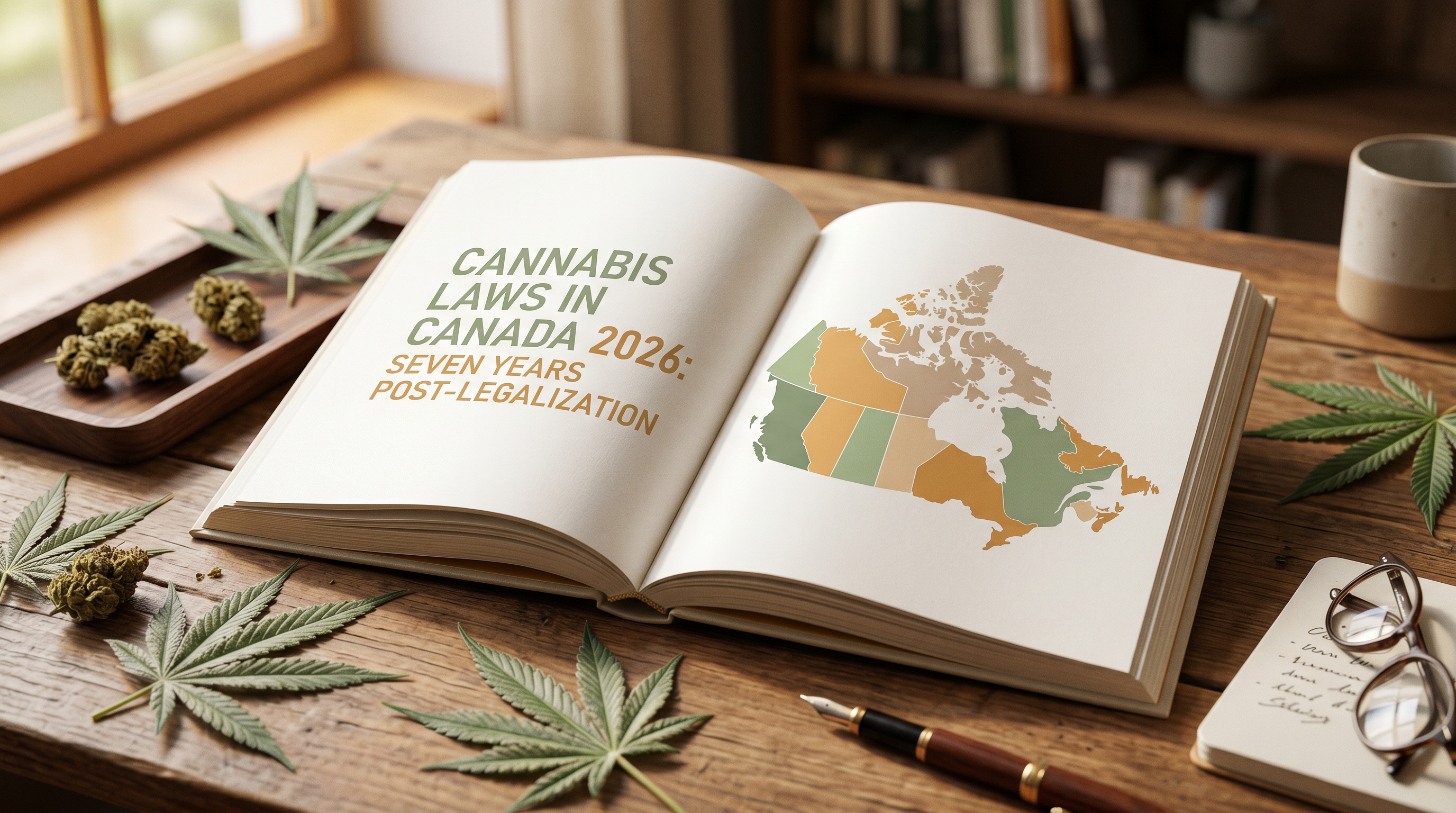
Province-by-province: the 2026 landscape
This is where Canada stops being one country for cannabis purposes and becomes thirteen. Below is the high-level map of legal age, retail model, and home-grow rules. (Possession remains 30 grams in public everywhere, set federally.)
| Province / Territory | Legal Age | Retail Model | Home Grow (4 plants) |
|---|---|---|---|
| Ontario | 19 | OCS online + private stores | Allowed |
| Quebec | 21 | SQDC government monopoly | Banned |
| British Columbia | 19 | Government (BC Cannabis) + private | Allowed |
| Alberta | 18 | Private retail under AGLC | Allowed |
| Manitoba | 19 | Government-regulated retail | Banned (medical only) |
| Saskatchewan | 19 | Private retail, licensed | Allowed |
| Nova Scotia | 19 | NSLC government stores | Allowed |
| New Brunswick | 19 | Cannabis NB (government) | Allowed |
| Newfoundland & Labrador | 19 | Private retail, regulated | Allowed |
| Prince Edward Island | 19 | PEI Cannabis (government) | Allowed |
| Yukon | 19 | Government + private | Allowed |
| Northwest Territories | 19 | NTLCC (government) | Allowed |
| Nunavut | 19 | Government online + agents | Allowed |
A few patterns worth noticing:
- Retail is the biggest variable. Ontario runs the Ontario Cannabis Store (OCS) as the sole online and wholesale channel. It also licenses thousands of private storefronts. Quebec funnels everything through the government-run SQDC. Alberta and Saskatchewan lean almost entirely on private retail. Several smaller provinces and all three territories keep tight government control.
- Quebec is the strict end of the spectrum: age 21, a state monopoly, no home growing, and the country’s narrowest product rules.
- Alberta is the loose end: age 18, the most robust private retail market, and full home-grow rights.
The practical upshot for a traveler: legal in Vancouver does not mean legal the same way in Montreal. Always check the destination province, not just “Canada.”
Driving, public use, and the rules that still bite
Legalization did not touch impaired driving law. Driving while impaired by cannabis is a criminal offence across Canada [Justice Canada, 2024]. Federal law sets per se blood-THC limits. The lower limit is 2 nanograms per millilitre, a lesser summary offence. The higher limit is 5 ng/mL, a more serious hybrid offence. Penalties climb further when alcohol is present too. Police can demand a roadside oral-fluid test. The penalties escalate fast, from fines to licence suspension to jail. If you consume, do not drive, full stop.
Public consumption rules also vary by province and municipality. Some places allow it roughly anywhere you can smoke tobacco; others restrict it sharply. Landlords and condo boards can prohibit smoking and growing on their property. And cannabis still cannot legally cross the Canadian border in either direction, even between two legal jurisdictions like Canada and a legal US state. Federal US law treats it as a controlled substance, so do not bring it to the airport.
Seven years in: did legalization work?
In March 2024, the federal government tabled the final report of the Legislative Review of the Cannabis Act [Rosenberg, 2024]. This was a statutorily required check-up. An independent expert panel chaired by Morris Rosenberg led it. The panel held nearly 140 engagement sessions and heard from over 600 participants. It produced 54 recommendations to federal policymakers plus 11 observations for provinces and health bodies.
The headline conclusion was clear. The panel believed legalization was the right decision. It found that the 2018 framework is a solid foundation to build on. The most visible win is the illegal market. Diverting sales away from unregulated dealers was the central goal, and it largely worked. The legal market captured the bulk of cannabis spending by the mid-2020s. The illicit share shrank toward roughly a fifth of the market.
But the review was not a victory lap. The panel flagged real concerns:
- High-potency THC products. The growing popularity of very strong extracts and flower worried the panel from a public-health angle, echoing debates happening in legal US states too.
- Youth use. Canada has historically high youth cannabis-use rates. The panel did not find legalization spiked them, but it urged setting and tracking concrete targets to bring them down.
- Industry burden. The legal sector is squeezed by taxes and regulatory costs, and the panel called on Health Canada to ease the financial and administrative load so legal operators can actually compete with the illicit market they were meant to replace.
- Indigenous engagement. The panel pushed for deeper consultation with First Nations on both public-health concerns and economic opportunity.
In other words, Canada’s experiment is broadly judged a success on its core public-safety aims, while the economics of the legal industry remain genuinely difficult. That is a far more honest report card than either the boosters or the critics predicted in 2018.
What this means for you as a consumer
Legal access changes the question you should be asking. When cannabis is illegal, the only goal is not getting caught. When it is legal and regulated, you get something far more valuable. You get consistent, lab-tested products with known cannabinoid and terpene content. That is where the real learning starts.
Once you can read a label, you can pay attention to why one product relaxes you and another leaves you wired and anxious. Most people blame the strain name. The better predictor is the terpene and cannabinoid profile. Different profiles tend to produce different effects for different people.
- If you reach for calm and sleep, the Relaxing High family, anchored by myrcene, is the place to start. Classic examples include Granddaddy Purple, Northern Lights, and Bubba Kush.
- For mood and brightness, the Uplift High family leans on limonene. Think Super Lemon Haze, Tangie, or Strawberry Cough.
- For daytime energy and focus, the Energetic High family is driven by terpinolene and pinene, with strains like Jack Herer, Durban Poison, and Green Crack.
- For physical comfort, the Relieving High family and caryophyllene point toward strains like Gelato and Wedding Cake.
- If you are brand new and want something forgiving, the Balancing High family, including Blue Dream and balanced options like Harlequin and Cannatonic, tends to be gentler.
- For the full-spectrum, multi-terpene experience, look at the Entourage High family with strains like OG Kush, Sour Diesel, and Girl Scout Cookies.
- Curious how linalool and ocimene shape the high? A regulated market is the safest place to experiment, with strains like Pineapple Express and ACDC for lower-THC sessions.
The strain matters less than how you respond to its profile. Two people can smoke the same Blue Dream and have opposite experiences. Legalization gives you the lab data; tracking your own reactions turns that data into a personal map.
How Canada compares to the world
Canada sits in a small but growing club of fully legal countries. If you want to see how the patchwork plays out elsewhere, these guides pair well with this one:
- The United States remains the great contrast, legal in many states but still federally prohibited. See Cannabis Legalization in the United States 2026 and the State-by-State Cannabis Laws 2026 overview.
- For the European angle, read Germany’s Cannabis Legalization and the Portugal Cannabis Laws 2026 decriminalization model.
- Canada’s federal-versus-state tension rhymes with debates explored in Can Cannabis Users Own a Gun? and Interstate Cannabis Commerce.
- Planning a trip? Pair this with The Rise of Cannabis Tourism and our guide on How to Travel With Cannabis.
- For the southern-hemisphere comparison, see Cannabis Laws in Australia 2026 and South Africa Cannabis Laws 2026.
The Professor’s bottom line
Canada did something genuinely hard: it built a legal, regulated cannabis market from scratch and, seven years on, the federal review concluded it was the right call. But “legal in Canada” is a federal headline hiding thirteen different realities. Your age limit, your shop, and whether you can grow a plant in your window all depend on which province you are standing in. Quebec at 21 with no home grow is a different country from Alberta at 18 with private stores and a garden. Learn your province’s rules. Respect the driving laws. And use the one thing legalization truly hands you, reliable lab data, to understand your own body instead of chasing a strain name.
Key takeaways
- It is legal nationwide. The federal Cannabis Act has been in force since October 17, 2018.
- Age depends on the province. It is 18 in Alberta, 21 in Quebec, and 19 everywhere else.
- Possession is 30 grams in public, set federally and the same everywhere.
- Home grow is four plants per household, but Quebec and Manitoba ban it, and the Supreme Court upheld those bans.
- Retail varies a lot, from government monopolies like the SQDC to private stores in Alberta.
- Edibles cap at 10 mg of THC per package, and driving with THC in your blood is a crime.
- The 2024 federal review judged legalization a success on its core aims, while noting real concerns about potency, youth use, and industry economics.
Educational, not legal advice. This article summarizes cannabis laws as of May 2026 for general education. Laws change, and provincial and municipal rules add detail this overview cannot capture. Always confirm the current rules with official government sources for your specific province or territory before acting. This is not legal advice.
Sources
- Government of Canada, Health Canada — Cannabis laws and regulations: https://www.canada.ca/en/health-canada/services/drugs-medication/cannabis/laws-regulations.html
- Department of Justice Canada — Cannabis Legalization and Regulation: https://www.justice.gc.ca/eng/cj-jp/cannabis/
- Government of Canada — Legislative Review of the Cannabis Act: Final Report of the Expert Panel (March 2024): https://www.canada.ca/en/health-canada/services/publications/drugs-medication/legislative-review-cannabis-act-final-report-expert-panel.html
- Government of Canada — Tabling of the Final Report (news release, March 22, 2024): https://www.canada.ca/en/health-canada/news/2024/03/government-of-canada-tables-final-report-of-the-legislative-review-of-the-cannabis-act.html
- Supreme Court of Canada — Murray-Hall v. Quebec (Attorney General), 2023 SCC 10: https://www.scc-csc.ca/judgments-jugements/cb/2023/39906/
- Borden Ladner Gervais (BLG) — Summary of Murray-Hall v. Attorney General of Québec: https://www.blg.com/en/insights/2023/05/cannabis-regulation-act-summary-of-murray-hall-v-attorney-general-of-quebec
- CBC News — Ban on homegrown cannabis plants in Quebec upheld by Supreme Court: https://www.cbc.ca/news/canada/montreal/supreme-court-cannabis-provincial-law-plants-personal-use-1.6810476
- Wikipedia — Cannabis laws of Canada by province or territory: https://en.wikipedia.org/wiki/Cannabis_laws_of_Canada_by_province_or_territory


