Amsterdam Coffeeshop Guide 2026: A First-Timer's Handbook
Heading to Amsterdam? This first-timer's guide covers coffeeshop rules, the tolerance policy, edibles caution, etiquette, and 2026 traveler tips.


Welcome, traveler. Is Amsterdam on your 2026 trip list? Are you curious about stepping into one of its famous coffeeshops? Then you’ve come to the right place. I’m Professor High, and this is your friendly pre-flight briefing. The goal here isn’t to hype anything up. It’s to help you walk in calm, informed, and respectful. That way your first visit becomes a good memory, not a cautionary tale.
Amsterdam’s coffeeshops are one of the most misunderstood things in cannabis culture. People picture a free-for-all. The reality is far more orderly. It runs on a uniquely Dutch policy, a tidy set of rules, and an unwritten code of manners that locals truly care about. Let’s unpack all of it.
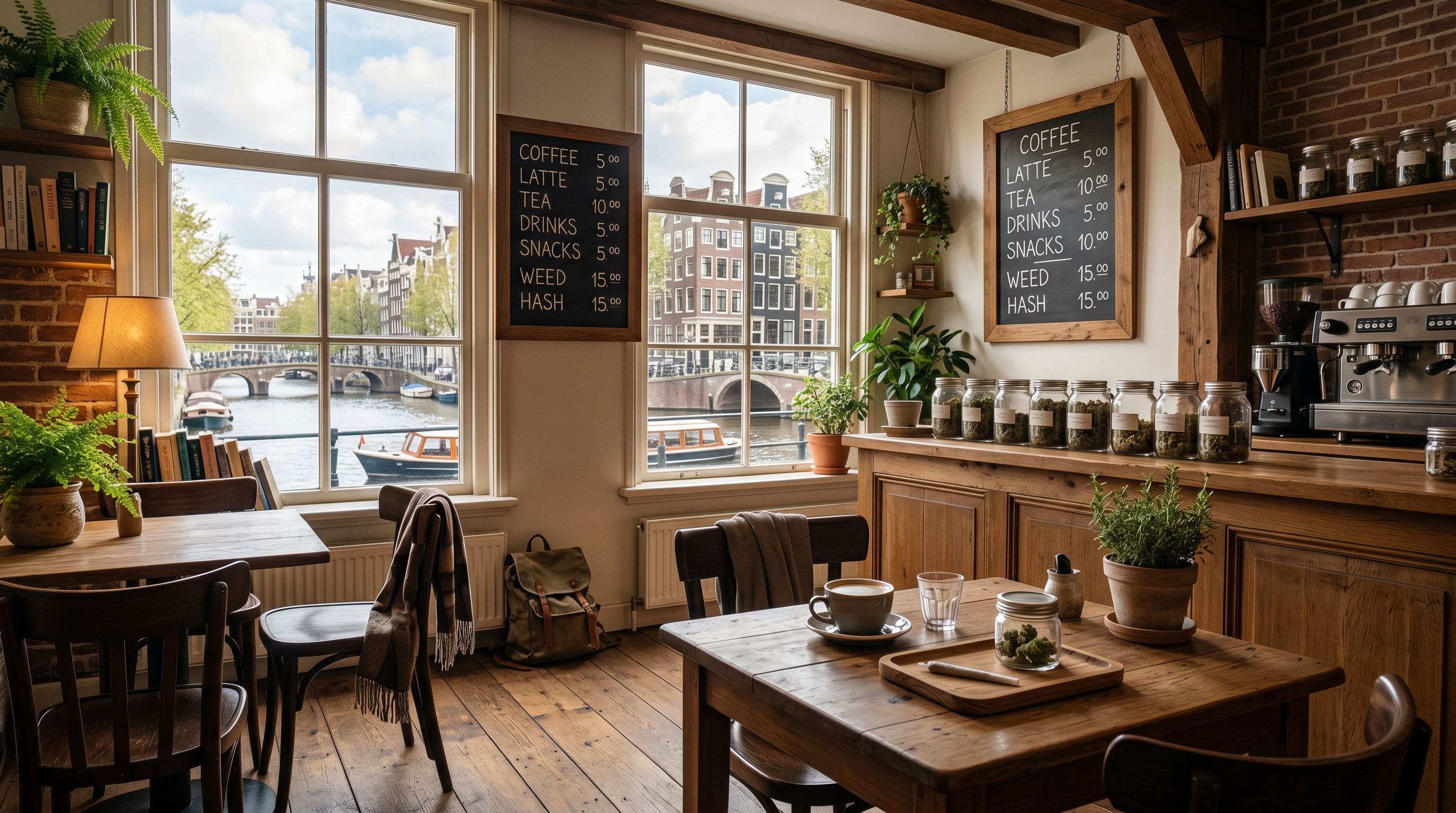
First, the most important thing: this is education, not legal advice
Cannabis laws and local rules change, sometimes fast. They also differ from your home country. Nothing here is legal advice. The rules below reflect the situation as of mid-2026. Always check current local guidance and a shop’s house rules before you act. When in doubt, ask the staff. They deal with confused tourists every day. They would much rather answer your question than watch you get it wrong.
The “Gedoogbeleid”: tolerated, not fully legal
Here’s the concept that trips up almost every first-timer. In the Netherlands, recreational cannabis is not technically legal. What exists is a long-standing policy called the gedoogbeleid, which translates roughly to “tolerance policy.”
Under the gedoogbeleid, selling and holding small amounts of cannabis is still illegal on paper. But prosecutors choose not to charge people when strict conditions are met. A licensed coffeeshop that follows the rules is left alone. So is a person carrying a personal amount. In short: it is allowed in practice, not in law.
Why does this distinction matter to you as a visitor? Because “tolerated” comes with conditions, and those conditions are exactly the rules below. Step outside them and the tolerance evaporates. The system works precisely because nearly everyone respects the boundaries. Think of it less like a green light and more like a carefully maintained truce.
The core rules every visitor must know
Coffeeshops operate under nationally standardized criteria, often summarized by Dutch authorities with the acronym AHOJG (no advertising, no hard drugs, no nuisance, no minors, limited quantities). For a traveler, here’s what that translates to on the ground:
- You must be 18 or older. This is strictly enforced. If you look under 25, expect to be asked for ID.
- Bring a passport or national ID card. Many coffeeshops do not accept driver’s licenses, especially from non-EU countries. A passport is your safest bet.
- The purchase limit is 5 grams per person, per day. This limit applies to you across all coffeeshops combined, not 5 grams per shop.
- No alcohol on the premises. Licensed coffeeshops cannot sell alcohol. If a venue serves beer, it isn’t a coffeeshop.
- No hard drugs. Ever. Coffeeshops deal only in cannabis products. Anything else is firmly off-limits and outside the tolerance policy.
- Personal possession is capped at 5 grams. Carrying more than the tolerated amount steps outside the policy.
Quick-facts table: Amsterdam coffeeshops at a glance
| Topic | The Rule (2026) |
|---|---|
| Minimum age | 18+, ID checked if you look under 25 |
| Accepted ID | Passport or national ID card (driver’s license often refused) |
| Purchase limit | 5 grams per person, per day (total) |
| Alcohol | Not sold or permitted in coffeeshops |
| Hard drugs | Strictly prohibited |
| Public smoking | Banned in busy central zones (fines apply) |
| Edibles (“space cake”) | Limited availability; effects are delayed and easy to overdo |
| Tipping budtenders | Welcome and appreciated |
Do’s and don’ts: the unwritten etiquette
The rules above are the law. This next part is the culture, and locals notice the difference between a respectful guest and a clueless one.
| Do | Don’t |
|---|---|
| Ask the budtender for guidance | Walk in and demand “the strongest thing you have” |
| Start with a small amount | Over-order on your first visit |
| Tip your budtender a euro or two | Treat staff like a vending machine |
| Consume inside the coffeeshop | Light up in the street, on trams, or near schools |
| Respect non-cannabis patrons and neighbors | Be loud, messy, or disruptive |
| Pace yourself with edibles | Eat a second space cake because “nothing’s happening yet” |
The single best move you can make is to talk to the budtender. These folks know their stuff. They want you to have a good time and come back. Tell them you’re new. Tell them what kind of experience you want. Then let them steer you toward something gentle. A good budtender is like a sommelier who actually wants you to enjoy the meal.

Edibles and “space cakes”: the part where people get caught out
If there is one section to read twice, it’s this one. Edibles, often sold as “space cakes,” are responsible for the overwhelming majority of unpleasant tourist experiences in Amsterdam. Not because they’re dangerous in some exotic way, but because of basic pharmacology that travelers underestimate.
When you eat cannabis instead of inhaling it, your liver turns THC into a stronger, longer-lasting form. The onset is slow, often 30 minutes to two hours. The effects also last far longer than smoking, sometimes most of a day. This is the same biology I cover in the first-time cannabis users guide and the beginner’s dosing chart: the delay is exactly what fools people.
The classic mistake goes like this. You eat a space cake, feel nothing after 30 minutes, decide it was a dud, and eat another. An hour later, both doses hit at once, and now you’re far deeper than you intended. The fix is simple and absolute:
Start low, go slow, and wait. Take a small amount, wait a full two hours before even considering more, and remember you cannot un-eat an edible. If you want to understand the contrast between cautious and aggressive dosing, the high-dose vs microdose edibles breakdown is worth a read before you travel.
Inhaled cannabis is far more forgiving for first-timers precisely because the feedback loop is fast. You feel it within minutes, so you can stop when you’ve had enough. Many seasoned visitors skip edibles entirely on their first trip for this exact reason.
Public consumption: keep it inside
Amsterdam has tightened up on where you can actually consume. Since 2023, the city has banned public cannabis smoking in its busiest central zones, including parts of the famous De Wallen district, and as of 2026 enforcement is active with fines of roughly EUR 100. Smoking is also prohibited on public transport, in vehicles, and near schools.
The safe rule of thumb: consume inside the coffeeshop. That’s what the space is for, it’s comfortable, and you’ll never have to wonder whether you’re in a fine zone. Wandering the canals with a lit joint is exactly the “party tourism” behavior that has fueled the political debates we’ll get to next.
The “wietexperiment”: why your weed might be different now
Here’s a genuinely interesting development for 2026 that even many regulars don’t fully understand. The Netherlands is running a national pilot officially called the Controlled Cannabis Supply Chain Experiment, nicknamed the wietexperiment or the “closed coffeeshop chain” experiment.
The gedoogbeleid always had a “back door” problem. Selling cannabis was tolerated. But the wholesale supply that stocked the shops was never regulated. That left criminal groups in the picture. The wietexperiment aims to fix this. It links a small set of licensed, quality-checked growers straight to the shops. The result is a legal supply you can trace from seed to sale.
The experimental phase launched in April 2025 across ten cities. It involves roughly 75 to 80 coffeeshops and ten chosen growers. Early reports on the first year have been cautiously upbeat. Inspectors found a modest number of rule breaches among the growers, but no signs of criminal involvement. That is a meaningful result. The experiment is set to run through roughly 2029, with a possible extension.
What does this mean for your visit? If you shop in a participating city, the products may come in standard, regulated packaging with clearer labels. Amsterdam was not one of the launch cities. So most central Amsterdam shops still run on the classic tolerance model. It’s a moment of change, and that patchwork is part of what makes 2026 such an interesting time to visit.
The tourist-access debate: rescinded, uneven, and worth watching
You may have read scary headlines about Amsterdam “banning tourists” from coffeeshops. The truth is messier. A plan to limit sales to Dutch residents has come up many times. It has been debated but never fully put in place in Amsterdam. Some border cities did adopt resident-only rules to curb cross-border “drug tourism.” Amsterdam, so far, has kept its shops open to visitors aged 18 and up.
Still, the debate is alive. Pushes to limit cannabis tourism in the city center came back in late 2025. Local politics could shift the picture. The practical point for travelers: as of 2026, tourists can still buy legally. But this is the rule most likely to change in the coming years. Check the current situation before you book a trip built around coffeeshops. Never assume yesterday’s rules are today’s.
What to actually order: a gentle Dutch starter menu
Amsterdam coffeeshops helped popularize many strains that are now global classics, so you may recognize some names on the menu. A few traveler-friendly favorites you’ll commonly encounter:
- White Widow is arguably the most iconic Dutch-bred strain of all, balanced and widely available. It’s a sensible first ask.
- Northern Lights is a heavy, mellow classic often associated with deep relaxation, a good fit for an evening wind-down.
- Amnesia Haze and the broader Haze lineage lean bright and cerebral, but these can be potent, so go easy.
- Super Silver Haze is another Amsterdam Cannabis Cup legend with an energetic, uplifting reputation.
- Skunk #1, Jack Herer, and AK-47 are foundational names you’ll see on many menus.
- Power Plant and Cheese are Dutch and UK classics with bold, recognizable aromas.
- For something heavier and old-school, Hindu Kush, G13, and White Russian appear on plenty of menus, while Blueberry is a fruity crowd-pleaser.
The strain name alone won’t tell you how you’ll respond, though. What really shapes your session is the terpene profile and how your own body reacts to it. A relaxing, sleepy night often tracks with myrcene. I group that into the Relax High family. A brighter, mood-lifting session leans on limonene in the Uplift High family. Energetic, creative effects from terpinolene sit in the Energy High family. Want something gentle and even-keeled? Ask the budtender for a Balance High option. The pinene and caryophyllene terpenes are worth knowing by name too.
If you’re brand new to all of this, our best cannabis strains for beginners guide and the full cannabis terpenes guide are the perfect homework before you fly.
Set yourself up for a good experience
A few traveler harm-reduction notes that have nothing to do with the law and everything to do with having a nice time:
- Eat something first. Don’t walk in on an empty stomach.
- Hydrate. Bring water; coffeeshops usually sell drinks too.
- Mind your tolerance. If you’re a relaxed evening smoker at home, Amsterdam menus can run stronger than you expect. Aiming for happy and euphoric is easy; chasing maximum sleepy sedation on day one rarely ends well.
- Don’t mix with alcohol. The combination amplifies dizziness and nausea.
- Have a chill plan. Pick a strain in the stress-relief lane and give yourself nowhere to be.
- If you took too much, find a calm spot, sip water, breathe, and wait it out. It will pass. Black pepper (rich in caryophyllene) is a folk remedy some travelers swear by for taking the edge off.
And if you’re returning home, leave it in the Netherlands. Crossing borders with cannabis, even small amounts, can be a serious offense in many other countries. The Dutch tolerance policy generally applies only within the Netherlands.
Track what works, wherever you are
Here’s my parting thought as Professor High. The best souvenir from a coffeeshop trip isn’t the strain name on the menu. It’s learning what your body actually enjoys. Maybe myrcene-forward, body-high strains leave you couch-locked. Maybe a bright cerebral sativa is your sweet spot. That knowledge travels with you long after the trip ends.
Want to remember what worked instead of relying on a fuzzy memory? That’s exactly what the High IQ app is built for. It logs strains, terpene profiles, and how you really felt. So your next session, in Amsterdam or anywhere, starts from real data instead of guesswork. And if you want to know how your tolerance shifts after a holiday of indulgence, the cannabis tolerance breaks guide is a great follow-up read.
Travel safe, be a good guest, start low, and enjoy one of cannabis culture’s most fascinating cities. The coffeeshops have been welcoming curious first-timers for decades. Walk in with respect and a little knowledge, and you’ll fit right in.
Key takeaways
- Cannabis is tolerated, not legal. The gedoogbeleid only works because people follow the rules.
- You must be 18+. Bring a passport. The limit is 5 grams per day, total.
- No alcohol. No hard drugs. No smoking in busy central zones.
- Edibles are the big trap. Start small, wait two hours, and never re-dose early.
- The wietexperiment is reshaping supply in ten cities, though not Amsterdam itself yet.
- Tourist access is still open in 2026, but the debate is live. Check before you book.
- Ask the budtender, pace yourself, and leave it all in the Netherlands when you go home.
This article is educational and cultural in nature and is not legal advice. Cannabis laws, tolerance policies, and local enforcement vary and change over time. Always verify current regulations and respect local rules before consuming.
Sources
- Government of the Netherlands, “Controlled Cannabis Supply Chain Experiment: Background information and experiment design” — https://www.government.nl/topics/controlled-cannabis-supply-chain-experiment/background-information-and-experiment-design
- Government of the Netherlands, “Experimental phase of the closed coffee shop chain experiment (‘weed experiment’) starts on April 7th” — https://www.government.nl/latest/news/2025/04/02/experimental-phase-of-the-closed-coffee-shop-chain-experiment-weed-experiment-starts-on-april-7th
- StratCann, “First year of Dutch cannabis pilot project a success” — https://stratcann.com/news/first-year-of-dutch-cannabis-pilot-project-a-success/
- Prohibition Partners, “Netherlands Adult-Use Cannabis Market Overview 2025” — https://prohibitionpartners.com/2025/10/13/netherlands-adult-use-cannabis-market-overview-2025/
- isweed.legal, “Can Tourists Buy Weed in Amsterdam? 2026 Rules Explained” — https://www.isweed.legal/blog/can-tourists-buy-weed-amsterdam-2026


