

Does OCal Certification Mean Pesticide-Free Cannabis?
OCal certification concerns practices and eligible products. A batch COA reports test results. Neither proves zero pesticide residue or a health advantage.


No. OCal certification does not prove zero pesticide residue. It identifies certification to California’s comparable-to-organic standards. A batch certificate of analysis, or COA, answers a different question: what the lab reported for that batch.
The useful distinction is production and handling evidence versus batch test evidence. Both matter. Neither establishes that a product is healthier or will produce better effects.
What does OCal certification actually cover?
OCal sets standards for growing and handling cannabis. It also sets rules for which products may carry the OCal designation. California’s Department of Food and Agriculture, or CDFA, oversees its program for cultivators and distributors. Manufacturers have a separate route through the Department of Public Health, or CDPH. CDFA explains the program and agency split.
Certification involves more than a lab result. The certifier reviews the operation’s system plan. They also review the site inspection and any tests performed. The plan describes the work practices. Land conditions, allowed inputs and records all matter. So do controls against mixing with other products or contact with banned substances. See CDFA’s final regulations, §§10104–10105, 10202, 10209 and 10504.
The OCal certificate names the operation and certifier. It gives the site, license types and key certification details. It does not turn every product linked to that business into an OCal product.
For cannabis and nonmanufactured products, the rules require OCal-produced cannabis. They also require the certifier to be identified on the label. That is why operation status and product eligibility need separate checks. See §§10300 and 10504. The certificate’s required fields do not include a product list.
How is OCal different from a batch COA?
OCal certification concerns compliance with production and handling standards. A COA concerns testing.
California’s Department of Cannabis Control, or DCC, requires batches of cannabis goods to be tested before sale. Labs report results on COAs, including whether the batch passes or fails the required tests. OCal products must meet that testing requirement too. Certification does not replace it. DCC’s testing overview explains the batch-reporting system.
| OCal certification evidence | Batch COA evidence |
|---|---|
| Question: Does the operation comply with the certification standards, and is the product eligible? | Question: What did testing report for the identified batch? |
| Look for: Operation, certifier, status and relevant product scope. | Look for: Batch identity, test dates, reported results and limits. |
| Limit: An operation’s status does not certify every product bearing its brand name. | Limit: A passing report does not establish OCal production practices. |
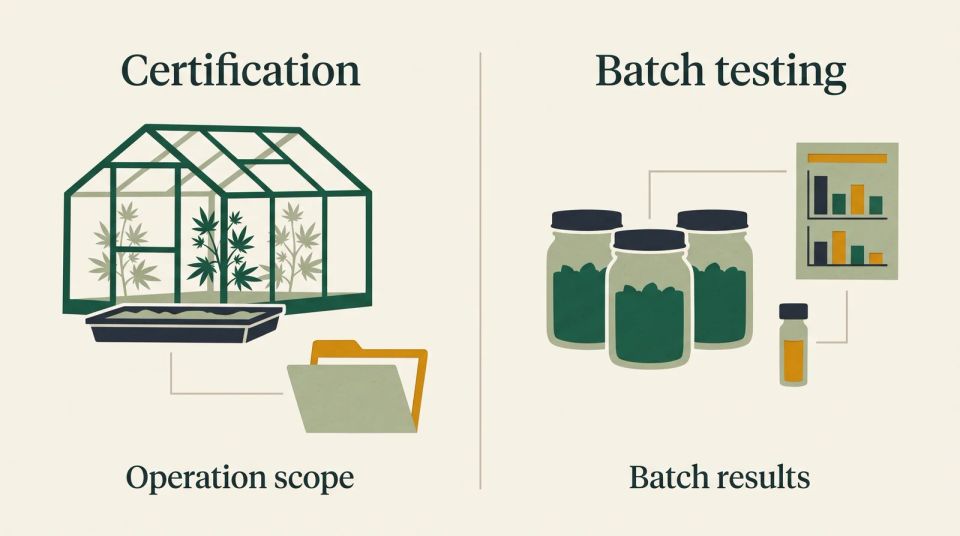
Certification and batch testing answer different questions. Shapes and bars are schematic, not test data or product approval.
The batch identity comes first when you read the test report. Use our lesson on matching a COA to the package’s batch or lot. A report for another batch cannot answer the question about yours.
The record also depends on the sample behind it. Our chain-of-custody lesson explains how sample identity and handling connect material to a result.
Why doesn’t OCal mean zero pesticides?
The OCal rules define which substances are allowed or banned. “Synthetic” does not mean “always prohibited.”
CDFA’s rules allow certain synthetic substances under stated conditions. They also ban certain nonsynthetic ones. An input must meet the program’s rules. Calling it natural does not settle the question. This distinction appears in §10105.
Residue testing is part of oversight too. Under §10711, certifiers conduct periodic tests. The rule also sets a yearly minimum number of operations to sample. Those checks differ from DCC’s tests of retail-bound batches. The presence of an OCal designation does not mean a certifier separately tested every retail jar.
If a test detects a prohibited substance, the certifier must investigate its cause. The rules also define when residue excludes cannabis from OCal sales or labels. §§10711–10712 therefore describe a testing-and-response system, rather than a promise of absolute absence.
CDFA’s residue-response guidance further explains the investigation. A detection alone does not establish intentional prohibited use. That does not make every residue acceptable. The substance, test result and circumstances still matter.
On the COA side, “not detected” means the method did not detect the listed substance under its reporting conditions. It is not proof of zero molecules or a test for every possible chemical. Our pesticide-results lesson covers that analytical distinction.
What should I compare with an OCal claim?
Compare the claim with evidence about the operation and the particular product. A program name on a package is a starting point.
CDFA links to its Certified Operations list. The version opened for this lesson was updated October 9, 2026. It gives operation names, certifiers, status and product information. Match those details to the claim, rather than assuming a shared brand name settles the scope.
For manufactured products, use CDPH’s OCal program page and its verification resources. CDPH’s manufacturer FAQs explain two separate requirements: third-party certification and department registration. An application alone does not allow OCal sales. The word “registered” alone does not establish product certification.
Then examine the batch report separately. Compare the package’s identity with the COA, and read the test and report dates in context. Our lesson on COA age and package dates explains why the dates answer different questions.
This same habit applies to the wider transaction: dispensary verification checks distinguish evidence about a business from evidence about a product. No single badge answers both.
Does certification establish a health advantage?
No health advantage follows from certification alone. Meeting production standards is one claim. Passing a test panel is another. Neither demonstrates a benefit to a person.
An OCal certificate does not establish that inhaling or eating the product is harmless. Nor does it prove a medical benefit or predict stronger effects. Those claims require their own evidence. A production designation cannot supply that evidence.
Key takeaways
- OCal concerns certified practices and eligible products; a COA reports batch testing.
- Check operation status and product scope separately from batch identity.
- Allowed-input rules and residue oversight do not promise absolute zero residue.
- Certification does not establish a health or effects advantage.
FAQ
Is OCal the same as USDA organic certification?
No. OCal is California’s comparable-to-organic cannabis program. Its designation is separate from USDA organic certification. Use the relevant California program resources to assess an OCal claim.
Does a passing COA make cannabis OCal?
No. A passing COA reports testing status for a batch. It does not establish compliance with OCal production, handling and certification requirements.
Does pesticide detection prove the OCal claim was false?
Not by itself. Under CDFA’s rules, detecting a prohibited substance requires investigation into its cause. Product eligibility depends on the applicable residue rules and circumstances. The label alone cannot resolve them.
Does an operation’s OCal status cover every product it sells?
No. Match the claim to the relevant product and certification scope. A business can have OCal status while some items linked to its name remain outside that scope.
Sources
- CDFA: OCal program and verification resources.
- CDFA: OCal Final Regulation Text, especially §§10105, 10300, 10504 and 10711–10712.
- CDFA: Responding to Results of Pesticide Residue Testing, April 23, 2021.
- CDFA: Certified Operations list, version updated October 9, 2026.
- DCC: Testing laboratories.
- CDPH: Manufactured-product OCal program and manufacturer FAQs.
Program pages and linked rules were checked October 11, 2026. This lesson explains the evidence categories. It does not decide compliance for a particular product.


