Cannabis Laws in Spain 2026: The Social Club Model
Cannabis in Spain sits in a legal gray zone: private use is decriminalized, but clubs, public use, and sales follow strict rules. The 2026 picture.


Have you heard that “weed is legal in Spain”? Maybe you pictured Amsterdam-style shops lining the Barcelona seafront. I have some careful unpacking to do. Spain is one of the most fascinating cannabis jurisdictions on the planet. But that is not because it legalized anything. It didn’t. Instead, Spain built a quiet, lawyer-shaped loophole. What you do in private is mostly your own business. And thousands of members-only associations grow and share cannabis in a closed circuit. The courts have spent two decades arguing about it.
Welcome to the Cannabis Social Club model. It is unlike anything in North America, different from the Dutch coffeeshop system, and frequently misunderstood by the travelers who fly in expecting a dispensary crawl. Let’s walk through how it actually works in 2026, where the legal lines really sit, and why “decriminalized” and “legalized” are two very different animals.
Quick Facts: Cannabis in Spain (2026)
| Question | Status in 2026 |
|---|---|
| Private personal use | Decriminalized (not a crime) |
| Private home cultivation | Tolerated for personal use; not visible from public space |
| Public use or possession | Administrative offense — fines under the Ley Mordaza |
| Buying or selling cannabis | Illegal; sale and trafficking are criminal offenses |
| Commercial dispensaries | Do not exist legally |
| Cannabis Social Clubs | Legal gray area; private non-profit associations |
| Can tourists just walk in? | No — clubs are members-only, by referral |
| Medical cannabis | Framework approved (2022); slow, limited rollout |
| Typical public-use fine | Roughly €601–€30,000 range; most are €600–€2,000 |
This is education, not legal advice. Cannabis law in Spain turns on local enforcement, regional politics, and individual court rulings that can contradict each other. Always check current local rules before you act, and never treat a blog post as a substitute for a Spanish lawyer.
Decriminalized, Not Legalized — The Crucial Distinction
Here is the single most important sentence in this entire guide: private cannabis use in Spain has never been a crime, but cannabis commerce very much is.
Spain’s 1978 Constitution enshrines a strong right to personal privacy and autonomy. Spanish courts have long read that as a limit on state power. The state has no business policing what an adult consumes at home. So personal possession and use in a private space sits outside the criminal code entirely. Growing a few plants for yourself, out of public view, falls into the same tolerated zone.
Step outside that private bubble, though, and the picture changes fast:
- Public consumption and possession are administrative infractions. The law is the Ley Orgánica de Seguridad Ciudadana, nicknamed the Ley Mordaza (“Gag Law”). Penalties are fines, not jail. The headline range runs from €601 up to €30,000 for aggravating circumstances. In practice, a tourist caught smoking in a plaza is more likely to see a fine in the €600–€2,000 band, plus confiscation.
- Selling, buying, importing, or trafficking any amount is a criminal offense that can carry prison time. There is no legal retail channel. None.
So when someone says cannabis is “legal” in Spain, they usually mean something narrower: “you probably won’t be prosecuted for using it at home.” That is decriminalization of private use. It is a world away from the regulated, taxed, commercial legalization you see in Canada or many US states. Want a clean comparison of full federal legalization? Canada’s 2026 framework is the textbook example. The United States patchwork shows the messy middle.
The Cannabis Social Club Model, Explained
If you can’t buy cannabis legally and you can’t use it in public, how do hundreds of thousands of Spaniards consume regularly? Through a structure found almost nowhere else: the Cannabis Social Club, or Asociación Cannábica (CSC).
A Cannabis Social Club is a private, non-profit association. It is registered under Spain’s constitutional right of association. The legal theory is elegant. A closed group of adult consumers pools resources to grow cannabis together. The harvest is purely for their own shared use. They never sell to outsiders, never advertise, and never turn a profit. So arguably no “sale” and no “trafficking” takes place. It is framed as shared private consumption among “specific and previously identified persons,” scaled up.
In practice, a typical club works like this:
- You must be referred by an existing member. Clubs deliberately do not advertise and are not open to the public. The referral rule is not a vibe — it is load-bearing legal architecture. It keeps the membership a defined, private circle rather than an open market.
- You join formally: show ID, prove you are an adult (18+, though some clubs set 21+), confirm you are already a cannabis consumer, sign the bylaws, and pay a modest registration fee (often €20–€50) plus monthly dues.
- You declare your consumption needs. The club aggregates member demand and grows accordingly, aiming to match supply to the membership — never to produce a sellable surplus.
- You consume on-site, in the club’s private members-only space, not on the street. Collecting your allotted amount is treated as covering production costs, not buying a product.
This “closed-circuit” design — cultivate internally, distribute only to declared members, consume only within private space — is what keeps clubs (mostly) out of the trafficking category. It is also exactly why a club is not a shop.

Catalonia, Barcelona, and the Basque Country
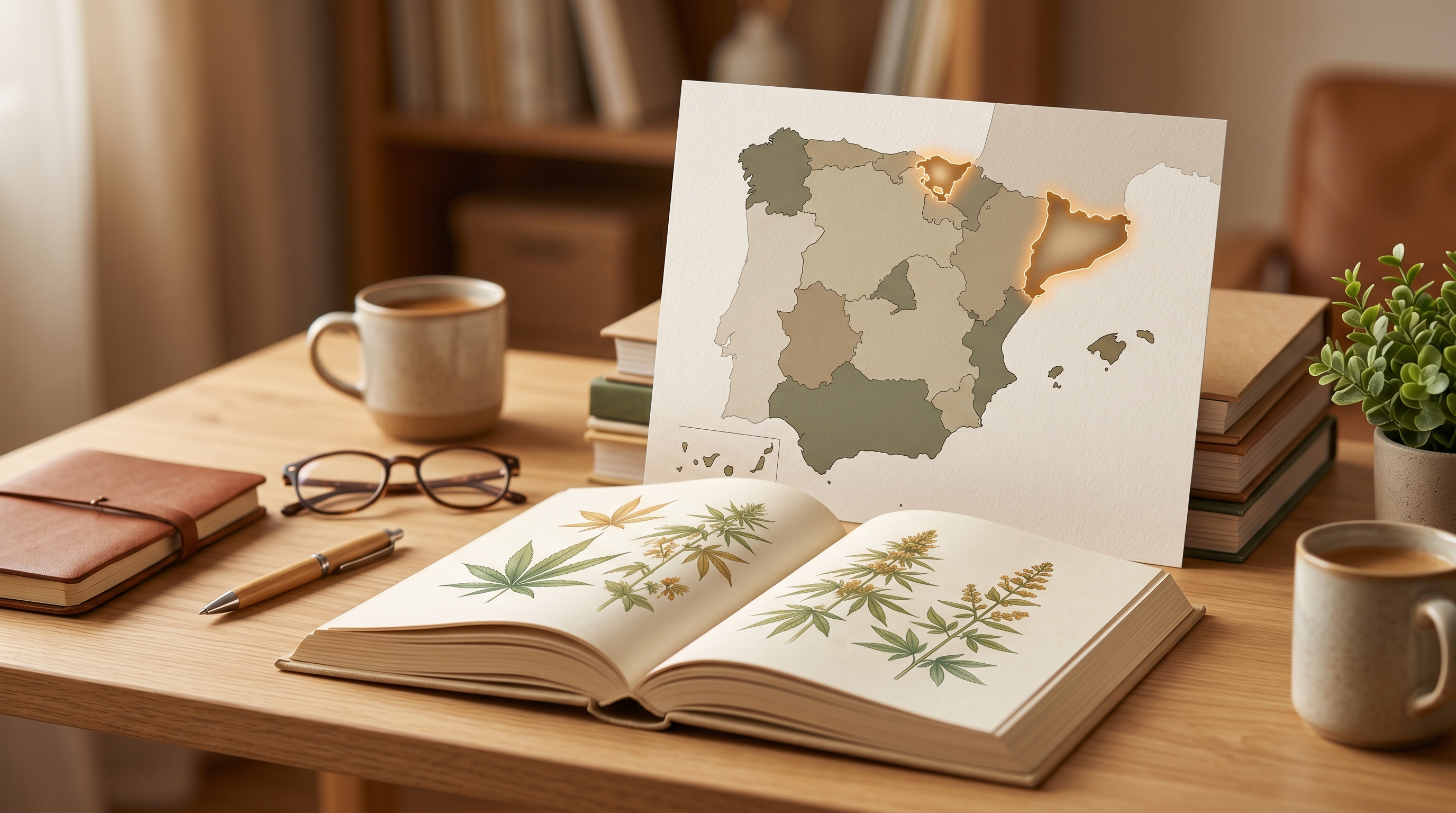
The clubs are not spread evenly across Spain. The model is heavily concentrated in two regions with strong traditions of civic association and a degree of political openness to it.
Catalonia — and Barcelona in particular — is the epicenter. At the peak of expansion, Barcelona alone reportedly housed over 200 clubs. Catalonia accounts for the large majority of associations nationwide. Catalonia even tried to put the model on a formal regional footing. In 2017 it passed regulations that recognized clubs, capped annual cultivation, and set rules for registered members.
The Basque Country is the other major hub, with its own deep tradition of social clubs and harm-reduction-minded local policy.
Madrid and Andalusia have meaningful numbers too, but nothing like the density of Catalonia. Nationwide, estimates put the active club count somewhere in the high hundreds to roughly a thousand, depending on who’s counting and how many are in legal limbo at any given moment.
Why It’s Still a Legal Gray Area
If Catalonia regulated clubs in 2017, why do I keep calling this a “gray area”? Because Spain’s higher courts repeatedly pulled the rug out.
The crucial blow came in 2021. The Spanish Supreme Court struck down regional regulations governing clubs. Its reasoning: drug policy is a national matter, so an autonomous community cannot legislate it alone. Earlier Constitutional Court decisions had already invalidated similar local attempts. The result? Clubs are back to operating on judicial doctrine — the accumulated body of court rulings about shared consumption — rather than any clear statute.
And those rulings are not consistent. The same club activity can play out two ways. One operator is acquitted; another is convicted of supply under the Penal Code. It depends on the court, the region, and the scale. It also depends on whether prosecutors can show the operation looked more like a business than a genuine private collective. Enforcement is just as uneven. Some local police use heavy discretion and largely leave compliant clubs alone. Elsewhere, authorities crack down. Barcelona’s city council has at times moved to close clubs. It accused them of violating municipal rules and fueling cannabis tourism.
So the honest 2026 summary: clubs are tolerated but legally precarious. They exist in the space between “not explicitly legal” and “not reliably prosecuted.” That ambiguity is the whole game.
A Word to Travelers: This Is Not Amsterdam
This is where well-meaning visitors get burned, so let me be blunt.
Spanish cannabis clubs are members-only, by referral, and not legal tourist shops. A Dutch coffeeshop can sell to any adult who walks in. A Spanish CSC cannot. It is legally premised on being a private circle of pre-identified members. Picture a club that starts treating walk-in tourists as customers. It stops looking like shared private consumption. It starts looking like the exact retail trafficking the law criminalizes. That is the behavior that tends to draw crackdowns.
A few realities to keep in mind:
- You cannot legally buy cannabis anywhere in Spain, full stop.
- “Membership” promotions hustled to tourists on the street are a legal and safety risk for everyone involved, and some clubs admit residents only.
- Smoking in public — beach, plaza, park — invites a Ley Mordaza fine and confiscation.
- Crossing a border into or out of Spain with cannabis is straightforward trafficking. Don’t.
If you’re researching Spain as part of a broader European trip, it pairs interestingly with the Netherlands’ tolerated-but-illegal coffeeshop system, Portugal’s pioneering decriminalization of all drugs, and Germany’s 2024 move toward legal home cultivation and clubs. Each took a different road; Spain’s club model is its own creature.
Medical Cannabis: Slow Progress
Spain’s medical-cannabis story has moved at a glacial pace. A parliamentary subcommittee in 2022 recommended a regulated medical framework. Then in 2024 a royal decree advanced the rules. It proposed that only specialist physicians could prescribe cannabis-based products. And it limited those to a short list of qualifying conditions — think chronic pain, certain epilepsies, cancer-treatment side effects, and multiple sclerosis spasticity.
Two big caveats apply for 2026. First, the rollout has been slow and narrow. Second, the draft framework did not open the door to dispensing cannabis flower. The emphasis is on standardized, pharmacy-channeled preparations. So Spain’s medical program is real on paper. But it remains far more restrictive than the recreational gray market that the social clubs occupy.
How This Connects to Understanding Your Cannabis
Legal frameworks decide where you can use cannabis. They tell you nothing about how a given strain will actually make you feel — and that is the part most people get wrong, whether they’re in a Barcelona club or a Denver dispensary.
The effect you experience comes far more from a strain’s terpene profile and cannabinoid balance. The “sativa vs. indica” label on a jar matters far less. That’s the whole reason we built the High Family system. It groups strains by their dominant terpene chemistry and the experience it tends to produce.
A few anchors worth knowing:
- Myrcene is the heavy, couch-locking terpene behind a lot of Relax-family strains and the classic body-stone — useful if your goal is winding down, relaxation, or sleep.
- Limonene brings the bright, citrusy lift you find across Uplift-family cultivars, often associated with a happy, mood-elevating experience.
- Caryophyllene is the peppery one that interacts with CB2 receptors and shows up across Relief-family strains people reach for when chasing physical comfort.
- Terpinolene and pinene tend toward the Energy family — brighter, more focused, creative-leaning sessions.
Say you become a legitimate, long-term member of a Spanish club. The same principle applies that applies everywhere: track what you consume and how it affects you. Globally beloved cultivars behave differently from person to person. Think Blue Dream, Girl Scout Cookies, OG Kush, Gelato, Northern Lights, Sour Diesel, and Granddaddy Purple. That is exactly why logging your own effects beats trusting a menu description. Want the bigger picture on how policy is shifting region by region? Our breakdown of cannabis legalization across the United States is a good companion read.
Key Takeaways
Spain in 2026 is a study in nuance. Private use is left alone. Public use gets fined. Sales are criminal. And in the gap between those rules sits the Cannabis Social Club. It is a genuinely original model: members-only, non-profit, and closed-circuit. It has survived two decades of legal turbulence. The reason is simple — it refuses to look like a business.
It is not a shop. It is not legalization. It is not for tourists wandering in off the Ramblas. It is a privacy-rooted workaround. And it works only as long as it stays private, non-commercial, and small. It has to look like sharing rather than selling. Understand that, and you understand Spanish cannabis better than most of the people lighting up on the beach — and getting fined for it.
Sources
- Cannabis in Spain — Wikipedia
- Cannabis Social Clubs in Spain — how cannabis associations work (Cannapio)
- Is Weed Legal in Spain? Laws, Fines & Cannabis Clubs (WeedMadrid)
- The Legal Status of Cannabis in Spain (Royal Queen Seeds)
- Guide to Cannabis Social Clubs in Spain (Green Dream Club)
- Cannabis Laws in Spain — A Complete Guide (Cannabis Training University)
Educational content only. This article does not constitute legal advice. Cannabis laws and their enforcement change frequently and vary by region — consult qualified local counsel before making any decisions.


