The Seasonal Cannabis Guide: Perfect Strains for Every Time of Year
Spring, summer, fall, or winter—your body's chemistry shifts with the seasons. Here's how to match your cannabis to the time of year.


Updated July 2026: New research from Castonguay-Paradis et al. (2025) has confirmed seasonal endocannabinoidome shifts in humans for the first time, and a July 2026 study provides mechanistic evidence for terpene-specific synergy at cannabinoid receptors. Internal links updated to reflect newer strain profiles and the Summer 2026 strain rankings.
Why the Season Changes the High You Need
Here’s something that surprises most people when they first hear it: your body’s endocannabinoid system does not operate the same way in July as it does in January. Research confirms that endocannabinoid levels — particularly anandamide, often called the “bliss molecule” — fluctuate with seasonal changes in daylight, temperature, and activity patterns [Hillard, 2018]. A 2025 human study published in Gut Microbes directly measured these seasonal shifts in circulating endocannabinoidome mediators for the first time, finding that several N-acylethanolamines (NAEs) — the family that includes anandamide — varied significantly by season, independent of vitamin D status or lifestyle habits [Castonguay-Paradis et al., 2025]. Your serotonin peaks in summer and craters in winter. Your melatonin surges when nights grow long. Your inflammation markers climb when temperatures drop. The internal chemistry you bring into every cannabis experience shifts across the calendar, and that means the strain that felt like liquid sunshine on a June afternoon can feel completely wrong on a dark December evening.
Think about it from a different angle. You don’t eat the same foods year-round. You don’t wear the same clothes. Most people don’t even listen to the same music. So why reach for the same cannabis experience regardless of the season?
This guide is built on a straightforward principle: matching your cannabis to the season is smart chemistry, not just a vibe. By understanding how terpene profiles interact with your body’s natural seasonal rhythms, you can choose cannabis that feels calibrated to the world around you rather than working against it.
We’ll walk through the biology of seasonal shifts and how they connect to the endocannabinoid system, then break down which terpene profiles and High Families best complement each season. Every section includes specific strain picks with the chemistry to explain the recommendation — not just vibes, but reasons. Whether you’re a seasoned connoisseur building a seasonal rotation or someone who just wants their cannabis to actually feel right, the framework here applies across the board.
Let’s get seasonal.
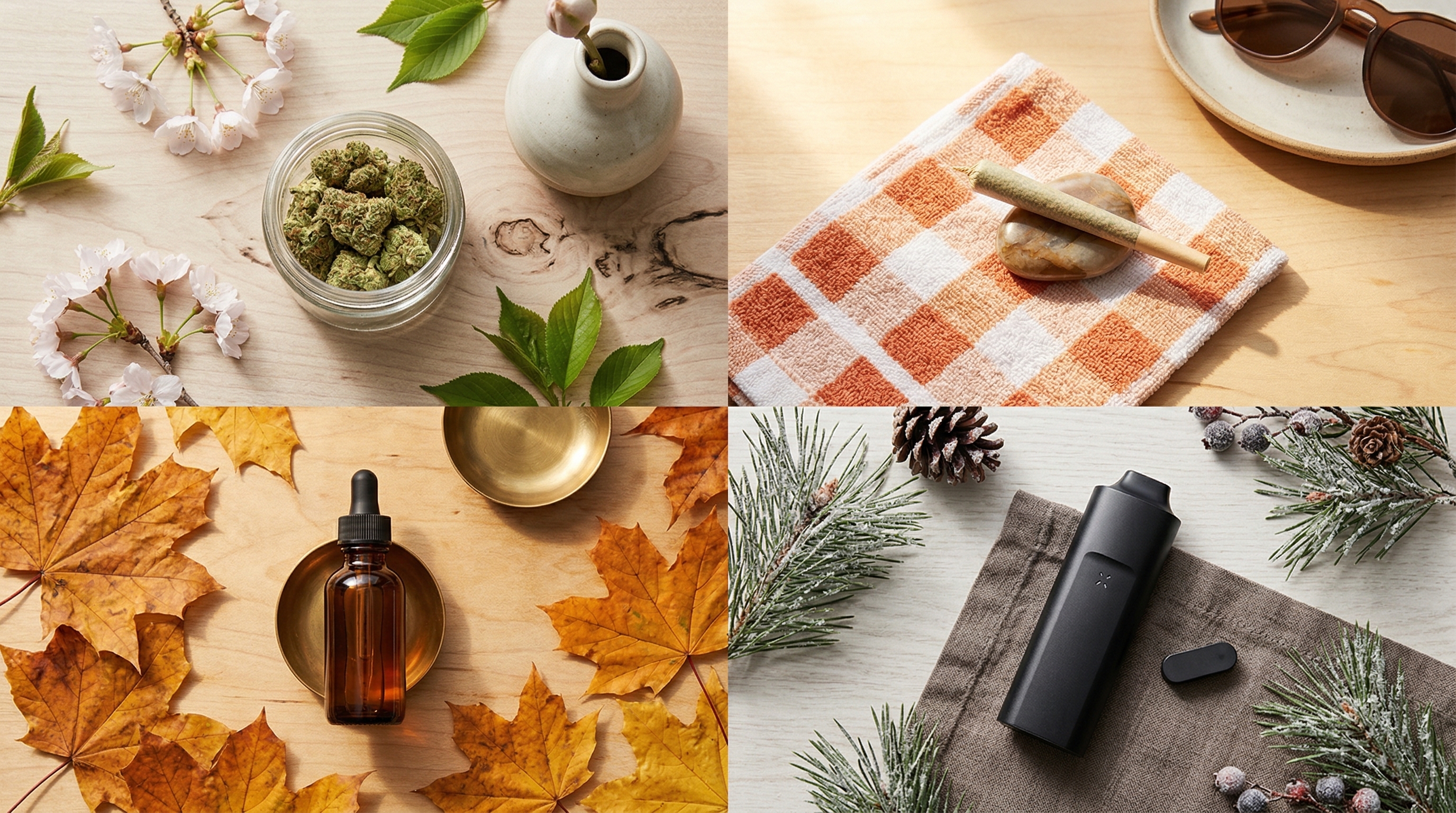
The Science: How Seasonal Biology Connects to Your Endocannabinoid System
Your ECS Is Not Static
Your endocannabinoid system (ECS) is a vast signaling network that helps regulate mood, sleep, appetite, pain perception, and immune response. It operates through endocannabinoids (molecules your body produces naturally, like anandamide and 2-AG), receptors (CB1 and CB2, distributed throughout your brain and body), and enzymes that break everything down. Cannabis compounds — THC, CBD, and the full terpene spectrum — interact with this same system, which is why cannabis affects so many different functions.
But the ECS is not a fixed thermostat. Several key biological systems that interface with it shift meaningfully across the year:
Serotonin production peaks in summer and declines in winter, directly driven by sunlight exposure [Lambert et al., 2002]. Serotonin and the ECS share overlapping regulatory pathways in mood circuits, which means your baseline emotional state entering a cannabis experience is seasonally variable — often without you realizing it.
Melatonin levels rise in autumn and winter as nights grow longer, priming your body toward sedation [Wehr, 2001]. A Relaxing High strain may hit meaningfully harder in January than in August, not because the cannabis changed, but because your biology is already leaning in that direction.
Anandamide, your body’s own THC-like molecule, appears to be influenced by sunlight and exercise patterns — both of which are strongly seasonal [Hillard, 2018]. A 2025 study mapping endocannabinoid dynamics across the circadian cycle found that 26 of 78 measured endocannabinoids showed significant circadian rhythmicity, with NAE levels rising progressively through the light-dark cycle [Farfara et al., 2025]. Higher natural anandamide in summer may mean that lower THC doses achieve a comparable mood lift. This is why many experienced consumers notice their dose needs to shift across the year.
Inflammation markers tend to increase in colder months, partly due to reduced physical activity, less sunlight, and lower vitamin D production [Khoo et al., 2011]. This makes anti-inflammatory terpenes like caryophyllene and humulene more physiologically relevant in winter — not just nice to have, but potentially meaningful for comfort and recovery.
Terpenes: The Actual Mechanism
Terpenes are not merely responsible for how cannabis smells. They are biologically active compounds that modulate how cannabinoids interact with your body — the foundation of the entourage effect first described by Mechoulam and Ben-Shabat [1998] and expanded by Russo [2011]. A 2026 receptor study added mechanistic detail: it found that terpenes may act as both partial agonists and allosteric modulators at CB1 and CB2 receptors, with specific terpene-receptor pairings producing synergistic rather than merely additive effects — limonene, pinene, and ocimene synergize with THC at CB1 receptors, while caryophyllene and linalool synergize at CB2 [Raz et al., 2026]. This was measured in engineered cells, not in people. Different terpene profiles produce genuinely different experiential signatures, and those signatures align with seasonal needs in predictable ways.
| Terpene | Primary Effects | Peak Seasonal Relevance |
|---|---|---|
| Limonene | Mood elevation, stress relief | Spring & Summer |
| Terpinolene | Mental clarity, energized focus | Spring & Summer |
| Ocimene | Bright, cerebral energy | Summer |
| Myrcene | Deep relaxation, sedation | Autumn & Winter |
| Caryophyllene | Anti-inflammatory, physical comfort | Autumn & Winter |
| Humulene | Grounding, body ease | Winter |
| Linalool | Calming, anxiety relief | Seasonal transitions |
| Pinene | Alertness, memory support | Spring & outdoor use |
A 2021 survey study by Kamal et al. found that cannabis consumers intuitively adjusted their consumption patterns seasonally — preferring sedating strains in winter and energizing ones in summer — even without understanding the terpene science behind their choices. Your instincts are already pointing you in the right direction. This guide gives those instincts a reliable framework.
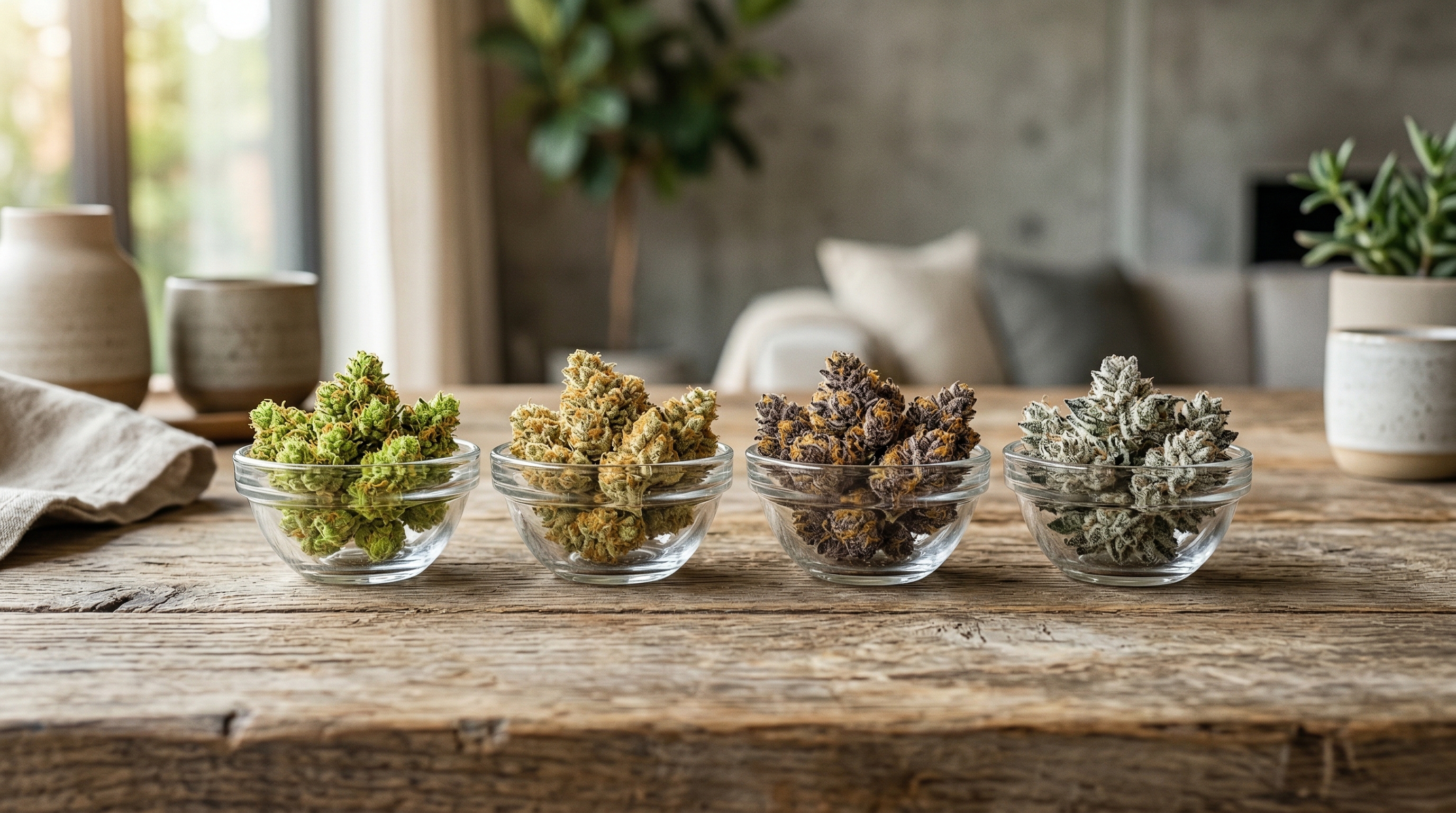
Your Season-by-Season Cannabis Playbook
Spring: Renewal, Creativity, and Gentle Uplift
Spring is a season of transition. Your body is emerging from winter’s lower serotonin baseline and elevated melatonin, and daylight hours are lengthening rapidly. You may feel a surge of creative energy mixed with residual winter sluggishness — the perfect conditions for strains that gently uplift without overwhelming. Heavy sedation profiles feel wrong here. You want to open windows, start projects, get outside.
The Biology of Spring
As daylight increases through March and April, serotonin production begins rebounding [Lambert et al., 2002]. This is why spring genuinely feels more optimistic for most people — it’s not just psychology, it’s neurochemistry. The best spring cannabis works with this upswing rather than suppressing it. Terpinolene- and limonene-dominant strains amplify the mood lift without creating the racy edge that higher-THC summer strains can bring when your system is still recalibrating.
Best High Families for Spring
- Uplifting High — Limonene- and linalool-dominant strains provide mood elevation and social warmth that mirrors spring’s energy. These are the strains that make you want to call a friend, take a walk, or start that project you’ve been thinking about since February.
- Energetic High — Terpinolene-forward strains deliver focused, creative productivity perfect for spring cleaning — literal or metaphorical. Lighter body load, more cerebral orientation.
- Balancing High — For the first few weeks of spring, while your body is still mid-transition, a gentler balanced profile may help smooth the shift from heavy winter sedation to full energetic stimulation. Many consumers find starting here makes the seasonal change feel less jarring.
What to Look For on the Shelf
- Dominant terpenes: limonene, terpinolene, pinene
- THC range: 18–24% for functional daytime use
- Aromas: Citrus, floral, fresh pine, green herb
Spring Strain Picks
Jack Herer — The classic for a reason. This terpinolene-dominant Haze hybrid delivers clear-headed energy, sustained focus, and creative flow that feels perfectly calibrated for the emergence of longer days. Named after the legendary cannabis activist, its cerebral clarity won’t pin you to the couch when you’re itching to get outside. THC: 18–24%.
Strawberry Cough — Sweet, berry-forward, and gently uplifting. The pinene content supports alertness, while the mild terpinolene and limonene backbone keeps things clear and social without being overwhelming. A reliable spring entry point, especially for those easing out of heavier winter strains. THC: 18–22%.
Super Lemon Haze — High limonene content and sparkling citrus character deliver the mood elevation that makes spring mornings feel genuinely exciting. Two-time High Times Cannabis Cup winner. The bright uplift here is particularly good for creative work and social energy as social calendars start filling up again. THC: 20–25%.
Mimosa — A Clementine x Purple Punch cross with one of the most inviting aromas in cannabis: fresh-squeezed citrus and tropical brightness. The limonene-forward profile provides uplifted energy with just enough myrcene from the Purple Punch lineage to keep it from feeling sharp. A perfect spring Sunday strain. THC: 19–27%.
Pineapple Express — Accessible, tropical, and forgiving. The terpinolene-myrcene balance keeps the experience functional and clear-headed at moderate doses. Particularly well-suited for outdoor beginners who want energizing effects without anxiety. THC: 17–22%.
Spring Transition Tip: If you’ve been leaning on heavy myrcene-dominant strains all winter, don’t switch abruptly to a pure terpinolene strain. Your ECS receptors have been calibrated to heavier sedation profiles. Spend the first week of spring with a Balancing High strain or a 1:1 THC:CBD product, then work up to the brighter profiles. Your body will thank you.
Summer: Energy, Adventure, and Social Connection
Summer is peak serotonin season. Your body is naturally more energized, socially engaged, and physically active. Natural anandamide levels may be elevated from increased outdoor activity and sunlight exposure [Hillard, 2018], which has a practical implication: lower doses may feel more potent in summer. The same quantity that felt moderate in February might feel intense in July.
This is the season for cannabis that matches the pace — outdoor activities, social gatherings, festivals, creative adventures, and long evenings where you actually want to stay awake and present.
The Biology of Summer
High serotonin, elevated natural anandamide, longer active days, and more physical movement all combine to create a baseline state that’s already inclined toward energy and connection. Heavy sedating strains work against this biology — myrcene-dominant profiles often feel inappropriate in the height of summer, creating a dragging heaviness when the world outside is calling. Light, energizing terpene profiles that amplify what’s already there are the play.
Best High Families for Summer
- Energetic High — Ocimene- and terpinolene-dominant strains match summer’s active pace and outdoor lifestyle. Ideal for hikes, beach days, festivals, and anything where you want to be in your body and present to your surroundings.
- Uplifting High — Limonene-dominant strains amplify the already-elevated mood chemistry of long summer evenings. The social lubricant of the cannabis world.
- Entourage High — Complex multi-terpene profiles shine in summer when your system is robust enough to appreciate nuance. These strains reward slower consumption and attention.
What to Look For on the Shelf
- Dominant terpenes: terpinolene, ocimene, limonene
- THC range: 15–22% for active outdoor use; up to 26% for calmer social settings
- Aromas: Tropical, citrus, fresh herb, mango, tropical fruit
Summer Strain Picks
Durban Poison — The “espresso of cannabis.” This pure South African sativa features high terpinolene content and notable THCV levels — a cannabinoid associated with energizing, appetite-modulating effects. The result is an especially clean, cerebral energy without the racy edge that high-THC sativas can bring. Ideal for long active summer days where sustained focus matters. THC: 17–26%.
Green Crack — Sharp mango-citrus character with focused, alert energy that keeps you moving and curious. The terpinolene and myrcene combination creates a surprisingly functional effect profile — energizing without the jitteriness. One of the most reliably activating strains in legal markets. THC: 16–22%.
Tangie — Intense tangerine terpene profile dominated by limonene, with an enthusiastic, motivating high perfect for sustained physical or creative activity. The citrus brightness lifts mood reliably and consistently, even into the middle hours of a long summer afternoon. THC: 19–22%.
Golden Goat — Tropical and spiced citrus with a terpinolene-forward profile that produces creative, energized focus. Strong but clean-headed, making it a natural fit for beach days, poolside conversations, and outdoor creative sessions. A Colorado dispensary staple with a loyal following. THC: 23–25%.
Clementine — Ultra-high limonene content makes this one of the most purely mood-elevating strains available. Less physically activating than the terpinolene-forward options, more focused on the feeling of pure sunny positivity. Excellent for social summer evenings and group settings. THC: 17–22%.
Sour Diesel — An East Coast legend with pungent diesel-citrus character and fast-acting cerebral effects. The limonene dominance keeps social energy flowing, while the caryophyllene keeps the body comfortable through active days. Many users describe a compounding effect when used outdoors — the physical activity amplifies the high. THC: 18–25%.
For a data-driven look at what’s performing best this summer, see our Top Strains for Summer 2026 ranked by real consumption data, and the Top 10 Cannabis Strains of 2026 for the full annual picture.
Summer Dosing Note: Hydration matters more than you think. Cannabis causes dry mouth by binding to cannabinoid receptors in salivary glands, and summer heat compounds dehydration risk significantly. Keep water close, particularly with energizing strains that make it easy to forget to drink while you’re in the flow. Also: exercise releases stored THC from fat tissue, so start conservatively before physically demanding activities.
Autumn: Reflection, Comfort, and Seasonal Depth
Autumn is a season of transition in the opposite direction. As daylight decreases, melatonin production ramps back up and serotonin begins its seasonal decline. This is a natural time for turning inward — cozy evenings, slower days, deeper conversations, introspective creative work, and the kind of comfort that outdoor summer strains don’t quite deliver.
Your cannabis should mirror this shift toward warmth and depth. The strains that felt sharp and bright in July begin to feel a bit thin by October. You start reaching for something with more weight to it.
The Biology of Autumn
The transition from summer to fall represents one of the most significant neurochemical pivots of the year. Serotonin levels begin declining as daylight hours shorten, while melatonin production increases. This combination produces the natural tendency toward earlier evenings, more reflective moods, and a preference for warmth and comfort over stimulation. It’s not seasonal affective disorder — it’s seasonal calibration. Working with it rather than against it produces a far better cannabis experience.
Inflammation markers also begin trending upward in autumn, particularly as temperatures drop and physical activity levels start to reduce [Khoo et al., 2011]. This is when caryophyllene-rich strains begin earning their place in the rotation — not just for their experiential qualities but for their functional CB2 receptor activity.
Best High Families for Autumn
- Relaxing High — Myrcene-dominant strains begin feeling more aligned as your body’s natural sedation chemistry increases. Perfect for those first cool evenings with a candle, a book, or a record.
- Relieving High — Caryophyllene and humulene strains provide physical comfort as temperatures drop and joints stiffen. The functional anti-inflammatory properties of these terpenes become genuinely relevant.
- Entourage High — The complexity of multi-terpene profiles pairs beautifully with autumn’s reflective character. These are strains to explore slowly, not to hurry.
What to Look For on the Shelf
- Dominant terpenes: myrcene, caryophyllene, linalool
- THC range: 20–28% for evening use; 15–22% for active autumn days
- Aromas: Earthy, spicy, woody, grape, berry, fuel
Autumn Strain Picks
Blue Dream — A Blueberry x Haze cross with a beautifully balanced effect: gentle full-body ease paired with cerebral warmth that keeps conversations flowing on autumn evenings. One of the most widely available strains in legal markets and consistently reliable as a seasonal bridge. The moderate profile makes it equally suitable for early autumn days and cool evenings. THC: 17–24%.
Wedding Cake — Rich, peppery sweetness from a high caryophyllene content, with vanilla and earthy depth. The effects are deeply physically comforting while maintaining enough mental clarity for conversation and contemplation. A natural fit for the kind of long autumn evening where the plan is nothing specific except being comfortable. THC: 25–27%.
Zkittlez — Candy-sweet and fruity with a linalool content that adds gentle euphoric warmth. Less sedating than pure myrcene heavyweights, making it ideal when the evening involves socializing — a dinner party, a campfire gathering, the first cool outdoor bonfire of the season. THC: 19–23%.
Granddaddy Purple — The archetypal autumn-evening strain. Myrcene and linalool dominate, delivering deep full-body ease that feels like finally exhaling after a long year. The signature grape-berry aroma alone evokes something cozy and unhurried. As autumn deepens toward winter, this strain tracks perfectly with the body’s natural turn toward rest. THC: 17–23%.
Cherry Pie — Beta-caryophyllene-dominant with a sweet cherry and earthy spice profile. The effect tends toward euphoric warmth with physical comfort — perfect for the autumn scenario where you want to feel good in your body and genuinely relaxed in your mind without full sedation. THC: 16–24%.
Gelato — A crowd-pleasing entourage profile with caryophyllene, limonene, and linalool working together for a layered experience that’s simultaneously physically comfortable and cerebrally engaged. Complex enough to be interesting, smooth enough to be easy. THC: 20–25%. Read more about why Gelato’s popularity keeps compounding in Gelato Decoded.
Autumn Insight: This is an excellent season to explore cannabis paired with reflective practices — journaling, creative writing, long conversations, or simply sitting with good music. The natural introspective quality of autumn, combined with a Relaxing High strain, creates a contemplative depth that summer’s stimulating profiles don’t easily access.
Winter: Rest, Recovery, and Deep Relaxation
Winter is your body’s natural recovery season. Melatonin is at its peak, serotonin at its lowest, inflammation markers tend to be elevated, and your circadian rhythm pushes hard toward rest [Wehr, 2001]. Fighting this biology with high-stimulation strains often feels genuinely uncomfortable in winter — a mismatch between what your body is signaling and what you’re giving it. The winter cannabis rotation leans into the season rather than resisting it.
This doesn’t mean numbing yourself. The best winter strains create a quality of deep, intentional rest — the kind that feels earned and restorative rather than simply knocked-out. They pair with long evenings, indoor warmth, comfort food, slow conversations, and the particular pleasure of having nowhere to be.
The Biology of Winter
Seasonal affective disorder (SAD) is the clinical extreme of what everyone’s biology experiences in winter to some degree: lower serotonin, disrupted sleep, reduced motivation, increased appetite, and a pull toward sedentary behavior. Cannabis can play a constructive role here — but the strain matters enormously. Energizing terpinolene strains may amplify restlessness and anxiety in a body already under hormonal stress. High-CBD strains and myrcene-caryophyllene profiles tend to serve the season far better.
Caryophyllene is particularly relevant in winter. As the only terpene known to directly bind to CB2 receptors in the endocannabinoid system [Gertsch et al., 2008], it modulates the immune and inflammatory pathways that are most active in cold months. It provides physical comfort without the heavy sedation of pure myrcene, which matters on winter days when you still need to function.
Best High Families for Winter
- Relaxing High — The primary winter family. Myrcene-heavy profiles align with your body’s biological mandate for rest and repair. These are your blanket, fireplace, long-movie strains.
- Relieving High — Caryophyllene and humulene-dominant strains address cold-weather physical discomfort and inflammation without full sedation. The functional daytime winter choice.
- Balancing High — For winter daytime use when you need to stay functional, gentle balanced profiles prevent the drowsiness that pure myrcene strains bring in a body already inclined toward sleep.
What to Look For on the Shelf
- Dominant terpenes: myrcene, caryophyllene, humulene, linalool
- THC range: Higher CBD ratios for daytime (1:1 to 20:1 CBD:THC); 20–28% THC for evening
- Aromas: Earthy, peppery, herbal, hash, woody, lavender
Winter Strain Picks
Granddaddy Purple — Already mentioned in autumn, but GDP earns its full place in winter. The myrcene and linalool profile produces the kind of physical warmth and mental calm that turns a cold night indoors into something genuinely pleasant. This is not a subtle strain — it’s for evenings when rest is the entire point. THC: 17–23%.
Northern Lights — One of the most celebrated pure indicas in cannabis history. Myrcene-forward with a reputation for near-perfect physical relaxation and mental calm. In winter, when your body has been running on reduced serotonin and elevated melatonin for months, Northern Lights feels less like a pharmaceutical and more like finally letting go. THC: 16–21%.
OG Kush — The foundational caryophyllene strain of modern cannabis. Deep body ease, complex earthy-pine-fuel aroma, enough cerebral quality to keep you present and engaged rather than simply unconscious. The winter evening strain for people who want to feel good without checking out completely. THC: 19–26%. For the full story on why OG Kush remains one of the most important strains in modern genetics, see OG Kush: The Genetic Backbone of Modern Cannabis.
Purple Punch — A Larry OG x Granddaddy Purple cross with grape candy sweetness and a deeply sedating myrcene-linalool profile. Heavy and warm in the best possible sense — a strain specifically engineered by nature for cold winter nights when sleep quality is the goal. THC: 18–25%.
Bubba Kush — Heavy myrcene and caryophyllene produce exceptional full-body sedation for the deepest winter nights. Not a functional strain — save this for evenings where early sleep is actually the plan. It’s the cannabis equivalent of a weighted blanket. THC: 14–22%.
Harlequin — A high-CBD strain (roughly 5:2 CBD:THC ratio) that provides clear-headed calm and gentle physical ease without significant intoxication. For winter daytime use — when full sedation would derail the day but you still want the comfort and anxiety relief that cannabis provides. The myrcene and pinene profile keeps things both relaxing and functional.
ACDC — Very high CBD (up to 20:1 CBD:THC), minimal psychoactive effect, and notable caryophyllene content. For winter days when physical discomfort is real but you need to maintain full functionality — working from home, caring for family, or simply getting through the day. One of the most medically respected strains in legal markets.
Winter Strategy: Keep two strains on hand in winter. A Balancing High or high-CBD option for daytime when the world still requires your presence, and a Relaxing High for the long evenings. Single-strain solutions tend to underserve winter’s split demands.
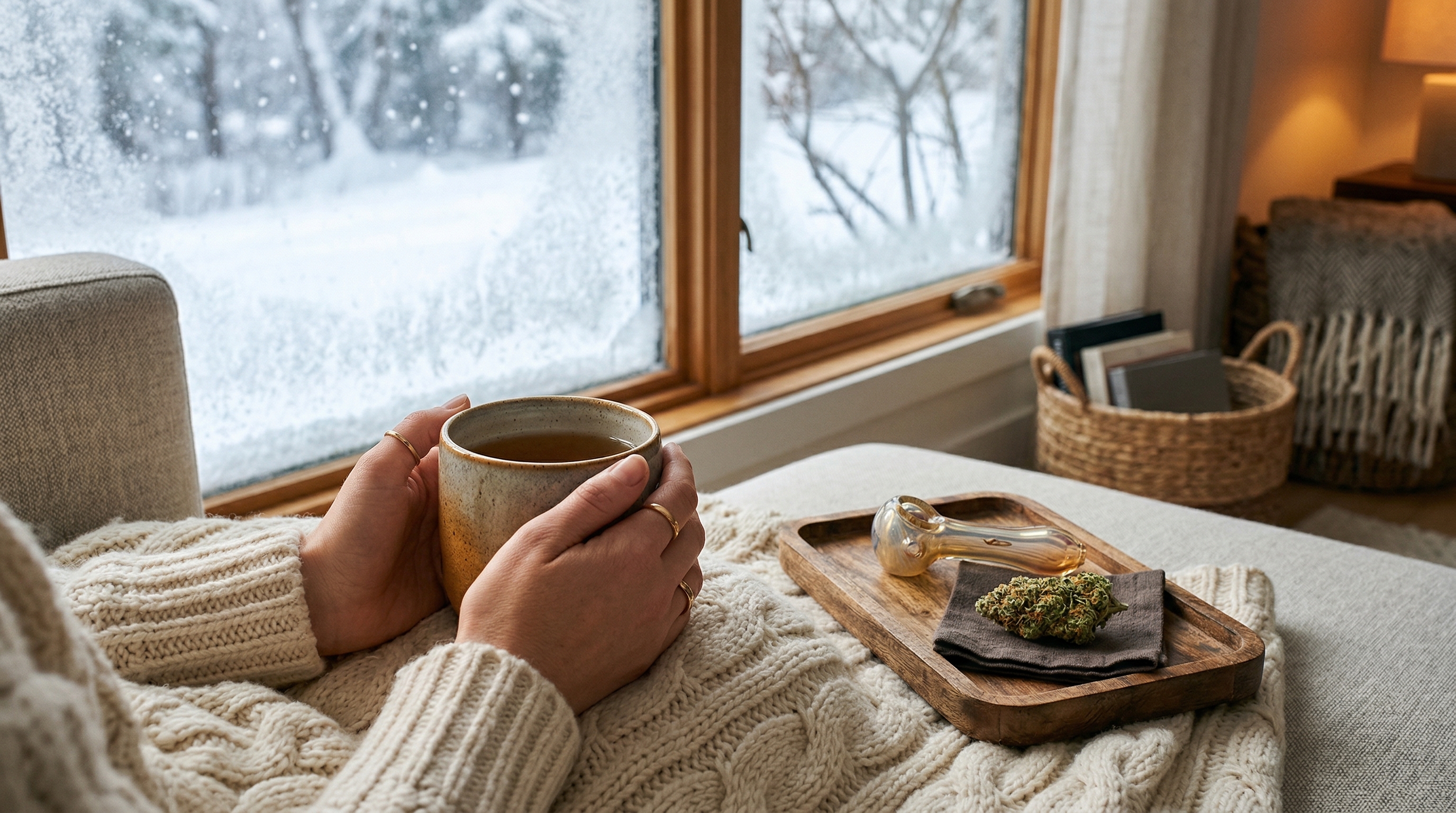
Seasonal Transitions: The Overlooked Factor
Most seasonal guides stop at the four seasons themselves. But the transitions between seasons — roughly February through March (winter to spring) and September through October (summer to fall) — are often the most disorienting cannabis experiences people have, and the least discussed.
During these transitional weeks, your body is recalibrating its hormonal and neurochemical balance relatively rapidly. Daylight hours are changing at their fastest pace. Serotonin is either climbing or falling quickly. Melatonin is actively shifting. The result: neither your winter strains nor your spring strains feel quite right, and dosing that felt reliable for weeks suddenly seems off.
Transitional Strategies
- Balancing High strains with gentle, low-intensity terpene profiles — Look for strains with diverse terpene spectra rather than a single dominant note. Complexity and balance over intensity.
- 1:1 THC:CBD ratios — The CBD moderates THC’s more extreme effects while preserving its benefits, which is particularly useful when your ECS sensitivity is actively shifting.
- Microdosing (2–5mg THC) — The transitional period is an ideal time to reduce your baseline dose. You may be surprised how effective a smaller amount feels when your body is mid-shift.
- Tolerance recalibration — A short tolerance break of 2–5 days during seasonal transitions helps your CB1 receptors reset alongside your natural biology. Many experienced consumers do this intentionally at equinoxes.
The transition from summer to fall (September) tends to catch people off guard more than the opposite shift — the energy of summer makes it easy to forget that the body is already adjusting to shorter days before you consciously notice it. If you find that your reliable summer strains start feeling heavier or more anxious around late August, your ECS is telling you to shift profiles earlier than the calendar says.
Using High Families as Your Seasonal Navigation System
Rather than chasing specific strain names — which vary wildly by market and availability — use the High Families system as your seasonal compass. High Families classifies strains by terpene chemistry and experiential effect rather than the outdated indica/sativa binary, which tells you almost nothing about how a strain will actually feel.
Here’s the complete seasonal mapping:
| Season | Primary High Families | Key Terpenes | Mood/Activity |
|---|---|---|---|
| Spring | Uplifting, Energetic | Limonene, Terpinolene, Pinene | Creative projects, socializing, outdoor emergence |
| Summer | Energetic, Uplifting | Ocimene, Terpinolene, Limonene | Active outdoor pursuits, adventure, group energy |
| Autumn | Relaxing, Relieving | Myrcene, Caryophyllene, Linalool | Cozy evenings, reflection, comfort |
| Winter | Relaxing, Relieving | Myrcene, Caryophyllene, Humulene | Deep rest, recovery, warmth |
| Transitions | Balancing | Diverse spectrum | Recalibration, micro-dosing, gentle support |
At any dispensary that labels terpenes — and more do every year — you can apply this framework directly to whatever strains they carry, without needing to know specific names. Ask for their dominant terpene data, match it to the table, and you have a reliable filter.
Practical Dosing Across the Seasons
Dose lower in summer. Natural anandamide production may be elevated from sunlight and exercise, making your ECS more sensitive. If you’ve been consuming consistently through the colder months, cut your summer dose by 20–30% and adjust from there. You’ll likely find it’s enough — or more than enough.
Dose mindfully in autumn. The transition to longer nights shifts your baseline toward sedation. A strain that felt perfectly balanced in September may start feeling heavier by November. Monitor your responses as the season changes, not just once at the beginning of it.
Dose intentionally in winter. Your body is already primed toward rest and sedation. High-myrcene strains can compound melatonin-driven sleepiness to a point that becomes unpleasant rather than comfortable — what some call “the wrong kind of couch lock.” If you find winter cannabis is more sedating than you want, try strains with caryophyllene rather than myrcene as the dominant terpene.
Consider CBD:THC ratios across the year. Balanced and high-CBD products are underutilized in seasonal cannabis planning. They provide comfort, mood support, and anti-inflammatory benefit without heavy psychoactivity — which makes them particularly valuable for daytime winter use and seasonal transitions.
Key Takeaways
- Your endocannabinoid system fluctuates seasonally. Serotonin, melatonin, anandamide, and inflammation levels all shift with daylight and temperature — changing how cannabis affects you before you even consume it.
- Terpene profiles matter more than strain names. Matching dominant terpenes to seasonal chemistry (limonene and terpinolene in spring and summer; myrcene and caryophyllene in autumn and winter) is a reliable, market-agnostic framework.
- Use High Families as your compass. Energetic and Uplifting for warm months, Relaxing and Relieving for cold months, Balancing for transitions.
- Dose lower in summer. Natural endocannabinoid elevation from sunlight and activity means your system is already primed — you need less.
- Dose intentionally in winter. Your body is inclined toward sedation. Lean into the season with myrcene and caryophyllene profiles rather than fighting it with stimulating terpenes.
- Don’t skip the transitions. September and March are when seasonal mismatches are most common and most uncomfortable. Plan a recalibration — balanced strains, lower doses, or a short tolerance break.
FAQs
Does cannabis actually feel different in different seasons?
Yes, and the mechanism is well-supported by biology. Your baseline neurochemistry — serotonin, melatonin, anandamide — shifts measurably with seasonal changes in light exposure and temperature [Lambert et al., 2002]. Since cannabis compounds interact with the same systems, the same strain can produce noticeably different subjective effects in July versus January. This is not placebo — it’s the ECS responding to a different internal environment.
Should I adjust my dose seasonally?
It’s worth experimenting. If you’re more active and getting more sunlight in summer, natural anandamide levels may be higher, making your ECS more sensitive. Lower doses often work better. In winter, the sedation-primed biology can make relaxing strains hit harder than expected. Start lower whenever you shift seasonal profiles.
Is this just the indica/sativa thing repackaged?
Not at all. The indica/sativa classification is based on plant morphology and has little scientific correlation with actual effects [Piomelli & Russo, 2016]. The High Families system and the seasonal framework here are built on terpene chemistry — the actual compounds responsible for experiential differences. Seasonal recommendations grounded in terpene profiles are far more predictive than “indica for winter, sativa for summer.”
What about seasonal affective disorder (SAD)?
Cannabis may offer some support during the lower-serotonin months, but it is not a treatment for clinical SAD. If you experience significant depression or dysfunction during winter months, consult a healthcare provider. That said, the biology here is real: limonene-dominant strains may help support mood in the lower-serotonin months of late autumn and winter, while caryophyllene strains may address some of the physical discomfort that accompanies seasonal low moods. See our companion article on cannabis and serotonin for the full picture.
What if I live somewhere without dramatic seasons?
Even in temperate or subtropical climates, daylight hours still shift and your circadian biology responds. The changes may be subtler, but the principle holds. Pay attention to your energy, mood, and sleep patterns throughout the year, and let your cannabis choices follow those cues even if the temperature outside barely moves.
How do I find strains with specific terpene profiles at my dispensary?
More dispensaries include dominant terpene data on packaging or menus — look for it wherever you shop. Ask budtenders for their top three strains by dominant terpene for the category you want. You can also use strain profiles and filter by terpene dominance, or browse High Families for curated recommendations by effect type.
Sources
- Hillard, C.J. (2018). Circulating endocannabinoids: From whence do they come and where are they going? Neuropsychopharmacology, 43, 155–172.
- Lambert, G.W., Reid, C., Kaye, D.M., Jennings, G.L., & Esler, M.D. (2002). Effect of sunlight and season on serotonin turnover in the brain. The Lancet, 360(9348), 1840–1842.
- Wehr, T.A. (2001). Photoperiodism in humans and other primates: evidence and implications. Journal of Biological Rhythms, 16(4), 348–364.
- Khoo, A.L., Chai, L.Y., Koenen, H.J., Sweep, F.C., Joosten, I., Netea, M.G., & van der Ven, A.J. (2011). Regulation of cytokine responses by seasonality of vitamin D status in healthy individuals. Clinical & Experimental Immunology, 164(1), 72–79.
- Russo, E.B. (2011). Taming THC: potential cannabis synergy and phytocannabinoid-terpenoid entourage effects. British Journal of Pharmacology, 163(7), 1344–1364.
- Mechoulam, R., & Ben-Shabat, S. (1999). From gan-zi-gun-nu to anandamide and 2-arachidonoylglycerol: the ongoing story of cannabis. Natural Product Reports, 16, 131–143.
- Gertsch, J., Leonti, M., Raduner, S., Racz, I., Chen, J.Z., Xie, X.Q., … & Zimmer, A. (2008). Beta-caryophyllene is a dietary cannabinoid. Proceedings of the National Academy of Sciences, 105(26), 9099–9104.
- Piomelli, D., & Russo, E.B. (2016). The cannabis sativa versus cannabis indica debate: an interview with Ethan Russo, MD. Cannabis and Cannabinoid Research, 1(1), 44–46.
- Kamal, B.S., Kamal, F., & Lantela, D.E. (2018). Cannabis and the anxiety of fragmentation—A systems approach for finding an anxiolytic cannabis chemotype. Frontiers in Neuroscience, 12, 730.
- Castonguay-Paradis, S., Demers-Potvin, É., Rochefort, G., et al. (2025). Seasonal variations in circulating endocannabinoidome mediators and gut microbiota composition in humans. Gut Microbes, 17(1), 2476563.
- Farfara, D., Lewitus, G.M., Korin, B., et al. (2025). Circadian-related dynamics of the endocannabinoid system in male mouse brain. bioRxiv, 2025.04.15.648929.
- Falcy, B., Denaroso, G., Akli, S., et al. (2025). Endocannabinoid signaling is a critical link between circadian desynchronization and metabolic dysfunction. bioRxiv, 2025.09.29.678590.
- Raz, N., Eyal, A.M., Fahoum-Khalefa, N., Tauber, M., Schurr, N., & Ben-Chaim, Y. (2026). Synergistic and additive terpene-THC interactions in cannabinoid CB1 and CB2 receptors. Biochemical Pharmacology, 251, 118185. DOI: 10.1016/j.bcp.2026.118185


