Triploid Cannabis: The Seedless Genetics Revolution
Triploid cannabis carries three chromosome sets instead of two, making it nearly seedless. Here's how it's bred and what the science actually shows.

You have almost certainly eaten a triploid. That seedless watermelon at the summer cookout, the banana you packed for lunch, the seedless grapes in your kid’s lunchbox — all triploids. They have an odd number of chromosome sets, which jams up their reproductive machinery and leaves them functionally seedless.
Now breeders are bringing that same trick to cannabis. And the pitch is seductive: plants that shrug off stray pollen, finish more uniformly, and maybe even pack a bit more punch. The 2025 trade-show floor was buzzing about it, and a handful of companies are already selling triploid seed.
So is this the future of cannabis genetics, or just clever marketing wearing a lab coat? Let’s walk through the actual biology, the published evidence, and where the honest gaps still are.
Ploidy 101: counting chromosome sets
Every plant and animal stores its genetic instructions in chromosomes, and those chromosomes come in matched sets. The word for “how many complete sets” is ploidy.
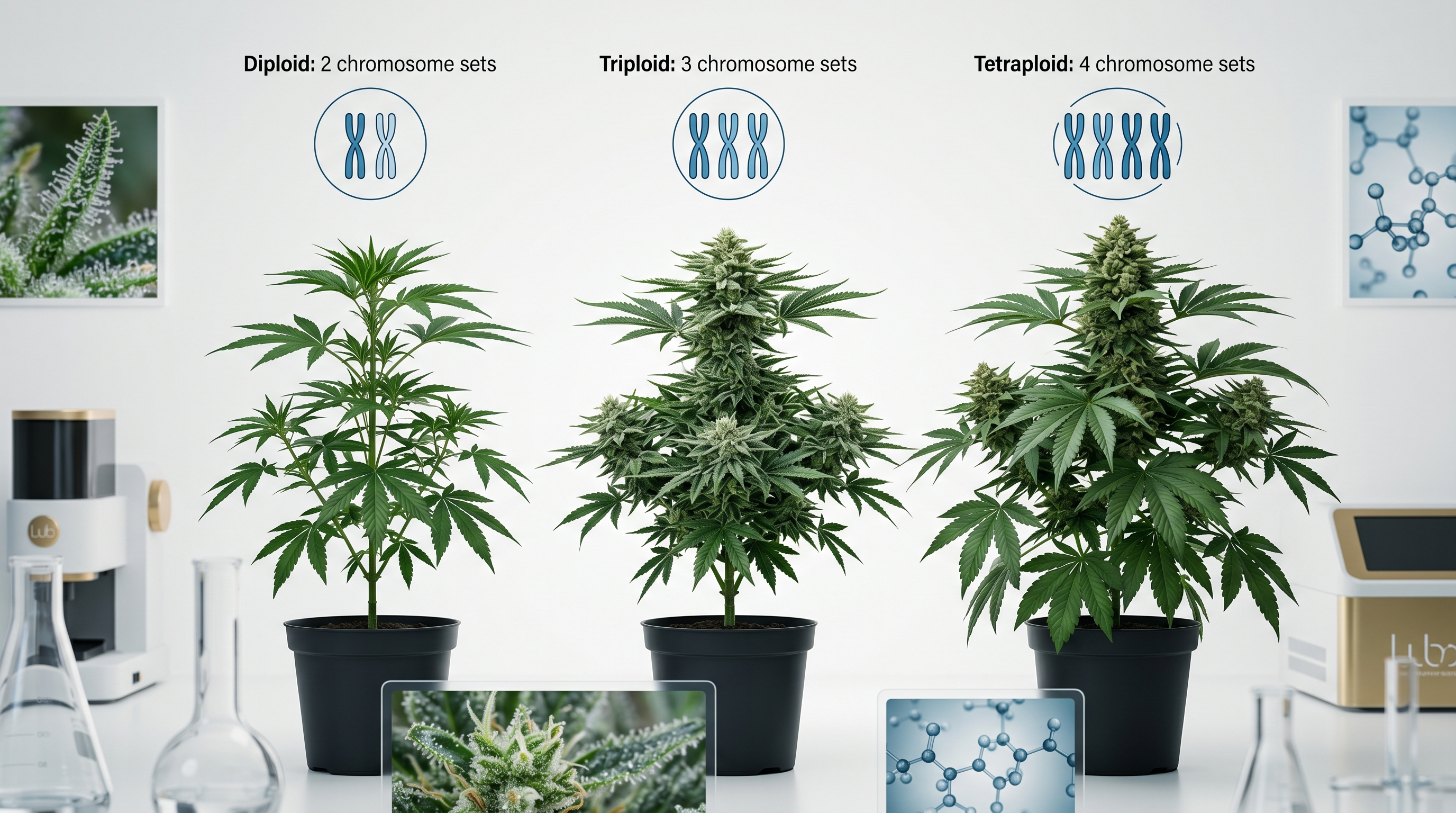
- Diploid (2n): Two sets — one from each parent. This is the normal, default state for cannabis. Cannabis sativa is naturally diploid with 20 chromosomes (two sets of 10). Almost every plant you have ever smoked was diploid.
- Triploid (3n): Three sets. An odd, unbalanced number — and that’s the whole point.
- Tetraploid (4n): Four sets. Double the normal. Bigger cells, often bigger leaves, and a stepping stone to making triploids.
Here’s the key idea. To make working sperm and egg cells, a plant has to split its chromosomes into even halves during a process called meiosis. A diploid (2 sets) splits cleanly into 1 + 1. A tetraploid (4 sets) splits into 2 + 2. But a triploid has three sets, and three doesn’t divide evenly. The chromosomes get distributed at random, producing mostly garbled, non-viable gametes. The plant tries to reproduce and mostly fails.
That reproductive failure is the feature, not the bug. It’s exactly why a triploid is largely sterile and seedless. If this chromosome-counting world is new to you, our explainer on how your genetics determine your cannabis experience is a friendly on-ramp, and the polyploid cannabis breakthrough guide covers the tetraploid side in depth.
How triploids are made: tetraploid × diploid
You can’t just wish a triploid into existence. Breeders build it in two stages.
Stage one: make a tetraploid. Cannabis rarely makes tetraploids on its own, so breeders force it. They treat seedlings, sprouting seeds, or tissue-cultured shoots with a chemical that blocks cell division. The two common ones are colchicine (the old standby) and oryzalin (newer, gentler, and effective at far lower doses). These chemicals stall the machinery that pulls duplicated chromosomes apart. The cell then ends up with double the chromosome set: a tetraploid. Reported success rates range from about 26% to over 90%, depending on the cultivar, the dose, and the timing.
Stage two: cross the tetraploid with a normal diploid. When a 4n plant breeds with a 2n plant, each parent gives half its sets — 2 from the tetraploid, 1 from the diploid. The result is 3n triploid seed. Cross direction matters. A 2024 study found that using the tetraploid as the mother (4x × 2x) yields far more viable triploid seed. The reverse cross runs into a snag called “triploid block” that aborts the seed.
There’s a catch that keeps breeders up at night: mixoploids. When you chemically double chromosomes, you rarely convert every cell. A plant can end up a mosaic of doubled and normal cells — looking tetraploid while secretly harboring diploid tissue. One 2024 study had to test candidate tetraploids by flow cytometry ten times over 140 days to confirm stability. A sloppy tetraploid parent produces a messy, inconsistent batch of seed. This is part of why getting reliable triploid cannabis to market took years of refinement.
Because triploids are mostly sterile, you can’t easily reproduce a winning triploid from its own seed. The plant is usually maintained and multiplied through cloning or tissue culture instead — a workflow that connects to broader cannabis breeding at home concepts, even if home growers won’t be inducing tetraploids in the kitchen.
Why “seedless and sterile” actually matters
To a casual smoker, “seedless” sounds like a nice-to-have. To a commercial grower, it’s close to a holy grail. Here’s why.
Cannabinoids and the terpenes that shape your experience concentrate in the flowers of female plants. Once a female flower is pollinated, research indicates it tends to redirect energy from resin toward seed production, which generally reduces cannabinoid concentration in the bud [Kurtz et al., 2024]. Seeded buds are typically harsher, lower in potency, and basically unsellable as premium flower. (For the bigger picture on how those resin compounds sort into effects, see our guide to understanding High Families.)
The threat is pollen — and pollen travels. It can drift from a neighboring hemp or grain field (outdoor isolation distances of up to 16 km have been recommended), sneak in on a worker’s clothes, or appear when a stressed female plant throws a few male flowers of its own. A single rogue pollen source can seed an entire room or field.
This is where triploids shine. Because they produce almost no viable seed even when deliberately bombarded with pollen, they act like an insurance policy. In a controlled 2024 study, triploid plants challenged with pollen produced 98.5% to 99.5% fewer filled seeds than diploids in the same conditions [Kurtz et al., 2024]. That’s a dramatic margin of safety. A grower running triploids worries a lot less about the catastrophe of an accidental pollination wiping out a harvest.
There’s a secondary appeal: uniformity. A clonally maintained triploid line is genetically identical plant to plant, which can mean a more even canopy, more predictable finish times, and fewer surprises at harvest. Predictability is money in commercial cultivation.
The yield and potency question (read this part carefully)
Here’s where the marketing and the science start to diverge, so let’s be honest about it.
The theory is reasonable. Polyploid plants have larger cells, and extra copies of genes can sometimes mean more “gene dosage” for the enzymes that build cannabinoids and terpenes. Tetraploid studies have shown larger leaves, bigger stomata, and — in one well-known 2019 trial on drug-type cannabis [Parsons et al., 2019] — roughly 40% higher trichome density and a measurable bump in CBD in the buds.
But “reasonable theory” is not the same as “proven in your flower.” Look at what the peer-reviewed data actually says:
- That same 2019 study found no significant increase in dried bud yield or THC content in tetraploids versus diploids [Parsons et al., 2019].
- A 2021 study on CBG-dominant hemp found triploids trended toward higher biomass and roughly 1.5% higher cannabinoid concentration — but the differences were not statistically significant [Crawford et al., 2021].
- A 2024 study across 15 genotypes concluded that triploid growth and flower production were similar to diploids, and that the occasional standout was better explained by which parent strains were used than by ploidy itself [Kurtz et al., 2024].
- A separate metabolomics analysis even found lower THCA in triploids than diploids for the cultivars tested [Hesami et al., 2023].
Now contrast that with the commercial claims. Some breeders selling triploid genetics report “dramatic” yield jumps in large-scale grows. A few facilities reportedly approach six pounds of flower per light. Those are real numbers from real production rooms, and they’re genuinely exciting.
But they haven’t been peer-reviewed. And big commercial yield gains can come from many things: better parent genetics, healthier disease-free clones, tighter growing, or simply the uniformity benefit. Telling “triploid magic” apart from “we just grew it better” takes controlled trials that mostly haven’t been published yet. Even the breeders pushing triploids admit the trichome-and-potency idea “still needs peer-reviewed validation.”
The honest verdict: Triploids deliver clear, demonstrated value as a seedless insurance policy. The potency and yield upside is plausible and intriguing, but as of 2026 it remains largely unconfirmed by independent science. If a budtender swears triploids are automatically stronger, that’s enthusiasm running ahead of the data.

Triploid vs. general polyploid breeding
It’s easy to lump “triploid” and “polyploid” together, but they play different roles.
Polyploid is the umbrella term for any plant with extra chromosome sets — including tetraploids. Tetraploids are fertile (mostly), and breeders value them as building blocks and for traits like vigor, larger cells, and altered chemistry. You’d keep a tetraploid around to breed with.
Triploid is a specific, usually sterile endpoint. You don’t breed onward from a triploid; you grow it for flower and clone it to keep the line going. Think of the tetraploid as the factory and the triploid as the finished, sealed product.
There’s a fun wrinkle: triploids aren’t always lab-made. A 2023 study found natural triploids in cannabis at roughly 1 in 200 plants (about 0.5%), and some celebrated elite cultivars — the legendary clone-only MAC1, for instance — turned out to be triploid all along, with no sign anyone engineered it [Toth et al., 2023]. Nature occasionally rolls the same dice breeders are now loading on purpose. If you enjoy this kind of genetic detective work, phenotype hunting is the art of spotting those special individuals.
The limitations and the skepticism
A few reasons to keep your expectations grounded:
- Response is genotype-dependent. Polyploid induction works beautifully in some cultivars and produces sickly, slow-growing duds in others. There’s no universal “triploid upgrade.”
- The chemistry can shift unpredictably. Several studies report changed terpene profiles in polyploids — sometimes for the better, sometimes not. A favorite strain turned triploid might not smell or feel quite the same.
- Off-target effects. Chemicals like colchicine can cause mutations beyond just doubling chromosomes, and the long-term consequences in cannabis aren’t fully mapped.
- It’s harder than it looks. Mixoploid contamination, embryo rescue, repeated flow-cytometry testing — reliable triploid seed is genuinely difficult to produce at scale.
- The potency hype outruns the data. As covered above, independent confirmation of higher yield or THC is still thin.
None of this means triploids are a gimmick. The seedless benefit alone justifies the interest. It just means “triploid” isn’t a magic word. The same truth that runs through all of cannabis genetics applies here: the label on the jar tells you less than how your body responds. Diploid or triploid, the effect still comes down to the cannabinoid and terpene fingerprint — and to how you, specifically, react to it. Your own biology matters too, from why some people simply can’t handle THC to how MTHFR gene variants shape cannabis metabolism. That’s exactly the kind of pattern the High IQ app is built to help you track, so you can learn what actually works for you instead of trusting the marketing copy.
Frequently asked questions
Is triploid cannabis genetically modified (GMO)? No. Triploids are made through selective breeding and chromosome doubling, not by inserting foreign DNA. It’s the same century-old technique behind seedless watermelons and bananas. No genetic engineering in the GMO sense is involved.
Will triploid weed get me higher? Maybe, maybe not. Some commercial growers report higher potency, but independent peer-reviewed studies have so far found no reliable, statistically significant THC increase. Treat “stronger” claims with healthy skepticism for now.
Is triploid cannabis safe to consume? Yes. A triploid is just cannabis with an extra chromosome set — the same situation as the seedless fruit you already eat. The cannabinoids and terpenes are the same molecules. The chemicals used to create the original tetraploid parents aren’t present in the flower you consume.
Why are triploids basically seedless? Three chromosome sets can’t divide evenly during reproduction, so the plant produces mostly non-viable pollen and eggs. Even when hit with pollen, it sets almost no seed — which is the entire commercial appeal.
Can I grow triploids from seed at home? You’d buy triploid seed from a breeder, but you generally can’t breed your own triploids without lab tools (mitotic inhibitors, tissue culture, flow cytometry). And because triploids are sterile, you can’t save seed from them — you’d clone instead. Curious how seeds differ in the first place? See our guide to feminized vs. autoflower vs. regular seeds.
How is this different from autoflowering genetics? Completely different traits. Autoflowering comes from Cannabis ruderalis genetics and controls when a plant flowers. Triploidy controls whether it can make seeds. A plant could theoretically be both.
Key Takeaways
Triploid cannabis is one of the most genuinely interesting developments in modern breeding — a borrowed trick from watermelons and bananas, finally dialed in for cannabis after years of frustrating lab work. Its strongest, best-documented benefit is seedlessness: near-total resistance to the pollen contamination that haunts commercial growers, plus the uniformity that comes from a stable, clonable line.
The yield and potency story is more cautious. The biology is plausible, the field reports are exciting, and the peer-reviewed evidence is still mixed and early. As triploid genetics spread from a few pioneering companies like Tesoro Genetics and the broader push from groups such as Dewey Scientific, expect both real innovation and a fair amount of hype to ride along together.
Same advice as always from Professor High: don’t choose your flower by buzzwords. A triploid plant and a classic diploid can both be excellent — or both be mediocre. What matters is the chemistry inside and how it lands for you. Keep paying attention to your patterns, because that’s the only data set that’s truly about you. If you want to go deeper on how breeders are chasing strength, our piece on the THC potency arms race is a great next read, as is the story of the landrace strains that started it all.
Sources
- Parsons, J.L., et al. (2019). “Polyploidization for the Genetic Improvement of Cannabis sativa.” Frontiers in Plant Science. https://www.frontiersin.org/journals/plant-science/articles/10.3389/fpls.2019.00476/full
- Kurtz, L.E., et al. (2020). “Production of Tetraploid and Triploid Hemp.” HortScience, 55(10). https://journals.ashs.org/hortsci/view/journals/hortsci/55/10/article-p1703.xml
- Crawford, S., et al. (2021). “Characteristics of the Diploid, Triploid, and Tetraploid Versions of a Cannabigerol-Dominant F1 Hybrid Industrial Hemp Cultivar.” Genes, 12(6). https://pmc.ncbi.nlm.nih.gov/articles/PMC8234880/
- Kurtz, L.E., et al. (2024). “Cannabis Triploids Exhibit Reduced Fertility and Similar Growth and Flower Production Compared to Diploids.” Journal of the American Society for Horticultural Science, 149(2). https://journals.ashs.org/jashs/view/journals/jashs/149/2/article-p75.xml
- “Naturally Occurring Triploidy in Cannabis.” (2023). Plants, 12(23). https://pmc.ncbi.nlm.nih.gov/articles/PMC10708021/
- “Machine Learning-Aided Optimization of In Vitro Tetraploid Induction in Cannabis.” (2025). PubMed. https://pubmed.ncbi.nlm.nih.gov/40004209/
- Chmiel, P. (2026). “Are Triploids The Next Big Thing In Cultivation?” Cannabis Industry Journal. https://cannabisindustryjournal.com/feature_article/are-triploids-the-next-big-thing-in-cultivation/
- Dewey Scientific. https://www.deweyscientific.com/


