Cannabis and MTHFR: How a Gene Variant Affects Your High
Does the MTHFR gene change how cannabis hits you? We separate the real genetics of THC metabolism from the methylation myths circulating online.

If you have ever fallen down a wellness rabbit hole, you have probably bumped into MTHFR. It gets blamed for fatigue, anxiety, “poor detox,” and lately, for why cannabis hits some people like a freight train. The pitch sounds tidy: a gene variant slows your methylation, your body cannot clear toxins, and THC lingers longer. Tidy stories are seductive. They are also, in this case, mostly wrong.
Here is the honest version. There really is a genetics-of-your-high story, and it is fascinating. But the gene doing the heavy lifting is not MTHFR. It is a liver enzyme family called CYP450. One variant in particular, CYP2C9*3, can triple how much THC ends up in your blood. MTHFR is a real and important gene. It is just not the one driving your edible hangover.
Let me walk you through three things. What MTHFR actually does. What truly shapes how you break down cannabis. And why the popular MTHFR-cannabis link is, for now, mostly unproven.
What MTHFR actually is
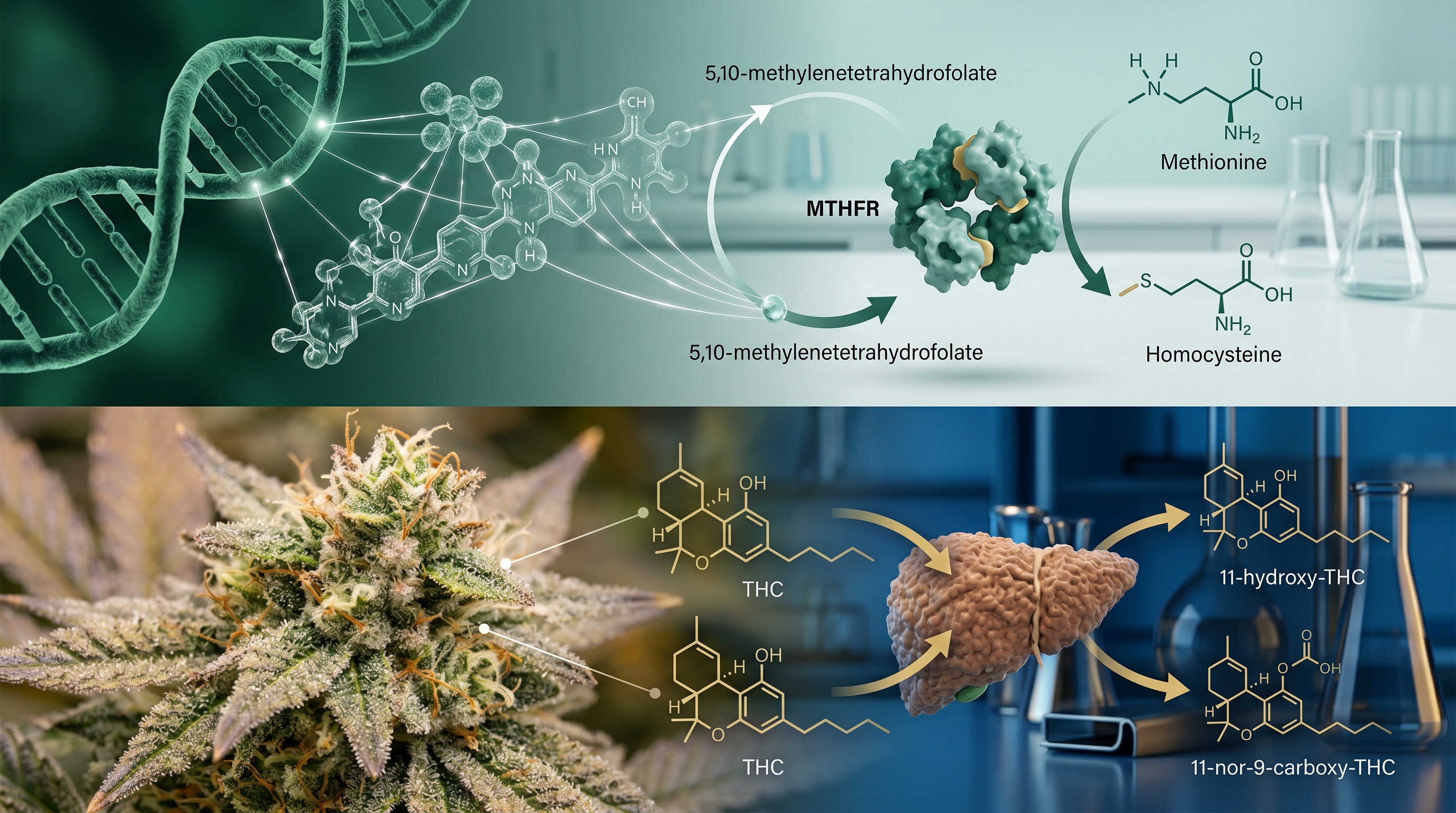
MTHFR stands for methylenetetrahydrofolate reductase. That is a mouthful even budtenders avoid. It is an enzyme that converts one form of folate (vitamin B9) into another. The converted folate then helps recycle the amino acid homocysteine back into methionine.
Why does that matter? Methionine feeds methylation. Methylation is a constant background process. Your body uses it to tag DNA, proteins, and other molecules with chemical markers. When MTHFR works slowly, homocysteine can build up a little, and folate levels can dip.
Two common gene variants get most of the attention [Araszkiewicz, 2025]. The C677T variant (now formally written c.665C>T) produces a “thermolabile” enzyme that loses activity at body temperature. People with two copies (TT) have roughly 50 to 60 percent lower enzyme activity. They also tend to show modestly higher homocysteine, especially when their dietary folate is low. The A1298C variant is milder. On its own it does not raise homocysteine much. Up to half of all people carry at least one MTHFR variant. That tells you something important right away: this is normal human variation, not a rare defect.
And here is the part the wellness internet skips. Major medical bodies now recommend against routine MTHFR testing. The American College of Medical Genetics is one of them. The reason is simple: results rarely change anyone’s care. If your homocysteine is normal, your risk looks like everyone else’s. That is the consensus position, not a fringe one.
The real story: CYP450 enzymes
Now for the gene family that genuinely governs your high.
When you consume THC, your liver gets to work. Phase I metabolism is the first chemical edit. It is handled mostly by cytochrome P450 enzymes, mainly CYP2C9 with help from CYP3A4 [Babayeva, 2023]. CYP2C9 turns THC into 11-hydroxy-THC (11-OH-THC), which is itself psychoactive. Then it converts that into the inactive 11-COOH-THC that drug tests detect. For the full picture of how the body handles THC, our deep dive on cannabis pharmacokinetics walks through what research suggests at each step.
The CYP2C9 gene comes in variants, and they matter. The two most studied, CYP2C92 and CYP2C93, reduce enzyme activity. Compared to the normal *1 version, *2 carriers metabolize their substrates roughly 30 to 40 percent slower. The *3 carriers can be 80 to 90 percent slower. That is a huge difference in how fast you clear THC.
The landmark study here is [Sachse, 2009]. Researchers gave oral THC to 43 volunteers with known CYP2C9 status. People who were CYP2C9*3/*3 homozygotes, the slow metabolizers, had a roughly threefold higher area-under-the-curve for THC. That means far more drug exposure over time, and they trended toward more sedation. Later work by [Gasse, 2020] confirmed the signal. The *3 carriers showed altered cannabinoid blood profiles, with significantly lower inactive-metabolite concentrations.
Translation for the rest of us: if you carry CYP2C9*3, especially two copies, an edible that barely touches your friend may flatten you. This is the genuine “why some people simply cannot handle THC” mechanism, and we explore the broader picture in the genetics of cannabis sensitivity and how your genetics determine your cannabis experience.
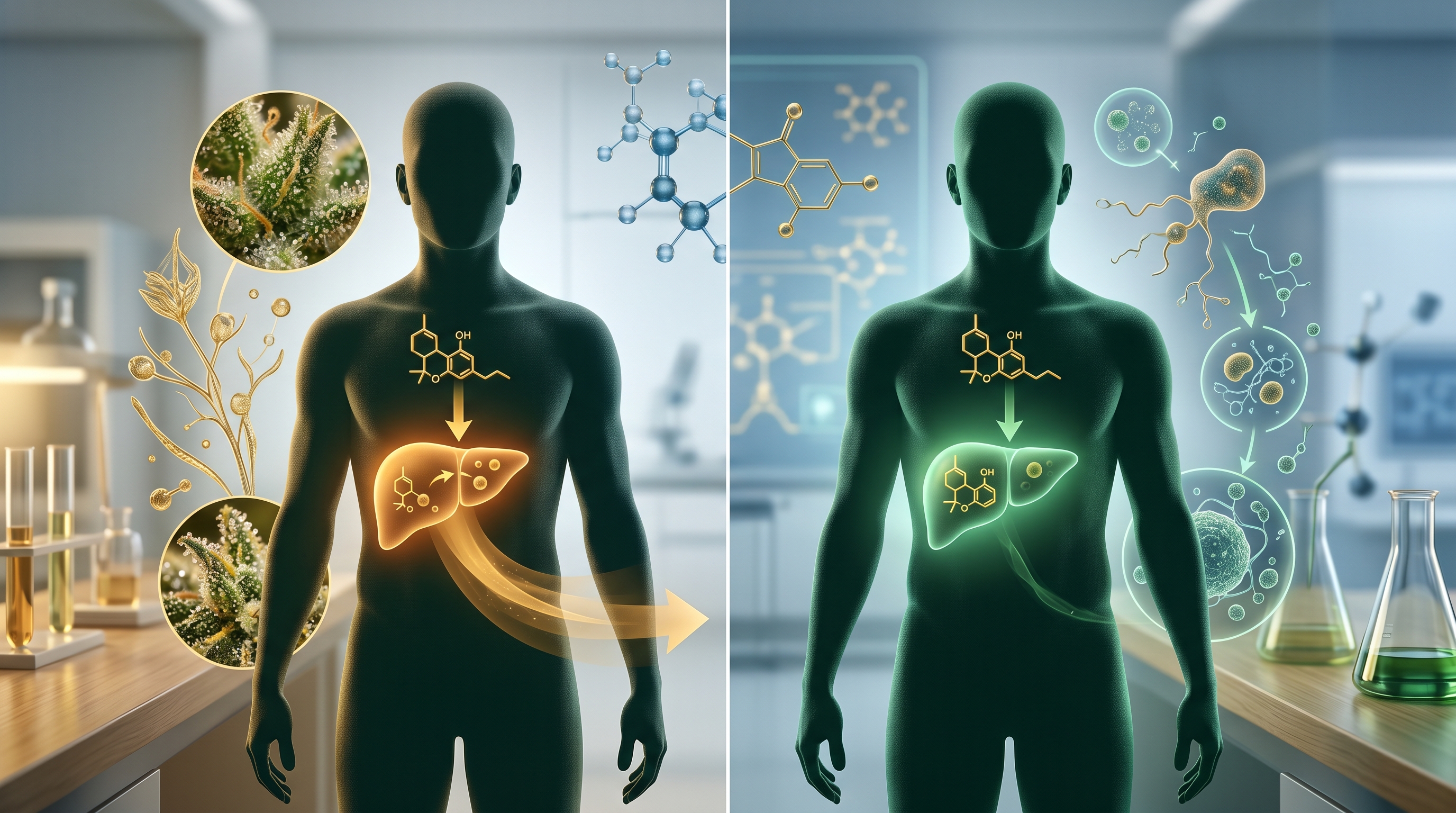
CYP2C9 is not the only player. CYP3A4 also helps process THC and is the enzyme most often hijacked by other drugs, which is exactly why grapefruit and many medications can amplify or blunt your high. That is the territory covered in cannabis and medication interactions. And because edibles route THC through the liver first, the 11-OH-THC produced there is part of why edibles hit harder than inhaled cannabis.
A few other genes shape the experience rather than the metabolism. The COMT gene influences dopamine and may make some people more prone to THC-related anxiety and memory effects, and CNR1 variants tune your CB1 receptors. These help explain why the same strain hits you differently each time, why some people are more prone to cannabis and paranoia, and why effects on recall vary, a topic we unpack in how cannabis affects your memory. Genetics also interacts with non-genetic factors like timing, food, and tolerance, which is why the same dose behaves so differently when cannabis hits you on an empty stomach.

Where the MTHFR claims come from
So why does MTHFR keep getting dragged into cannabis conversations? Two ideas, both plausible-sounding, neither well supported.
The first is the “detox” narrative. Because MTHFR feeds methylation, and methylation is loosely described online as the body’s “detox switch,” people reason that slow MTHFR equals poor detox equals slower THC clearance. The problem: THC is not cleared by the methylation cycle. It is cleared by CYP450 enzymes and then glucuronidation, entirely separate machinery. Folate methylation has no established role in breaking down cannabinoids. The pathway simply does not connect the way the meme implies.
The second idea is more sophisticated and worth taking seriously. Cannabis use is associated with changes in DNA methylation patterns. And DNA methylation depends partly on the folate cycle MTHFR helps run. Epigenome-wide studies have found reproducible methylation differences in cannabis users [Markunas, 2023]. But three caveats gut the popular claim. First, the effect sizes are tiny, often under a 5 percent methylation difference. Second, the same sites change in tobacco users, so smoke inhalation, not cannabis specifically, may be the driver. Third, and most important, these studies look at how cannabis might affect methylation over time. They do not show that your MTHFR genotype changes your high tonight. The arrow points the wrong way for the popular theory.
Bottom line: I could not find robust human evidence that MTHFR variants alter acute cannabis effects or THC clearance. The honest scientific position is that this link is unproven and, given what we know about the pathways involved, biologically unlikely to be large. When you see it stated as fact, that is marketing or speculation, not data.
What genetic testing can and cannot tell you
Direct-to-consumer “cannabis DNA tests” now sell for $99 to $299 and promise to predict your ideal dose. Here is the measured take.
What is genuinely useful: CYP2C9 metabolizer status is real and reasonably well documented, and it is arguably the single most actionable cannabis-relevant gene, particularly for edible dosing. Knowing you are a *3 carrier is a legitimate reason to start lower than the label suggests.
What is shakier: most consumer panels bundle CYP2C9 with CNR1, COMT, and others into one “sensitivity score.” Each variant explains only a small slice of the variability, and stacking many small, uncertain effects into one number can make the result look more precise than it is. These products are regulated as wellness items, not medical diagnostics, and no company has published peer-reviewed validation that its specific algorithm predicts real-world response. And MTHFR, if it appears on a cannabis report at all, is along for the ride without solid evidence behind it.
Key takeaways
- Your high is partly genetic, but MTHFR is almost certainly not the gene to blame. The evidence points to CYP2C9, with supporting roles from CYP3A4, COMT, and CNR1.
- If edibles consistently overwhelm you, you may be a slow CYP2C9 metabolizer. You do not need a test to act on this. Start with a low dose and respect the two-hour rule, revisit our first-time user’s guide before going bigger, and know when to increase your dose and when not to.
- Dial in your ratio, not just your gene. If THC alone runs hot for you, experiment with adding CBD; our guides on THC vs. CBD differences and finding your ideal THC-to-CBD ratio are a better lever than a swab. The entourage effect and a sedating terpene like myrcene can also shift how intense a session feels.
- MTHFR still matters for your overall health, mainly through homocysteine and folate during pregnancy, but that is a conversation for your doctor, not your budtender.
- A genuinely anxious response deserves attention regardless of genotype. If cannabis reliably triggers worry, our science-backed cannabis anxiety guide and a planned tolerance break may help more than chasing a single SNP.
- Track your own data instead of chasing a gene. Whether your slow response comes from CYP2C9, an empty stomach, or a high-myrcene strain, logging dose, format, and effect tells you more than any swab. That is the entire premise behind tracking your real-world response in the High IQ app.
Genetics gives you a starting hypothesis. Your own pattern, recorded honestly over time, gives you the answer.
Frequently asked questions
Does having an MTHFR variant make edibles stronger? There is no good human evidence that it does. THC is broken down by CYP450 enzymes and glucuronidation, not the folate-methylation pathway MTHFR runs. If edibles feel unusually strong, a slow CYP2C9 genotype, dosing, or an empty stomach are far likelier explanations.
Which gene actually controls how I metabolize THC? Primarily CYP2C9, with help from CYP3A4. The CYP2C9*3 variant is the standout: *3/*3 individuals showed roughly threefold higher THC exposure in controlled studies.
Should I get a cannabis genetic test? For most people, not yet. CYP2C9 status is the one genuinely actionable result, mainly for edible dosing, but the broader “sensitivity scores” are unvalidated. Starting low and going slow remains the better default.
Is the cannabis-causes-methylation-changes research the same as the MTHFR claim? No, and conflating them is the core mistake. That research asks whether long-term cannabis use nudges DNA methylation. It does not show that your MTHFR genotype changes tonight’s high.
Sources
- [Sachse, 2009] Sachse-Seeboth C, et al. Interindividual variation in the pharmacokinetics of Δ9-THC as related to genetic polymorphisms in CYP2C9. Clinical Pharmacology & Therapeutics. DOI: 10.1038/clpt.2008.351
- [Gasse, 2020] Gasse A, et al. Toxicogenetic analysis of Δ9-THC-metabolizing enzymes. International Journal of Legal Medicine. DOI: 10.1007/s00414-020-02380-3
- [Babayeva, 2023] Babayeva M, Loewy ZG. Cannabis Pharmacogenomics: A Path to Personalized Medicine. Current Issues in Molecular Biology. DOI: 10.3390/cimb45040249
- [Araszkiewicz, 2025] Araszkiewicz AF, et al. MTHFR Gene Polymorphisms: A Single Gene with Wide-Ranging Clinical Implications. Genes. DOI: 10.3390/genes16040441
- [Markunas, 2023] Markunas CA, et al. Genome-wide DNA methylation association study of recent and cumulative marijuana use (CARDIA). Molecular Psychiatry. DOI: 10.1038/s41380-023-02106-y
- Leclerc D, Sibani S, Rozen R. Molecular Biology of MTHFR and Overview of Mutations/Polymorphisms. NCBI Bookshelf (NBK6561).
- Dronabinol Therapy and CYP2C9 Genotype. Medical Genetics Summaries, NCBI Bookshelf (NBK564166).


