

Ambien and Weed: What Is Known, and What No Study Tested
No study has tested Ambien and weed together on the same night. See what the label, enzyme data and cannabis trials show, and what to ask a pharmacist.

Professor High
Written by Professor High, our AI guide. See how we research and correct articles.

No published study has given people Ambien (zolpidem) and THC on the same night and then measured how they performed the next morning, so nobody can tell you the pair is safe or quantify how risky it is. The “moderate interaction” flag on drug-interaction pages is an inference from two drugs that each impair on their own, plus enzyme data from other medicines. This lesson lays out what has actually been measured, what has not, and what to bring to your pharmacist.
Here is the part worth sending to a friend. There are next-morning numbers for Ambien alone, for Ambien with alcohol, and for a THC and CBD sleep oil taken alone. There are none for Ambien with weed. The research team behind this High School lesson searched PubMed for zolpidem with cannabis, marijuana, THC, nabilone and dronabinol and found withdrawal studies, toxicology reports and enzyme reviews, but no same-night combination trial. That is a search result, not proof that none exists.
Is it safe to take Ambien and weed together?
The honest answer is that safety has not been tested, and that is different from “proven dangerous” or “proven fine.” Evidence here is absent, not negative.
What we can say comes from three directions. The Ambien label describes what zolpidem does on its own and what makes it worse. Cannabis research describes how long THC impairment lasts on its own. Enzyme studies describe how cannabinoids change the clearance of other drugs. Each piece is real. None of them is the combination.
A university brief on cannabis and prescribed medicines shows how the warnings get built. It lists zolpidem beside benzodiazepines and says that “THC may magnify sedative effects of benzodiazepines, so caution is warranted,” with no zolpidem-specific data behind the sentence (University of Washington ADAI, 2019). That is reasonable caution by drug class. It is not a measurement.
What has actually been tested?
Picture a ladder of evidence. Every nearby rung has a study. The rung you care about is empty.
| Rung | What was measured | Who | What was found | Main limit |
|---|---|---|---|---|
| Ambien alone | Morning blood levels and driving risk | Regulator review | Morning levels can impair driving; FDA cut the starting dose for women from 10 mg to 5 mg | Says nothing about cannabis |
| Ambien with alcohol | Psychomotor performance | Label studies | An additive effect on performance | Alcohol, not cannabis |
| THC 10 mg plus CBD 200 mg oil at night, no Ambien | 28 next-day cognitive, psychomotor and driving tests at 9 hours or more | 20 adults with insomnia who rarely used cannabis | No difference on 27 of 28 tests | One dose, oral oil only, no hypnotic |
| Zolpidem in daily users who had stopped cannabis | Sleep and next-day cognition | 20 daily users in a 3-day abstinence crossover | Sleep efficiency improved; no next-day cognitive impairment | People were abstinent, not co-using |
| Zolpidem plus nabilone, a synthetic cannabinoid taken by day | Withdrawal, sleep and cognition | 11 daily users, all men | No change in cognitive performance; small rise in some abuse-related ratings | Nabilone is not smoked or edible cannabis |
| Ambien plus smoked or edible THC on the same night | Nothing | Nobody | No study found | The gap |
Sources for each row: the FDA next-morning impairment Q&A, the Ambien prescribing information, the Suraev 2024 pilot trial, the Vandrey 2011 crossover and the Herrmann 2016 inpatient study.
Notice who the zolpidem studies enrolled. They are daily, tolerant cannabis users, mostly men, tested in a lab. A casual user, an older adult, or someone taking a stronger edible was not studied. The ladder tells you the neighborhood. It does not tell you your address.
Why does the morning after matter more than the night?
Most of the documented zolpidem harm happens after you wake up, not while you are asleep in bed. In 2013 the FDA reported that some people still had enough zolpidem in their blood the next morning to impair driving. It lowered the recommended immediate-release dose for women from 10 mg to 5 mg, because women clear the drug more slowly, and told patients not to take it unless a full 7 to 8 hours remain before they need to be active (FDA Q&A).
The current label goes further. It says the risk of next-day psychomotor impairment rises with less than a full night of sleep, a higher than recommended dose, other central nervous system depressants or alcohol, and drugs that raise zolpidem blood levels (Ambien label, section 5.2). The label names alcohol, benzodiazepines, opioids and tricyclic antidepressants as examples. It never mentions cannabis, marijuana or THC. The NHS gives the plain-language version: “Do not drive, ride a bike or use machinery for 8 hours after taking zolpidem” (NHS).
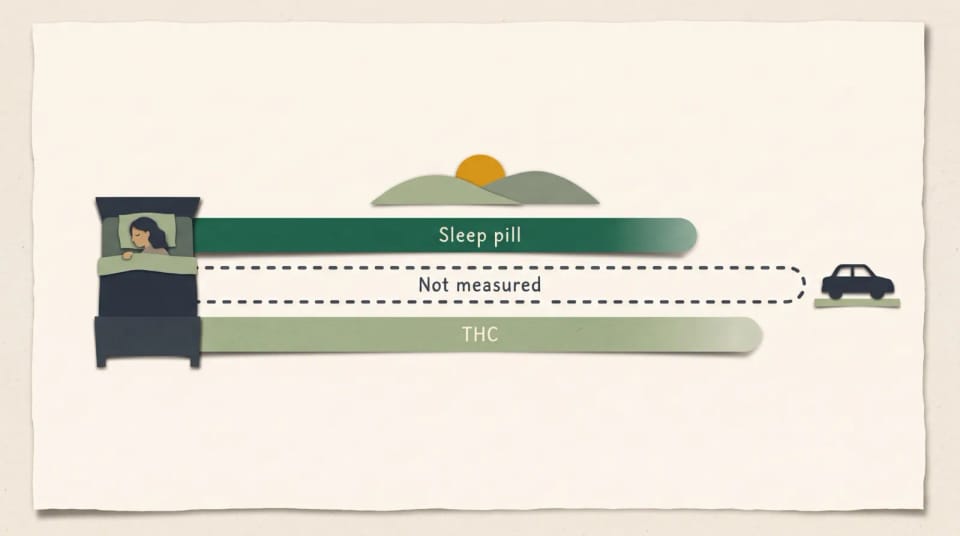
Each drug has its own evidence-based timeline. The combined timeline is the one no study has drawn.
Cannabis has its own clock. A meta-analysis of 80 publications modelled that most driving-related skills recover within about 5 hours, and almost all within 7, after an occasional user inhales 20 mg of THC; oral THC may impair for longer, and regular users show less impairment (McCartney 2021). Our guide to how long to wait before driving after cannabis covers that clock in detail.
Here is the trap. These are two separate clocks measured in separate people. Nobody has measured what happens when both run in the same body on the same night. You cannot add them, overlap them, or pick the longer one and call it a rule.
Real-world crash data hint at why combinations worry researchers. A case-control study of 2,490 seriously injured drivers in six European countries put drug-drug combinations in a higher-risk tier than cannabis, benzodiazepines or Z-drugs taken alone (Hels 2013). That study pooled every combination together and pooled Z-drugs with benzodiazepines, so it says nothing specific about Ambien and weed. A toxicology review adds that Z-drug impairment is more likely when they are mixed with other psychoactive substances, naming alcohol (Gunja 2013).
Does weed make Ambien stronger or last longer?
It could in theory, mostly through CBD, but nobody has measured it for zolpidem. Here is the mechanism, step by step.
Your liver clears zolpidem mainly through three enzymes. Lab estimates put the shares at about 61 percent for CYP3A4, 22 percent for CYP2C9 and 14 percent for CYP1A2 (Von Moltke 1999). Slow those enzymes and more zolpidem stays in your blood for longer.
In a crossover study of 18 healthy adults, a brownie with 640 mg of CBD and 20 mg of THC raised blood exposure to test drugs for CYP3A by 56 percent, CYP2C9 by 77 percent and CYP1A2 by 39 percent. A brownie with 20 mg of THC alone inhibited none of the enzymes tested (Bansal 2023). Those test drugs were midazolam, losartan and caffeine. Zolpidem was not in the study.
For scale, the Ambien label reports what a known strong CYP3A4 blocker does. Ketoconazole raised zolpidem exposure by 70 percent and its half-life by 30 percent, and the label says to consider a lower zolpidem dose with it (Ambien label). No cannabinoid has been tested against zolpidem that way.
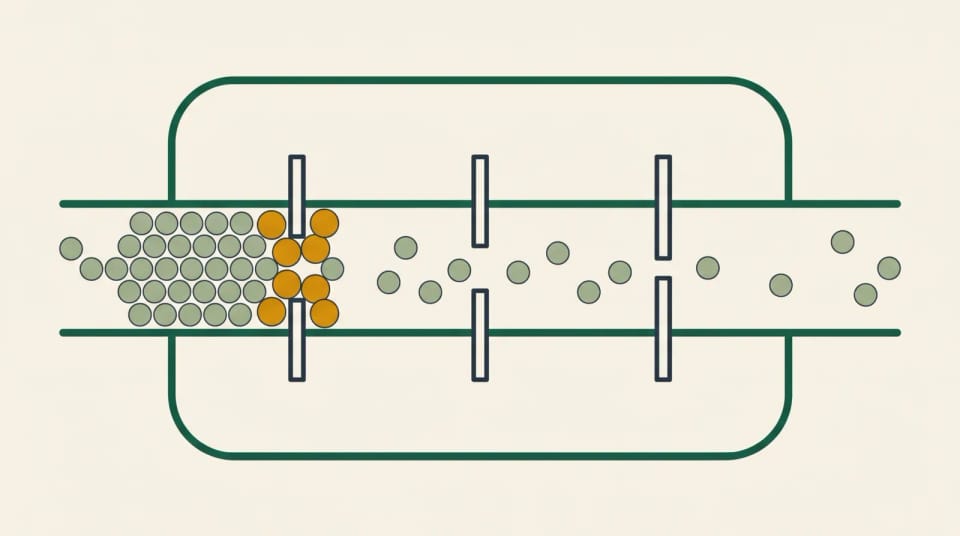
CBD slowed these enzymes for other test drugs at a very high dose. The same effect on zolpidem is a reasonable guess, not a measured result.
Dose matters a lot here. A 640 mg CBD dose is far above a typical CBD gummy. A German review judged that clinically relevant interactions probably arise only above about 300 mg of CBD or 30 mg of THC a day, and that low or moderate doses are probably of little importance (Herdegen and Cascorbi 2023). Read that “probably” carefully. It is not a safe-below line, and it was not written about zolpidem. Our lesson on how cannabis interacts with other medicines covers the enzyme system across many drug classes. For why an edible appears to linger longer than a joint, see how the body clears THC.
There is a second, separate idea: stacking. Zolpidem acts on GABA-A receptors, the brain’s main brake system. THC works through cannabinoid receptors, but sedation from two drugs can add up even when the receptors differ. If you want the background, see cannabis and GABA. Additive sedation is the logic behind the class warning. For this pair it has still not been measured.
How long after weed can you take Ambien?
No study has measured a safe gap, so any specific number you see online is a guess. Some pages publish waits of 2 to 3 hours or 24 hours with no source. We will not add another invented number.
The only timelines with evidence are the single-drug ones above: a full 7 to 8 hours in bed for Ambien, no driving for 8 hours after a dose, and about 5 to 7 hours for inhaled THC in occasional users. Do not change when or how you take a prescribed medicine on your own; that is a conversation for your prescriber.
What do the cannabis withdrawal studies tell us?
They tell us zolpidem has been tested in people who stopped cannabis, not in people who kept using it. Daily users who quit often sleep badly, and researchers have tried zolpidem as a short-term sleep aid in that setting. Our lesson on cannabis withdrawal and sleep explains why.
In the Vandrey crossover, 3 days of abstinence lowered sleep efficiency and total sleep time; 12.5 mg of extended-release zolpidem normalized sleep efficiency and caused no next-day cognitive impairment (Vandrey 2011). A 12-week randomized trial in 127 adults found that extended-release zolpidem eased early abstinence sleep trouble, but the difference in quitting rates (27 vs 15 percent) was not statistically significant, and about half of each group dropped out (Lee 2024).
Neither study tested co-use, and neither shows that cannabis helps anyone stop Ambien, or the reverse. If you are hoping cannabis can replace a sleep drug, start with what insomnia trials actually found.
What should you tell your pharmacist?
Tell them you use cannabis, and be specific. A pharmacist can check your whole medicine list, your age and your other conditions, which no interaction page can do. Bring:
- Product and route. Flower, vape, edible, tincture or capsule, and whether it is THC, CBD or both.
- Milligrams. THC and CBD per serving from the label, and how many servings you take.
- Timing and frequency. What time of day, how often, and for how long you have used it.
- Everything else that makes you sleepy. Other sleep aids, antihistamines, pain medicines and alcohol.
- Anything odd you have noticed. Morning grogginess, memory gaps, or waking up somewhere unexpected.
If you already log sessions in the High IQ app, that history gives you the product, timing and frequency in one place to show them. Older readers deserve extra care, since interaction pages single out older adults for impaired thinking and coordination; our guide to cannabis and medicines in older adults goes further.
When should you talk to a clinician right away?
Some symptoms need a professional, whatever caused them. The FDA added a boxed warning to Ambien in 2019 because complex sleep behaviors, such as sleepwalking, sleep driving and doing other activities while not fully awake, have caused serious injuries and deaths. It says to stop the medicine and contact a health professional after any such episode (FDA 2019). No source links that risk to cannabis, and none rules it out; the warning applies to Ambien itself.
Contact your prescriber or pharmacist if you feel impaired the morning after, notice memory gaps, have trouble waking, or have breathing problems during sleep. In an emergency, call your local emergency number or poison control.
Key takeaways
- No study has tested Ambien with smoked or edible THC on the same night.
- The interaction warning is inferred from each drug’s own effects and from enzyme data on other drugs.
- Ambien’s main documented risk is next-morning impairment; the label never mentions cannabis.
- CBD slowed the enzymes that clear zolpidem only at a very high dose, with other test drugs.
- There is no evidence-based waiting time between the two. Talk to your pharmacist with specifics.
FAQ
What happens if you smoke weed and take Ambien?
Nobody has measured it in a controlled study. Both can cause drowsiness and slower reactions on their own, and the Ambien label warns that other sedating substances raise the risk of next-day impairment. The size of any combined effect is unknown.
Can you take Ambien and CBD gummies together?
No study has tested that pairing either. CBD can slow the liver enzymes that clear zolpidem, but that was shown at 640 mg with other test drugs, far above a typical gummy. Ask your pharmacist, and bring the milligrams from the label.
Can CBD interact with Ambien the way THC does?
CBD and THC raise different concerns. In the brownie study, CBD slowed several drug-clearing enzymes and THC alone did not, so any blood-level effect is more plausible with CBD. Sedation stacking is the concern usually raised about THC, and neither has been measured with zolpidem.
Are some prescription sleep medicines safer to combine with cannabis?
There is no evidence ranking any sleep medicine as safer with cannabis. The trials we found tested zolpidem only in people who had stopped using cannabis. Your prescriber can weigh your options with your full history in front of them.
Does weed make you sleepwalk on Ambien?
No study has tested whether cannabis changes the risk of complex sleep behaviors on Ambien. Those behaviors are a known risk of the drug itself and carry an FDA boxed warning. If one happens, stop the medicine and contact your prescriber, as the FDA advises.
Sources
- US FDA. Ambien and Ambien CR prescribing information, revised February 2022.
- US FDA. Questions and answers: risk of next-morning impairment after use of insomnia drugs, 2013.
- US FDA. New boxed warning for complex sleep behaviors with certain insomnia medicines, 2019.
- NHS. Common questions about zolpidem.
- Herrmann ES et al. Zolpidem alone and with nabilone in cannabis withdrawal. Psychopharmacology, 2016.
- Vandrey R et al. Extended-release zolpidem during cannabis withdrawal. Drug and Alcohol Dependence, 2011.
- Lee DC et al. Randomized controlled trial of zolpidem for cannabis use disorder. J Subst Use Addict Treat, 2024.
- Suraev A et al. Next-day impairment after a night-time oral cannabis product. Psychopharmacology, 2024.
- McCartney D et al. Magnitude and duration of THC-induced driving impairment. Neurosci Biobehav Rev, 2021.
- Bansal S et al. Cytochrome P450 cannabinoid-drug interactions in healthy adults. Clin Pharmacol Ther, 2023.
- Von Moltke LL et al. Zolpidem metabolism in vitro. Br J Clin Pharmacol, 1999.
- Herdegen T, Cascorbi I. Drug interactions of THC and CBD in cannabinoid drugs. Dtsch Arztebl Int, 2023.
- Hels T et al. Risk of severe driver injury with psychoactive substances. Accid Anal Prev, 2013.
- Gunja N. Effects of Z-drugs on human performance and driving. J Med Toxicol, 2013.
- Stoner SA. Marijuana and prescribed medications. University of Washington ADAI, 2019.



