Cannabis and GABA: Modulating the Anxiety Brake
GABA is your brain's brake pedal. How cannabis modulates it through retrograde signaling, why THC dose flips calm into anxiety, and what terpenes do.

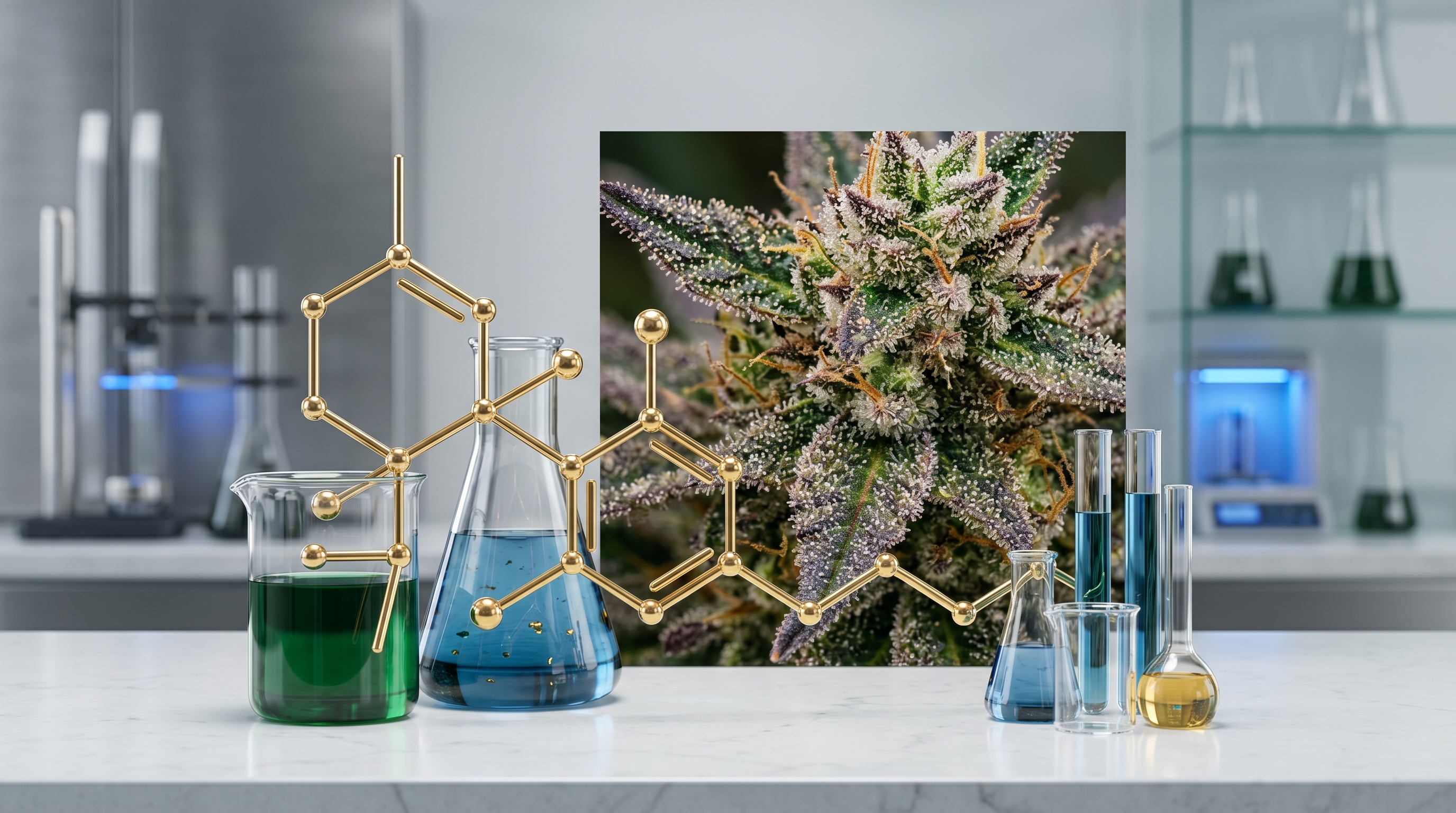
If a strain that was supposed to mellow you out instead left your heart pounding and your thoughts racing, the system didn’t fail because you’re “doing it wrong.” It failed because cannabis was quietly turning a dial on one of the most important control systems in your brain — and at the wrong setting, that dial does the opposite of what you wanted.
That dial controls GABA, the brain’s primary brake. Understanding how cannabinoids and terpenes modulate GABA is, in my opinion, the single most useful frame for making sense of why the same plant can be calming one night and anxiety-provoking the next. So let’s open the hood. As always: this is education, not medical advice, and nothing here should replace a conversation with a clinician — especially if you take medication or live with an anxiety or psychiatric condition.
GABA: the brain’s brake pedal
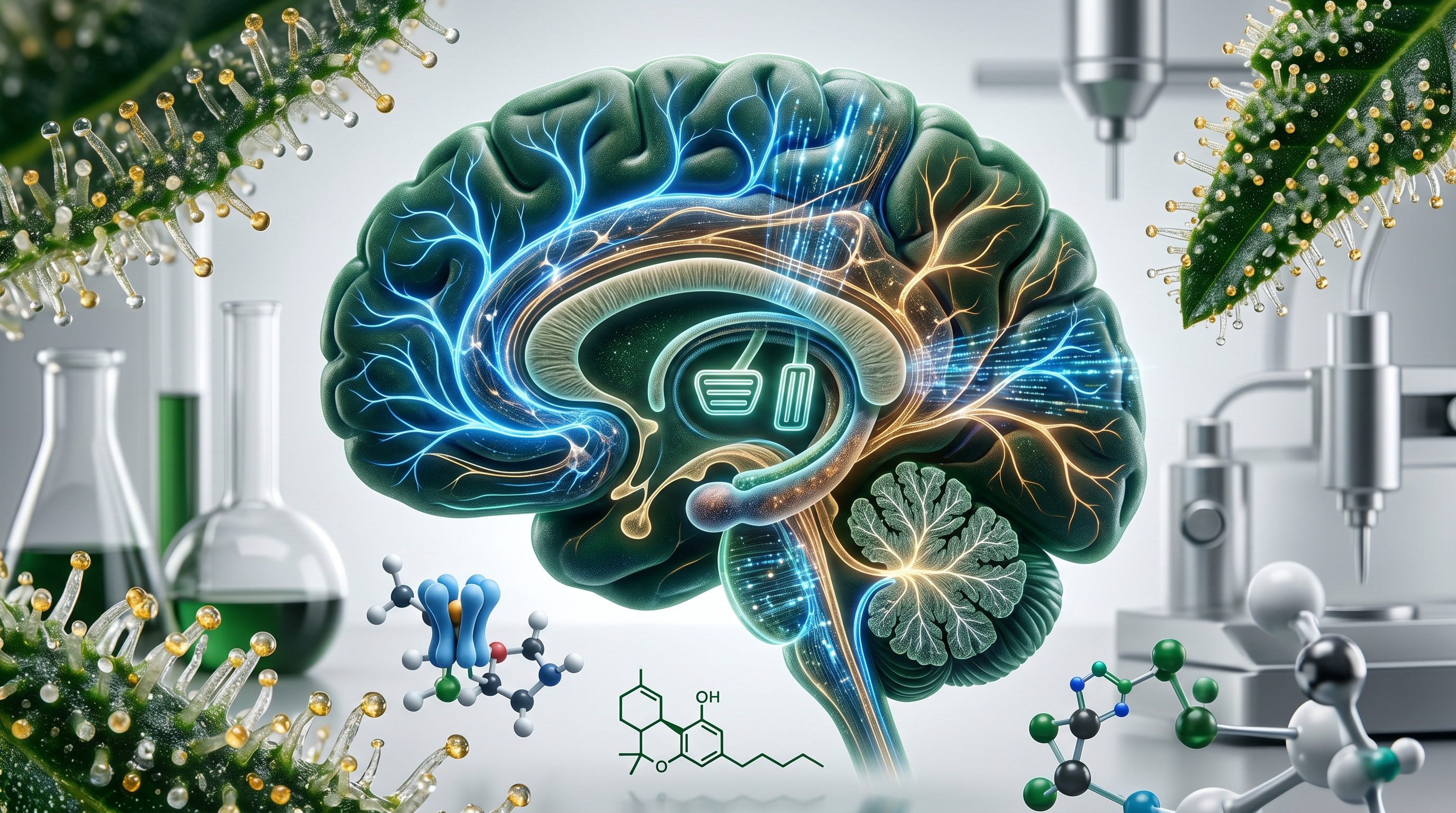
Your nervous system runs on a balance between two opposing forces. Glutamate is the main excitatory neurotransmitter — think of it as the accelerator, the “go” signal that makes neurons fire. GABA (gamma-aminobutyric acid) is the main inhibitory neurotransmitter — the brake that tells neurons to quiet down and not fire.
Roughly 20–40% of synapses in the mammalian brain are GABAergic, and the cells that release GABA — interneurons — act like local traffic cops, restraining runaway excitation so circuits don’t spiral into noise [Castillo et al., 2012]. When GABAergic tone is healthy, you feel regulated: alert but not jittery, relaxed but not sedated. When the brake is weak, anxiety, racing thoughts, and even seizures can emerge. This is exactly why classic anti-anxiety drugs like benzodiazepines work by enhancing GABA signaling — more on that comparison later (and no, I’m not going to tell you to swap one for the other).
Here’s the part most cannabis content skips: cannabis doesn’t contain GABA, and THC doesn’t bind to GABA receptors. So how does a plant end up adjusting the brain’s brake? Through a beautifully indirect mechanism that runs backward.
The endocannabinoid system runs the signal in reverse
Most neurotransmission flows one direction: a presynaptic neuron releases a chemical, and a postsynaptic neuron receives it. The endocannabinoid system (ECS) flips this script. If you want the full primer, our endocannabinoid system guide lays out the receptors, ligands, and enzymes — but here’s the short version that matters for GABA.
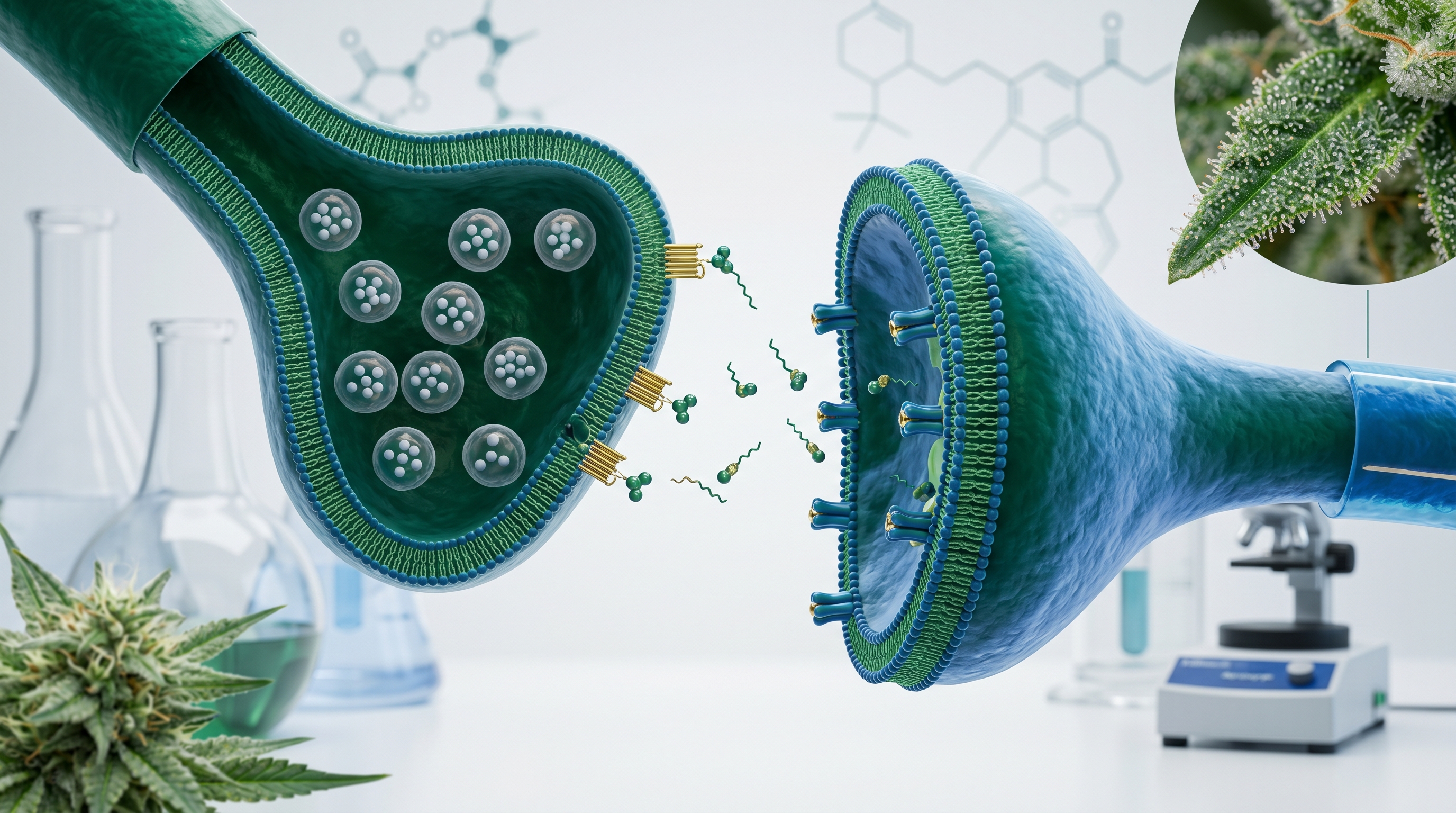
When a postsynaptic neuron gets strongly activated, calcium floods in and triggers it to synthesize endocannabinoids — chiefly 2-AG and anandamide — on the spot. These lipid messengers then travel backward across the synapse to the presynaptic terminal, where they activate CB1 receptors. This is called retrograde signaling, and it’s the ECS’s core trick: the receiving cell talks back to the sending cell to say “ease off.” (We dig deeper into one downstream consequence in your brain on endocannabinoids: how 2-AG controls dopamine decisions.)
CB1 receptors are among the most abundant G-protein-coupled receptors in the brain, and critically, a large share of them sit on the terminals of GABAergic interneurons — especially the cholecystokinin-positive (CCK+) subtype in the hippocampus and amygdala [Wilson & Nicoll, 2001]. When an endocannabinoid activates CB1 there, it suppresses GABA release. The brain has a name for this: depolarization-induced suppression of inhibition (DSI).
DSI: lifting the brake, on purpose
Read that mechanism carefully, because it’s counterintuitive. Activating CB1 on a GABA neuron doesn’t add inhibition — it removes it, because CB1 turns down the GABA release. The landmark work establishing endocannabinoids as the retrograde messengers behind DSI came from Wilson and Nicoll’s 2001 hippocampal studies, where DSI was completely abolished in CB1-knockout mice [Wilson & Nicoll, 2001]. In other words: no CB1, no brake-lifting.
Physiologically, DSI is useful and brief — it’s a momentary, local easing of inhibition that helps tune the timing and plasticity of circuits. But when you flood the brain with exogenous cannabinoids (the THC from your flower or vape), you’re no longer dealing with a brief, targeted nudge. You’re applying CB1 activation broadly and for hours. That’s where the double edge appears.
Why this is a double-edged sword for anxiety
This is the crux of the whole article. The very same receptor — CB1 — sits on two opposing kinds of nerve terminals, and which one dominates depends on the dose. This produces what researchers call a biphasic (two-phase) dose response, and it’s been demonstrated in both rodents and humans [Rey et al., 2012].
The clearest mechanistic account comes from Rey and colleagues, working in Beat Lutz’s lab, using mice engineered to lack CB1 specifically on either glutamatergic or GABAergic neurons [Rey et al., 2012]:
- Low doses → calming. At low cannabinoid doses, CB1 activation on glutamatergic (excitatory) terminals dominates. The brain dials back the accelerator, net excitation drops, and the effect is anxiolytic (anxiety-reducing). In their study, this calming effect disappeared only in mice lacking CB1 on glutamatergic neurons.
- High doses → anxiety. At high doses, CB1 activation on GABAergic (inhibitory) terminals takes over. Now the brain is suppressing its own brake — DSI on a massive scale — and excitation runs unchecked. The effect flips to anxiogenic (anxiety-provoking). This effect vanished in mice lacking CB1 on GABAergic neurons.
Tellingly, the same team showed that boosting GABA-B receptor signaling with a positive allosteric modulator counteracted the high-dose anxiety — direct evidence that the anxiogenic phase reflects too little GABAergic braking [Rey et al., 2012]. So when high-THC flower tips you into a spiral, a reasonable read is: you suppressed the brake instead of the gas.
In humans, this maps onto the amygdala, the brain’s threat-detection hub, which is dense with CB1 receptors. Functional imaging work has tied THC-induced anxiety to changes in amygdalar activity, consistent with the idea that overshooting CB1 in fear circuits flips the valence of the experience. If you’ve ever wondered why a session went sideways, our deep dive on cannabis and paranoia: why it happens and how to prevent it connects this mechanism to the lived experience — and our complete science-backed guide to cannabis and anxiety walks through practical implications.

The practical takeaway from the biphasic curve
The biphasic curve is why “start low, go slow” is more than a slogan — it’s pharmacology. The dose that calms and the dose that alarms can be surprisingly close, and the threshold differs from person to person based on CB1 density, baseline anxiety, tolerance, and even genetics. This is also why a low-THC, balanced approach tends to land in the soothing range, which is part of the logic behind our Balancing High family. If you’re prone to anxious highs, lower-THC, higher-CBD chemovars — the kind clustered in the Relaxing High family — keep you on the favorable side of the curve. Strains like Harlequin, ACDC, Cannatonic, and Pennywise are frequently cited examples of high-CBD profiles, while heavy hitters can push past your personal tipping point.
Where CBD fits: an indirect hand on the brake
THC pulls on GABA indirectly by suppressing its release through CB1. CBD (cannabidiol) takes a different and, in some ways, opposite route. CBD has very low affinity for CB1, so it doesn’t drive the DSI cascade the way THC does. Instead, lab work suggests CBD can act as a positive allosteric modulator (PAM) of the GABA-A receptor — meaning it doesn’t activate the receptor itself, but enhances how strongly GABA’s own braking signal lands [Bakas et al., 2017].
In recombinant human GABA-A receptor studies, both CBD and the endocannabinoid 2-AG behaved as positive allosteric modulators with low-micromolar potency [Bakas et al., 2017]. If that mechanism holds up in vivo, it offers a tidy explanation for why CBD is associated with anxiolytic and anticonvulsant properties: it leans on the brake from a completely different angle than THC. It also helps explain the practical observation that CBD can take some of the edge off THC — a reason full-spectrum and balanced products often feel gentler than THC isolate. (We discuss CBD’s broader role in our endocannabinoid tone theory piece.) That said, the human evidence remains early, doses in studies are often far higher than what’s in a typical product, and “PAM in a dish” is not the same as “anxiolytic in a person.”
Terpenes that talk to GABA
Cannabinoids aren’t the only molecules in the jar with something to say to the GABA system. Two terpenes deserve attention here, and both reinforce why we treat terpene profiles as a core part of the experience (see our terpenes guide).
Linalool — the lavender-scented terpene — is the most compelling case. In vitro work shows linalool acts as a positive allosteric modulator of GABA-A receptors, enhancing GABAergic currents at the sedative α1β2γ2 subtype [Milanos et al., 2017]. Behavioral studies go further: inhaled linalool produced anxiolytic effects in mice that were blocked by a benzodiazepine-site antagonist, pointing squarely at GABA-A as the mechanism — and notably, without the motor impairment you’d expect from a sedative [Harada et al., 2018]. That’s a striking result, and it’s why linalool shows up so often in calming chemovars. Dig into the details on our linalool terpene page and in linalool: the lavender terpene for calm and sleep.
Myrcene — the earthy, musky terpene behind the “couch-lock” reputation — is more debated. It’s broadly associated with sedation and muscle relaxation, and some preclinical work suggests GABAergic involvement, though the human evidence is thinner than the folklore implies. We’ve pushed back on overconfident claims in the myrcene 0.5% rule: a cannabis myth, and you can weigh the nuance on our myrcene terpene page and in myrcene: the sedating terpene behind couch-lock. The honest summary: myrcene probably contributes to a relaxing body experience, but treating it as a precise GABA dial is overreach.
These terpene effects are also a big part of why two products with identical THC numbers can feel completely different — the synergy story we tell in the science of terpene synergy. Terpene-forward, calming profiles cluster in families like Relaxing High and contribute to the full-spectrum logic of the Entourage High. When you want a body-down, slowing experience, you’re often chasing relaxed, sleepy, or sedated effects — and the GABA system is doing a lot of that work behind the scenes.
The benzodiazepine comparison (and a firm caveat)
It’s tempting to draw a straight line from “CBD and linalool nudge GABA-A like benzodiazepines do” to “cannabis is a natural Xanax.” Please don’t. The mechanisms rhyme but they are not equivalent, and the stakes are too high for a clean analogy.
Benzodiazepines are powerful, prescription-only positive allosteric modulators of GABA-A with well-characterized dosing, well-documented dependence and withdrawal risks, and serious, sometimes fatal interactions — particularly with opioids and alcohol. The GABAergic actions of CBD and linalool described above come largely from cell and animal models at controlled concentrations, not from head-to-head human trials against benzodiazepines. Cannabis is not a validated substitute for prescribed anti-anxiety medication, and you should never start, stop, or adjust a benzodiazepine (or any prescription) based on a blog post. If you take a benzodiazepine, an SSRI, or any psychoactive medication, talk to your prescriber before adding cannabis — there are real interaction concerns, which we cover in cannabis and medication interactions.
Putting it together: the personalization angle
Here’s the uncomfortable truth that the GABA story makes unavoidable: there is no universal “calming strain.” The biphasic curve means the exact same chemovar can sit on the anxiolytic side for one person and the anxiogenic side for another, depending on dose, tolerance, CB1 density, baseline anxiety, and which terpenes ride along. A label that says “relaxing” is a starting hypothesis, not a guarantee.
That’s exactly why I keep nudging readers away from chasing strain names and toward chasing patterns. If you log what you consume — the cannabinoid ratio, the dominant terpenes, the dose, and how you actually felt — you start to see your personal threshold: the line where calm tips into anxious, and which terpene profiles keep you comfortably on the right side. That’s the entire premise of tracking your sessions in High IQ: not to tell you what should work, but to surface what does work for your particular brake system.
The bottom line
GABA is the brain’s brake, and cannabis is a surprisingly indirect, dose-sensitive way of pressing or releasing it. Low-dose THC tends to ease off the accelerator and calm you; high-dose THC can suppress the brake itself and tip you into anxiety. CBD and terpenes like linalool appear to lean on the GABA-A receptor from a gentler angle, which is part of why balanced, terpene-rich profiles feel kinder to anxious nervous systems. None of this is medical advice — it’s a map. Use it to start lower, respect your personal threshold, and pay attention to your own data.
Sources
- Wilson, R. I., & Nicoll, R. A. (2001). Endogenous cannabinoids mediate retrograde signalling at hippocampal synapses. Nature, 410(6828), 588–592. doi:10.1038/35069076
- Rey, A. A., Purrio, M., Viveros, M.-P., & Lutz, B. (2012). Biphasic effects of cannabinoids in anxiety responses: CB1 and GABA-B receptors in the balance of GABAergic and glutamatergic neurotransmission. Neuropsychopharmacology, 37(12), 2624–2634. doi:10.1038/npp.2012.123
- Castillo, P. E., Younts, T. J., Chávez, A. E., & Hashimotodani, Y. (2012). Endocannabinoid signaling and synaptic function. Neuron, 76(1), 70–81. doi:10.1016/j.neuron.2012.09.020
- Bakas, T., van Nieuwenhuijzen, P. S., Devenish, S. O., McGregor, I. S., Arnold, J. C., & Chebib, M. (2017). The direct actions of cannabidiol and 2-arachidonoyl glycerol at GABA-A receptors. Pharmacological Research, 119, 358–370. doi:10.1016/j.phrs.2017.02.022
- Milanos, S., Elsharif, S. A., Janzen, D., Buettner, A., & Villmann, C. (2017). Metabolic products of linalool and modulation of GABA-A receptors. Frontiers in Chemistry, 5, 46. doi:10.3389/fchem.2017.00046
- Harada, H., Kashiwadani, H., Kanmura, Y., & Kuwaki, T. (2018). Linalool odor-induced anxiolytic effects in mice. Frontiers in Behavioral Neuroscience, 12, 241. doi:10.3389/fnbeh.2018.00241
Professor High writes for education, not medical guidance. Cannabis affects everyone differently, especially around anxiety and mental health. If you live with an anxiety disorder or take medication, talk to a qualified clinician before using cannabis.


