High-Dose vs Microdose Edibles: What to Expect at Every Tier
A beginner's guide to edible dose tiers from 1mg microdose to 50mg+, what each feels like, onset, duration, and the 2-hour rule that saves sessions.

Maybe you have eaten a gummy and felt nothing for an hour. So you ate three more. Then you spent the night convinced your couch was trying to talk to you. If so, this guide is for you. Edibles are one of the most misunderstood ways to use cannabis. Almost every bad experience traces back to a single confusion. People treat a 2.5mg microdose and a 50mg “high dose” as if they sit on the same scale. They do not. They are different experiences entirely.
The gap between a microdose and a high dose is not just “more” or “less.” It is the difference between a gentle background hum and a full-volume concert. Knowing where each tier sits, what it feels like, and how long it lasts is the best thing you can do to keep edibles fun instead of scary. Let me walk you through the whole ladder.
The Dose-Tier Ladder
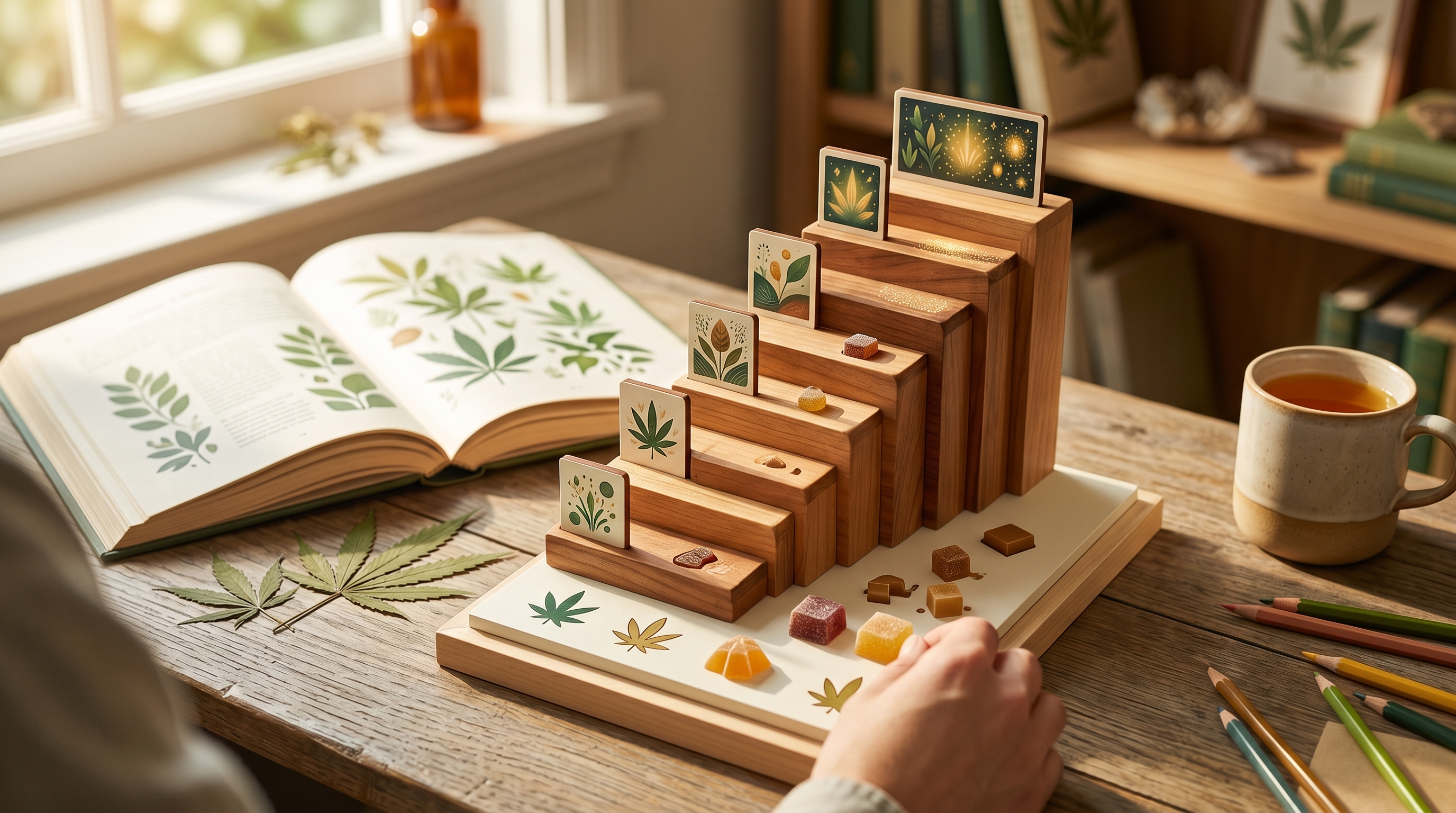
Edibles are measured in milligrams (mg) of THC. Unlike a puff from a joint, where you can stop the moment you feel enough, an edible is a fixed dose you commit to before you feel anything. That makes knowing the tiers essential. Here is how the ranges break down, drawing on the dosing charts published by Leafly, Kiva, and clinical reviews of oral THC.
| mg Range | Tier | What It Feels Like | Who It’s For |
|---|---|---|---|
| 1–2.5mg | Microdose | Subtle mood lift, mild focus, no real “high” | First-timers, daytime/functional use, sensitive people |
| 2.5–5mg | Low | Gentle euphoria, relaxation, mild giggles | Beginners, social settings, light symptom relief |
| 5–15mg | Moderate | Clear psychoactivity, altered time, body relaxation | Occasional users with some experience |
| 15–30mg | High | Strong euphoria, heavy impairment, couch-lock | Experienced users with established tolerance |
| 30–50mg+ | Very High | Intense, sedating, real risk of anxiety/nausea | High-tolerance regulars and certain medical patients |
A quick reality check on that table: 10mg is the standard “one serving” in many legal markets, but it is genuinely strong for someone who has never had an edible. A complete beginner and a daily medical patient can be separated by a factor of ten or more on this ladder. There is no universally “normal” dose. The right dose is the one that gives you the experience you want, which is exactly why we always say to find your ideal high rather than chasing a number or a strain name.
If you want a printable version with situation-specific recommendations, our cannabis beginner’s dosing chart breaks down how much THC suits different goals, and our first-time user’s guide covers what to expect overall.
Microdose Deep-Dive (1–2.5mg)
Microdosing has moved from a fringe idea to a legitimate area of clinical interest. At 1 to 2.5mg of THC, most people do not feel “high” in the traditional sense at all. Instead, research and consumer reports describe a subtle shift. You may notice a slightly better mood, less stress, and a touch of sensory boost. Music sounds a little richer. Food tastes a little better. Some people get gentle focus. You can usually function normally. People around you may not even be able to tell you have taken anything.
This is the tier I recommend for almost everyone starting out, and it is the foundation of microdosing for productivity and focus. Because the effects are so mild, the downside risk is small. It is very hard to have a frightening experience on 2mg. The tradeoff is that some people simply will not notice much at this level, which is fine: the point of a microdose is to establish a baseline, not to feel maximally altered.
A practical tip: look for products clearly labeled in 2.5mg pieces, or cut a standard 5mg gummy in half. Consistency matters more than precision here. Microdosing is also where many people land for daytime wellness routines, morning use focused on energy and clarity, or light creative work. It pairs well with the idea that THC percentage and dose size are poor proxies for the experience you actually want.

High-Dose Deep-Dive (15–50mg+) and the Cautions That Matter
The high end of the ladder is a completely different animal, and it deserves real respect. At 15 to 30mg, effects become strong. Expect intense euphoria for some. Add heavy impairment of coordination and short-term memory. Time can feel warped. Many people sink into deep physical sedation, or “couch-lock.” Above 30mg, the experience can overwhelm even seasoned users. The odds of anxiety, paranoia, nausea, or feeling dissociated go up.
Here is the most important point, and I want to hedge it carefully. Individual responses vary enormously. High-dose edibles are not inherently dangerous to a healthy adult. But they are very easy to misjudge. And an unpleasant edible experience can last many hours with no way to “turn it down.” The research is consistent on one thing. Overconsumption of edibles is rarely physically serious for adults. Even so, it is a more common reason for emergency-room visits than inhaled products, often for panic, intoxication, or cardiovascular symptoms [Leafly, 2022]. The reason is simple. You cannot un-eat a gummy.
If you do find yourself in over your head, it helps to know it will pass, and our guides on how to sober up from being too high, why greening out happens, and why cannabis can trigger paranoia and how to prevent it can help you ride it out and avoid it next time. High doses are best reserved for people who have deliberately worked up to them, ideally for a specific reason such as long-lasting symptom relief, and never as a starting point.
Onset, Duration, and the 2-Hour Rule
This is where edibles differ most dramatically from smoking or vaping, and it is the heart of why people get into trouble. When you inhale cannabis, THC hits your bloodstream through your lungs in seconds and peaks within 15 to 30 minutes. When you eat it, THC has to travel through your digestive system and liver first.
That detour through the liver does two things. First, it delays onset. Edibles typically take 30 minutes to 2 hours to kick in, sometimes longer on a full stomach. Second, the liver converts THC into a metabolite called 11-hydroxy-THC (11-OH-THC). This metabolite crosses the blood-brain barrier more readily, and it tends to produce a stronger, more body-heavy effect [PhenoDB, 2026]. This is why a 10mg edible can feel more intense than 10mg of inhaled THC. We cover the chemistry in depth in why edibles hit harder: the science of 11-OH-THC.
Here is a rough timeline for a conventional edible:
| Stage | Conventional Edible | Fast-Acting / Nano | Sublingual |
|---|---|---|---|
| Onset | 30–120 min | 10–20 min | 15–45 min |
| Peak | 2–4 hours | 45–90 min | 1–2 hours |
| Total duration | 4–12+ hours | 2–4 hours | 3–6 hours |
Which leads us to the single most important rule in all of edibles, the one that heads off most bad nights:
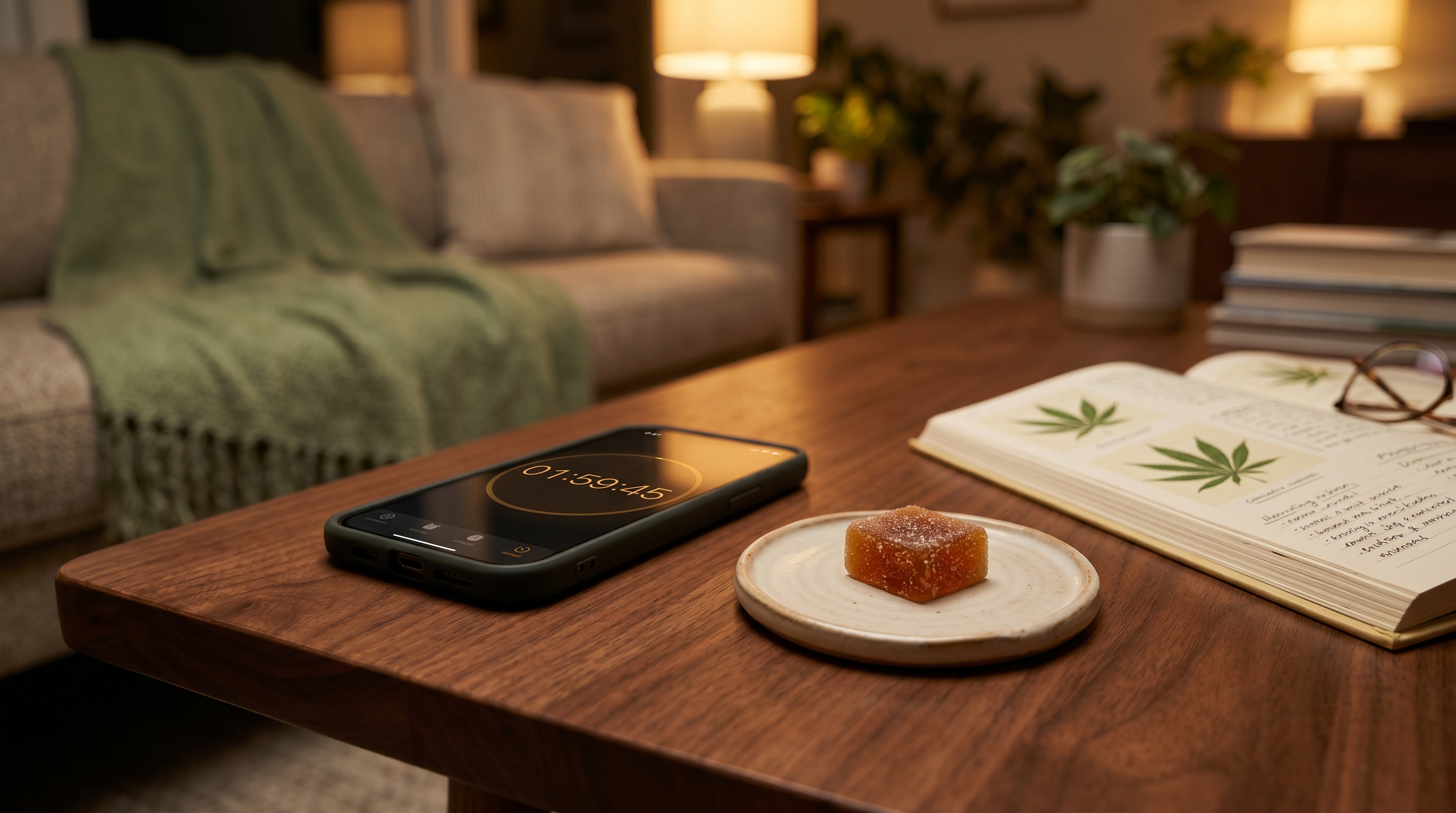
The 2-Hour Rule: After taking an edible, wait a full two hours before even considering more. Do not redose because you “don’t feel anything yet.” Set a timer on your phone.
We give this rule its own deep-dive in edible dosing for beginners: the 2-hour rule that saves sessions, because it is that important. Faster-onset products change the math somewhat: nano-emulsified THC absorbs faster and sublingual products onset sooner than conventional edibles, but even then, patience beats impatience every single time. For the full arc of an edible high, see how long a cannabis high lasts.
Why You Should Never Redose Too Soon
The “re-dosing trap” deserves its own section. It is the number-one cause of edible overconsumption [PhenoDB, 2026]. The story is always the same. Someone takes a 10mg gummy. They wait 45 minutes, feel nothing, and assume it was weak. So they take 20mg more. Ninety minutes later, all 30mg arrive at once. A pleasant evening turns into a white-knuckle marathon.
The math is brutal. Conventional edibles can take up to 90 minutes to onset. So a second dose at the 45-minute mark hits just as the first dose begins to peak. You have now committed to two or three times what you intended, with no undo button. This is why we wrote a whole guide on when to increase your dose and when not to. Within a single session, the answer is almost always the same. Not yet.
Tolerance adds to the confusion. Regular use downregulates your CB1 receptors. As a result, a daily user might need 15 to 20mg to feel what a newcomer feels at 2.5mg. But tolerance also fades fast. Even a few days off resets your sensitivity. That is the whole logic behind taking a tolerance break. If you have just come back from a break, treat yourself like a beginner again.
How to Find Your Tier
Finding your personal dose is not guesswork once you have a method. Here is the approach I recommend:
- Start at 2.5mg. Half of a standard 5mg piece. Yes, even if you are a heavy smoker, because inhaled tolerance does not fully transfer to edibles.
- Eat it with a light snack, not on a totally empty stomach. A small amount of fat aids absorption and smooths onset; a high-fat meal can intensify effects, so keep it modest.
- Set a 2-hour timer and do not touch more until it goes off. Plan a relaxed evening at home with nothing you need to drive to.
- Write down what happened. Product, dose, timing, and how you felt. After two or three sessions, your ideal tier becomes obvious.
- Adjust by 2.5mg at a time, in future sessions only. Up or down. There is no shame in being a 2.5mg person or a 15mg person.
That logging step is the secret weapon. So many things affect how an edible lands. Body composition, metabolism, your genetics (like CYP2C9 enzyme activity), what you ate, and your tolerance all play a role. The only reliable map is your own data. So track your dose, product, and response across sessions in the High IQ app. Over time, “edibles are unpredictable” turns into “I know exactly what 5mg does to me.” That is the difference between gambling and knowing.
If you are choosing between formats entirely, our guide on how to choose between flower, edibles, and concentrates can help you decide whether edibles are even the right tool for your goal.
Frequently Asked Questions
Is 10mg a lot for a beginner? For someone who has never had an edible, yes, 10mg can be a strong and potentially uncomfortable experience. It is the standard “one serving” in many markets, but standard does not mean beginner-friendly. Start at 2.5mg and work up.
Why didn’t I feel anything from my edible? A few things could be going on. Maybe it has not been long enough, so wait the full 2 hours. Maybe the product was dosed inaccurately. Or maybe you are a slow metabolizer whose liver processes THC differently. Some people genuinely need a slightly higher dose. Find that out across separate sessions, never by redosing the same night.
Are high-dose edibles dangerous? For a healthy adult, an overdose on edibles is extremely unlikely to be physically life-threatening, but it can be intensely unpleasant and last many hours. The bigger risks are accidental high doses in inexperienced people and edibles reaching children. Treat high doses with respect and keep them locked away.
Do microdoses build tolerance? Less aggressively than larger doses, but regular use of any amount can gradually shift your sensitivity. Periodic tolerance breaks keep even microdosing effective.
How long should I wait before driving after an edible? Because edibles last 4 to 12 hours and impair coordination, plan to not drive for the entire duration. When in doubt, wait until the next day. See cannabis and driving for the full picture.
Key Takeaways
- Microdose (1–2.5mg) and high dose (15–50mg+) are different tools, not just different amounts. One is a background hum; the other is a full concert.
- Start at 2.5mg, even if you smoke regularly. Inhaled tolerance does not fully carry over to edibles.
- Respect the 2-hour rule. Edibles can take up to 90 minutes to onset. Set a timer and do not redose early.
- Edibles feel stronger than the same mg inhaled because the liver makes 11-OH-THC, a more potent metabolite.
- Track your dose, product, and response. A few logged sessions turn guesswork into a reliable personal dose.
A microdose is a gentle background hum for daytime focus and calm. A high dose is a full-volume, hours-long experience for people who have earned their tolerance and know what they are signing up for. Wherever you land on the ladder, the same two rules carry you through. Start low, go slow, and treat the 2-hour rule like law. Track what works, and edibles stop being a gamble and start being a precision instrument.
Sources
- Leafly, “Edible dosing for beginners: With dosage chart by milligrams” — leafly.com/learn/consume/edibles/edible-dosing
- PhenoDB, “Cannabis Edibles Guide” (11-OH-THC, biphasic dose-response, onset/duration, re-dosing trap) — phenodb.eu/edibles-guide
- Kiva Confections, “Edibles 101: The Ultimate Edible Dosage Guide” — shopkivaconfections.com/blogs/news/edibles-101-the-ultimate-edible-dosage-guide
- RethinkTHC Research Team, “Cannabis Dosing Guide: How Much THC Is Right for Different Situations” (biphasic dose-response, CYP2C9, food interaction) — rethinkthc.com/articles/cannabis-dosing-guide-how-much-thc
- Mello Cannabis, “Edible Dosage Calculator Guide” — mellocannabis.com/2026/04/10/edible-dosage-calculator-guide
- [Schlienz et al., 2020] (effects of edible THC at different concentrations); Higher Leaf consumer summary — higherleaf.com/posts/edible-dosage-consumer-guide


