

Arizona Cannabis and Custody: Medical vs Adult-Use Rules
Arizona medical cannabis law names a custody proof standard. Adult-use law has different wording. Learn what the statutes and narrow case holdings establish.


Arizona’s medical law protects allowed conduct in custody cases, with an unreasonable-danger exception proved by clear and convincing evidence. Adult-use law has a broader sole-basis rule with different wording. Legal permission and evidence about parenting are separate questions.
That difference matters even when the products look the same. Our Arizona possession overview covers the familiar quantity limits. This lesson compares two legal protections. It also explains the limits of cases often cited to describe them. It is specific to Arizona, with sources checked on October 11, 2026.
What does Arizona’s medical custody rule say?
A.R.S. § 36-2813(D) addresses custody, visitation and parenting time with a minor. It protects conduct allowed under the medical cannabis chapter. It bars denial of those rights and a presumption of neglect or child endangerment. An exception applies if the person’s behavior creates unreasonable danger to the minor. That danger must be established by clear and convincing evidence.
Keep both conditions in the sentence: allowed conduct and evidence of danger. A card does not guarantee a specific parenting order. Nor does the law say an accusation proves danger.
Buying a product legally does not establish allowed medical conduct. Section 36-2811(A) sets out a medical-use presumption. It requires a registry card and possession within the allowable amount. Evidence of use outside the stated medical purpose can rebut that presumption. Our medical-card guide explains registration. That process and the facts of a custody dispute are different questions.
Does adult-use law repeat that proof standard?
No. Section 36-2852(A) lists lawful acts for adults 21 and older. The exceptions in §§ 36-2851 and 36-2853 still apply. Those allowed acts cannot be the sole basis for limiting a right or privilege protected by state or local law.
That is a broad protection. But this subsection does not repeat the medical provision’s custody-specific terms or its clear-and-convincing danger language. Those words alone do not settle how a court would apply the adult-use rule in a custody dispute.
| Provision | Protection and conditions |
|---|---|
| Medical: § 36-2813(D) | Custody, visitation, parenting time; neglect or child-endangerment presumptions. Conduct allowed under the medical chapter; unreasonable danger established by clear and convincing evidence. |
| Adult use: § 36-2852(A) | Listed lawful acts; state/local rights and privileges. Adults 21+; statutory exceptions; allowed acts cannot be the sole basis for limiting those rights. |
Keep the subsections separate: § 36-2852(B) concerns driving and cannabis components or metabolites; (C) concerns odor and reasonable suspicion. Neither is a custody-specific proof rule.
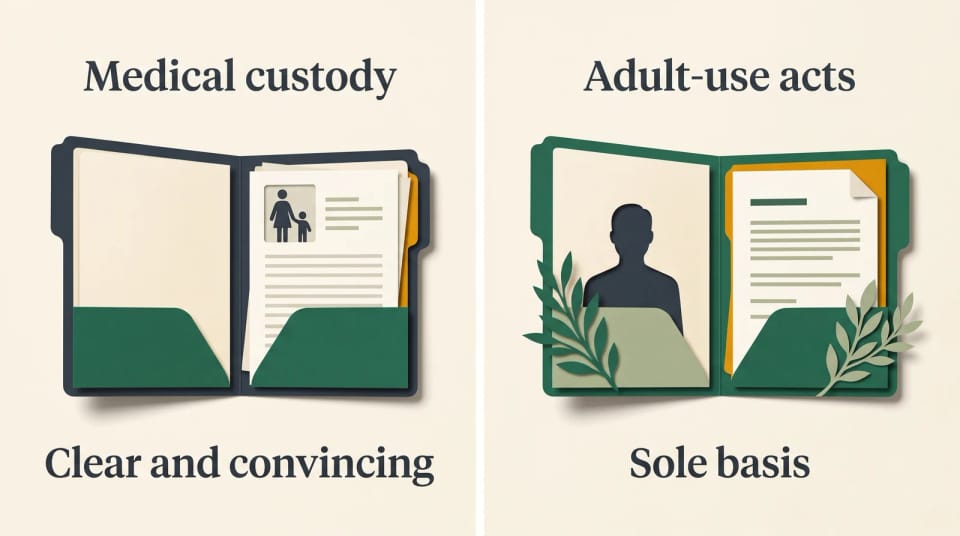
The medical text states a custody-specific danger and evidence condition. The adult-use text states a general sole-basis protection. Different wording does not predict a case outcome.
What do the cited cases actually decide?
The type of case matters as much as the word cannabis. A parenting order is one question. Ending parental rights is another. A central-registry finding is a third.
Ridgell, 2022: a central-registry finding. The published opinion reversed a prenatal neglect finding. It applied the medical-treatment exception. Paragraph 22 expressly left the presumption and unreasonable-danger arguments undecided. It does not decide the custody standard. It does not show that prenatal cannabis use is medically safe. CDC pregnancy guidance recommends avoiding cannabis during pregnancy. Our clinician appointment checklist helps prepare that separate health discussion. Ridgell v. ADCS, ¶¶ 15–22.
Darren G., 2017: termination of parental rights. This memorandum is not binding precedent. It assumed, without deciding, that the medical provision applied to lawful medical use in severance cases. The father lacked a current card and continued to use cannabis. The record also included concerns about caregiving and children’s access to substances. It did not decide the rule for a parent with conduct allowed under the medical chapter. Darren G. v. DCS, ¶¶ 11–12, judicial text reproduced by Justia.
Webster, 2022: relocation and parenting orders. This memorandum also is not binding precedent. It repeated the medical danger standard. It affirmed the orders, which included joint legal decision-making. It explained why speculative testimony had not harmed the mother’s case. The ruling supplies a specific example. It is not a binding adult-use custody rule. Webster v. Smith, ¶ 9, reproduced court PDF.
A published adult-use case, Kirsten, 2024, applied § 36-2852 to a driving-license suspension. The court rejected suspension without an impairment finding. The State had waived its alternative argument about impairment. It did not decide custody. A ruling about one right does not decide another. Kirsten v. ADOT/MVD.
How current is this comparison?
The legislature’s online statutes carry a caveat. The compilation is maintained for drafting. It reflects January 1 following the latest legislative session. The notice names Thomson Reuters as publisher of the official codified version. The legislature-hosted pages are not that official edition. Compilation notice.
For these two provisions, I checked the original initiative wording. I checked the legislature’s November 2024 amendment-history entries. I also checked the 2025 and 2026 tables of sections affected, and the delayed-effective list. Those checks did not identify a change to §§ 36-2813 or 36-2852. They support this comparison of the two texts. They are not a full audit of every related law. They do not predict a case outcome. 2024 history, 2025 table, 2026 table, delayed dates.
I did not identify a published decision applying adult-use protection to custody. That is a limit of this research. It does not prove that no such decision exists.
Other family questions need their own evidence. Talking with a teen about cannabis concerns communication. Employment protection concerns a different right. Neither answers what an Arizona custody court will decide. For a specific dispute, an Arizona lawyer needs to review current law and the actual case record.
FAQ
Does an Arizona medical card guarantee custody?
No. The statute protects conduct allowed under the medical chapter. It has an unreasonable-danger exception with an evidence standard. A card does not prove every fact or dictate the parenting order.
Do medical and adult-use laws state the same custody proof rule?
No. The medical text names custody and clear-and-convincing evidence of unreasonable danger. The adult-use text states a broader sole-basis protection. It does not repeat that wording. This difference does not predict different outcomes in every case.
Did Ridgell decide that prenatal cannabis use is safe?
No. It applied a medical-treatment exception in a central-registry case. It did not show pregnancy safety. It did not decide the separate custody danger standard.
Can a positive cannabis test settle the whole custody question?
It does not answer all the statutory questions by itself. Was the conduct allowed? Which provision applies? What behavior is alleged? What evidence supports danger? Those are distinct issues. This lesson does not assess a particular test or dispute.
Key takeaways
- Keep the medical custody provision and adult-use sole-basis provision separate.
- Read the conditions on allowed conduct beside the protection.
- Name the proceeding and narrow holding before using a case as an example.
- Legal status, medical safety and a family-court outcome require different evidence.
Sources
-
CDC: Cannabis and Pregnancy, January 31, 2025; opened October 11, 2026. Public-health recommendation, separate from a legal holding.
-
Arizona Legislature: § 36-2813, § 36-2811, § 36-2852 and § 36-2851. Legislature-hosted statutory text, with the compilation caveat explained above.
-
Arizona Legislative Council: November 2024 Proposition 105 history and initiative texts, 2025 and 2026 sections-affected tables, and delayed-effective dates. Relevant entries and pages checked, not a complete legal citator.
-
Arizona Court of Appeals: Ridgell, No. 1 CA-CV 21-0069, March 31, 2022; Kirsten, No. 1 CA-CV 24-0092, October 1, 2024. Official court PDFs.
-
Nonprecedential court memoranda reproduced by Justia: Darren G., No. 1 CA-JV 16-0078, January 2017; Webster, No. 1 CA-CV 22-0145 FC, November 1, 2022. These examples are not presented as controlling precedent.


