Talking to Your Doctor About Cannabis: What to Bring and Ask
Prepare for talking to your doctor about cannabis with a reusable card for products, use, medicines, goals, and questions about your medical record.

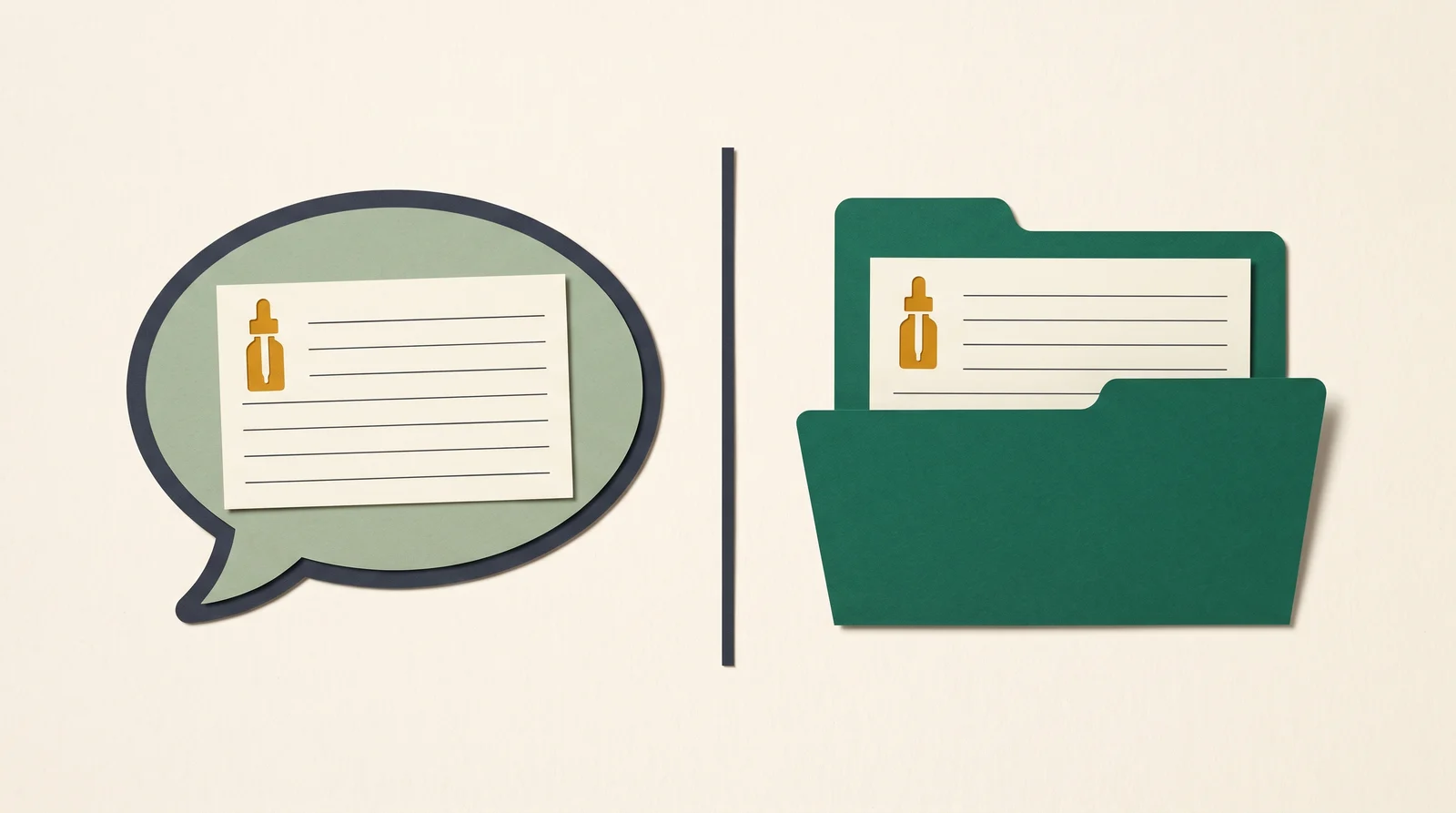
Bring the product label, your actual use pattern, medicines, and main concerns; ask how the discussion enters your medical record. A clear note gives your doctor facts to review. It does not ensure the doctor will recommend cannabis or keep the talk out of your chart.
Here in High School, we can make that note useful without pretending it is a treatment plan. This U.S. guide draws on patient advice. The card itself has not been tested as a way to improve health outcomes.
What should I bring to the appointment?
Bring information the care team can review, rather than just a strain name.
Connecticut’s Department of Consumer Protection advises patients to bring cannabis product-label information and discuss medicines, health conditions, procedures, and concerns about use. NIH also recommends listing your concerns in priority order and bringing a complete medicine list. Connecticut DCP, NIH
Use a label photo or written details for the cannabis product. Do not read “bring information” as permission to bring cannabis onto any facility’s grounds. Ask the clinic what materials it wants before the visit.
For each product, keep what the label says separate from what you actually use. If it lists milligrams per serving, copy those words and units. Then record how many pieces or how much liquid you take. If it lists a percentage, preserve the percentage. Do not turn it into an invented milligram dose.
Our lesson on edible label accuracy explains why label content and personal use need separate entries. If a homemade product has no reliable strength result, say so; a recipe calculation is an estimate. Our lab-methods lesson explains how a chemical measurement depends on what was tested.
Can I copy an appointment card?
Yes. Copy these prompts into a note and fill in what you know. Use a separate product line for each preparation. An empty field is not a reason to guess.
Product and use
- Product name and label/photo: ______
- THC/CBD amount exactly as labeled, with units; or “unknown”: ______
- How I take it: ______
- Typical amount I use, in pieces, milliliters, grams, or puffs as applicable: ______
- How often; when I started; recent changes; last use if relevant: ______
Health and medicines
- Why I use it or want to discuss it; symptoms and when they started: ______
- What I hope to change in daily life; what I have tried: ______
- Effects I have noticed, including unwanted effects or difficulty cutting back: ______
- Prescriptions, nonprescription drugs, vitamins, supplements, alcohol and other substances; amounts and frequency: ______
- Health conditions, allergies, pregnancy/breastfeeding, planned procedures or other care the clinician should know about: ______
Questions and follow-up
- My main question for this visit: ______
- What will be documented, and how is that information used or shared? ______
- What is the next step, and when should we review it? ______
The card draws on Connecticut’s cannabis topics and NIH’s visit advice. Clinician Mohab Ibrahim also advises explaining how much, how often, how long, and why you use cannabis. This is our layout. It is not a tested medical form. Ibrahim, 2024
A puff count describes an action, not a lab-measured THC dose. Our product-comparison lesson keeps strength, amount and route separate. “Unknown strength; about this much, this often” gives a clearer history than a made-up precise number. Tell the clinician which part is a label claim and which part is your estimate.
Include CBD products too. Explain the actual method: swallowed, held in the mouth, inhaled, or applied to skin. Our sublingual-versus-edible lesson explains why a product’s name alone does not describe its route. This card does not recommend a dose or route.
How do I start the conversation?
Raise your main concern early in the visit.
You could say: “I use cannabis, and I want to review it with my medicines and health history. I brought the label and a note about how I use it.” If you have not started, say that instead: “I’m considering cannabis for this problem. Can we discuss the evidence, other options, and risks?” These are suggested openings, not quotes from patients or tested scripts.
If privacy worries you, name that concern: “Before we go further, can you explain what goes into my chart and how the information can be shared?” You can also ask for time alone if a companion is present. NIH includes private discussion time in its visit-preparation guidance. NIH
Ask the clinician to review the complete medicine list. Our CBD liver-trial comparison shows why a tested protocol and dose do not establish personal safety. For a planned procedure, flag cannabis use early and discuss instructions with that team. Do not infer a safe combination or a stop-use window from this card.
Does telling my doctor mean it stays out of my record?
No. A private clinical conversation and an undocumented conversation are different things.
| Step | What it means | What it does not promise |
|---|---|---|
| Disclosure | You explain your use and concerns | A cannabis recommendation |
| Documentation | The clinician records relevant information | That no permitted sharing can occur |
| Treatment decision | The clinician assesses your care | An unchanged prescription or a particular outcome |
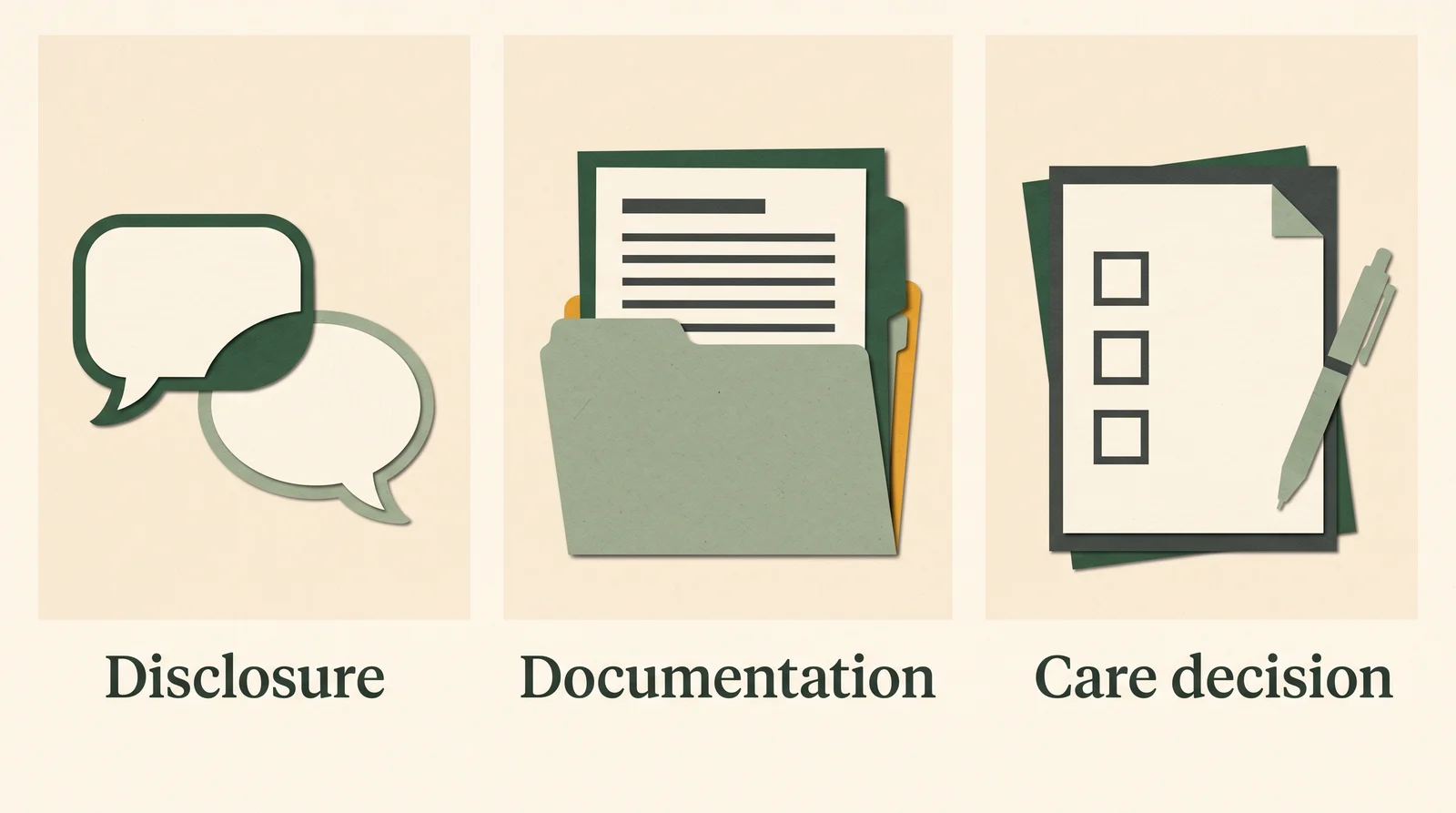
Sharing information, recording it, and deciding care are separate steps. A record is not a promise of either secrecy or a specific treatment.
HHS explains that HIPAA protects health information held by covered providers and other covered entities. It also allows uses and sharing for treatment, payment, and health care operations. It does not mean only one doctor can ever see your chart. HHS, 2025
There are defined exceptions too. HHS describes conditions for certain legal requests, legally required reports, and serious imminent threats. Those exceptions do not establish that an ordinary cannabis discussion is automatically reported to police. Ask about the rules that apply to your care setting. HHS disclosure FAQ
Ask for the clinic’s Notice of Privacy Practices and the contact who can explain it. It describes permitted uses, sharing, and your rights. It is more useful than a promise of absolute secrecy. HHS notice guidance
Records from certain federally assisted substance-use-disorder programs have additional rules under 42 CFR Part 2. Do not assume every primary-care mention of cannabis is automatically such a record. If you receive that care, ask which rules and notices cover it. HHS, reviewed September 2026
What does the VA example actually show?
It shows that documentation and access to care can coexist.
VA’s posted July 28, 2023 Directive 1315 says clinically relevant cannabis discussions must be documented in the electronic health record. It also says Veterans must not be denied VHA services solely for state-program participation or acknowledged use. Treatment decisions remain case by case, based on health and safety concerns. VHA Directive 1315
The current VA publications index still lists that directive, with July 2028 recertification. This is a VHA care-policy example. It is not a guarantee about every benefit, prescription, employer, insurer, or legal proceeding. VA publications index
What should I leave the visit knowing?
Ask for a clear next step and a follow-up plan.
That may mean more assessment, a medicine review, another treatment, or a referral. Asking about cannabis does not require the clinician to recommend it. If an explanation is unclear, ask them to repeat it in plain words. Record the instructions you receive, including whom to contact with questions. NIH visit guidance
Update the care team when your products, amounts, medicines, or symptoms change. The purpose is an accurate history, not a persuasive case for a product.
FAQ
What if I don’t know the THC dose?
Say “unknown” and describe the product and amount you actually use. Bring the label if you have it. Keep a calculated estimate separate from a measured result.
Should I mention CBD if I don’t use THC?
Yes. Include CBD in the product and medicine discussion. The Connecticut guidance and Ibrahim Q&A support reviewing cannabis use with your health history and medicines.
Can I ask for cannabis use to be left out of my chart?
You can ask how the clinician documents relevant information and explain your concern. Do not assume the clinic can promise omission. The VA directive explicitly requires documentation in its care setting.
Does preparing this card mean my doctor will recommend cannabis?
No. It organizes facts for a discussion. The care decision depends on the clinician’s assessment, and the card does not establish eligibility for a state program.
Key takeaways
- Bring label details and actual use as separate facts.
- Unknown strength stays unknown; do not invent milligrams.
- List all medicines, your goals, and unwanted effects.
- Disclosure, documentation, and treatment decisions are separate.
- Ask about the care plan and the clinic’s privacy notice.
Sources
- Connecticut Department of Consumer Protection. June 30, 2023. Talking to Your Healthcare Provider About Cannabis Use.
- National Institutes of Health. How To Prepare for a Doctor’s Appointment. No publication date displayed; accessed October 11, 2026.
- Ibrahim, M. April 19, 2024. Should I talk to my doctor about cannabis?. University of Arizona Health Sciences. Clinician Q&A.
- U.S. Department of Health and Human Services, Office for Civil Rights. Reviewed May 30, 2025. Your Rights Under HIPAA.
- HHS Office for Civil Rights. Reviewed November 2, 2020. Notice of Privacy Practices.
- HHS Office for Civil Rights. Created July 23, 2004; reviewed December 28, 2022. When does the Privacy Rule allow covered entities to disclose protected health information to law enforcement officials?.
- HHS Office for Civil Rights. Reviewed September 29, 2026. Understanding Confidentiality of Substance Use Disorder (SUD) Patient Records or “Part 2”.
- Veterans Health Administration. July 28, 2023. VHA Directive 1315: Access to VHA Clinical Programs for Veterans Participating in State-Approved Marijuana Programs. Current official publications listing checked October 11, 2026.

