How to Get a Medical Marijuana Card: A State-by-State Guide
A clear, step-by-step guide to getting a medical marijuana card in 2026 — qualifying conditions, telehealth evals, state fees, and why a card still pays off.


Here is a question I get all the time. “Weed is legal where I live. So why would I bother with a medical card?” It is a fair point. Walking into a shop with just your driver’s license feels like the whole point of legal weed.
But the math has shifted. In 2026, a medical marijuana (MMJ) card often pays for itself in the first few months. You get lower taxes. You get higher buying limits. You can qualify at age 18. And you get legal protections that other shoppers do not have. In the roughly 18 states with a medical program but no recreational one, a card is still the only legal way to buy at a dispensary.
The catch? There is no single national process. Cannabis is still messy at the federal level. So each state runs its own program, with its own rules, fees, and approved conditions. The good news: under all that variation, the path is much the same everywhere. Let me walk you through it.

Why Get a Card — Even Where Recreational Is Legal
In a medical-only state, the answer is easy. A card is your only legal way to buy. But in the 20-plus states with both programs, the choice is about value. Here is what a card actually gets you.
Lower taxes (this is the big one)
Weed carries some of the highest taxes of any product you can buy. And recreational shoppers pay nearly all of it. Medical patients are usually exempt or pay a small fraction.
Illinois is the clearest example. Recreational buyers there face an excise tax of 10% to 25%, set by THC percentage. Add state and local taxes, and the total can top 40% on a strong product. A patient buying the same item pays just 1%. That is the rate Illinois uses for prescription drugs. On a $300-a-month habit, that is roughly $720 to $1,080 saved each year.
It is not just Illinois. New Jersey patients pay no sales tax. Recreational buyers there pay 6.625% plus local fees. In Washington, the recreational rate tops 37%, and medical is exempt. For most regular users, the tax savings alone cover the cost of the card.
Higher possession and purchase limits
Patients get to carry and buy more. Colorado caps recreational buyers at 1 ounce. Patients can hold 2 ounces. Illinois caps recreational buyers near 30 grams. Patients can buy 2.5 ounces every 14 days. New Jersey gives patients up to 3 ounces per 30 days, versus a 1-ounce limit per recreational sale.
If you manage chronic pain, PTSD, or seizures, you may need a steady daily supply. Those higher limits can mean one shop trip a month instead of one a week.
Access at age 18 instead of 21
Recreational cannabis is locked to adults 21 and up, with no exceptions. Medical programs open the door at 18. Many states even allow minors with a parent or guardian’s consent for serious conditions like epilepsy. If you are a 19-year-old veteran with chronic pain, the card is not optional. It is your only legal path.
Home growing and product access
In Illinois, only patients can grow at home, up to five plants. Some states also cap THC in recreational products but not in medical ones. Connecticut and Vermont both do this. Medical menus also stock more options, like RSO, high-dose tinctures, and clinical-grade products.
Legal protections and reciprocity
This perk is the most overlooked. Roughly 8 to 20 states give some job protection to registered patients. The list includes Arizona, Connecticut, Delaware, Minnesota, Nevada, New Jersey, New York, and Pennsylvania. Recreational users in those same states get almost none. If your job drug tests, that paper trail can help you keep it. (Safety-sensitive, DOT, and federal roles are still exempt. Read more in our guide to cannabis and drug testing.)
A card can also help in housing fights (see our piece on whether your landlord can ban cannabis) and custody cases. Some states grant reciprocity too. They honor out-of-state cards for visiting patients. Oklahoma, Maine, Michigan, and Missouri are among them. No state offers that to recreational tourists, which matters if you plan to travel with cannabis.
Not sure the whole split makes sense? Our deep-dive on medical versus recreational cannabis explains why the line is more about red tape than biology.
The General Step-by-Step Process
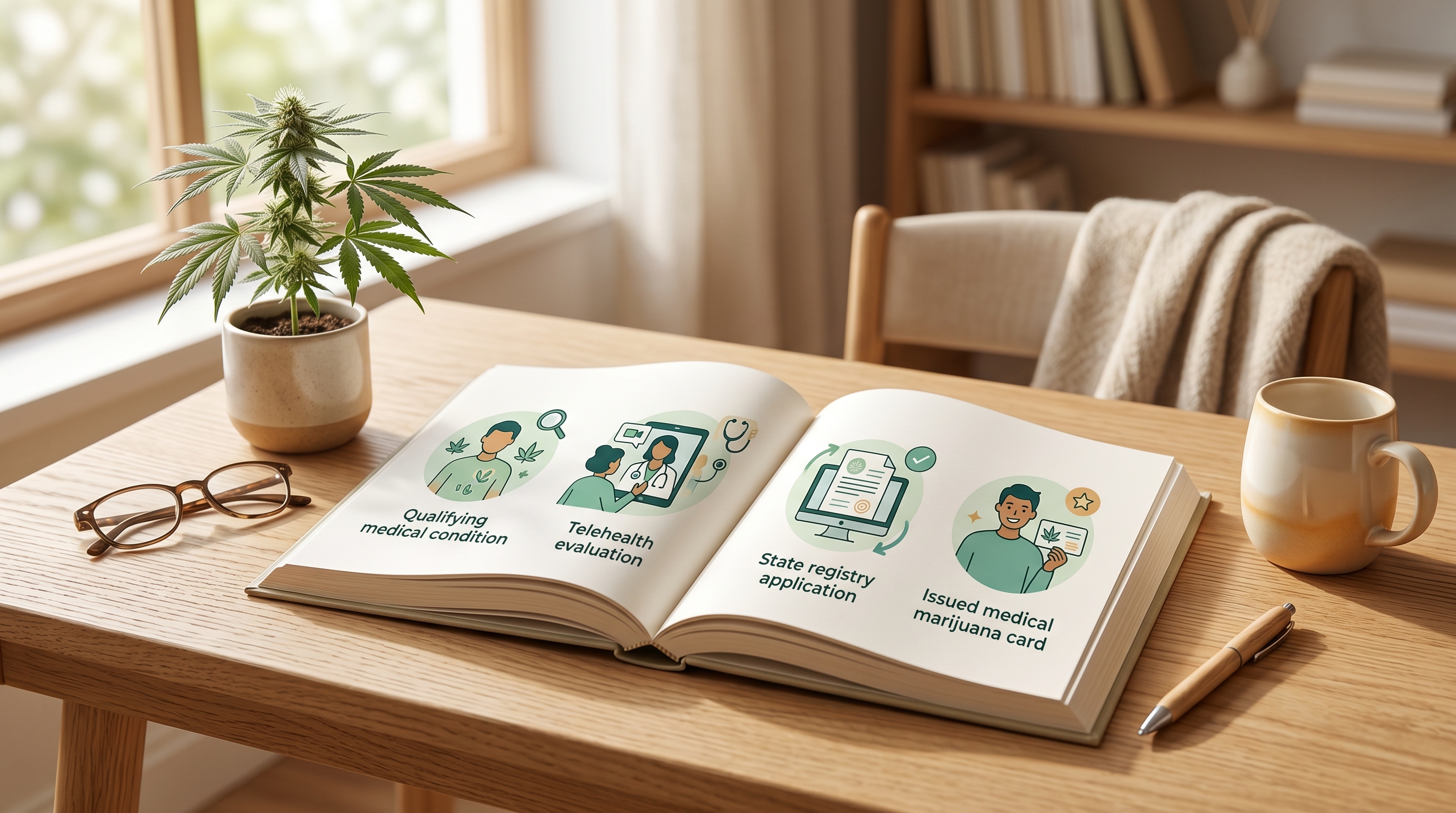
Each state is a bit different. But the order of steps is the same almost everywhere. Here is the path from “I think I qualify” to “I have a card.”
Step 1: Confirm you have a qualifying condition
Each state has its own list of conditions that make you eligible. Some states, like Ohio, use a strict list-based model. Your condition must be on the approved list. Others use physician discretion. There, the doctor decides if cannabis may help. Oklahoma lets a doctor recommend it for almost any condition. A few states use a hybrid of both. Check your state’s official registry website first, before you spend a dime.
Step 2: Get a physician certification (usually by telehealth)
You need a licensed provider to certify that you have a qualifying condition and that cannabis may help. In most states that is an MD or DO. Some states also allow a nurse practitioner or PA. It does not have to be your regular doctor.
Most states now allow telehealth visits. That is a secure video call, often 10 to 30 minutes, from your couch. Sites like NuggMD, Leafwell, and Veriheal focus on these. They offer same-day or next-day visits. For patients with a real qualifying condition, approval rates run above 95%. Many sites also offer a money-back guarantee if you are not approved.
Florida is the main exception. It requires at least one in-person visit before you can do telehealth follow-ups.
Step 3: Register with the state and pay the fee
Next you send your certification to your state’s health or cannabis agency. This is almost always an online portal. You will usually upload:
- A government photo ID (driver’s license, state ID, or passport)
- Proof of residency (utility bill, lease, or bank statement with your address)
- Your physician certification
- The state registration fee
In some states the doctor files the certification for you. In others you upload it yourself.
Step 4: Get your card
Wait times run from same-day to a few weeks. Colorado approves clean online applications in 1 to 3 business days. Ohio takes about 2 to 3 days. Florida takes around 10. Many states issue a digital temporary card right away, so you can shop while the real card is mailed. Nevada lets you use your approval letter for 60 days. The card itself arrives in 7 to 10 business days.
Common Qualifying Conditions
The exact list varies. But some conditions show up on nearly every state’s list. Pennsylvania, Colorado, and Nevada run very different programs, yet all three cover most of these:
- Chronic or severe pain (the most common qualifying condition by far)
- Cancer, including symptom care
- PTSD and, more and more, anxiety disorders
- Epilepsy and seizures — the conditions that drove early medical CBD use
- Multiple sclerosis and muscle spasms
- Glaucoma
- HIV/AIDS
- Severe nausea and wasting
- Crohn’s disease and bowel disease
- Autism spectrum disorders
- Parkinson’s, ALS, Huntington’s, and other nerve conditions
Many states keep adding to these lists. Some use catch-all wording too. Colorado, for one, covers “any condition for which a physician could prescribe an opioid.” So if you manage arthritis and joint pain, or you are an older adult exploring cannabis, odds are you already qualify on your state’s list.
What It Costs and How Renewal Works
Plan for two costs: the physician visit and the state fee.
Physician visit: Usually $75 to $250. Telehealth sites sit at the low end (California visits can run as little as $39). Because of the federal ban, insurance does not cover this.
State registration fee: This is where states differ the most, from nearly free to $200.
| State | State Registration Fee | Card Validity |
|---|---|---|
| Ohio | ~$0.01 | 1 year |
| Texas | $0 (CURT registry) | 1 year |
| Virginia | $0 | 1 year |
| Minnesota | $0 | 3 years |
| Connecticut | $0 | 1 year |
| Missouri | ~$28 | 3 years |
| Pennsylvania | $50 ($0 for SNAP/WIC) | 1 year |
| Michigan | $40 | 2 years |
| Oklahoma | ~$104 ($22.50 Medicaid/Medicare) | 2 years |
| Arizona | $150 ($75 for SNAP) | 2 years |
| Georgia | $25-$30 (low-THC oil only) | 5 years |
All in, plan for a first-year total near $100 to $400. Many states cut or waive fees for veterans, seniors, Medicaid users, and low-income patients. Colorado waives its fee fully for households at or below 185% of the federal poverty level.
Renewals are usually cheaper and faster. You mostly renew the state registration, though some states still want a new physician sign-off. Cards used to expire each year. Now the trend is longer terms. Arizona and Oklahoma issue 2-year cards. Minnesota offers 3 years. Georgia offers 5. Start your renewal 30 to 60 days before it expires. Florida wants a 45-day lead time.
The break-even math is simple. In a high-tax state, even a $150-a-month buyer often makes back the full card cost in tax savings within the first quarter.

How It Varies by State (Real Examples)
A few real examples show how different these programs feel on the ground:
- Texas does not issue a physical card at all. Your doctor enters you into the state registry (CURT). THC is capped, and your status lives in a database. No card, no fee.
- Florida requires that first in-person visit before any telehealth renewals. And visits are never covered by insurance.
- Colorado is one of the fastest. Clean online applications clear in 1 to 3 business days. Minors must see two separate providers.
- Oklahoma is the most open. Doctors can recommend cannabis for any condition. That makes it one of the easiest programs in the country.
- Ohio cut its state fee to about a penny in 2024. So your only real cost is the visit.
The rules change often. Always check the current details on your state’s official program website before you apply. For the bigger legal picture, our state-by-state cannabis laws guide and our overview of cannabis legalization in the United States are kept current.
Privacy and Employment Notes
A common worry: “Does a card put me in some federal database?” No. State registries are private. They are protected by state health-privacy laws, and they are not a public list. Still, a card does create a record of your doctor visit and program sign-up. That record is what helps you in a job or housing dispute. But it is a paper trail, so be aware of it.
Two honest notes. First, gun owners should know that any cannabis use, medical or not, makes you a prohibited buyer on the ATF’s Form 4473. A card does not change that, and it may document it. Second, a card does not override your employer’s drug policy on its own. Some states protect patients, but safety-sensitive and federal jobs are carved out. If your case is sensitive, read your state’s exact law or talk to a pro.
Choosing Where to Shop Once You Have It
A card gets you in the door. A good dispensary gets you the right product. Medical shops often have better-trained budtenders and stock more therapeutic options. Our guide to choosing the right dispensary covers what to look for. And if you are brand new, our first-time user’s guide and beginner’s dosing chart will keep your first sessions easy.
Once you shop as a patient, the real work starts. You need to find which products help your condition. That is less about the highest THC number and more about terpene profiles. We call these High Families. A patient using cannabis for sleep wants a different profile than one treating daytime pain. Dialing in your personal THC-to-CBD ratio takes a bit of trial and error. So track what works: strain, dose, format, and how you felt. That turns guesswork into a routine you can repeat. The High IQ app is built to help you do exactly that.
Key Takeaways
- The process is the same almost everywhere: confirm a qualifying condition, get a doctor’s certification (often by telehealth), register with the state, and get your card.
- A card still pays off in many recreational states. You get lower taxes, higher limits, age-18 access, and some legal protections.
- Plan for $100 to $400 in the first year. Veterans, seniors, and low-income patients often pay less.
- The details vary a lot by state. Always check your state’s official program site before you apply.
Frequently Asked Questions
Can I get a medical card online? In most states, yes, start to finish. You do a telehealth visit, get your certification, and send your documents through the state’s online portal. Only a few states (notably Florida, for the first visit) require an in-person appointment.
Do I need a qualifying condition, or can anyone get one? Every state requires a doctor’s certification tied to a qualifying condition. How strict that is depends on the model. Oklahoma is very open. List-based states like Ohio require a specific diagnosis.
Is it worth it if recreational is already legal? For regular users, usually yes. The tax savings alone often beat the yearly card cost in a few months. And that is before the higher limits and legal protections. For once-a-month users in a low-tax state, it may not pay off.
How long does the whole process take? The visit is 10 to 30 minutes. State processing runs from same-day (many states give you a digital card right away) to a few weeks.
Will my card work in another state? Sometimes. States like Oklahoma, Maine, Michigan, and Missouri honor out-of-state cards. But the rules are narrow. Never assume. Check before you travel.
Sources
- Veriheal — “How To Apply For A Medical Marijuana Card in 2026” (veriheal.com)
- Local Dispensary Guide — “How to Get a Medical Marijuana Card (2026)” (localdispensaryguide.com)
- Colorado Department of Public Health & Environment — “Apply for a Colorado medical marijuana card” (cdphe.colorado.gov)
- Pennsylvania Department of Health — “Register for the Medical Marijuana Program” (pa.gov)
- Nevada Division of Public & Behavioral Health — “Medical Marijuana Patient Cardholder Registry FAQs” (dpbh.nv.gov)
- Missouri Department of Health & Senior Services — “How to Apply — Patient Information” (health.mo.gov)
- CannabisMD TeleMed — “Medical Marijuana Card Costs by State 2026” and “Renewal Requirements by State 2026” (cannabismdtelemed.com)
- Green Rush — “How to Get a Medical Marijuana Card: The State-by-State Process, Costs, and Qualifying Conditions” (greenrushnews.com)
- RethinkTHC — “Is a Medical Card Worth It in 2026?” (rethinkthc.com)
- Herb — “How to Get a Medical Marijuana Card in Your State” and “Benefits of Medical Marijuana Cards in Recreational States” (herb.co)
- NuggMD — “Top Benefits of a Med Card in a Recreational State” (nuggmd.com)
- AllowedHere — “Medical vs. Recreational Marijuana: State-by-State Comparison (2026)” (allowedhere.com)
This article is for educational purposes only and is not legal or medical advice. Cannabis laws, fees, and qualifying conditions change frequently and vary by state. Cannabis remains illegal under federal law. Always verify current requirements on your state’s official medical cannabis program website and consult a licensed physician about whether medical cannabis is appropriate for you.


