Best Cannabis Strains for Playing Music and Jam Sessions
15 top cannabis strains for musicians and jam sessions — with terpene science, High Family picks, and dosing tips for peak creative performance.

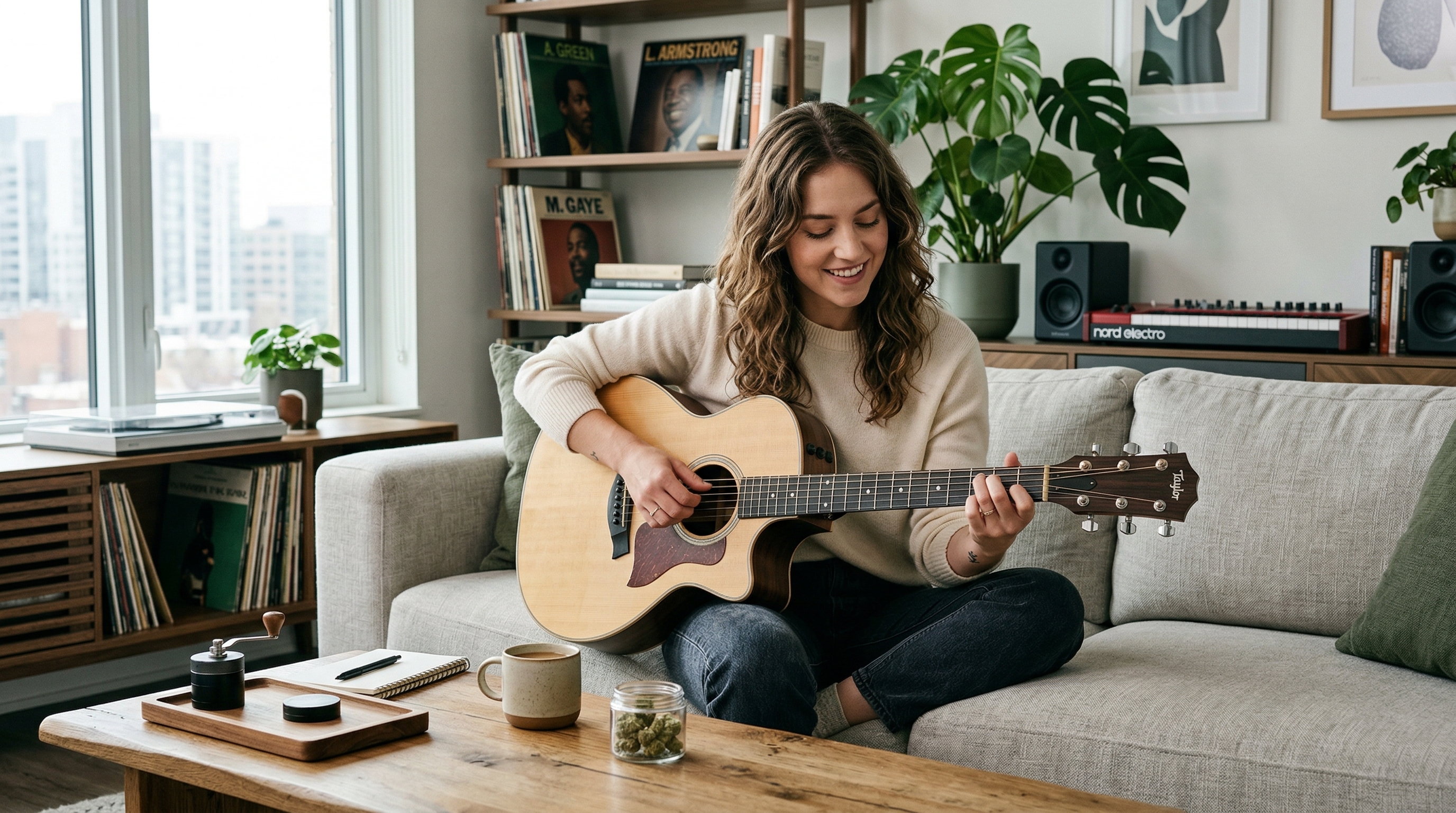
There is a reason Louis Armstrong called cannabis his “helper” and recorded “Muggles” back in 1928. A century later, the relationship between cannabis and music-making has only deepened — from the jazz clubs of Harlem to the home studios and garage jam spaces of today. But playing music is a fundamentally different task than listening to it. You are not passively absorbing sound. You are making decisions in real time: chord voicings, melodic phrasing, rhythmic feel, dynamics, improvisation. The strain you choose matters enormously, and picking the wrong one can leave you sitting with a guitar in your lap and no idea what to play next.
This guide is for the players — guitarists, drummers, keyboardists, bassists, horn players, producers, and anyone who makes music rather than just listens to it. We will cover the neuroscience of how cannabis affects musical performance, which terpene profiles tend to serve musicians best, and 15 specific strains broken down by the type of musician they suit. We will also look at the crucial difference between strains for improvisation versus composition, and how to time your consumption for maximum benefit.
If you want to understand why music sounds different when you are high from a listener’s perspective first, that article covers the neurochemistry in depth. Here, we are focused on the creative output side.
Quick Comparison: Strain Types for Musicians
| Use Case | Best Terpene Profile | High Family | Key Strains |
|---|---|---|---|
| Improvisation & Jamming | Limonene + Terpinolene | Uplift / Energy | Sour Diesel, Jack Herer, Durban Poison |
| Composition & Songwriting | Pinene + Limonene | Uplift | Jack Herer, Super Silver Haze, Strawberry Cough |
| Deep Rhythm & Groove | Myrcene + Caryophyllene | Balanced Hybrid | Blue Dream, Gelato, Wedding Cake |
| Studio Sessions (long focus) | Pinene + Ocimene | Energy | Durban Poison, Green Crack, Chocolope |
| Emotional / Expressive Playing | Linalool + Myrcene | Balanced / Relax | Northern Lights, Granddaddy Purple, Grape Ape |
| Low-Dose / High-Clarity | High CBD | Balance | Harlequin, ACDC, Cannatonic |
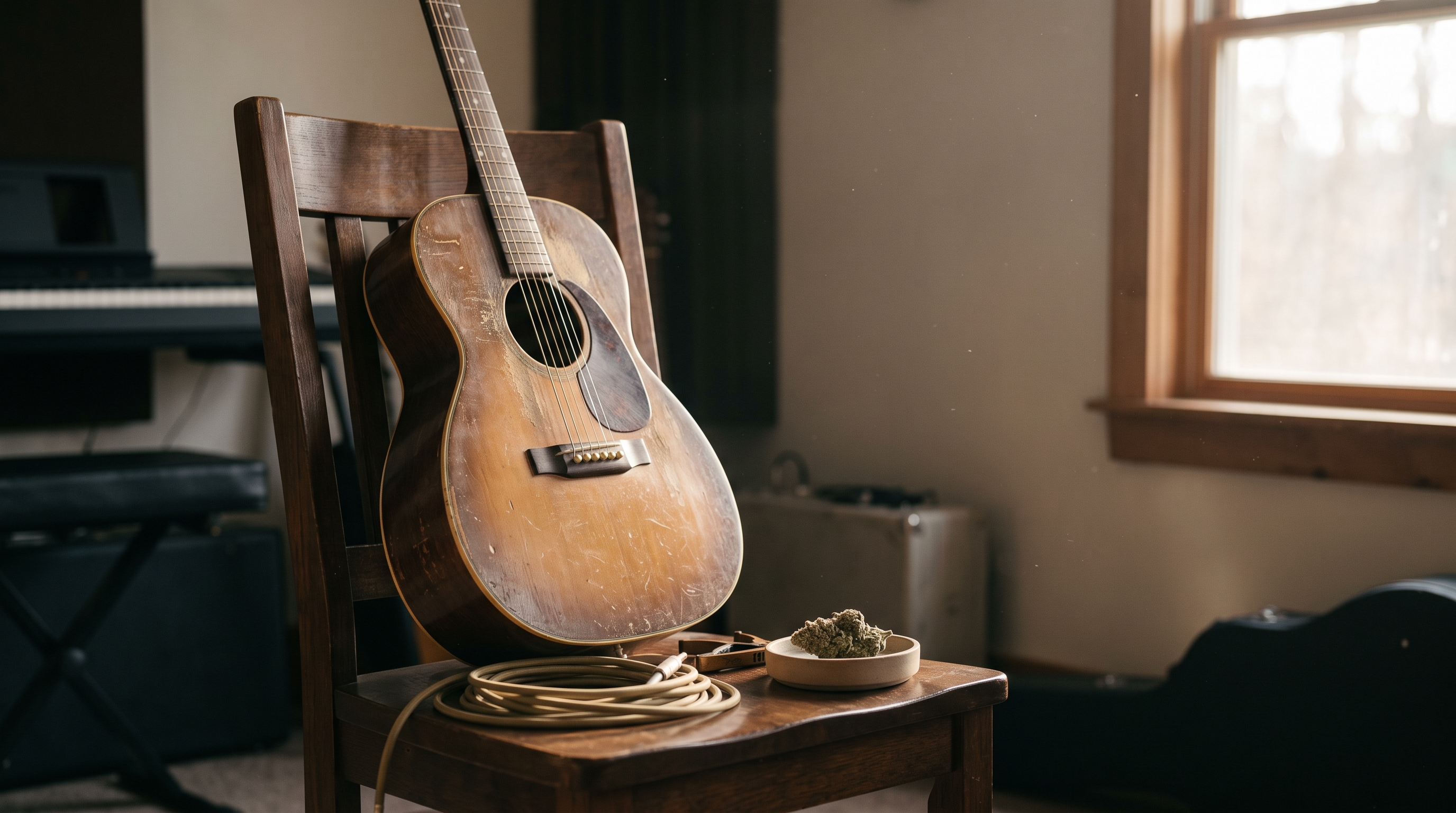
The Neuroscience: How Cannabis Affects Musical Performance
Temporal Dilation and Rhythm
One of cannabis’s most well-documented effects is on time perception. Research by Sewell et al. (2013) in Psychopharmacology confirmed that cannabis users consistently overestimate elapsed time — a phenomenon called temporal dilation. For musicians, this is a double-edged sword.
On the upside, temporal dilation can make spaces between notes feel more expansive. Phrases breathe. Solos that previously felt rushed can unfold with more intentionality. Jazz musicians have long described feeling “in the pocket” more easily — the sense that the groove is wider and more forgiving. On the downside, a drummer or bassist who loses objective time reference while high can rush or drag in ways they do not perceive in the moment. The key is self-awareness and the right strain.
Divergent Thinking and Improvisation
Improvisation is essentially applied divergent thinking — generating musical ideas rapidly, evaluating them in milliseconds, and committing to a direction. A 2012 study by Schafer et al. in Consciousness and Cognition found that cannabis was particularly effective at enhancing divergent thinking in people with low baseline creativity. For musicians who feel “stuck” or habitually fall back on the same licks and patterns, the right low-to-moderate dose may genuinely help break those patterns.
However, the same research noted that convergent thinking — the ability to critically evaluate and refine ideas — can be impaired at higher doses. This creates a practical principle: use cannabis to generate ideas, return sober to arrange and edit. Many professional musicians and producers report this as their workflow.
Dopamine, Emotional Resonance, and Touch
The ventral striatum — your brain’s primary reward center — has significant CB1 receptor density. When THC activates these receptors, dopamine release patterns shift in ways that can make emotionally charged playing feel more resonant and meaningful. A guitarist might find that minor-key phrases hit them harder emotionally, or that the physical sensation of the strings under their fingers becomes more textured and present.
A 2018 fMRI study from the University of Bath (Freeman et al., PMC5795345) found that cannabis increased participants’ desire to engage with music even while dampening objective neural responses to it. The paradox: less brain activity, more subjective desire and engagement. For a musician, this can translate into playing more freely — the inner critic quiets down, and the intuitive voice gets louder.
The Self-Criticism Effect
This may be the single most valuable thing cannabis offers musicians: temporary relief from the harsh inner critic. The prefrontal cortex, which is responsible for judgment and self-monitoring, is modulated by CB1 receptor activation. Many musicians report that cannabis helps them “get out of their own way” — they stop second-guessing every phrase and start trusting their instincts. For beginners who freeze up, or experienced players who have developed perfectionism-induced playing anxiety, this can be transformative.
Best Strains for Improvisation and Jamming
These strains prioritize mental fluidity, euphoric energy, and the ability to follow musical ideas wherever they lead. They are ideal for group jam sessions, blues jams, jazz improvisation, and any context where real-time creativity is the goal.
1. Sour Diesel
Sour Diesel is the quintessential musician’s sativa. Its fast-acting, cerebral rush makes it ideal for the first hour of a jam session — the energy is high, ideas come quickly, and the mood is elevated and playful. Dominant terpenes limonene and caryophyllene work together to lift the mood while grounding the nervous energy that pure limonene-forward strains can sometimes produce. THC typically ranges 20–25%.
The main caution: Sour Diesel can run hot for some musicians, especially at higher doses. If you tend toward anxiety, keep your dose modest and have some CBD on hand.
Best for: Blues jams, jazz improvisation, funk sessions, any situation where you want to solo freely and fearlessly
2. Jack Herer
Named after the legendary cannabis activist, Jack Herer has been a creative staple for decades. Its terpinolene and ocimene forward profile produces a uniquely euphoric, clear-headed creativity that feels different from standard sativas. Where Sour Diesel surges, Jack Herer flows — it produces a more meditative creative state that is excellent for melodic composition and thoughtful improvisation.
Many musicians specifically cite Jack Herer for its ability to help them “hear the music differently” — noticing chord tensions, voice leading, and rhythmic nuance with unusual clarity. THC typically runs 18–23%.
Best for: Singer-songwriters, melodic soloists, acoustic sessions, jazz and classical fusion
3. Durban Poison
Durban Poison is a pure African sativa with one of the most distinctive terpene profiles in cannabis. Dominated by terpinolene, it delivers a focused, energetic high that is remarkably free of the body heaviness or mental fog that some sativas can bring. Musicians frequently describe it as the strain that keeps them “in the room” — present, alert, and engaged rather than drifted off.
For drummers and percussionists especially, Durban Poison’s energetic clarity tends to support tight rhythmic playing rather than the time-stretching that heavier strains can cause. THC typically sits around 20%.
Best for: Drummers, rhythm section players, upbeat sessions, long multi-hour jams where you need sustained energy
4. Strawberry Cough
Strawberry Cough has a devoted following among musicians who deal with performance anxiety. It consistently produces euphoric, uplifting effects while being notably gentle on anxiety — rare among high-THC strains. In group settings, it encourages communication and playful musical conversation, making it a strong pick for ensemble playing.
Its myrcene and caryophyllene profile adds a soft body warmth that helps keep physical tension out of your playing — tight shoulders and clenched hands are the enemy of good guitar and piano technique.
Best for: Group jams with unfamiliar players, open mics, any situation where social anxiety might interfere with playing freely
Best Strains for Songwriting and Composition
Composition requires a somewhat different cognitive mode than improvisation. You need divergent thinking to generate raw material, but you also need enough mental clarity to evaluate what you have and build something coherent. The following strains tend to support this balance better than pure high-energy sativas.
5. Super Silver Haze
Super Silver Haze is a legendary three-way hybrid (Skunk, Northern Lights, Haze) that won the High Times Cannabis Cup three consecutive years. Its effect profile is uniquely suited to creative work: the onset is energetic and cerebral, but it mellows into a sustained, focused warmth rather than peaking hard and crashing. Songwriters describe it as producing a “flow state” — the sense of being absorbed in the work without feeling rushed or scattered. Dominant terpenes include myrcene, limonene, and caryophyllene. THC typically runs 18–23%.
Best for: Multi-hour songwriting sessions, producers building tracks, any creative work that requires sustained focus
6. Tangie
Tangie is a Skunk x California Orange descendant with an intensely bright, citrusy terpene profile dominated by limonene and myrcene. Its effect is described as “sunlight through a window” — warm, bright, and clear without the edge or race that some sativas carry. For songwriters, it consistently supports melodic thinking and lyrical flow. Many report that ideas arrive in complete, singable forms rather than fragmented musical sketches.
Best for: Lyric writing, melody generation, artists who feel creatively blocked or overthink their work
7. Chocolope
Chocolope is a sativa-dominant strain (Chocolate Thai x Cannalope Haze) with a rich, earthy chocolate aroma underpinned by terpinolene and pinene. The pinene content is particularly relevant for musicians — research suggests alpha-pinene may help counteract some of cannabis’s memory-impairing effects by inhibiting acetylcholinesterase, an enzyme that breaks down the neurotransmitter acetylcholine. For songwriting sessions where you need to remember melodic fragments and chord progressions, a pinene-forward strain like Chocolope can be genuinely useful.
Best for: Musicians who tend to lose track of ideas when high, long-form composition, progressive and complex songwriting
8. Mimosa
Mimosa (Purple Punch x Clementine) walks the line between energizing and grounding in a way that is ideal for the mid-session creative lull. Its limonene-forward profile keeps the mood bright and ideas flowing, while the Purple Punch genetics add just enough body relaxation to prevent the restlessness that pure sativas can cause after the first hour. THC ranges 19–27%.
Best for: When you want sustained creative energy without the edge; afternoon writing sessions; collaborative songwriting with a partner
Best Strains for Groove, Rhythm, and Deep Playing
These strains are for when technical precision matters less than feel — when you want to get so deep into a groove that the music plays itself. Hybrid and indica-leaning strains with higher myrcene content tend to excel here.
9. Blue Dream
Blue Dream is arguably the most universally beloved musician’s strain, and for good reason. This California-bred hybrid (Blueberry x Haze) balances just enough mental elevation to keep you engaged and creative with significant body relaxation that loosens physical tension in the hands, neck, and shoulders. Its myrcene and pinene profile produces a dreamy, introspective quality that is ideal for getting deep into a groove and staying there. THC runs 17–24%.
For rhythm guitarists, bassists, and drummers especially, Blue Dream tends to produce that elusive “locked in” feeling — where you stop thinking about what you are playing and the playing becomes automatic and feel-based.
Best for: Rhythm sections, long groove-based jams, soul and R&B styles, anyone chasing the “in the pocket” feeling
10. Gelato
Gelato is a high-THC hybrid with a creamy, dessert-like profile dominated by caryophyllene and limonene. Its balanced hybrid genetics produce an experience that begins with a warm cerebral glow and settles into full-body comfort — a perfect arc for a two-to-three hour jam session. Musicians describe it as removing the gap between intention and execution: what you hear in your head, your hands seem to play. THC commonly runs 20–25%.
Gelato sits comfortably in the Uplift to balanced hybrid range and is one of the most approachable strains for musicians who are newer to cannabis.
Best for: Experienced players seeking fluid execution; soul, funk, and neo-soul playing; any genre where warmth and feel matter more than technical precision
11. Wedding Cake
Wedding Cake (Triangle Kush x Animal Mints) is a potent hybrid with a rich terpene profile dominated by caryophyllene and limonene. Its effect arc is ideally suited to long sessions: an uplifting, creatively charged onset gives way to a deeply groovy, body-warm middle phase. The later stages lean indica and provide that “music is playing through me” feeling that many musicians chase. THC commonly runs 22–25%.
One caution: Wedding Cake’s higher THC content can push some players past the sweet spot into a heavier, less coordinated state. Dose carefully and give it time to develop before redosing.
Best for: Long sessions that evolve from energetic opening jams to deep, groove-based playing; any musician chasing the “zone”
Best Strains for Emotional and Expressive Playing
Some musicians use cannabis specifically to access deeper emotional registers — to play with more vulnerability, more rawness, more honest expression. These strains tend toward relaxation and introspection.
12. Northern Lights
One of the most iconic indicas ever bred, Northern Lights wraps the player in deep physical and mental relaxation while maintaining a peaceful, dreamy euphoria. For emotionally expressive playing — ballads, ambient music, slow blues, intimate acoustic sets — it can feel like the strain is helping you access feelings you normally keep guarded. The myrcene-dominant profile promotes physical ease without sedation at moderate doses. THC typically runs 16–21%.
Best for: Slow, emotionally expressive playing; ballads and ambient music; classically trained players who want to access more emotional spontaneity
13. Granddaddy Purple
Granddaddy Purple is a deep-body experience that some musicians use intentionally for specific types of expressive playing, particularly in blues, ambient, and drone-based music. Its myrcene-dominant profile produces full-body relaxation and a dreamy, introspective mental state. Where it excels is in removing the physical barrier between emotion and sound — tense, guarded players often find they play with more openness under GDP. THC sits around 17–23%.
The key warning here: GDP is a heavy strain, and most musicians will find it counterproductive for technical playing or anything requiring coordination and speed. Use it for feel-based, slower musical contexts.
Best for: Ambient music, drone-based playing, slow blues, musicians who play better when their body is completely relaxed
14. Harlequin
Harlequin is a CBD-dominant strain with roughly a 5:2 CBD-to-THC ratio. For musicians who want the creative and emotional benefits of cannabis without significant intoxication, it is one of the best options available. CBD may help modulate THC’s more disorienting effects while preserving the sense of emotional openness and reduced self-criticism. The myrcene and pinene profile supports both relaxation and mental clarity.
For musicians who perform rather than just jam privately, Harlequin is worth serious consideration. You stay cognitively sharp enough to perform reliably while still benefiting from the reduced self-consciousness that cannabis provides.
Best for: Live performances, musicians new to cannabis, anyone who needs to maintain technical precision while accessing cannabis’s creative benefits
15. Green Crack
Despite the dramatic name (often sold as Green Cush), Green Crack is a beloved, energizing sativa with a sharp, fruit-forward aroma. Its combination of myrcene and sativa genetics produces a warm, invigorating buzz that many musicians describe as making them want to play immediately. It is one of the few strains consistently reported to increase physical motivation and reduce the tendency to just sit and listen rather than actively create. THC typically runs 17–25%.
Best for: Getting started when motivation is low; musicians who need to get in the mood quickly; high-energy musical styles including punk, metal, and uptempo electronic music
Improvisation vs. Composition: A Practical Framework
Understanding when to use which type of strain requires understanding the cognitive demands of each task:
For improvisation, you want:
- High divergent thinking (ideas come fast and freely)
- Reduced self-criticism (you commit to phrases without second-guessing)
- Enhanced body awareness and physical feel
- Energy and motivation to keep playing
Strains for improvisation: Sour Diesel, Durban Poison, Jack Herer, Strawberry Cough. These are Uplift and Energy family strains with terpene profiles dominated by terpinolene, limonene, and ocimene.
For composition, you want:
- Divergent thinking to generate raw material
- Enough convergent thinking to evaluate and refine
- Memory retention (so you remember the good ideas)
- Sustained focus over multi-hour periods
Strains for composition: Jack Herer, Super Silver Haze, Chocolope, Tangie. Look for pinene content to support memory and terpinolene for sustained creative energy.
A workflow used by many professional musicians: Use an energizing, terpinolene-forward strain like Jack Herer or Durban Poison during the idea-generation phase. Record everything — voice memos, rough demos, anything. Then return sober to edit and arrange. Cannabis for inspiration, clarity for execution.
Terpene Cheat Sheet for Musicians
| Terpene | Effect Relevant to Musicians | Strains |
|---|---|---|
| Terpinolene | Focused creative energy, reduces monotony | Jack Herer, Durban Poison, Super Lemon Haze |
| Limonene | Mood elevation, social ease, reduces anxiety | Sour Diesel, Gelato, Tangie, Mimosa |
| Pinene | Mental alertness, memory support, clarity | Chocolope, Jack Herer, Dutch Treat |
| Myrcene | Body relaxation, “in the pocket” feel, groove | Blue Dream, Granddaddy Purple, Northern Lights |
| Caryophyllene | Grounding, anti-anxiety, emotional warmth | Gelato, Wedding Cake, Sour Diesel |
| Ocimene | Uplifting, energizing, creative openness | Jack Herer, Clementine, Strawberry Cough |
| Linalool | Calming, reduces physical tension, emotional access | LA Confidential, Lavender, Granddaddy Purple |
Dosing for Musicians: The Sweet Spot
The research consistently points in one direction: moderate doses outperform high doses for creative and cognitive work. A 2003 study (Green et al.) found that music appreciation was enhanced most at lower to moderate THC levels, with higher doses producing diminishing or negative returns. The same principle applies strongly to active music-making.
Practical dosing framework for musicians:
-
2–5 mg THC: Microdose range. Subtle reduction in self-criticism, mild mood elevation. Good for musicians who are sensitive to cannabis or need to maintain near-full coordination. Harlequin or a 1:1 product works well here.
-
5–10 mg THC: The sweet spot for most musicians. Divergent thinking is meaningfully enhanced, self-criticism is quieted, creative ideas flow more freely. Technical ability is minimally impaired at this level for experienced players.
-
10–15 mg THC: Higher creativity ceiling, but increasing risk of losing time reference and coordination. For experienced consumers in low-pressure, purely exploratory jam settings.
-
15 mg+ THC: Generally counterproductive for active music-making. The creative ceiling doesn’t continue to rise, but the probability of coordination issues, time distortion, and the urge to stop playing and just listen all increase.
Consumption method matters. For music-making specifically, vapor or flower gives you the most control over onset and duration. Edibles are generally a poor choice for active performance — the two-hour onset window and variable intensity make dose management nearly impossible in real-time musical contexts.
Practical Tips for Your Next Jam Session
Record everything. Cannabis-enhanced ideas can feel permanent in the moment and evaporate completely by tomorrow. Keep your phone recording or DAW open from the start of the session. Some of the best musical ideas come from the loose, associative thinking that cannabis enables — but only if you capture them.
Set a musical intention before consuming. Decide whether you are going to improvise freely, work on a specific song, practice technique, or explore a new genre. Having an intention before you get high means your divergent thinking has something to work with. Sessions without intention tend to drift into listening rather than playing.
Play with other musicians when possible. Group settings amplify the social and communicative benefits of cannabis. The reduced self-consciousness that cannabis provides is especially valuable in ensemble playing, where vulnerability and musical conversation are the whole point. The strains in the Uplift family family — Strawberry Cough, Mimosa, Jack Herer — are particularly well-suited to group jams.
Don’t forget your instrument’s physicality. For finger-heavy instruments like guitar, bass, or piano, the body-relaxing effects of myrcene-forward strains like Blue Dream can be meaningful. Releasing physical tension in the hands is one of the most direct routes to more expressive playing, and some musicians find that a balanced hybrid serves them better than a pure sativa for this reason.
Watch your time. If you are a drummer or bassist, your primary job is keeping time. Be especially conservative with dose if rhythmic precision is required. Consider starting with a pinene-forward strain (which research suggests may partially counter time distortion) or a CBD-dominant option like Harlequin.
FAQs
Does cannabis actually improve musical ability?
Cannabis does not improve technical ability — it cannot give you chops you do not have. What it may do is reduce the psychological barriers that prevent you from using the ability you have already developed. Reduced self-criticism, lower performance anxiety, and enhanced divergent thinking can all translate into playing that feels and sounds more expressive, free, and creative. The music does not come from the cannabis; it comes from you. The cannabis may help you get out of your own way.
Is sativa or indica better for playing music?
It depends on what you are playing and how. Sativa-dominant strains with terpinolene and limonene profiles (Uplift and Energy families) tend to serve improvisation, upbeat jams, and songwriting better. Indica-leaning strains with myrcene profiles tend to serve groove-based playing, emotional expression, and slower, more feel-based musical styles. Balanced hybrids — Blue Dream, Gelato, Wedding Cake — are often the most versatile option for musicians who do a range of things in a session.
What if cannabis makes me too self-conscious to play?
This happens, and it is usually a dose or strain issue. Very high doses of THC can actually increase self-consciousness and anxiety rather than reduce it. If cannabis tends to make you feel watched or judged while playing, try a lower dose, a CBD-dominant strain like Harlequin, or a 1:1 THC:CBD product. The anxiety-inducing effects of THC are significantly modulated by CBD.
Can cannabis help with stage fright for live performance?
Potentially, but the same cautions apply as above. Many performers report that a low dose of cannabis reduces the acute anxiety response that precedes live performance. However, higher doses can increase heart rate and produce paranoia in high-pressure environments. If you are going to use cannabis before performing live, practice with it in low-stakes settings first, use a CBD-forward or balanced strain, keep the dose very low, and have a plan if it makes things worse rather than better.
What about cannabis for music production and studio work?
Studio work, especially mixing and production, has a slightly different set of demands — sustained focus, critical listening, and attention to detail over long periods. Many producers report using cannabis specifically to access a different listening perspective: hearing their mix as a listener rather than as the person who made it. For this use case, lower doses and strains with pinene content (to support focus and memory) tend to work best. The best strains for focus and productivity article covers the cognitive focus angle in more depth.
Key Takeaways
-
Match the strain to the musical task. Improvisation calls for high-terpinolene and high-limonene strains in the Uplift and Energy families. Groove-based playing benefits from myrcene-forward balanced hybrids. Emotional and expressive playing is served by indica-leaning strains that release physical tension.
-
Terpenes matter more than indica/sativa labels. Look for terpinolene for creative energy, limonene for mood and social ease, pinene for memory and clarity, myrcene for body relaxation and groove feel, and caryophyllene for grounding and anti-anxiety effects.
-
The dose sweet spot for musicians is 5–10 mg THC. Above 10 mg, the probability of time distortion, coordination issues, and motivational drift all increase. Below 5 mg is useful for sensitive consumers or performance settings.
-
Jack Herer and Blue Dream are the most versatile all-around musician’s strains — the former for creative, uplifting sessions; the latter for groove-based, feel-heavy playing.
-
Record everything during cannabis-enhanced sessions. Ideas generated in creative flow are real, but the memory of them often is not.
-
Harlequin and other CBD-dominant strains are underrated for musicians. Particularly for live settings or for players who experience cannabis-induced anxiety, a CBD-forward approach captures much of the benefit with far less risk.
-
Cannabis is a creativity amplifier, not a creativity source. The music was always in you. The right strain, at the right dose, may help you access it more freely.
Ready to find your perfect playing strain? The High IQ app lets you track your cannabis sessions by activity, rate how each strain affected your creativity and focus, and build a personal profile of what actually works for you — not just what the label says. Over time, you will know exactly what to reach for before your next jam session.
Sources
- Freeman, T.P., et al. (2018). “Cannabis Dampens the Effects of Music in Brain Regions Sensitive to Reward and Emotion.” International Journal of Neuropsychopharmacology. PMC5795345.
- Sewell, R.A., et al. (2013). “Acute effects of THC on time perception in frequent and infrequent cannabis users.” Psychopharmacology. PMID: 22038538.
- Schafer, G., et al. (2012). “Investigating the interaction between schizotypy, divergent thinking and cannabis use.” Consciousness and Cognition, 21(1), 292–298. PMID: 22265859.
- Russo, E.B. (2011). “Taming THC: potential cannabis synergy and phytocannabinoid-terpenoid entourage effects.” British Journal of Pharmacology, 163(7), 1344–1364. PMID: 21749363.
- Fachner, J., & Rittner, S. (2011). “Ethnotherapy, music and trance: An EEG investigation into a sound-trance induction.” Music, Health, and Wellbeing. Oxford University Press.
- Darakjian, L., et al. (2025). “Exploring the interaction between cannabis and music.” International Journal of Audiology. PMC12448268.
- Salimpoor, V.N., et al. (2011). “Anatomically distinct dopamine release during anticipation and experience of peak emotion to music.” Nature Neuroscience. PMID: 21217764.
- Green, B., et al. (2003). “Being stoned: a review of self-reported cannabis effects.” Drug and Alcohol Review, 22(4), 453–460. PMID: 14660135.


