Best Cannabis Strains for Songwriting and Lyric Writing
Explore the science behind cannabis and musical creativity, plus the best strains and terpenes for unlocking your songwriting flow.

Updated July 2026: Added 2025 music perception research (Darakjian et al.), new internal links to terpene bioavailability science, GABA-anxiety pathways, and the ECS runner’s high connection.
Why Does Cannabis Make Music Feel So Different?
Here’s a question that’s haunted recording studios, bedroom producers, and campfire jam sessions for decades: why does cannabis seem to unlock something in the songwriting process? From Louis Armstrong’s lifelong advocacy to the psychedelic explorations of the Beatles, from Willie Nelson’s Red Headed Stranger sessions to Rihanna’s studio rituals, cannabis and music creation share a history so intertwined it’s practically a double helix.
But here’s the surprising part — it’s not just vibes and folklore. There’s actual neuroscience behind why certain cannabis strains may help you find a melody you couldn’t hear before, or why a line that felt clunky suddenly clicks into place after a few puffs. Your endocannabinoid system (ECS) — the same internal network that THC and CBD interact with — plays a documented role in auditory processing, pattern recognition, divergent thinking, and emotional expression. In other words, the very cognitive functions that songwriting demands.
Not every strain is going to turn you into Joni Mitchell, though. Some will lock you to the couch mid-verse. Others will send your mind racing so fast you can’t finish a thought, let alone a chorus. The key is understanding which terpene profiles and cannabinoid ratios actually support the creative state — and which ones derail it.
In this deep dive, we’re going to explore the neuroscience of cannabis-enhanced creativity, break down the specific terpene profiles that align with different stages of the songwriting process, and recommend specific strains organized by our High Families system. Whether you’re chasing a euphoric hook, a vulnerable verse, or the focus to actually finish a bridge, there’s a strain profile that may help you get there.
If you’re brand new to this topic, you might want to read our best cannabis strains for creativity science-backed guide first — it covers the foundational neuroscience in more depth. For general writing (journals, essays, prose), check out our best strains for writing and journaling companion piece. And if you’re more of a player than a writer, our best strains for playing music and jam sessions guide has you covered.
Let’s get into it.
The Science: What’s Actually Happening in Your Brain
How Cannabis Interacts with the Creative Brain
To understand why certain strains may support songwriting, you need to understand what’s happening in your brain when you create music — and how cannabinoids interact with those processes.
Songwriting is a divergent thinking task. Unlike solving a math equation (convergent thinking, where there’s one right answer), writing lyrics requires you to generate multiple possible ideas, make unexpected connections between concepts, and tolerate ambiguity. Think of it like casting a wide net into the ocean of your mind rather than fishing with a single hook.
Your brain’s default mode network (DMN) — the constellation of brain regions that activates during daydreaming, self-reflection, and mind-wandering — is critical to this process. Research suggests that THC may increase activity and connectivity within the DMN, particularly at low to moderate doses (Carhart-Harris et al., 2012). This is the neural signature of that feeling when your mind drifts freely between memories, emotions, and half-formed ideas — exactly the mental state where great lyrics tend to emerge.
But there’s a catch. A landmark study on cannabis and creativity found a dose-dependent relationship: low doses of THC (5.5mg) appeared to enhance divergent thinking, while higher doses (22mg) actually impaired it (Kowal et al., 2015). In other words, the “sweet spot” for creative cannabis use is modest. More isn’t better — it’s just more.
A 2025 mixed-methods study by Darakjian et al. in the Annals of the New York Academy of Sciences added another piece: surveying 104 adults, the researchers found that listening to music was the single most common activity while high (45% of participants), with significant self-reported increases in both hearing sensitivity and absorption in music. Thematic analysis identified four distinct patterns: altered cognitive reinterpretation of sound, perceptual effects ranging from new sensations to sensory overload, emotional openness, and embodiment or immersion. These map directly onto the cognitive states that songwriting demands.
Beyond THC, terpenes play a crucial and often underappreciated role. These aromatic compounds don’t just give strains their smell — they interact with neurotransmitter systems in ways that shape your subjective experience. For songwriters specifically:
- Limonene may elevate mood by increasing serotonin and dopamine activity, potentially creating the emotional openness that vulnerable lyric writing requires (Komiya et al., 2006).
- Pinene appears to support memory retention and mental clarity (Russo, 2011) — which could help you actually remember that brilliant line you just improvised. Our deep dive into terpene bioavailability explains how much of what you inhale actually reaches the brain.
- Linalool may reduce anxiety (Guzmán-Gutiérrez et al., 2015), quieting the inner critic that tells you every line is garbage before you’ve even finished writing it. For the deeper neuroscience of how cannabis modulates anxiety through the GABA system, see our article on cannabis and the GABA brake.
- Myrcene, in high concentrations, may promote sedation (do Vale et al., 2002) — great for sleep, less great for finishing your second verse.
- Terpinolene appears to support focused, alert creative energy without the racing-mind effect that can derail a writing session.
- Beta-Caryophyllene acts on CB2 receptors and may reduce stress and inflammation, contributing to sustained comfortable sessions.
This is why the old indica/sativa distinction is essentially useless for songwriters. What matters is the terpene profile and cannabinoid ratio, which is exactly what our High Families system is built around.
Songwriting’s Famous Cannabis Connections
The historical link between cannabis and songwriting isn’t just anecdote — it’s documented cultural record. Bob Dylan famously introduced the Beatles to cannabis in a New York hotel room in 1964, an encounter that Paul McCartney later credited as a creative turning point for the band. The psychedelic experimentation that followed produced Revolver, Sgt. Pepper’s, and some of the most inventive lyrics in pop history.
Willie Nelson has been open about his cannabis use throughout a career spanning seven decades. His landmark album Red Headed Stranger (1975) was written partly in a cannabis haze, and Nelson himself credits the plant with helping him access the emotional honesty that defines his songwriting. “I wouldn’t be where I am today without it,” he’s said in multiple interviews.
Across genres — from Bob Marley’s roots reggae to Jay-Z’s early mixtapes, from Alanis Morissette’s confessional alt-rock to Chance the Rapper’s jazz-influenced hip-hop — cannabis has appeared repeatedly as a tool for accessing emotional authenticity in lyrics. The common thread isn’t genre or era. It’s the willingness to write from a place of vulnerability and unexpected association.
Important caveat: Most research on cannabis and creativity involves acute, controlled doses. Chronic heavy use may actually reduce creative output over time. The science consistently points toward intentional, moderate use as the sweet spot for creative enhancement.
Matching Strains to Songwriting Stages
Here’s where the science meets the studio. Songwriting isn’t one monolithic activity — it’s a series of distinct creative stages, each requiring a different mental state. Let’s match those stages to the High Families that best support them.
Stage 1: Brainstorming and Freewriting
When you’re staring at a blank page and need to generate raw material — word associations, emotional fragments, melodic ideas — you need mood elevation and uninhibited flow. This is where the Energy High and Uplift High families shine.
These strains are rich in limonene and terpinolene, terpenes associated with serotonin and dopamine modulation. They tend to produce a euphoric, socially energized, creatively open headspace — perfect for capturing ideas before your inner critic kicks in.
Top picks for brainstorming:
| Strain | Key Terpenes | Why It Works |
|---|---|---|
| Super Lemon Haze | Limonene, Terpinolene | Bright, euphoric energy; ideas come fast and feel exciting |
| Tangie | Limonene, Myrcene (low) | Citrus-forward mood lift without heavy sedation |
| Strawberry Cough | Linalool, Pinene | Euphoria with enough clarity to capture ideas |
| Mimosa | Limonene, Beta-Caryophyllene | Joyful, motivating; great for writing feel-good hooks |
| Sour Diesel | Terpinolene, Caryophyllene | Fast-acting cerebral rush; classic for writers who need momentum |
Stage 2: Deep Writing and Emotional Excavation
This is the stage where you’re digging into personal experience, finding metaphors, and crafting verses with emotional weight. You need a nuanced, full-spectrum experience that doesn’t flatten your emotional range but expands it. Think of that Uplift High energy — the kind that opens up emotional access while keeping you present enough to actually write it down.
These strains feature multi-terpene complex profiles that produce layered, evolving effects — the kind that shift subtly as you work, keeping you engaged without overwhelming you.
Top picks for deep writing:
| Strain | Key Terpenes | Why It Works |
|---|---|---|
| Blue Dream | Myrcene, Pinene, Caryophyllene | Balanced euphoria and introspection; a studio classic for a reason |
| Jack Herer | Terpinolene, Pinene, Caryophyllene | Clear-headed inspiration with emotional depth |
| GSC (Girl Scout Cookies) | Caryophyllene, Limonene, Linalool | Full-body relaxation with creative mental energy |
| Pineapple Express | Limonene, Pinene, Caryophyllene | Energetic but grounded; great for sustained writing sessions |
| Trainwreck | Terpinolene, Pinene, Myrcene | Powerful creative rush with a complex, multi-layered effect profile |
| Northern Lights | Myrcene, Linalool | Introspective and emotionally open; excellent for confessional writing |
| Chemdawg | Caryophyllene, Limonene | Cerebral and thought-provoking; good for lyrical complexity |
Stage 3: Editing and Refining
Editing lyrics is a convergent thinking task. You need focus, precision, and the ability to critically evaluate what you’ve written. This is where many songwriters make the mistake of reaching for the same strain they brainstormed with — and end up rewriting everything into oblivion or declaring every rough draft a masterpiece.
The Energy High family, rich in terpinolene and ocimene, may support the focused productivity and mental clarity that editing demands. Think of it as precision over inspiration.
Top picks for editing and refining:
| Strain | Key Terpenes | Why It Works |
|---|---|---|
| Durban Poison | Terpinolene, Myrcene (low) | Laser focus and mental energy; the “espresso of cannabis” |
| Green Crack | Terpinolene, Ocimene | Sustained concentration without jitteriness |
| Dutch Treat | Terpinolene, Pinene | Clear-headed and organized; great for structural editing |
| Super Silver Haze | Terpinolene, Myrcene, Caryophyllene | Alert and focused with just enough warmth to stay in creative mode |
Stage 4: Vocal Performance and Melody Finding
When it’s time to actually sing or hum through your lyrics and find the melody, you may benefit from something that loosens physical tension — especially in the throat, chest, and jaw — without putting you to sleep. A gentle Relax High with moderate myrcene and CBD can help.
This is also the stage where many writers discover their most unexpected melodic turns — the slight relaxation can allow vocal improvisation that bypasses habitual patterns. If you’re curious about the broader science of how endocannabinoids interact with physical performance and body awareness, see our article on the ECS and runner’s high.
Top picks for vocal and melody work:
| Strain | Key Terpenes | Why It Works |
|---|---|---|
| Harlequin | Myrcene, Pinene (high CBD) | Physical relaxation with mental presence; won’t cloud your pitch awareness |
| Cannatonic | Myrcene, Caryophyllene (high CBD) | Tension relief without heavy psychoactivity |
| Granddaddy Purple | Myrcene, Linalool | Body relaxation for vocal ease; use sparingly to avoid couch-lock |
| ACDC | Myrcene, Pinene (very high CBD) | Minimal psychoactivity; reduces physical anxiety and performance tension |
The Complete Strain Lineup: 18 Picks for Songwriters
Here’s the full consolidated list, organized by how they may fit into your workflow. Each strain links to its full profile on our strain database where you can see its complete terpene breakdown, effects data, and community reports.
For Lyrical Brainstorming (Energy + Uplift)
Sour Diesel — The quintessential creative strain. Cerebral, fast-acting, and thought-provoking. Excellent for free-association writing where you’re chasing fragments rather than polished ideas. Dominant terpenes: caryophyllene, myrcene, limonene.
Super Lemon Haze — A two-time High Times Cannabis Cup winner and a perennial favorite among creative professionals. The citrus-forward limonene profile tends to produce bright, optimistic energy that makes even difficult emotional subjects feel approachable. Excellent for hook-writing.
Jack Herer — Named after the cannabis activist and author, this strain has a reputation for being almost specifically suited to writing tasks. Clear-headed, focused, mildly euphoric — users report feeling articulate and expansive rather than scattered. One of the most-cited strains in cannabis-and-creativity discussions.
Durban Poison — Pure sativa landrace from South Africa. Unusually high in terpinolene, which produces an energetic, clear-headed effect that feels closer to coffee than to the stereotypical “weed high.” Great for writers who want to stay productive across a long writing session without getting lost in the clouds.
Strawberry Cough — Linalool-dominant with a gentle euphoria that reduces social anxiety — useful if you’re co-writing or working with a producer. The mild nature makes it a good choice for daytime writing sessions.
Tangie — A resurgence of the classic Tangerine Dream genetics, Tangie brings an intensely citrus aroma with a mood-elevating, social, and creatively stimulating effect. Strong choice for pop writers who want a feel-good boost.
For Emotional Depth and Verse-Writing (Uplift + Relax)
Blue Dream — Probably the most commercially ubiquitous strain for a reason. It reliably produces a gentle, full-body relaxation paired with cerebral energy — giving you access to emotional depth without the couch-lock. A workhorse for long writing sessions.
Northern Lights — The choice for introspective, emotionally heavy writing. Myrcene-dominant with deep linalool notes, Northern Lights can help you access vulnerability and emotional honesty in lyrics that you might otherwise rationalize away. Better for evening sessions.
GSC (Girl Scout Cookies) — The terpene complexity here is exceptional: caryophyllene, limonene, and linalool in a profile that produces a euphoric, body-relaxed, emotionally open state. Many songwriters report that GSC helps them find unexpected emotional angles on familiar subjects.
Pineapple Express — Energetic but grounded, with a tropical terpene profile that keeps sessions feeling fresh even after hours of work. Better for upbeat, pop, or reggae-influenced writing than for dark introspective material.
Trainwreck — Fast-acting and powerful. The terpinolene-dominant profile creates a creative rush that can be intense if you’re not accustomed to it, but experienced writers often cite Trainwreck as one of the most effective strains for breaking through creative blocks. Start with a very low dose.
Chemdawg — The genetic ancestor of many famous strains (OG Kush, Sour Diesel), Chemdawg has a complex, cerebral effect that many lyricists describe as producing unusual word associations and metaphorical thinking. Not for beginners — the THC content tends to run high.
For Editing and Structural Work (Energy High)
Green Crack — Despite the provocative name, this is a clean, terpinolene-dominant strain with a well-documented reputation for sustained focus. Ideal for the editing stage when you need to be critical without losing all creative appreciation. Myrcene content is low, keeping sedation at bay.
Super Silver Haze — Multiple Cannabis Cup winner with a complex terpene profile that manages to be simultaneously focusing and creatively warm. Good for the editing stage when you still want some creative flow but need sharper critical judgment.
For Emotional Vulnerability and Vocal Work (Relax)
Harlequin — One of the most CBD-rich strains widely available, Harlequin’s high CBD:THC ratio produces minimal psychoactivity while delivering noticeable physical relaxation and mild anxiety relief. Excellent for singers who experience performance anxiety or vocal tension.
Cannatonic — High CBD, mild THC, and a caryophyllene-forward terpene profile that may help reduce physical and mental tension without impairing vocal awareness. Frequently used by performers for pre-show anxiety.
Granddaddy Purple — The myrcene and linalool combination produces deep body relaxation and a dreamy, introspective effect that can unlock emotionally vulnerable writing. Use at very low doses — GDP is potent, and overconsuming will send you to sleep before you finish the bridge.
Mimosa — For writers who want motivation and positivity without anxiety. The limonene-dominant profile creates a social, uplifting, gently energizing effect that makes it easy to sustain enthusiasm for a project across a long session.
The High Families Framework for Songwriters
Our High Families classification system groups strains by their effect profile rather than their plant genetics — which makes it much more useful for creative work. Here’s how it maps to the songwriting process:
- Energy High — Fast, focused, alert. Best for editing and late-stage refinement when you need productive concentration rather than open-ended exploration.
- Uplift High — Euphoric, mood-elevated, socially and creatively open. The primary family for initial brainstorming and emotional writing.
- Relax High — Gentle physical relaxation with mental clarity preserved. Best for vocal work, performance, and sessions where you need to ease physical tension without losing awareness.
For most songwriting sessions, you’ll spend the most time in Uplift territory — that’s where the raw material gets generated and the emotional work gets done. The Energy family is your editing tool. The Relax family is your physical performance prep.
Dosing for Creativity: Less Is Literally More
Remember that Kowal et al. (2015) study? It’s worth repeating: low doses enhanced divergent thinking, while high doses impaired it. For songwriting, this means:
- Start with 2.5–5mg THC if using edibles
- Take 1-2 small puffs if smoking or vaping, then wait 10–15 minutes before deciding if you need more
- Microdosing (sub-perceptual doses of 1–2.5mg) may be the most consistent approach for regular creative sessions
- Keep a voice recorder or notepad accessible — cannabis-enhanced ideas can feel slippery if you don’t capture them immediately
- Don’t chase the high — a heightened session isn’t the same as a more creative one. The writers who consistently produce quality work under cannabis tend to find their threshold and stay there
Pro tip from Professor High: The best songwriting session isn’t the one where you get the highest. It’s the one where you find the threshold — just enough to loosen the mental grip without losing the ability to execute. Think of it as tuning an instrument: you’re looking for resonance, not distortion.
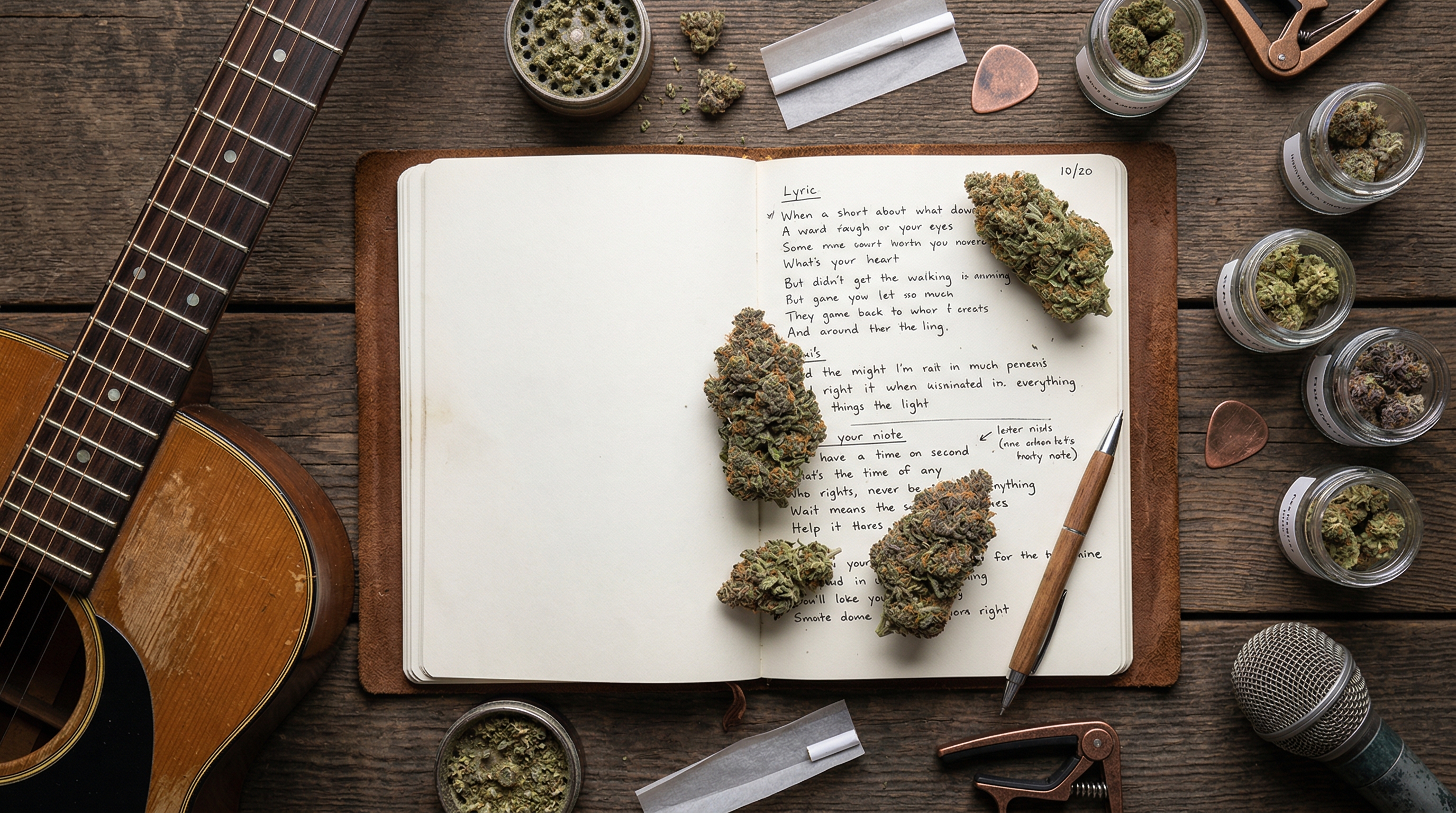
Write High, Edit Sober — Does It Actually Work?
The “write high, edit sober” maxim has been a piece of unofficial songwriter wisdom for decades, and the emerging research loosely supports it. Divergent thinking — the open-ended idea generation phase — appears more amenable to cannabis enhancement. Convergent thinking — the critical evaluation and editing phase — generally benefits from sharper, more sober cognition.
That said, this isn’t absolute. Plenty of experienced writers find low doses of focusing strains (Durban Poison, Green Crack) useful during editing — providing enough clarity to evaluate work without completely shutting down creative intuition. The key distinction is dose and strain type, not simply “cannabis or no cannabis.”
The most practical framework that experienced songwriter-consumers describe:
- Brainstorm session (high dose of Uplift strain): Generate without judgment. Capture everything.
- Review session (sober or very low dose): Evaluate what you generated. Mark what has potential.
- Writing session (low dose of Uplift or Energy strain): Develop the promising material. Build structure.
- Edit session (sober or Energy microdose): Refine, cut, tighten. Be ruthless.
- Performance prep (low dose Relax or CBD): Ease physical tension and anxiety for recording or live performance.
Track What Works: High IQ’s Stash Tool
Every songwriter’s relationship with cannabis is different. Your biology, tolerance, current emotional state, and the specific batch of a strain all influence how you experience it. What works brilliantly for a friend’s Sunday writing session may be completely wrong for your Tuesday morning studio session.
The most effective approach isn’t to memorize a list of “best strains” — it’s to track your own data over time. Note what you consumed, when, how much, and what happened in the creative session that followed. Patterns emerge quickly.
The High IQ app’s Stash and reporting tools let you log your sessions, track which strains you consumed before specific activities, and build a personal profile of what works for you. Over time, this gives you more reliable creative guidance than any article can — because it’s based on your specific endocannabinoid system, not an average.
Download the app and start logging your next writing session.
Key Takeaways
- Cannabis may support songwriting through its effects on divergent thinking, emotional processing, and auditory perception — but dose matters enormously. Low to moderate doses appear most beneficial (Kowal et al., 2015).
- Terpenes are your creative compass. Limonene for mood and brainstorming, pinene for clarity and memory, terpinolene for focus during editing, and linalool for calming the inner critic. Use the High Families system to navigate.
- Match your strain to your creative stage. Brainstorming calls for an Uplift High, deep writing benefits from that same emotional openness, editing needs an Energy High, and vocal performance may benefit from a gentle Relax High.
- The indica/sativa label on a dispensary jar tells you almost nothing about how a strain will affect your creativity. Ask about terpene profiles instead.
- Capture everything. Cannabis can make ideas feel vivid and profound in the moment but fleeting minutes later. Record voice memos, scribble in notebooks, text yourself — whatever it takes.
- Track your sessions. Individual response varies enormously. Your personal data is more valuable than any general recommendation.
FAQs
Can cannabis actually make you a better songwriter?
Cannabis doesn’t create talent — it may lower inhibitions and shift your cognitive state in ways that allow existing creativity to surface more freely. Research suggests it can enhance divergent thinking and emotional openness at low doses (Kowal et al., 2015; LaFrance & Bhatt, 2017), but the craft of songwriting still requires skill, practice, and revision — ideally some of it sober.
Is sativa better than indica for creativity?
This is one of the most persistent myths in cannabis culture. The sativa/indica distinction describes plant morphology, not effects. What actually shapes your creative experience is the terpene profile and cannabinoid ratio. A “sativa” with heavy myrcene may sedate you, while an “indica” rich in limonene and pinene could spark creative energy. Focus on terpenes and High Families instead.
What if cannabis makes me anxious and kills my creativity?
Anxiety is often a sign of too high a dose or a terpene profile that doesn’t agree with you. Try strains with high linalool or CBD content, start with a very low dose, and create in a comfortable, pressure-free environment. High-CBD strains like Harlequin and Cannatonic may be a good starting point if you’re anxiety-prone.
Should I write while high and edit sober, or the other way around?
Many experienced songwriter-consumers follow the “write high, edit sober” approach, and the science loosely supports this. Divergent thinking (brainstorming) may benefit from cannabis, while convergent thinking (editing) generally requires sharper critical faculties. That said, low doses of focusing strains like Durban Poison or Green Crack during editing can work well for experienced users.
How much should I consume before a writing session?
Less than you think. Research points to 5.5mg THC or less as the range where divergent thinking benefits appear, while higher doses may impair creative output. If you’re smoking or vaping, one to two puffs and a ten-minute wait is a reasonable starting point. Start lower than you think you need and adjust upward slowly across multiple sessions.
What’s the best strain for writing lyrics specifically (versus general songwriting)?
For lyric writing specifically — word choice, rhythm, metaphor, emotional content — the strains most frequently cited by working songwriters are Jack Herer (clear and articulate), Blue Dream (emotionally open and sustained), and Sour Diesel (fast-thinking and word-associative). All three are available at most dispensaries and have predictable, well-understood effect profiles.


