Best Cannabis Strains for Yoga and Stretching
Discover science-backed cannabis strains for yoga and stretching. Learn which terpenes enhance flexibility, focus, and mindful movement.

Why Your Yoga Mat and Your Cannabis Might Be a Perfect Match
Here’s a number that may surprise you: a 2019 survey of over 600 cannabis users who exercised found that 70% reported using cannabis around the time of exercise, with 78% of those reporting that it enhanced their enjoyment of the workout and 52% saying it helped with motivation — and yoga was one of the most commonly cited activities [Everson et al., 2019]. That’s not anecdote. That’s a pattern worth understanding.
The reason cannabis and yoga pair so naturally comes down to biology. Both practices engage your endocannabinoid system (ECS) — the vast molecular signaling network that regulates pain perception, mood, inflammation, and your sense of where your body is in space. Understanding why they work together, and more importantly which strains support which aspects of practice, is the difference between a session that feels transcendent and one that leaves you too fuzzy to follow your own breath.
This guide cuts through the noise. We’ll walk through the neuroscience of cannabis and movement, break down exactly which terpenes and cannabinoid ratios support flexibility, focus, and mindful presence, and then give you concrete strain recommendations organized by yoga style. Whether you’re flowing through a vigorous vinyasa or melting into a long yin hold, you’ll know precisely what to look for.
No medical claims — just terpene chemistry, endocannabinoid science, and the kind of evidence-based framework that helps you make genuinely informed choices.
Let’s roll out the mat.
The Science: Why Cannabis and Yoga Target the Same System
Your Endocannabinoid System — The Bridge Between the Two
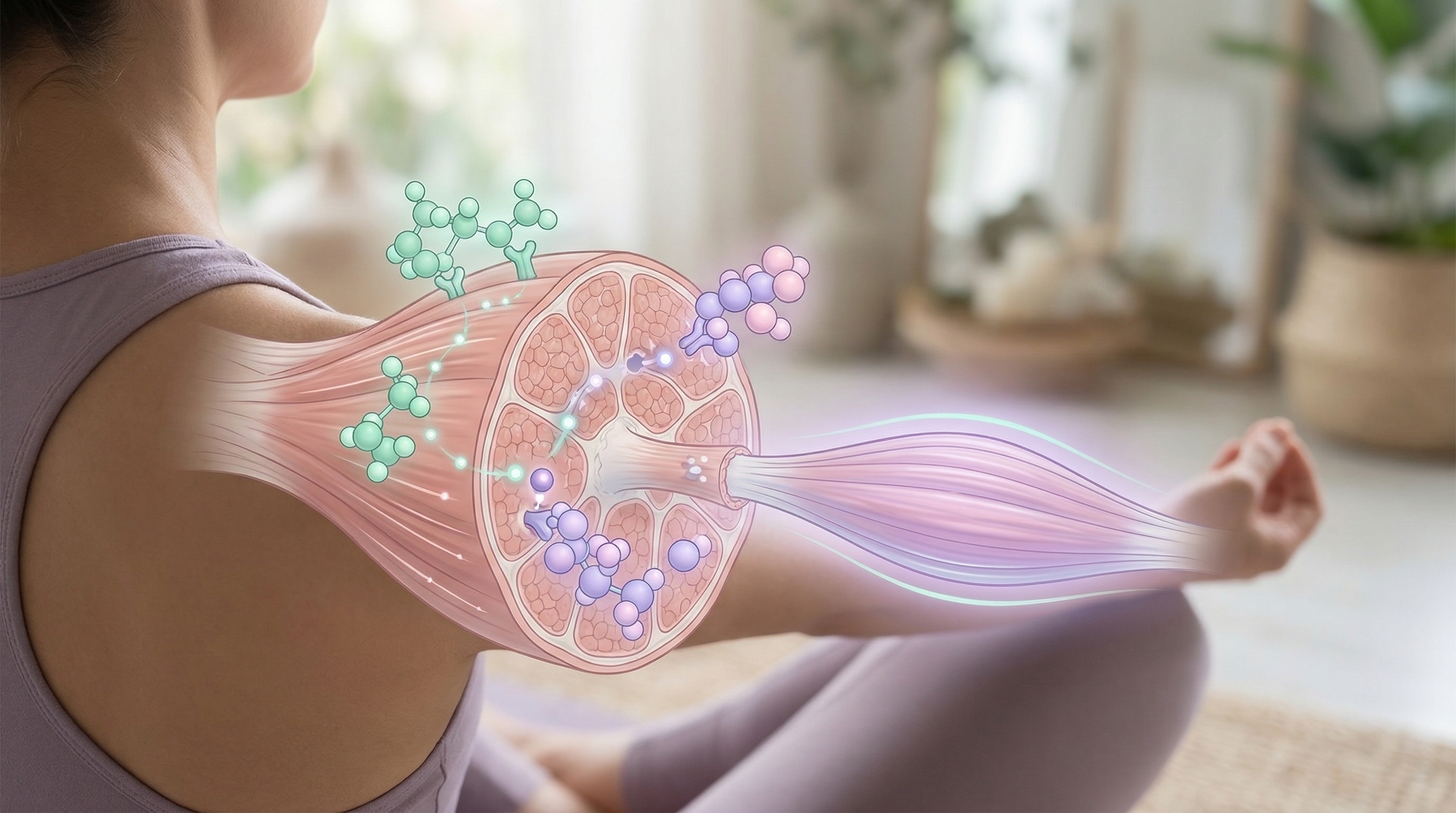
To understand why cannabis and yoga complement each other so well, you need to understand the endocannabinoid system (ECS). Think of it as your body’s internal balance manager — a signaling network of receptors (CB1 and CB2), endogenous cannabinoids (primarily anandamide and 2-AG), and the enzymes that synthesize and break them down.
The ECS regulates a remarkable range of functions: pain sensitivity, inflammatory response, mood regulation, proprioception (your sense of body position in space), and even the perception of time. All of these are central to a quality yoga experience.
Here’s what makes the pairing particularly compelling: yoga itself appears to modulate endocannabinoid tone. A 2020 study found that experienced yoga practitioners had significantly elevated circulating levels of endocannabinoids compared to non-practitioners, suggesting that deep breathing, sustained stretching, and meditative focus may upregulate the ECS over time [Sadhasivam et al., 2020]. The practice essentially primes the system that plant cannabinoids then interact with.
When you introduce phytocannabinoids — plant-derived molecules like THC and CBD — into this already-activated system, effects may be synergistic. THC binds directly to CB1 receptors (concentrated in the brain and nervous system), potentially amplifying body awareness and proprioceptive sensitivity. CBD modulates the ECS indirectly by inhibiting FAAH, the enzyme that breaks down anandamide — potentially prolonging the natural “bliss state” that yoga cultivates [Leweke et al., 2012].
Think of your ECS as a volume dial. Yoga slowly turns it up. The right cannabis strain, at the right dose, may give it one additional nudge — but the direction and quality of that nudge depends entirely on which compounds you choose.
What Research Suggests About Terpenes and Physical Practice
Cannabinoids capture most of the attention, but terpenes — the aromatic compounds responsible for each strain’s distinctive scent — may be equally important for a yoga-optimized experience. These small, volatile molecules interact with neurotransmitter systems, modulate inflammation, and cross the blood-brain barrier to influence mood and cognition. Research increasingly supports the concept of the entourage effect: the idea that terpenes work synergistically with cannabinoids to fine-tune their effects [Russo, 2011].
Here are the terpenes most relevant to yoga practice:
Myrcene is the most abundant terpene in cannabis. Research suggests it may enhance cellular membrane permeability, potentially allowing cannabinoids to take effect more rapidly [Russo, 2011]. Myrcene is also associated with muscle-relaxant and sedative effects — ideal for passive, long-hold stretching in yin yoga, though it can tip into heavy sedation at higher doses.
Linalool is also found in lavender and has demonstrated anxiolytic (anti-anxiety) and analgesic properties in preclinical research [Guzmán-Gutiérrez et al., 2015]. For practitioners dealing with performance anxiety or racing thoughts during meditation, linalool-rich strains may help quiet mental chatter without dulling awareness. A 2018 study in rodent models suggested linalool may modulate the GABAergic system similarly to benzodiazepines — offering calm without the cognitive impairment [Linck et al., 2018].
Limonene appears to elevate mood through serotonergic mechanisms [Zhang et al., 2019]. Some studies have shown it may reduce cortisol levels — which aligns directly with the stress-reduction goals of most yoga practices. Its citrusy, energizing quality makes it a strong candidate for active, flow-based styles.
Beta-caryophyllene is unique: it’s the only terpene known to directly activate CB2 receptors, functioning essentially as a dietary cannabinoid [Gertsch et al., 2008]. CB2 activation is associated with anti-inflammatory signaling in peripheral tissues — potentially supporting recovery from physically demanding practice without any psychoactive effects.
Pinene has demonstrated bronchodilatory effects in some research, meaning it may support airway openness [Falk et al., 1990]. For pranayama (breathwork) practices, this could theoretically support fuller breathing — though robust human clinical data remains limited. Pinene may also counteract some of THC’s short-term memory effects, helping practitioners stay mentally clear during sequences [Russo, 2011].
| Terpene | Key Effect for Yoga | Best Practice Style |
|---|---|---|
| Myrcene | Muscle relaxation, sedation | Yin, Restorative |
| Linalool | Anxiety reduction, calm focus | Meditation, Gentle Flow |
| Limonene | Mood elevation, stress relief | Vinyasa, Power Yoga |
| Beta-Caryophyllene | Anti-inflammatory, body comfort | Post-practice recovery |
| Pinene | Airway support, mental clarity | Pranayama, Morning Flow |
Key insight: The “best strain for yoga” depends entirely on what kind of yoga you’re doing. A vigorous ashtanga practice demands a very different chemical profile than a 90-minute yin session.
Matching Strains to Your Practice Style
Instead of relying on the outdated indica/sativa binary — which research has shown is an unreliable predictor of effects [Sawler et al., 2015] — we use the High Families system, which classifies strains by their terpene chemistry and the experiences they consistently produce. Here’s how to match them to your practice.
For Vinyasa and Power Flow: The Uplifting High Family
If your practice is dynamic, breath-linked, and physically demanding, you want elevated mood paired with mental clarity and enough body awareness to stay in flow. The Uplifting High family — characterized by limonene and linalool dominance — delivers mood elevation and energized presence without heavy sedation.
Recommended strains:
-
Super Lemon Haze — A Lemon Skunk x Super Silver Haze cross with a strongly limonene-dominant profile. Many practitioners report enhanced body awareness and a positive, energized headspace without feeling weighed down. Two-time Cannabis Cup winner. THC typically 18-22%.
-
Strawberry Cough — Known for its smooth, anxiety-reducing effects and gentle uplift. The sweet berry aroma (primarily limonene and myrcene) may help practitioners stay present through challenging sequences without overstimulation.
-
Jack Herer — A legendary terpinolene-forward strain (Haze x Northern Lights #5 x Shiva Skunk) with a well-balanced terpene profile. Named after the cannabis activist, it delivers clear-headed energy and creative, intuitive movement. Many experienced practitioners consider it a yoga standard.
-
Mimosa — A Clementine x Purple Punch cross with bright citrus-forward flavor. The strong limonene profile pairs with just enough myrcene for physical ease, making it a popular morning flow choice.
-
Super Silver Haze — A classic with a lemon-spice terpene profile. Research on its terpinolene content suggests an energizing, cerebral effect profile consistent with sustained physical activity.
Dosing tip for flow yoga: Less is genuinely more. A single low-dose inhalation (approximately 1-2 mg THC equivalent from flower or a quality vaporizer) 10-15 minutes before practice allows you to maintain coordination and balance while enhancing the mind-body connection. Vaporizing at lower temperatures (315-360°F) may preserve more of the lighter, uplifting terpenes like limonene that combust at higher temperatures [Hazekamp et al., 2006].
For Yin and Restorative Yoga: The Relaxing High Family
Yin yoga involves holding passive stretches for 3-5 minutes, targeting deep connective tissue — fascia, ligaments, and joint capsules rather than muscle. Here, you want profound physical relaxation and the patience to sit with mild discomfort during long holds. The Relaxing High family, driven by myrcene and often featuring higher CBD ratios, is built for this.
Recommended strains:
-
Granddaddy Purple — A myrcene-dominant classic (Big Bud x Purple Urkle) with a deeply physical, muscle-relaxing profile. Many practitioners describe it as helping them fully surrender into long holds and find a meditative stillness. 17-23% THC.
-
ACDC — A high-CBD cultivar (often reaching 20:1 CBD:THC ratios) that provides notable body relaxation without significant psychoactive effects. CBD’s interaction with FAAH may prolong anandamide’s natural relaxation effect — making this excellent for practitioners who want physical benefits without altered cognition. See our deep dive on how to find your ideal THC to CBD ratio.
-
Northern Lights — A myrcene-rich Afghan landrace-derived classic. At low doses, many users describe it as deeply calming without being incapacitating. Its earthy, sweet terpene profile supports the kind of passive surrender that makes long yin holds productive.
-
Purple Kush — Myrcene and linalool combine for a deeply physical relaxation profile. Research on linalool’s GABAergic modulation suggests it may contribute to the calm, inward focus that characterizes good restorative sessions [Linck et al., 2018].
Dosing tip for restorative yoga: For passive practices, you can afford slightly higher doses since balance and coordination are less critical. A CBD-dominant option (10-20 mg CBD with minimal THC via sublingual tincture) is a particularly accessible starting point that research suggests may reduce anxiety without impairing proprioception [Linares et al., 2019].
For Meditation and Pranayama: The Balancing High Family
Breathwork and seated meditation require mental clarity alongside physical relaxation — a quiet mind that remains alert and observant. The Balance High family, with its gentle, even terpene profiles and often moderate CBD content, offers subtle enhancement without overwhelming the senses.
Recommended strains:
-
Harlequin — A roughly 5:2 CBD:THC ratio strain with myrcene, pinene, and myrcene in its profile. Many users describe it as clear-headed and grounding — present and aware without the cognitive buzz that can distract during meditation. A go-to for mindful practitioners.
-
Cannatonic — Another balanced CBD:THC option with a reputation for gentle, body-focused effects that don’t cloud the mind. Its lower THC content (typically 6-10%) makes overconsuming significantly less likely.
-
Ringo’s Gift — Named after cannabis activist Lawrence Ringo. This high-CBD cultivar (up to 24:1 CBD:THC depending on phenotype) offers customizable, subtle effects. Many meditation practitioners find it supports a clear, open awareness.
-
ACDC — Works double duty here. For meditation specifically, its near-absence of psychoactive THC makes it one of the most approachable options for deepening body awareness without mental distraction.
Dosing tip for meditation: For seated practices, sublingual CBD tinctures or CBD-dominant flower in a low-temperature vaporizer tend to give the most consistent, controllable results. The goal is not to feel high — it’s to gently reduce the friction between a busy mind and a still body.
For Post-Practice Recovery: The Relax High Family
After an intense practice, inflammation and muscle soreness can set in, particularly in the connective tissue targeted by yin yoga. The Relax High family — rich in beta-caryophyllene and myrcene — targets physical comfort through CB2 receptor activation and anti-inflammatory pathways.
Recommended strains:
-
GSC (Girl Scout Cookies) — High in caryophyllene with OG Kush x Durban Poison lineage. CB2 activation from caryophyllene may support anti-inflammatory signaling in peripheral tissues, making this a popular post-practice choice.
-
Bubba Kush — Caryophyllene and myrcene combine for deep physical relief. Many practitioners find its warm, heavy body effect helpful for the 20-30 minutes of savasana-style rest after demanding practices.
-
Blue Dream — A Blueberry x Haze cross that offers a gentler physical relaxation profile than full indicas, with enough mental lift to avoid post-practice lethargy. Its balanced myrcene, pinene, and caryophyllene content makes it a versatile recovery option.
-
Skywalker OG — Caryophyllene-forward with a deeply relaxing body effect. Research on caryophyllene suggests its CB2 agonism may reduce inflammatory markers without the psychoactive properties of CB1 agonism [Gertsch et al., 2008].
Dosing and Timing: The Science of Getting It Right
Even a perfectly matched strain can disrupt your practice if the dose or timing is off. Here’s what research and practitioner experience converge on:
The Biphasic Effect — Why Less Is Almost Always More
Cannabis follows a well-documented biphasic response pattern — low doses and high doses can produce near-opposite effects [Sulak, 2016]. At low doses (1-5 mg THC), cannabis tends to reduce anxiety, enhance sensory awareness, and support body presence. At higher doses (15+ mg), it can increase anxiety, impair motor coordination, and fragment the focused awareness that makes yoga valuable.
For any physical practice involving balance, proprioception, and coordinated movement, this means microdosing or very low dosing is almost always the optimal approach. Research on cannabis and exercise suggests that moderate doses may enhance enjoyment, while higher doses may impair performance — a consistent finding across multiple survey studies [Everson et al., 2019].
Timing by Consumption Method
| Method | Onset | Peak | Best For |
|---|---|---|---|
| Inhalation (vape/smoke) | 1-5 minutes | 15-30 minutes | Pre-practice timing precision |
| Sublingual tincture | 15-30 minutes | 45-90 minutes | Longer 90-minute sessions |
| Edible | 45-120 minutes | 2-3 hours | Extended restorative/yin workshops |
| Topical | 15-45 minutes (local) | 1-2 hours | Targeted muscle/joint areas |
For a 60-minute vinyasa class: A single small inhalation via vaporizer 10 minutes before practice aligns the peak effect window with the most demanding portion of your flow.
For a 90-minute yin session: A low-dose sublingual tincture (5-10 mg CBD, 1-2 mg THC) taken 20-30 minutes before class provides more consistent, sustained effects across the full session.
For post-practice recovery: Timing is less critical — choose whatever consumption method you find most convenient. Topicals applied to specific tight areas (hips, hamstrings, shoulders) may offer localized relief without any systemic effects, since transdermal CBD does not typically reach the bloodstream in sufficient concentration to produce psychoactive effects [Hammell et al., 2016].
Safety Considerations
A few critical points for combining cannabis with physical practice:
- Start well below your normal dose — physical activity can intensify cannabis effects for some users
- Hydrate consistently — cannabis may reduce saliva production and can affect perceived thirst
- Skip inversions if any dizziness arises — headstands, shoulder stands, and handstands require undiluted proprioceptive feedback
- Never drive to or from class under the influence of THC-containing cannabis
- Cannabis may mask pain signals — be mindful not to push past your actual structural range of motion, especially in deep hip openers
The Historical and Cultural Context Worth Knowing
Cannabis and yoga share a deeper historical relationship than most Western practitioners realize. Cannabis (known as ganja in Sanskrit contexts) has been referenced in the Atharva Veda — one of Hinduism’s four ancient sacred texts — as one of five sacred plants [Clarke & Merlin, 2016]. Some Shaivite yoga traditions have long incorporated cannabis as a sacrament for deepening meditation and accessing altered states of consciousness. The god Shiva himself is associated with cannabis use in traditional texts.
In modern Western wellness contexts, this history has been largely obscured. But it provides important context: the pairing of cannabis and contemplative movement isn’t a modern experiment — it’s a revival of a practice with roots stretching back thousands of years, now being examined through the lens of contemporary neuroscience.
Practical Tips for a Mindful Session
Building Your Cannabis-Yoga Ritual
- Set an intention before consuming — what quality do you want to cultivate? Relaxation? Presence? Physical ease?
- Match your strain to your style using the High Families framework above
- Dose conservatively — you can always use more next time, but you can’t undo over-consumption mid-practice
- Create your space — soft lighting, calming music, a dedicated mat area free from distractions
- Start with familiar sequences — now is not the time to attempt challenging new inversions or arm balances for the first time
- Track your results — note which strains, doses, and timing worked best for which practice styles
The High IQ app makes this systematic. You can log sessions, track strain effects, and build a personal database of what works for your specific body and practice over time.
What to Avoid
- High-myrcene, high-THC strains before active yoga — the sedation will fight your energy
- Edibles before any balance-dependent practice — the delayed onset makes precise timing nearly impossible
- Strains you’ve never tried before — introduce new strains at home first before bringing them to a practice context
- Combining with alcohol — even small amounts of alcohol and cannabis together amplify impairment significantly [Hartman et al., 2015]
Key Takeaways
-
Cannabis and yoga engage overlapping biological systems — specifically the endocannabinoid system, which regulates pain, mood, inflammation, and proprioception. Research suggests yoga itself upregulates endocannabinoid tone, potentially making practitioners more sensitive to cannabis effects [Sadhasivam et al., 2020].
-
Terpenes determine your experience more than strain names. Look for myrcene and linalool for deep physical relaxation (yin, restorative), limonene for energized mood elevation (vinyasa, flow), beta-caryophyllene for anti-inflammatory recovery support, and pinene for mental clarity and airway support during pranayama.
-
Match your strain to your practice style using High Families. Uplifting High for vinyasa and power flow, Relaxing High for yin and restorative, Balance High for meditation and pranayama, Relax High for post-practice recovery.
-
The biphasic effect means low doses are almost always better for physical practice. Research consistently shows that low-dose THC may enhance enjoyment and body awareness, while higher doses impair coordination and can increase anxiety.
-
Timing your consumption method to your session length is as important as choosing the right strain. Vaporized flower for timed pre-practice doses; sublingual tinctures for sustained effects through longer sessions.
FAQs
Can cannabis actually make you more flexible?
Not directly — cannabis doesn’t alter muscle or connective tissue structure. However, myrcene-rich strains may promote muscle relaxation, and THC’s analgesic properties may reduce the discomfort that limits your willingness to hold deep stretches. Many practitioners report feeling more flexible, which likely reflects reduced pain perception and enhanced body awareness rather than actual structural change. Research suggests cannabis may modulate pain perception through multiple pathways including CB1-mediated analgesia and CBD’s modulation of TRPV1 receptors [Russo, 2008].
Is CBD or THC better for yoga?
It depends on your goals and experience level. CBD may support relaxation and reduce anxiety without psychoactive effects — making it accessible for beginners or those wanting subtle enhancement. Low-dose THC can deepen body awareness and create a more immersive experience of movement. Many experienced practitioners find that balanced ratios (1:1 or 2:1 CBD:THC) offer the best integration — enough THC for enhanced sensory presence, enough CBD to moderate anxiety and cognitive impairment. Start with CBD-dominant options and adjust gradually. See our guide on how to find your ideal THC to CBD ratio.
What if cannabis makes me too “in my head” during yoga?
This is a sign you’ve either chosen a strain too high in stimulating terpenes (limonene, terpinolene) for your current needs, or overdosed. Try a myrcene-dominant or linalool-forward strain at a lower dose, or shift to a high-CBD, low-THC option. Many practitioners also find that the anxiety-producing experience resolves naturally once they ground into physical movement — the body focus of yoga can actually help redirect runaway THC-induced thought patterns.
Can I use cannabis for every yoga session?
There’s no universal answer, but most practitioners who combine cannabis and yoga thoughtfully treat it as an occasional enhancement rather than a daily requirement. Cannabis tolerance builds with regular use, which may reduce the novelty and sensitivity that makes the pairing valuable. It’s also worth preserving the experience of non-cannabis yoga — developing your practice on its own terms deepens your baseline and makes the occasional enhanced session more meaningful.
What about CBD topicals for sore muscles after yoga?
CBD topicals are a legitimate option for localized discomfort. Transdermal CBD has shown some evidence of reducing localized inflammation in animal studies [Hammell et al., 2016], and many practitioners use CBD-infused balms or salves on tight hips, hamstrings, and shoulders after practice. Because topicals don’t typically reach systemic circulation in significant amounts, they won’t produce any psychoactive effects — making them appropriate even for practitioners who prefer to stay clear-headed. See our guide to cannabis topicals and how they work.
Sources
-
Everson, E.S. et al. (2019). “Characteristics of cannabis use during exercise.” PLOS ONE. DOI: 10.1371/journal.pone.0220112
-
Sadhasivam, S. et al. (2020). “Novel genome-wide associations for anxiety in elderly from a yoga and meditation retreat.” Translational Psychiatry. DOI: 10.1038/s41398-020-0732-1
-
Leweke, F.M. et al. (2012). “Cannabidiol enhances anandamide signaling and alleviates psychotic symptoms of schizophrenia.” Translational Psychiatry. DOI: 10.1038/tp.2012.15
-
Russo, E.B. (2011). “Taming THC: potential cannabis synergy and phytocannabinoid-terpenoid entourage effects.” British Journal of Pharmacology. DOI: 10.1111/j.1476-5381.2011.01238.x
-
Russo, E.B. (2008). “Cannabinoids in the management of difficult to treat pain.” Therapeutics and Clinical Risk Management. DOI: 10.2147/TCRM.S1928
-
Guzmán-Gutiérrez, S.L. et al. (2015). “Linalool and β-pinene exert their antidepressant-like activity through the monoaminergic pathway.” Life Sciences. DOI: 10.1016/j.lfs.2015.09.012
-
Linck, V.M. et al. (2018). “Effects of inhaled linalool in anxiety, social interaction and aggressive behavior in mice.” Phytomedicine. DOI: 10.1016/j.phymed.2010.01.010
-
Zhang, L.L. et al. (2019). “Limonene: A review of its biological properties.” Food and Chemical Toxicology. DOI: 10.1016/j.fct.2019.110268
-
Gertsch, J. et al. (2008). “Beta-caryophyllene is a dietary cannabinoid.” PNAS. DOI: 10.1073/pnas.0803601105
-
Falk, A.A. et al. (1990). “Uptake, distribution and elimination of alpha-pinene in man after exposure by inhalation.” Scandinavian Journal of Work, Environment & Health. DOI: 10.5271/sjweh.1771
-
Sawler, J. et al. (2015). “The Genetic Structure of Marijuana and Hemp.” PLOS ONE. DOI: 10.1371/journal.pone.0133292
-
Hammell, D.C. et al. (2016). “Transdermal cannabidiol reduces inflammation and pain-related behaviours in a rat model of arthritis.” European Journal of Pain. DOI: 10.1002/ejp.818
-
Hartman, R.L. et al. (2015). “Cannabis effects on driving lateral control with and without alcohol.” Drug and Alcohol Dependence. DOI: 10.1016/j.drugalcdep.2015.01.040
-
Hazekamp, A. et al. (2006). “Evaluation of a vaporizing device for the administration of tetrahydrocannabinol.” Journal of Pharmaceutical Sciences. DOI: 10.1002/jps.20574
-
Linares, I.M. et al. (2019). “No Acute Effects of Cannabidiol on the Sleep-Wake Cycle of Healthy Subjects: A Randomized, Double-Blind, Placebo-Controlled, Crossover Study.” Frontiers in Pharmacology. DOI: 10.3389/fphar.2018.01365
-
Clarke, R.C. & Merlin, M.D. (2016). Cannabis: Evolution and Ethnobotany. University of California Press.
-
Sulak, D. (2016). “Introduction to the Endocannabinoid System.” NORML. norml.org/library/the-endocannabinoid-system


