Cal-Mag for Cannabis: Deficiency Symptoms and Fixes
Cannabis cal-mag deficiency? Learn to spot calcium and magnesium symptoms, fix pH lockout, and dial in dosing for soil, coco, and hydro grows.


If you have ever watched your healthiest-looking plant suddenly throw rust-colored speckles across its top leaves, or watched the lower fan leaves turn yellow between the veins while the veins stay stubbornly green, you have probably met the two most misunderstood nutrients in the garden: calcium and magnesium. Most growers lump them together as “cal-mag” and reach for a bottle when something looks off. That instinct is usually right, but it is only half the story. The other half is why the deficiency showed up in the first place, because pouring more cal-mag into a plant that cannot absorb it is a fast way to make things worse.
This guide breaks down what calcium and magnesium actually do, how to tell a calcium problem from a magnesium problem from a plain old nitrogen problem, and how to fix and prevent both. Think of it as the same philosophy we bring to helping people understand their own cannabis effects and terpene responses: the symptom is a clue, not the diagnosis. You have to read the whole plant.

What Calcium and Magnesium Actually Do
Calcium (Ca) and magnesium (Mg) are secondary macronutrients, which is a slightly misleading name. Plants do not need them in the headline quantities they need nitrogen, but they need them constantly and in meaningful amounts. Skip them and your grow falls apart in ways that look like a dozen other problems.
Calcium is the structural mineral. It is the glue in cell walls, the signal that tells new cells how to divide and where to point, and a key player in root development and stem strength. Here is the critical detail for diagnosis: calcium is immobile. Once it is locked into a leaf, the plant cannot move it elsewhere. So when calcium runs short, the plant cannot rob old leaves to feed new ones. The damage shows up in the newest growth first — the tender top leaves and developing tips.
Magnesium is the engine of photosynthesis. It sits at the center of every chlorophyll molecule, which means no magnesium, no green, no sugar production. Magnesium is mobile, the opposite of calcium. When it runs short, the plant cannibalizes its oldest, lowest leaves and shuttles the magnesium up to the new growth that matters most for survival. That is why a magnesium deficiency creeps up from the bottom of the plant.
That single difference — immobile calcium hitting the top, mobile magnesium draining the bottom — is the most useful diagnostic shortcut you will learn here. It is the same kind of pattern-reading that separates guessing from understanding, whether you are reading a leaf or reading how a strain like Northern Lights actually affects you versus what the label promises.
Calcium Deficiency: Reading the Symptoms
Calcium deficiency announces itself on new growth, usually the upper leaves sitting closest to the light. Watch for:
- Brown or bronze spots and splotches scattered across young leaves — this is the signature symptom
- Crinkling, mottling, and small dead spots on developing foliage
- Curled, distorted leaf tips as new leaves fail to unfurl correctly
- Weak, hollow stems that crack or snap easily in severe cases
- Slow, stunted root and flower development when the problem drags on
Because calcium is tied up in structure, a long-running deficiency does not just make leaves ugly — it weakens the whole architecture of the plant. Stems that should support heavy flowers in late bloom go soft and hollow. This is one of the quieter ways a calcium problem sabotages your yield long before you would think to blame nutrients.
Magnesium Deficiency: Reading the Symptoms
Magnesium deficiency starts low and works its way up. The hallmark is interveinal chlorosis — yellowing of the tissue between the leaf veins while the veins themselves stay green, giving the leaf a skeleton-like, herringbone look. Specifically:
- Yellowing between the veins on the lower, older leaves first
- Veins remaining distinctly green even as the surrounding tissue fades
- Crispy, curling leaf edges that feel brittle to the touch
- Rust-colored or brown spots developing as the deficiency worsens
- Reddening or purpling stems and petioles in some plants (not universal)
Left unchecked, magnesium deficiency marches steadily up the plant, and the worst-hit lower leaves eventually brown out and drop. Because chlorophyll production depends on magnesium, a serious deficiency directly cuts into photosynthesis — your plant is literally losing its ability to make energy.
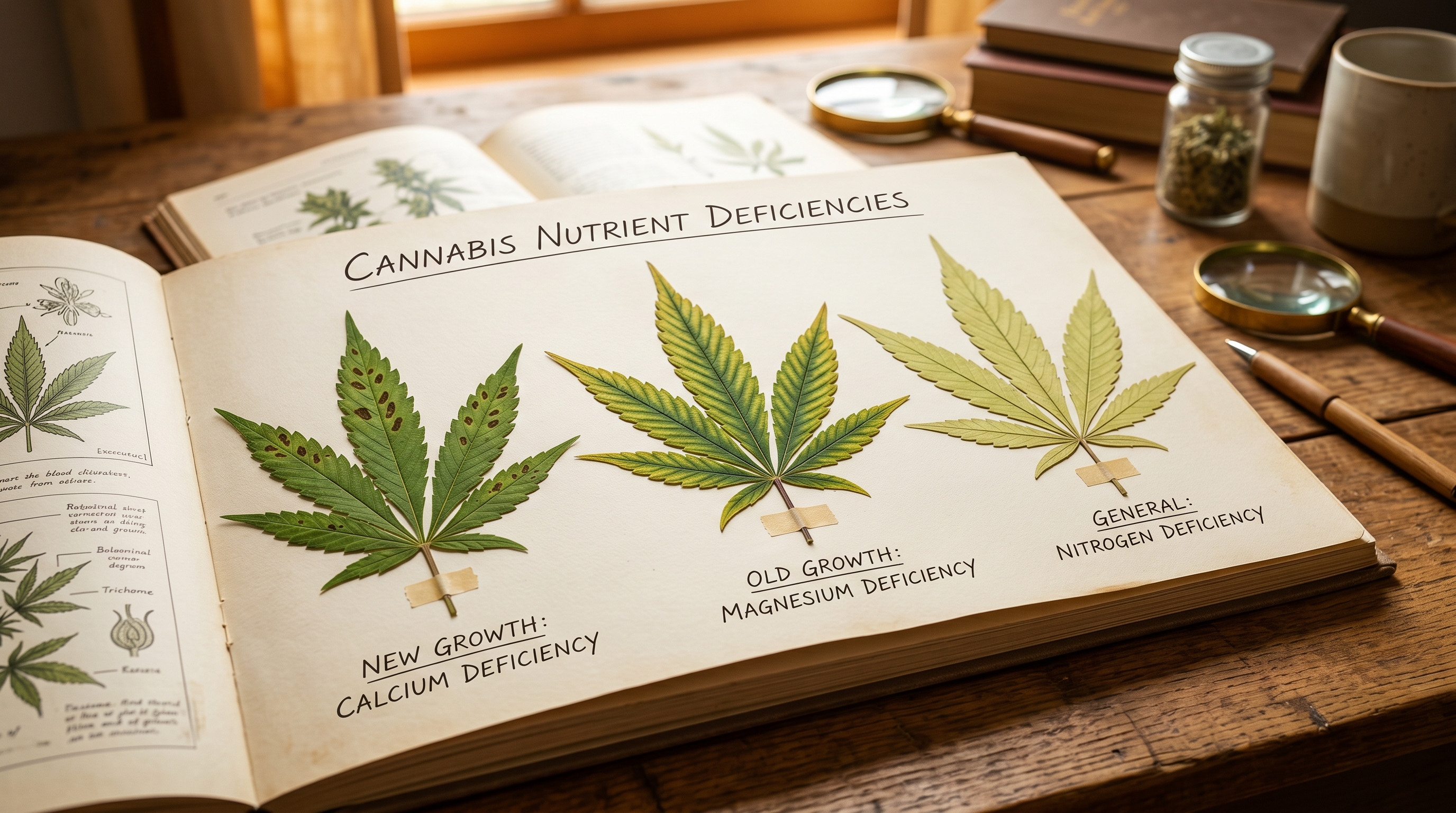
The Diagnosis Table: Calcium vs. Magnesium vs. Nitrogen
The single most common diagnostic mistake is confusing a cal-mag issue with a nitrogen deficiency, because all three involve yellowing. The differences are in where the symptom appears and how the yellowing is distributed. Here is your cheat sheet:
| Clue | Calcium (Ca) | Magnesium (Mg) | Nitrogen (N) |
|---|---|---|---|
| Where it starts | New growth / top leaves | Old growth / lower leaves | Old growth / lower leaves |
| Mobility | Immobile (stuck in old leaves) | Mobile (moves to new growth) | Mobile (moves to new growth) |
| Yellowing pattern | Spotting, not uniform yellowing | Interveinal — yellow between green veins | Uniform — whole leaf fades evenly |
| Spots | Brown/bronze spots, crinkling | Rust spots as it worsens | Rarely spotty; even pale-green to yellow |
| Stems | Weak, hollow, brittle | Sometimes red/purple | Sometimes red/purple |
| Texture | Distorted, curled new tips | Crispy, curling edges | Soft, limp, then drops |
| First fix to check | Raise/correct pH, add calcium | Correct pH, add magnesium | Add nitrogen feed |
The takeaway: if your top leaves are spotty and distorted, look at calcium. If your bottom leaves are yellowing between green veins, look at magnesium. If your bottom leaves are yellowing uniformly and the plant looks pale all over, you probably have a nitrogen issue, not a cal-mag one — and dumping cal-mag on it will not help. (For the broader picture, our guide to common cannabis growing problems and how to fix them walks through the full menu of leaf symptoms.)
Why It Happens: The Causes Behind the Symptoms
Here is the part most growers skip, and it is the part that actually matters. A deficiency does not always mean the nutrient is absent. More often the nutrient is present in the medium but the plant cannot absorb it. There are four big culprits.
1. pH Lockout (The Number One Cause)
Nutrient uptake is governed by root-zone pH. Each nutrient has a window of pH values where it is available; drift outside that window and the roots simply cannot pull the nutrient in, no matter how much is sitting there. This is called pH lockout, and it is the most common reason for a “cal-mag deficiency” that does not respond to more cal-mag.
Calcium tends to lock out when pH drops too low (acidic). Magnesium does the same. So an acidic root zone can starve a plant of both at once, even with a fully stocked reservoir. Adding more cal-mag to a locked-out plant does nothing except potentially build up salts and make the next problem worse. Fix the pH first. Maintaining a stable root-zone pH is the foundation of healthy feeding your cannabis plants — get it wrong and every other input is wasted.
2. RO and Soft Water
Reverse-osmosis (RO) water and naturally soft tap water are stripped of dissolved minerals, including the trace calcium and magnesium that “hard” water provides for free. If you run RO water and do not add cal-mag back, you are feeding your plants a calcium- and magnesium-free diet by default. This is one of the most common reasons hydro and RO growers see deficiencies that soil growers rarely encounter.
3. Coco Coir’s Calcium Appetite
Coco coir is a fantastic medium, but it has a quirk: its cation-exchange sites preferentially bind calcium (and magnesium), holding them away from the roots until those sites are saturated. Fresh, unbuffered coco will essentially eat your calcium and magnesium for the first stretch of a grow. That is why coco growers should run supplemental cal-mag from day one and ideally pre-buffer or pre-soak unbuffered coco in a cal-mag solution before planting. If you are weighing media, our breakdown of super soil and living soil recipes shows how an amended organic medium handles calcium very differently from coco.
4. Intense Light and Fast Growth
Modern high-output LED grow lights push plants to photosynthesize and transpire harder, which increases demand for the nutrients that fuel that growth — magnesium especially, since it sits at the heart of every chlorophyll molecule. A feeding schedule that was fine under weaker lighting can come up short under an intense LED, surfacing as a magnesium deficiency on a plant that is otherwise thriving. Big, fast-growing plants in peak vegetative growth simply draw down cal-mag faster than slow ones.

The pH Reference: Your First and Best Tool
Before you reach for any bottle, check your pH. These are the target ranges where calcium and magnesium uptake stay healthy:
| Growing Medium | Overall Safe Range | Sweet Spot for Ca/Mg |
|---|---|---|
| Soil | 6.0 – 7.0 | 6.2 – 7.0 (ideally 6.5–7.0) |
| Coco Coir | 5.5 – 6.5 | 6.0 – 6.5 |
| Hydroponics | 5.5 – 6.5 | 6.0 – 6.5 |
Notice that soil runs a touch higher than coco and hydro. Soil’s biology buffers pH and works best slightly less acidic; coco and hydro need a lower, tighter window. A cheap digital pH pen (calibrated regularly) is the single most valuable diagnostic tool in your grow room. If you only test the pH going in, also test the runoff coming out — a big gap between the two tells you the root zone has drifted.
How to Fix It: A Step-by-Step Recovery
When you confirm a calcium or magnesium deficiency, work through these steps in order. Resist the urge to skip straight to the cal-mag bottle.
-
Check and correct pH first. Test your input water and your runoff. If pH is out of range, that is almost certainly your problem. Bring it back into the medium-appropriate window above using pH-up or pH-down before doing anything else.
-
Flush if you suspect lockout or salt buildup. If pH is badly off or you have been over-feeding, flush the medium with clean, pH-corrected water carrying a light dose of balanced nutrients. This clears the salt buildup that blocks uptake and resets the root zone. (Note this is a corrective flush — different from the pre-harvest flushing debate, which is about a separate question entirely.)
-
Add a cal-mag supplement. Once pH is dialed in, supplement. A common starting dose is about 1 teaspoon (5 ml) of a cal-mag product per gallon of water, but always follow your specific product’s label, since concentrations vary widely. Coco and RO growers should treat cal-mag as a standing part of every feed, not a one-time rescue.
-
For organic soil growers, reach for dolomite lime. Dolomite lime supplies both calcium and magnesium and gently buffers pH toward neutral over weeks. Working roughly 6–7 teaspoons of fine dolomite lime per gallon of soil into the mix before planting is a classic slow-release insurance policy. Crushed eggshells or gypsum can add calcium, but pair them with a magnesium source so you do not over-correct one and trigger the other.
-
Wait and watch the new growth. This is the part growers get wrong. Damaged leaves do not heal — calcium is immobile, and chlorophyll lost to magnesium deficiency does not come back to an old leaf. Judge your fix by the new growth, which should look healthy within about a week. Do not panic and re-dose because the spotty old leaves still look spotty.
Prevention: Stop the Problem Before It Starts
The best deficiency is the one that never happens. A few habits keep cal-mag issues out of your garden entirely:
- Run cal-mag by default in coco and hydro, and with RO water. These setups have no natural calcium or magnesium buffer, so build the supplement into your base feed from the start rather than waiting for symptoms.
- Keep pH stable and in range. A consistent, well-managed root-zone pH helps prevent lockout, which appears to be the cause of most “phantom” deficiencies. This is the same discipline that underpins a solid watering routine — consistency beats intensity.
- Amend soil before you plant. Dolomite lime or a quality organic amendment program loads the medium with slow-release calcium and magnesium so the plant draws on a reservoir instead of a single feed.
- Match feeding to your lighting. If you upgrade to a stronger grow-tent setup or higher-output LEDs, expect higher cal-mag demand and adjust your schedule up accordingly.
- Test runoff periodically. A quick runoff pH and EC check catches drift before it becomes a visible deficiency.
Key Takeaways: The Professor’s Summary
Calcium and magnesium teach the same lesson over and over: a symptom is the end of a chain, not the start. The yellow leaf is real, but the cause is usually upstream — a pH that drifted, a medium that needs supplementing, a light that outgrew the feed schedule. Read the pattern (top vs. bottom, spotty vs. interveinal vs. uniform), confirm with a pH test, and fix the root cause before you reach for the bottle.
That habit — measure, read the pattern, fix the cause, then verify with new growth — is exactly the mindset we built the High IQ app around for consumers, too. Whether you are dialing in a coco grow or dialing in your own response to a Relax-family strain heavy in myrcene, the move is the same: stop guessing, start observing, and let the evidence tell you what is actually going on.
Sources
- Grow Weed Easy — How to Fix Cannabis Magnesium Deficiency
- Grow Weed Easy — How to Fix Cannabis Calcium Deficiency
- Advanced Nutrients — How To Fix Calcium and Magnesium Deficiencies In Cannabis
- Cronk Nutrients — What Is CalMag for Cannabis? Dosage by Coco, Soil & Hydro
- Grow With Jane — Calcium Deficiency and Toxicity in Cannabis


