Cannabis Super Soil: Build Living Soil From Scratch
Build cannabis super soil from scratch. A living soil recipe with base mix, amendments, and the cooking period so you grow with just water.

If growing cannabis feels like one long chemistry exam, super soil is the antidote. You stop mixing bottled nutrients. You stop checking pH at every watering. You stop chasing runoff numbers. Instead, you build one rich, biologically alive soil at the start of the season. After that, you mostly just add water. The plant feeds itself by partnering with the microbes living in the dirt. It is the closest thing to letting nature run your grow while you watch.
This guide covers what living soil really is, the base mix and amendments to use, the all-important “cooking” period, and how to use the finished soil in your pots. By the end you can build a batch from scratch. You will also understand why so many craft growers say it makes the most flavorful, terpene-rich flower they have ever smoked.
What Is Living Soil (and Super Soil)?
“Super soil” and “living soil” get used interchangeably, and for our purposes they mean the same thing: a heavily amended organic growing medium that contains everything a cannabis plant needs from seed to harvest, plus the living web of microbes, fungi, and bacteria that release those nutrients on demand.
The late breeder Subcool made the term “super soil” famous. He spent years refining a recipe that let him run plants in nursery pots using nothing but plain water. The big idea is simple. Instead of feeding the plant, you feed the soil. The microbes, fungi, and other tiny organisms do the work. They break down organic matter into forms the roots can drink up just when they need them. It mimics how cannabis thrives in nature, where no one measures parts-per-million.
This is the opposite of the bottled-nutrient approach. There, you act as the middleman, delivering precise doses on a schedule. With living soil, the soil is the middleman. Once that shift clicks, everything else makes sense. New to growing? Start with our beginner’s guide to growing cannabis at home, then come back here to level up your medium.
The Base Mix: Your Foundation
Every great living soil starts with a balanced base before you add heavy amendments. The classic rule of thumb is thirds. One-third holds water. One-third adds aeration. One-third is compost or worm castings. Think of it as the skeleton, the lungs, and the gut of your soil.
- Water retention (about 1/3): Sphagnum peat moss or coco coir. Peat is slightly acidic and holds moisture beautifully; coco is a more sustainable, pH-neutral alternative. If you care about your footprint, read our take on cannabis and sustainability before choosing.
- Aeration (about 1/3): Coarse perlite, pumice, or lava rock. This creates the air pockets roots and microbes need to breathe. Skip fine perlite; you want chunky material that resists compaction.
- Life and nutrition (about 1/3): A blend of finished compost and high-quality earthworm castings (EWC). Castings are the single most important ingredient here. They are dense with beneficial microbes and gentle, chelated nutrients that jump-start the whole biological engine.
Many growers shortcut the base by starting with a quality pre-mix like a peat-and-perlite blend, then heavily amending it. That is perfectly fine. The base is just the canvas; the amendments are where the magic happens.
The Amendments: Feeding the Soil Food Web
Amendments are the slow-release pantry your microbes will work through over the grow. Below is a representative chart drawn from classic Subcool-style recipes and modern living-soil practice. Quantities are a starting point per roughly 1 cubic foot of base mix; scale up proportionally for larger batches.
| Amendment | Provides | Rough Amount (per cu ft) | Notes |
|---|---|---|---|
| Earthworm castings | Microbes, gentle NPK | 1 to 2 quarts | The microbial heart of the mix |
| Kelp meal | Potassium, 60+ trace minerals, growth hormones | 1/2 cup | Cytokinins boost resin and stress resistance |
| Neem meal | Slow nitrogen, pest suppression | 1/2 cup | Discourages fungus gnats and root pests |
| Crab or crustacean meal | Chitin, calcium, phosphorus | 1/2 cup | Chitin recruits beneficial fungi |
| Fish bone meal | Phosphorus, calcium | 1/2 cup | Vegan growers swap for soft rock phosphate |
| Blood meal (optional) | Fast nitrogen | 1/4 cup | Use alfalfa meal for a vegan nitrogen source |
| Bone meal (optional) | Phosphorus, calcium | 1/4 cup | Replace with soft rock phosphate if vegan |
| Basalt or glacial rock dust | Broad-spectrum minerals, silica | 1 cup | Remineralizes for long-term vigor |
| Gypsum | Calcium and sulfur | 1/4 cup | Adds calcium without shifting pH |
| Dolomite or oyster shell lime | Calcium, pH buffering | 2 tbsp | Stabilizes acidity from peat |
| Biochar (pre-charged) | Microbe habitat, nutrient retention | 1 to 2 cups | Charge it first or it will rob nutrients |
| Mycorrhizal inoculant | Root-fungi symbiosis | per label | Colonization insurance for roots |
A few notes are worth keeping in mind. Kelp is the unsung hero. Its growth hormones and micronutrients show up directly in your terpene profile. That is part of why super-soil flower so often tastes incredible. To learn how terpenes shape your experience, read our cannabis terpenes guide. Vegan growers can build a cruelty-free mix too. Just swap the animal meals (blood, bone, fish) for alfalfa meal, soft rock phosphate, and extra kelp. The soil still works. It simply leans more on plant and mineral inputs.
This dialed-in nutrition is the living-soil answer to careful feeding schedules. Our cannabis nutrients guide covers those schedules in detail. Instead of timing macronutrients yourself, you load them in once and let the biology meter them out.
Mixing and Cooking the Soil
Here is where patience separates the great grows from the disappointing ones. Mixing is easy; cooking is mandatory.
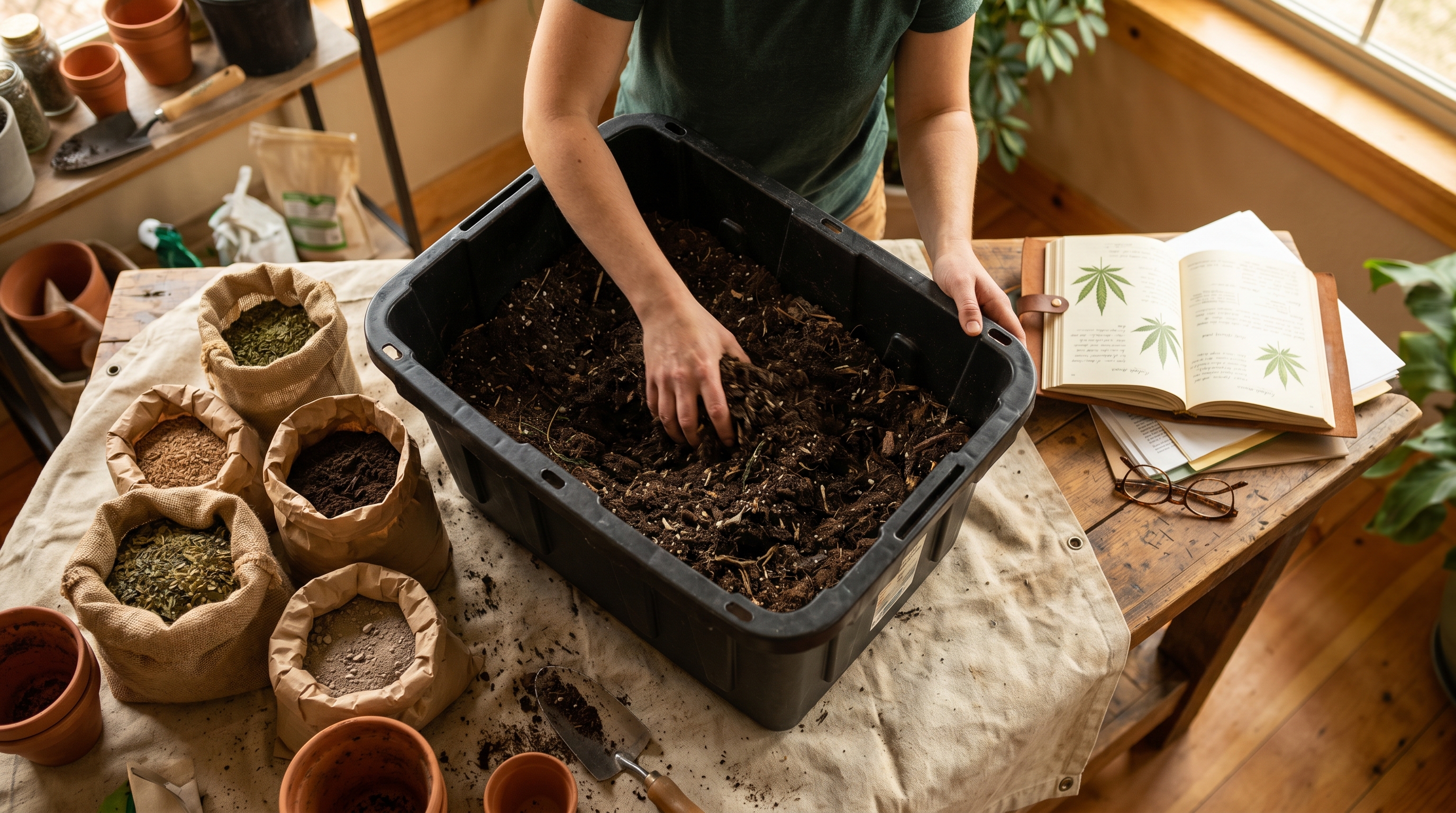
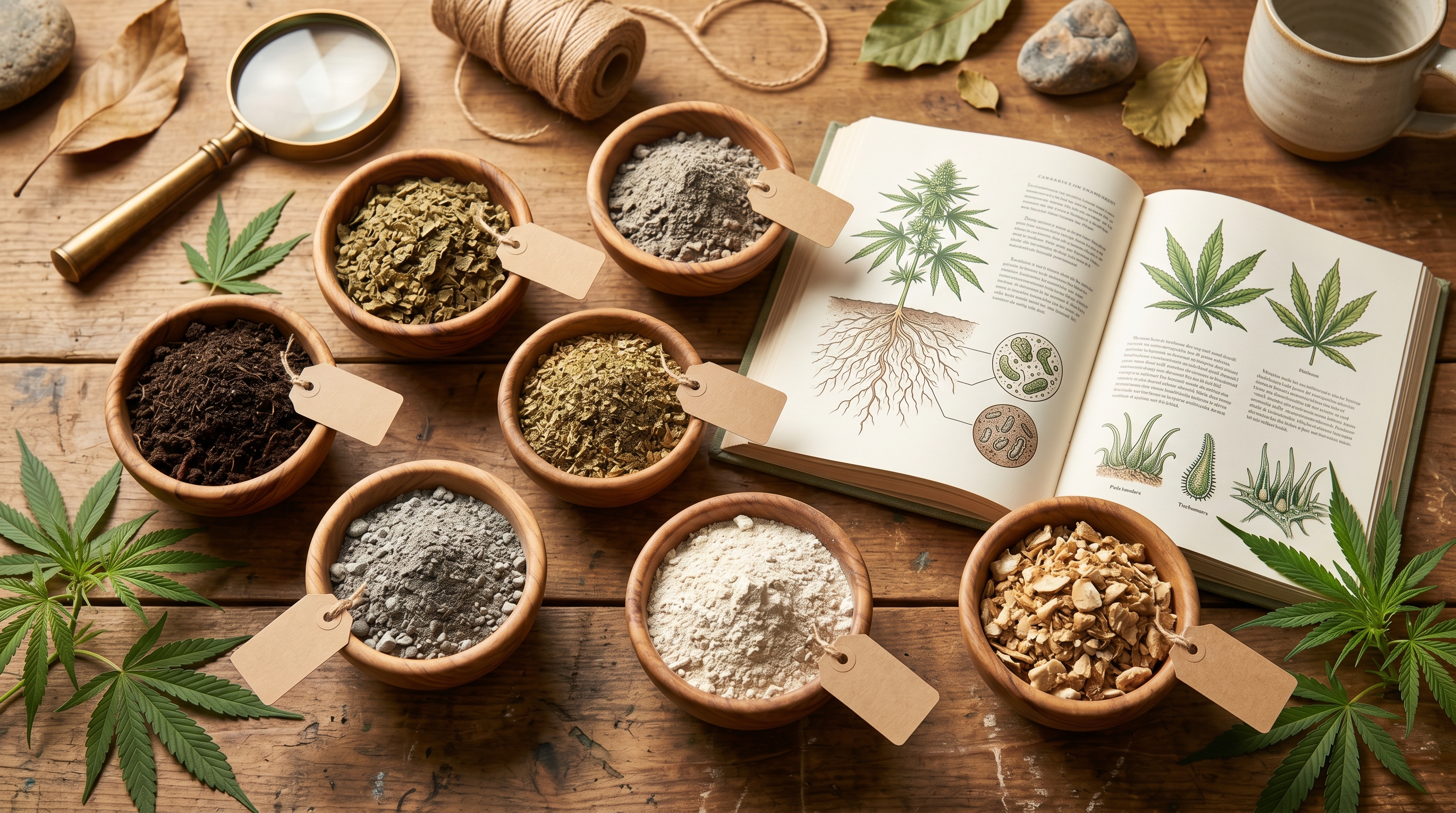
Mixing. Lay out a large tarp or use a clean bin or trash can. Some growers add ingredients in layers (smelly amendments like fish bone meal first, covered by base soil) and rake between layers; others dump everything in and turn it. Either works. Your goal is a uniform, single-color blend with no visible pockets of any one amendment. Wear a dust mask, this gets dusty.
Moisten, then cook. Once mixed, water lightly until the soil feels like a wrung-out sponge. It should be moist but never soggy. Then cover it and let it “cook” for 4 to 8 weeks. During this window, microbe populations explode and the raw amendments break down into plant-ready forms. The pile can genuinely heat up. That is exactly why we call it cooking. Turn the pile every 4 to 7 days to spread moisture and oxygen, re-wetting as needed.
You will know it is ready when it smells like a forest floor after rain: earthy, sweet, and complex. Does it still smell of ammonia? Then the nitrogen has not finished breaking down. Give it more time. Planting into undercooked soil is the most common beginner mistake, and it can burn young roots. If leaf problems show up later, our guide to common cannabis growing problems will help you diagnose them.
The cook takes over a month, so plan backward from your planting date. Outdoor growers should mix in early spring. That way the soil is ready for the outdoor growing season. To see how the cook fits the wider calendar, check our cannabis growing stages timeline.
Using the Soil: Containers and Top-Dressing
You have two main ways to deploy finished super soil.
The layered method (Subcool’s original). Place hot, fully amended super soil in the bottom one-third to one-half of the container. Fill the top with plain base soil. Then transplant established seedlings or rooted clones into the gentle top layer. As roots grow down, they reach the rich super soil just when the plant is mature enough to handle it. This protects tender seedlings from nutrient burn. Never start seeds directly in concentrated super soil.
The full-strength method. Did your soil cook long enough at moderate amendment rates? Then you can fill the whole container and plant directly. This is common with milder living-soil recipes built on the thirds base. When in doubt, layer.
Container choice matters. Fabric pots breathe well and keep your soil aerobic. Bigger is better, too. More soil volume means more nutrient reserves and more stable biology. Many growers use 7 gallons or larger so the soil can feed a plant start to finish. The environment still matters as well. Dial in your grow room humidity, temperature, and CO2 no matter the medium.
Top-dressing. As the grow goes on, you can sprinkle dry amendments on the surface and water them in. Or add a light layer of fresh worm castings and compost. This “feeds the soil” again without disturbing roots. It is the foundation of no-till growing, where the same living soil is reused for years. After each harvest, re-amend the spent soil with fresh compost, castings, and dry amendments. Then cook again for 3 to 4 weeks before replanting.
Watering and Microbe Care
Watering super soil is refreshingly simple. You are not feeding liquid nutrients, so you just water when the top inch or two dries out. Avoid heavy runoff. Runoff washes away the very nutrients your microbes are releasing. Wet the medium fully, then wait until it dries down to your first knuckle.
The one ongoing chore is keeping your microbe population happy. Two tools do most of the work:
- Aerated compost tea. Steep compost or worm castings in dechlorinated water with an air stone and air pump for about 24 hours, often with a splash of molasses to feed the bacteria. This brews a living liquid you drench into the soil to boost or restore microbial life. Use nitrogen-rich castings tea during vegetative growth and a phosphorus-leaning tea (such as bat guano) during flowering.
- Light top-dressings. A weekly sprinkle of castings or compost keeps the soil from depleting over a long flower cycle.
One caution: if your soil ever develops a rotten-egg or sour smell, it has gone anaerobic and harbors harmful bacteria. Do not mix contaminated soil back into healthy soil; discard it. A healthy living soil always smells sweet and earthy.
Pros and Cons vs. Bottled Nutrients
Super soil is fantastic, but it is not the right fit for everyone. Here is the honest trade-off.
| Living Soil / Super Soil | Bottled Nutrients | |
|---|---|---|
| Day-to-day effort | Very low (mostly just water) | High (mix, measure, pH every feed) |
| Setup time | 4 to 8 week cook required | Ready immediately |
| Cost over time | Cheap once built; reusable for years | Recurring bottle purchases |
| pH management | Mostly self-regulating | Constant monitoring |
| Flavor and terpenes | Often exceptional, full-spectrum | Good, but can taste “clean” |
| Correcting problems | Slow (dry amendments take time) | Fast (adjust the next feed) |
| Precision and control | Lower | Very high |
| Sustainability | Higher, especially no-till | More packaging and waste |
The big win is the hands-off, full-flavor experience. A no-till bed also gets better every cycle. The big drawback is the upfront wait. You also cannot fix a deficiency overnight, since dry amendments take days to break down. Many growers run super soil because it removes the guesswork. Others prefer bottles for the tight control. Your setup matters too, so weigh our indoor vs. outdoor growing comparison when deciding.
Frequently Asked Questions
How long does super soil take to make? Plan on a minimum 4-week cook, with 6 to 8 weeks being safer. Start building 6 to 8 weeks before your intended planting date to leave a buffer.
Can I plant seeds directly in super soil? No. Concentrated super soil is too hot for seeds and tender seedlings. Start them in mild base soil and let roots grow into the rich layer, or use a milder full-strength living-soil recipe.
Do I really never need nutrients? For a single cycle in a properly built, large container, plain water plus the occasional compost tea is usually enough. Long flowering plants or hungry strains may want light top-dressings. If you started growing with bottles, the transition is covered conceptually in our nutrients guide.
Can I make a vegan super soil? Yes. Replace blood, bone, and fish meals with alfalfa meal, soft rock phosphate, and extra kelp. The microbes do not care about the source, only the nutrients.
Does super soil really improve flavor? Many growers find living-soil flower has richer, more complex terpenes. Sun-grown organic plants show a similar pattern, which we explore in why sun-grown cannabis has better terpenes.
Where does super soil fit in the bigger growing picture? It is your medium and feeding strategy. Everything else, from harvest timing to drying and curing, still applies. And if you are choosing genetics, our seed types explainer and seed bank buyer’s guide will get you started right.
Key Takeaways
Super soil rewards growers who think like gardeners, not chemists. Build a balanced base. Layer in a thoughtful set of amendments. Then, crucially, give the biology time to cook. Do that and you get a low-maintenance medium that often makes the best-tasting flower of your life. With no-till care, it only gets better season after season.
The deeper lesson is one we preach at This Is Why I’m High. The best results come from understanding the system, not chasing one magic input. No single number on a label tells you how a strain will hit. In the same way, no single bottle makes a great grow. Build the living system, then track what works. Want to see how that idea applies to choosing what you smoke? Start with how to find your ideal high.
Sources
- Subcool’s Super Soil Step-by-Step — High Times Magazine. https://hightimes.com/news/subcools-super-soil-step-by-step/
- How to Make Organic Supersoil — Alchimia Grow Shop. https://www.alchimiaweb.com/blogen/how-to-make-organic-supersoil/
- Living Soil Cannabis Growing: Complete Guide — DSS Genetics. https://dssgenetics.com/blog/growing/advanced-cultivation/living-soil-cannabis-growing-complete-guide-2026
- Super Soil Recipe — Hydrobuilder Learning Center. https://learn.hydrobuilder.com/super-soil-recipe/
- Super Soil for Cannabis and Living Soil Benefits — Atami. https://atami.com/en-ca/blog/cultivation/living-soil-cannabis-super-soil-for-cannabis-explained


