Organic Cannabis Amendments: Castings, Guano & Compost Tea
Worm castings, guano, kelp, and compost tea explained: NPK roles, top-dressing vs amending, and a foolproof aerated tea recipe for organic cannabis.


Ever poured a bottle of bright-blue “bloom booster” into your watering can and wondered what it actually does to your plant? You are asking the right question. Synthetic salts feed the plant fast and directly. But they skip the most interesting part of growing: the living world in the soil. Organic amendments take the opposite path. Instead of force-feeding the plant, you feed the soil. Then the soil feeds the plant.
That is the whole idea behind organic cannabis growing. It is the foundation of methods like living super soil and no-till recycled growing. The payoff is real. You get smoother flavor, cleaner-burning flower, and fewer nutrient-lockout headaches. Best of all, your soil gets better every season instead of being thrown away. There is also a real environmental upside to skipping the bottled-nutrient treadmill.
In this guide I will walk you through the core organic amendments every grower should know, what each one actually contributes (in plain NPK terms), how to apply them without cooking your roots, and how to brew the single most useful tool in the organic arsenal: actively aerated compost tea. Let’s dig in.

Why feed the soil instead of the plant?
Healthy soil is not dirt. It is a living web of bacteria, fungi, protozoa, nematodes, and earthworms. Growers call it the soil food web. These organisms break down organic matter into forms roots can absorb. Mycorrhizal fungi go a step further. They form partnerships with the roots, extend their reach, and trade phosphorus for plant sugars.
When you grow organically, your amendments do not feed the plant directly. They feed that ecosystem. Microbes break down the raw inputs slowly and steadily. Nutrients release in sync with what the plant can use. That buffering is why a well-built organic mix is so forgiving. It is also why many growers can run a “water-only” garden after the initial build. Compare that to the constant pH-and-EC babysitting of a bottled feeding schedule, and the appeal is obvious.
One rule sits above all others: soil pH for cannabis should land between 6.0 and 7.0 [Cannigma, 2026]. Outside that window, nutrients lock up. Plants then show deficiencies even when the soil is loaded with food. Most of the common growing problems growers chase are really pH or over-feeding issues in disguise.
The core amendments and their NPK roles
Plant nutrition runs on three macronutrients: Nitrogen (leafy green growth), Phosphorus (roots and flower development), and K, or potassium (overall plant health, water regulation, and bud density). Organic amendments rarely fit a single tidy number the way a synthetic bottle does, but each leans toward a role. Here is how the workhorses stack up.
| Amendment | Approx. NPK lean | What it does | When to use |
|---|---|---|---|
| Worm castings (EWC) | ~1-1-1 (low, gentle) | Massive microbial charge, humus, water retention | Mix in + top-dress, all stages |
| Compost | Low, broad | Organic matter, structure, biology | Build phase + top-dress |
| High-N bat guano | ~10-3-1 | Fast nitrogen for leafy veg growth | Vegetative |
| High-P bat guano | ~0-7-0 to 3-10-1 | Phosphorus for flower set | Pre-flower / early flower |
| Seabird guano | ~12-12-2 (varies) | Balanced, fast-acting boost | Veg into flower |
| Kelp meal | ~1-0-2 | Trace minerals, growth hormones (cytokinins) | All stages + foliar |
| Neem meal | ~6-1-2 | Slow N, pest/soil-pest suppression | Build phase + top-dress |
| Crab/crustacean meal | ~5-2-0.5 | Nitrogen + chitin (boosts beneficial fungi) | Build phase |
| Alfalfa meal | ~2-1-2 | Nitrogen + triacontanol growth stimulant | Veg |
| Blood meal | ~12-0-0 | Strong, fast nitrogen (use sparingly) | Early veg |
| Bone meal | ~3-15-0 | Slow-release phosphorus + calcium | Pre-flower |
| Basalt / glacial rock dust | trace | Remineralizes with slow trace elements | Build phase |
| Azomite | trace | Broad-spectrum trace minerals | Build phase |
| Gypsum | Ca + S, no pH change | Calcium and sulfur without raising pH | Build phase + top-dress |
A few notes on the headliners worth memorizing:
Worm castings (vermicompost)
If you only buy one amendment, buy castings. The NPK numbers look unimpressive precisely because that is not the point. Castings are the single richest microbial inoculant available to home growers, with beneficial-organism counts often several times higher than ordinary thermophilic compost [Aqualogi, 2026]. They improve structure, hold water, and gently feed without any burn risk. Use them everywhere: blend 5 to 20 percent into your mix, top-dress a quarter-cup to a cup per plant, and use them as the base of your compost tea.
Bat and seabird guano (know your type)
Guano is where beginners get tripped up, because “guano” is not one product. High-nitrogen bat guano (often mined from insect-eating bat colonies, around 10-3-1) drives lush vegetative growth. High-phosphorus bat guano (closer to 0-7-0 or 3-10-1) is a flowering specialist for bigger bud set. Seabird guano tends to be more balanced and fast-acting. Always read the label and match the type to the growth stage you are in. Guano is potent, so under-dose rather than over-dose.
Kelp meal
Kelp is the multivitamin of the garden. The NPK is modest, but kelp delivers more than 60 trace minerals plus natural plant-growth hormones (cytokinins) that improve stress resistance and root development. It shines in both the soil and as a foliar feed.
Neem and crab meal
These two are the soil’s bodyguards. Neem meal adds slow nitrogen while suppressing soil-borne pests and fungus gnats. Crab (crustacean) meal brings nitrogen plus chitin, which actively feeds the beneficial fungi that outcompete pathogens. Together they are a cornerstone of any super soil build.
Rock dusts and gypsum
Basalt, glacial rock dust, and azomite are your long-game minerals. They release trace elements over months to years, which is why they are central to recycled, no-till systems where the same soil runs for years. Gypsum (calcium sulfate) supplies calcium and sulfur without nudging your pH, and that sulfur quietly supports terpene production for richer aroma.

Top-dressing vs. mixing in: two ways to amend
There are two moments to add amendments, and choosing the right one matters.
Mixing in (amending the build). This is when you incorporate dry amendments throughout the whole soil volume before planting. It is the right approach for the slow, “hot” inputs (guano, blood meal, alfalfa) and for the long-release minerals (rock dust, gypsum, bone meal). Here is the catch that bites new organic growers: a freshly amended mix must “cook” before roots go in. Give it two to four weeks (longer is better, and serious super-soil builders go up to two months) so microbes can pre-digest the hot inputs. A mix that smells sweet and earthy is ready; a sharp ammonia smell means it needs more time. Skip this step and you can burn seedlings on day one.
Top-dressing (feeding established plants). Once a plant is in the pot, you do not want to dig up and disturb the root zone. Instead, you sprinkle amendments on the soil surface, then let watering and biology carry the nutrients down. Top-dressing is perfect for gentle, fast-cycling inputs like castings, kelp, and a light dusting of guano. A typical rhythm is one to two tablespoons per gallon of pot size every three to four weeks, watered in with plain water or compost tea. A layer of mulch over the top-dress protects surface biology and locks in moisture.
The general principle: mix in the slow and hot stuff before planting; top-dress the gentle and fast stuff during the grow.
Brewing actively aerated compost tea (AACT)
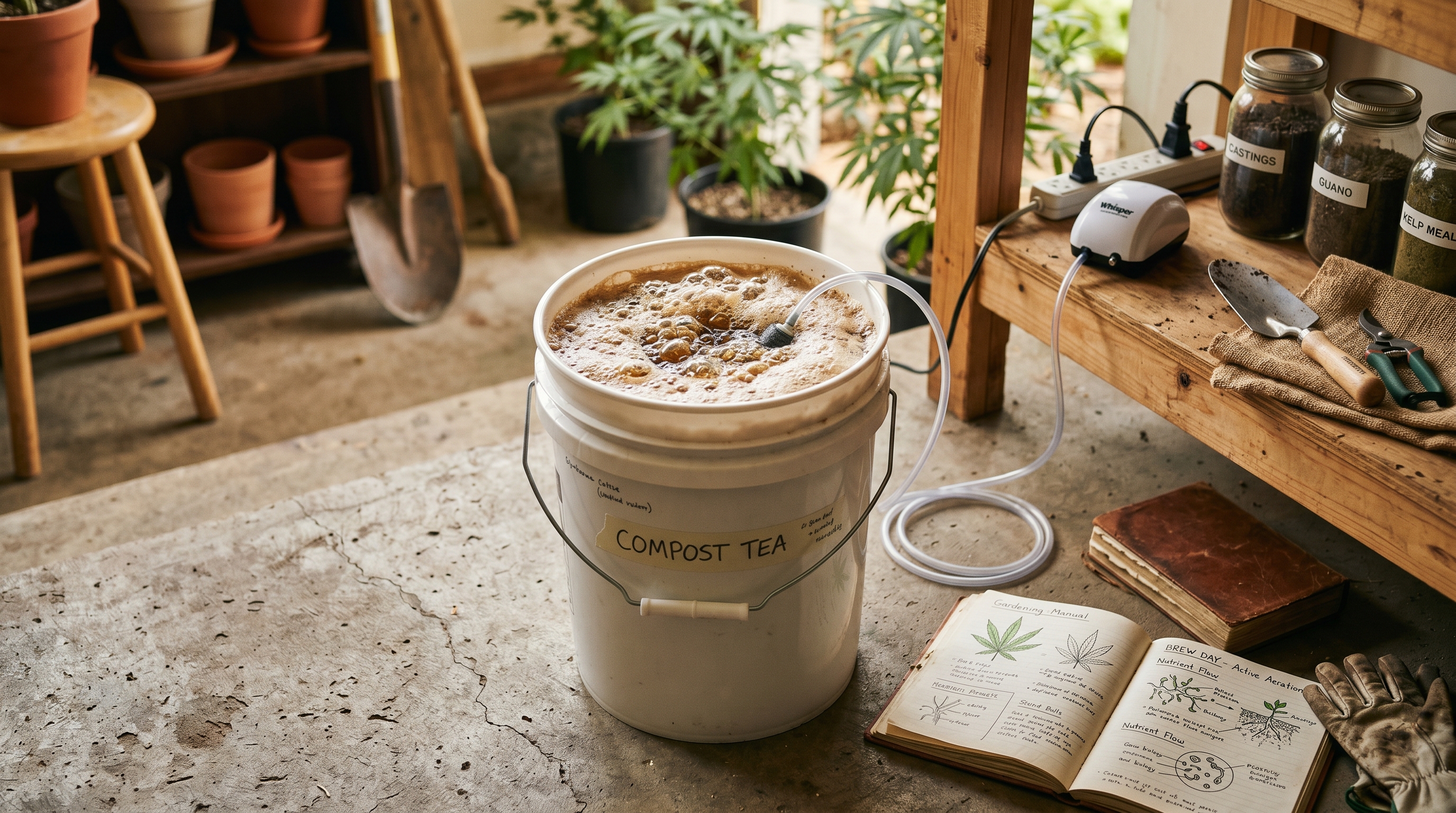
Compost tea is where organic growing gets genuinely fun. The idea is simple: take a small amount of microbially rich castings or compost, suspend it in dechlorinated water, add a microbe food source, and pump in oxygen for a day. The aeration causes the beneficial aerobic microbes to multiply exponentially, turning a cup of castings into gallons of living inoculant.
Equipment
- A 5-gallon bucket (it actually holds about 4 gallons of tea)
- An aquarium air pump plus air stone and tubing (bigger is better; aim for roughly 0.5 liters of air per minute per liter of water)
- A fine mesh bag or paint-strainer bag (optional, but keeps solids out of your sprayer)
- Dechlorinated water (rainwater is ideal; or leave tap water out uncovered for 24 hours so chlorine off-gasses)
Chlorine is the silent tea-killer. The whole point is to grow microbes, and chlorinated tap water will slaughter the very organisms you are trying to cultivate. Never skip the dechlorination step.
A reliable base recipe
For ~5 gallons of dechlorinated water:
- 2 cups worm castings (or finished compost) — your microbial seed
- 2 to 3 tablespoons unsulphured blackstrap molasses — the microbe food (sugar)
- Optional ¼ cup kelp meal for added fungal diversity and trace minerals
- Optional 1 tablespoon fish hydrolysate for a fungal-leaning, flowering tea
Place the castings (loose or bagged) in the water, dissolve the molasses in a little warm water first so it does not just sink, add any extras, drop in the air stone, and turn the pump on. Brew for 24 to 36 hours at 65–75°F (18–24°C) [Ilgm, 2025].
Bacterial vs. fungal tea
You can steer the tea toward different microbial profiles depending on the plant’s stage:
- Bacterial-dominant teas brew faster (6 to 12 hours) and favor leafy vigor. Lean on castings, molasses, and alfalfa. Great for vegetative growth.
- Fungal-dominant teas need a longer 24-to-36-hour brew and benefit from kelp, fish hydrolysate, and humic acid. Fungi support bigger, denser buds and richer terpenes during flower.
The smell test and using it fast
A finished tea has a layer of foam on top and smells sweet and earthy, like good forest soil. If it smells sour, rotten, or like ammonia, it went anaerobic — dump it and start over, since anaerobic teas may harbor pathogens. Tea is alive and perishable. Once the air pump shuts off, the oxygen depletes within hours and the microbes appear to die back fast [Biology, 2026]. Apply within 4 to 6 hours of the pump going quiet. Got leftovers? Pour them on outdoor beds or your compost pile rather than storing them.
Application
You have two ways to apply tea, and both are useful:
- Soil drench: Dilute roughly 1 part tea to 1–2 parts plain water and pour into the root zone. This inoculates the soil food web and improves nutrient cycling. Pre-water the soil first so it accepts the tea evenly.
- Foliar spray: Mist the leaves (undersides too) in the early morning or late evening. The microbial film helps fend off pathogens and disease.
Apply a bacterial tea every 1 to 2 weeks in veg and a fungal tea every 2 to 3 weeks in flower. Stop foliar sprays a few weeks before harvest to keep your buds clean.
Timing amendments by growth stage
Matching the input to the stage keeps your plant fed without waste:
- Seedling / early veg: Go gentle. Castings and a mild bacterial tea are plenty. Avoid hot nitrogen inputs that can burn tender roots.
- Vegetative: Nitrogen drives leafy growth. Top-dress kelp and a touch of high-N guano or alfalfa; run bacterial teas. This is the time to build the frame that will hold your flowers.
- Pre-flower / transition: Shift toward phosphorus. Side-dress high-P bat guano or bone meal in the first two to three weeks of flower to support bud set.
- Flower: Lean on potassium and phosphorus, fungal-dominant teas, and kelp for terpene and resin support. Ease off heavy nitrogen so the plant directs energy into buds, not leaves.
- Late flower: Back off feeding entirely and let the soil’s residual biology carry the plant home, which keeps the final flower clean-tasting through drying and curing.
This rhythm works whether you are growing indoors or outdoors, though outdoor and sun-grown plants on a seasonal schedule often need fewer interventions thanks to a larger soil volume and natural biology.
Cautions: do not over-amend
The most common organic mistake is enthusiasm. More is not better.
- Don’t stack high-P amendments. Over-applying phosphorus (multiple guanos plus bone meal plus rock phosphate) can lock out calcium, magnesium, and potassium through ion antagonism [Seedconnect, 2025]. You end up with deficiencies despite a soil full of food.
- Respect the cook time. Hot inputs that have not been microbially digested will burn roots. When in doubt, wait longer.
- Mind your C:N balance. Aim for a mix that is not nitrogen-heavy to the point of going sour. A diverse, balanced build is more resilient than a souped-up one.
- Start conservatively and observe. Apply a modest dose, watch the plant for two weeks, then adjust. It is far easier to add more than to undo an overdose.
- Watch the water. Organic systems live or die by microbial health — chlorinated water and synthetic pesticides near the root zone undo your hard work.
If you are brand new to all of this, build your foundation with our complete beginner’s grow guide and a proper grow space before chasing exotic amendments.
The Professor’s bottom line
Organic amendments reward patience with flavor, resilience, and a garden that improves over time. Master a handful of inputs — castings, the right guano for the stage, kelp, and a clean compost tea — and you will outgrow bottled nutrients without ever missing them. Feed the soil, let the biology work, and your plants will tell you what they think come harvest.
And when you do harvest? Pay attention to how that organically grown flower actually makes you feel. Terpene and cannabinoid expression shift with how a plant is grown. Tracking your real-world results — not just the label on the jar — is how you dial in what works for you. The High IQ app helps you log strains, effects, and patterns over time so your next grow (and your next dispensary trip) gets smarter.
Key takeaways
- Feed the soil, not the plant. Organic amendments fuel the soil food web, which then feeds your roots on its own schedule.
- Castings first. Worm castings are the best single buy: a huge microbial charge with zero burn risk.
- Match guano to the stage. High-N guano for veg, high-P guano for flower. Always read the label.
- Cook hot mixes 2 to 4 weeks before planting; top-dress gentle inputs during the grow.
- Compost tea is alive. Use clean water, brew 24 to 36 hours, and apply within 4 to 6 hours.
- Don’t over-amend. Stacking phosphorus locks out other nutrients. Start small and watch the plant.
Frequently asked questions
Do I really need to let amended soil “cook”? For freshly mixed soil with hot inputs like guano, blood meal, or alfalfa, yes. Two to four weeks lets microbes pre-digest those amendments so they don’t burn your roots. Top-dressing gentle inputs onto an established plant does not require a cook period.
What’s the difference between high-N and high-P guano? High-nitrogen guano (around 10-3-1) fuels leafy vegetative growth; high-phosphorus guano (closer to 0-7-0 or 3-10-1) supports flowering and bud development. Always check the product label and match it to your plant’s stage.
Why did my compost tea smell bad? A sour, rotten, or ammonia smell means it went anaerobic — usually from too little oxygen, too much molasses, or brewing too long. Don’t use it on your plants; dump it and brew a fresh batch with stronger aeration.
How long does compost tea last? Not long. It is a living product, so apply it within 4 to 6 hours after the air pump shuts off. After that, oxygen depletes and the beneficial microbes die back.
Can I just use compost tea instead of dry amendments? Tea is an inoculant and a light feed, not a complete nutrient program. It shines alongside a properly amended soil — the dry amendments supply the nutrients, the tea supplies and multiplies the biology that unlocks them.
Sources
- The Seed Connect — The Role of Organic Soil Amendments in Sustainable Cannabis Cultivation (amendment NPK table, application rates, phosphorus-lockout cautions): https://theseedconnect.com/blog/organic-soil-amendments-cannabis-role/
- The Cannigma — How to Prepare Organic Living Soil for Cannabis (soil food web, cook time, pH range, mulch): https://cannigma.com/how-to/organic-living-soil-cannabis-guide/
- I Love Growing Marijuana (ILGM) — Beginner’s Guide to Compost Tea for Cannabis (AACT recipe, bacterial vs. fungal tea, application frequency): https://ilgm.com/resources/guides/beginners-guide-to-compost-tea-for-cannabis
- Biology Insights — How to Make Compost Tea for Cannabis (aeration rates, brewing temperature, perishability, soil drench vs. foliar): https://biologyinsights.com/how-to-make-compost-tea-for-cannabis/
- Aqualogi — Worm Casting Tea Recipe (casting-to-water ratios, dilution, anaerobic warning): https://www.aqualogi.com/worm-casting-tea-recipe/
- True to Plant — Best Soil for Growing Cannabis: Complete Guide (amendment functions by stage, living-soil components): https://truetoplant.com/best-soil-growing-cannabis-complete-guide/


