

California Sober: What the 19–27% Less Alcohol Trial Measured
California sober is informal slang, often cannabis without alcohol. A lab trial measured less drinking in one task. It did not show recovery.

California sober is informal slang, not a diagnosis or a treatment. Merriam-Webster’s dictionary sense is recreational marijuana and/or alcohol while abstaining from other drugs, and often, more specifically, marijuana only while abstaining from alcohol and other drugs. Merriam-Webster: California sober. The lab trial found less alcohol consumed after THC, with mixed craving results. It did not prove recovery or safer combined use.
What does California sober mean?
The phrase has no single clinical definition. The dictionary entry above has two related senses. Everyday use often means the specific one: cannabis, and no alcohol. Some people stretch it to other selective-use patterns. None of those uses is a diagnosis, a prescription, or proof that the pattern is safer.
The rest of this article is a close reading of one experiment, not a plan for replacing alcohol with cannabis. Jane Metrik and colleagues published a crossover trial online in November 2025 and in the February 2026 American Journal of Psychiatry. Its widely shared “19–27% less” figure describes the share of offered alcohol consumed in a two-hour task. Participants could earn money for leaving drinks unconsumed. Metrik, 2026
What does “19–27% less alcohol” mean?
It means a relative reduction from the placebo session’s consumption, not a 19–27-percentage-point drop.
The paper reports these shares of the total alcohol offered during the choice task:
| Smoked condition | Share of offered alcohol consumed | Change versus placebo |
|---|---|---|
| Placebo, 0.03% THC | 36.25% | Reference |
| 3.1% THC flower | 29.52% | 6.73 percentage points lower; about 19% relative reduction |
| 7.2% THC flower | 26.61% | 9.64 percentage points lower; about 27% relative reduction |
Those are the paper’s reported consumption values. The relative calculation uses the placebo value as its denominator. For the 7.2% condition, (36.25 − 26.61) ÷ 36.25 × 100 = 26.59%, rounded to 27%. Metrik, 2026
The same result can be described as 9.64 percentage points less of the offered alcohol, or about 27% less relative to placebo. Neither number is a recovery rate. It is also not a fall in usual weekly drinking or a percentage change in craving.
Both active conditions reduced consumption versus placebo. The difference between the two active conditions was not statistically significant: p = .13. The larger numerical drop does not establish that the stronger flower worked better.
What were people choosing between?
They could consume a mini-drink or keep its cash value.
Each of two 60-minute blocks offered four mini-drinks of a participant’s preferred beverage and a $12 tab. Each mini-drink not consumed was worth $3. The offered alcohol amount was tailored to the participant; eight mini-drinks did not mean eight ordinary full-size standard drinks. The study protocol describes a 45-minute drinking window within each block. Study protocol, updated September 2025
This was a controlled choice task in a room set up like a bar. It was not an ordinary evening where someone chose cannabis and had no alcohol available. Some participants still drank after active THC.
The money alternative existed in every condition. It therefore does not erase the randomized comparison. But it matters when asking where the result applies: the trial tested drinking with that alternative available. It did not test the same task without payment, so it cannot tell us how much the incentive changed the THC effect.
Who took part, and what did they receive?
The participants already knew both cannabis and alcohol and were not seeking treatment.
Researchers randomized 157 adults aged 21–44. The reported analysis included 138 who completed at least two sessions: 138 placebo sessions and 134 sessions for each active condition. This was a crossover study, so participants returned for different conditions on separate days, rather than staying in one parallel treatment group. Metrik, 2026
Eligibility included cannabis use at least twice weekly in the past month, a familiar smoking route, heavy episodic drinking at least monthly, and prior use of both substances on the same occasion. People intending to quit or receive alcohol or cannabis treatment were excluded, as were people with relevant medical risks or inability to abstain without withdrawal.
The analyzed group used cannabis on an average of 84.4% of days. About 76% met criteria for current cannabis use disorder; about 43% met criteria for current alcohol use disorder. This was not a sample of people new to THC, and not everyone had AUD. Our cannabis use disorder lesson explains the distinction between use, dependence and a disorder.
Sessions used NIDA-supplied flower cigarettes with 3.1% THC, 7.2% THC, or 0.03% THC placebo, with only trace CBD. Participants followed paced smoking after requested cannabis abstinence of 15 hours and alcohol abstinence of 24 hours. They were screened and monitored in the lab.
Flower percentage is not a swallowed or absorbed dose. These strengths do not translate into a recommended number of milligrams, puffs, edibles or THC drinks. The product-comparison lesson explains why concentration, amount and route are different facts. Our pouch absorption evidence lesson shows another case where one format’s study cannot establish another format’s effects.
Did THC reduce alcohol craving?
The answer depends on which craving measure and time point you mean.
The paper and its posted protocol describe two primary craving measures: an averaged Alcohol Craving Questionnaire score, or ACQ-SF-R, and a single urge item. The headline drinking result was a secondary outcome. Time to first drink was exploratory. Metrik, 2026, protocol
| Outcome and timing | What the trial found | What that does not establish |
|---|---|---|
| Primary composite craving, immediately after smoking | Neither active condition differed significantly from placebo | That every craving result was null |
| Composite response to alcohol cues | Alcohol cues raised craving; THC did not significantly alter that rise | A demonstrated block on cue-triggered craving |
| Primary single urge item, immediately after smoking | The 7.2% condition was lower than placebo; 3.1% was not significantly different | Consistent suppression across both strengths and measures |
| Composite craving after the second drinking block | A later change was lower in the 3.1% condition versus placebo; the 7.2% interaction was not significant | A general craving-treatment effect before drinking |
| Secondary drinking choice | Both active conditions reduced consumption versus placebo | Long-term abstinence or reduced combined harms |
| Exploratory time to first drink | Longer with 7.2% versus placebo; not significantly longer with 3.1% | A proven safe interval or sustained behavior change |
The immediate urge rating was 1.93 after 7.2% THC versus 2.31 after placebo, on a seven-point scale. The later composite finding came after the alcohol-consumption period, at the end of the second block, with a reported interaction of −0.16 and p = .02. It should not disappear from a summary that calls all craving results null. Neither finding establishes a reliable treatment for alcohol craving.
All p values were unadjusted for multiple comparisons. In plain words, the analysis tested many contrasts without correcting these thresholds for the whole set. That qualification matters when interpreting isolated positive results. It does not make the observed drinking result disappear. Metrik, 2026
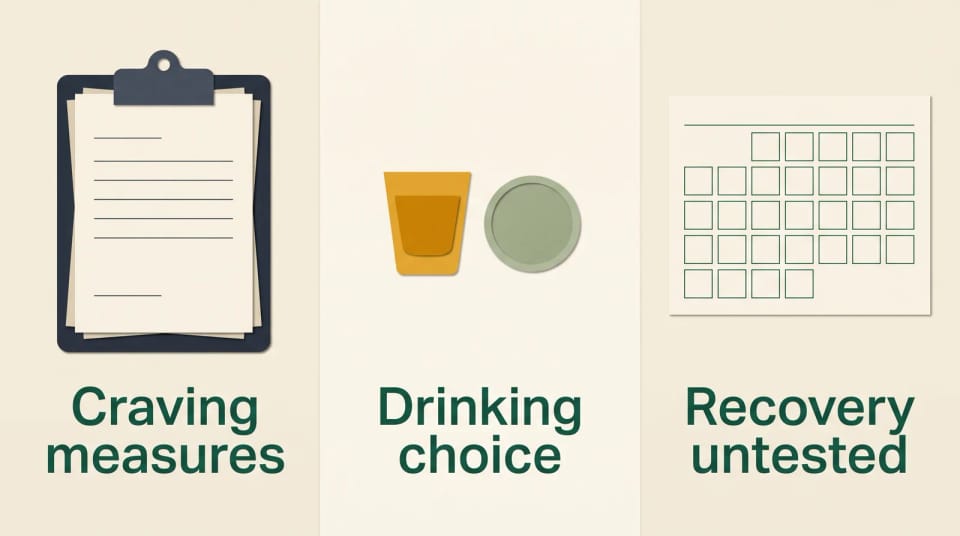
Conceptual evidence map: craving measures and the drinking-choice task were assessed. Long-term recovery was not tested in this experiment.
Was less drinking also less intoxication or harm?
The trial did not establish a reduction in combined harms.
Both active THC conditions increased subjective intoxication, anxiety and heart rate compared with placebo. Immediately after smoking, mean heart rate was about 72 beats per minute after placebo, 91 after 3.1% THC and 98 after 7.2%. These are laboratory averages, not a personal risk estimate. Metrik, 2026
A smaller alcohol amount is a meaningful behavioral finding. It does not automatically measure total impairment, injuries or longer-term health when THC is also involved. The authors explicitly said whether the consumption reduction lowers harms from simultaneous use is unknown.
This experiment supplies no cannabis-before-alcohol recipe and no clearance time for driving. Our oral-versus-inhaled response comparison illustrates why a result must stay tied to the preparation, population and outcome actually tested.
The proposed explanations—such as reaching a preferred level of intoxication or effects of overnight cannabis deprivation—remain hypotheses. This trial did not establish a receptor mechanism for the drinking change. Staff blinding effectiveness was also not evaluated.
Does this make cannabis a treatment for alcohol problems?
No. This experiment does not establish cannabis as an AUD treatment or a safe substitute for alcohol.
The authors called such recommendations premature and potentially risky. Its short lab sessions in familiar users did not test months of recovery, starting cannabis in nonusers, or a full switch away from alcohol. A smoker’s response in this task also cannot establish the effect of a retail edible, CBD product or THC beverage. Metrik, 2026
If the question comes from concern about your own drinking, review it with a clinician. NIAAA describes counseling and medicines among evidence-based alcohol treatment options. It also warns that suddenly stopping after prolonged heavy drinking can cause potentially life-threatening withdrawal; seek medical help to plan that change. This study is not a home-detox protocol. NIAAA treatment guidance
Our appointment-preparation card can help you organize what you actually use, medicines and concerns for that discussion. It is a preparation tool, not a treatment decision.
FAQ
What does California sober mean?
It is informal slang. Merriam-Webster’s broader sense is marijuana and/or alcohol while abstaining from other drugs. The more specific sense is marijuana only, with no alcohol and no other drugs. It is not a clinical diagnosis. The trial in this article is not a recovery program.
Did the trial show that stronger cannabis reduces drinking more?
It showed a larger numerical drop with 7.2% flower, but the difference between active conditions was not statistically significant. It does not support choosing a stronger product to reduce drinking.
Does 27% less mean 27% of people stopped drinking?
No. It is a relative change in the share of offered alcohol consumed compared with placebo. It is not the proportion of people who quit or recovered.
Were all the primary craving results null?
No. The immediate composite and cue-response comparisons were null, but the higher-strength condition reduced the immediate urge item. A later composite interaction also favored the lower-strength condition after drinking.
Was this a study of people trying to quit alcohol?
No. People planning to quit or seek treatment were excluded. The results should not be treated as an AUD remission trial.
Key takeaways
- The 19–27% headline is relative consumption change in a lab task.
- Participants could earn cash for leaving mini-drinks unconsumed.
- Primary craving results varied by measure and timing.
- Both active conditions reduced drinking; neither proved superior.
- Lower alcohol consumption did not establish recovery or safer co-use.
Sources
- Metrik, J., Aston, E. R., Gunn, R. L., Swift, R., MacKillop, J., & Kahler, C. W. (2026). Acute Effects of Cannabis on Alcohol Craving and Consumption: A Randomized Controlled Crossover Trial. American Journal of Psychiatry, 183(2), 134–143. Published online November 19, 2025. DOI: 10.1176/appi.ajp.20250115. PMID: 41254853. Full author manuscript. Funding included NIAAA and career-development awards; funders reported no role beyond financial support. MacKillop disclosed a principal role in Beam Diagnostics and consulting to Clairvoyant Therapeutics. Other authors reported no conflicts.
- Metrik, J., principal investigator, Brown University. Cannabis’s Impact on Alcohol Motivation and Consumption: Trial Protocol. Updated September 7, 2025. Official registry-linked protocol and analysis plan. Posted version is dated after study completion; it is not an independent result or proof of an unchanged original plan. The separate manuscript-linked DOCX supplement could not be accessed for this review; no unread supplement-only findings are used.
- ClinicalTrials.gov. Marijuana’s Impact on Alcohol Motivation and Consumption, NCT02983773. Current record checked October 11, 2026; last update posted April 21, 2026. Registration of the same experiment, not a replication.
- National Institute on Alcohol Abuse and Alcoholism. Treatment for Alcohol Problems: Finding and Getting Help. Current patient guidance, accessed October 11, 2026. No publication date displayed in the opened page. Supports care options and the withdrawal warning, not cannabis efficacy.
- Merriam-Webster. California sober. See https://www.merriam-webster.com/dictionary/California%20sober


