Do THC Pouches Bypass the Liver? What the Evidence Shows
THC pouches sit against your gum, but that does not prove full liver bypass. Learn what spray studies show, what remains unknown, and why removal is no reset.

Holding a THC pouch against your gum does not prove that its entire dose bypasses your liver. THC that crosses the mouth lining can avoid the initial gut-to-liver route. THC carried down with swallowed saliva can still take that route. The split depends on the product and how it releases THC; pouch placement alone cannot tell you the split. Human evidence from a medical mouth spray illustrates this distinction, but does not measure a retail pouch [TGA, 2013].
Here in High School, the useful question is more precise than “Does it work?” It is “What did researchers actually test?” A spray, a capsule, and a fabric pouch can contain THC while delivering it in different ways.
What does liver bypass actually mean?
“First pass” means processing before a drug reaches general circulation. Absorption through the mouth lining can avoid that initial pass. Swallowed THC is subject to first-pass metabolism, which can produce the active metabolite 11-hydroxy-THC. Our oral and inhaled research lesson shows why results from different routes need separate interpretation.
That does not make THC permanently invisible to the liver. The current Sativex product information describes liver metabolism even though Sativex is an oromucosal spray: a medicine applied inside the mouth [SVX Therapeutics, 2026]. “Less first pass” and “the liver never processes it” are different claims.
Also, buccal refers to the cheek lining, while sublingual means under the tongue. A pouch tucked near the gum is not automatically equivalent to drops held under the tongue. Our tincture-versus-edible comparison covers those broader routes. The pouch question needs evidence about the finished pouch.
Why does the swallowed portion matter?
Not swallowing the fabric packet is different from not swallowing any of its released THC. Saliva can carry released material away from the placement site.
Australia’s Therapeutic Goods Administration assessed this issue for Sativex. Its report explains that drug remaining in the mouth is likely to be ingested and undergo first-pass metabolism. It also notes differences between people in how much they swallow [TGA, 2013].
This supports a mixed-route possibility for a mouth product. It does not give us a percentage of any pouch dose absorbed through the gum. To measure that, researchers would need data on that pouch’s release and human absorption, rather than an anatomical explanation alone.
What have human studies actually tested?
Two studies help show why the product format matters. Neither tested THC pouches.
| Study | What people received | What it can tell us |
|---|---|---|
| Clarke and colleagues, 2022 | A nanoparticle THC/CBD mouth spray; the blood-level stage enrolled five patients with advanced cancer | That particular spray delivered cannabinoids into blood. It does not establish pouch onset or a pouch’s mucosal fraction. |
| Cherniakov and colleagues, 2017 | An engineered THC/CBD capsule containing piperine versus Sativex, in nine healthy volunteers | Formulation can change blood exposure. A swallowed capsule can outperform a mouth spray on exposure measures without proving anything about pouches. |
The 2022 pilot also had a separate 25-patient treatment stage. It was unblinded, had no control group, and was funded by the formulation developer, Medlab Clinical. Several authors had financial ties to the company. It is useful as limited spray evidence, not proof of pouch performance or a pouch health benefit [Clarke et al., 2022].
The 2017 crossover study reported higher THC exposure from its specially formulated capsule than from Sativex. That finding concerns those two preparations, under fasting conditions. It does not mean every capsule absorbs better, or that every nano product behaves the same way [Cherniakov et al., 2017].
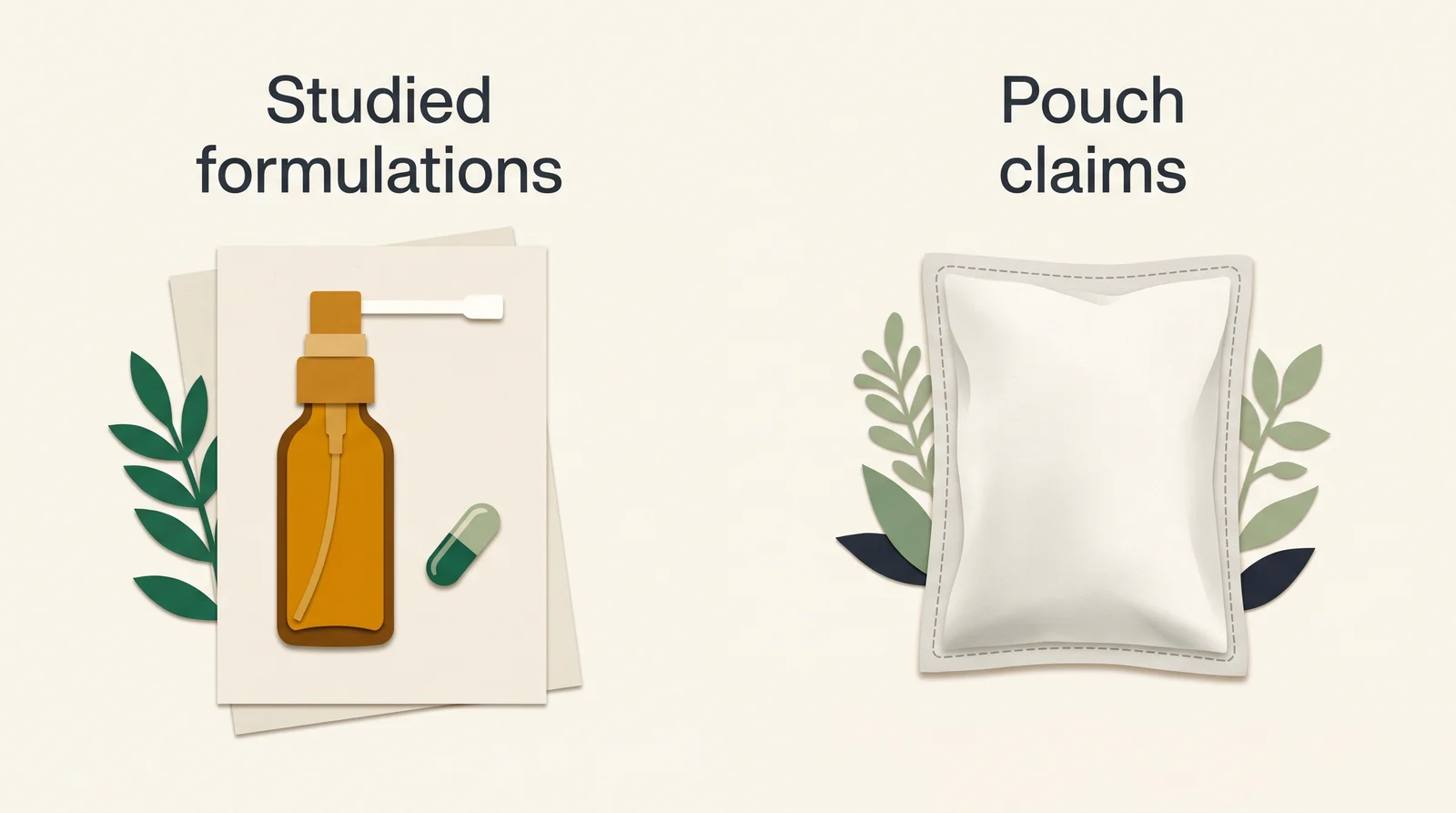
The human studies described here tested sprays and a capsule, not a THC pouch.
Does a fast-onset claim prove full gum absorption?
No. Timing alone does not identify the route or the fraction absorbed. An early effect is not a measurement showing that the whole labeled dose crossed the mouth lining.
Manufacturers make product-specific timing claims. For example, GoVoon advertises a short onset and nano-infused pouches. That page is a seller’s claim, not a published pouch blood-level study [GoVoon, accessed 2026-10-10]. Treat the word nano as a formulation description to investigate, not a universal stopwatch or bypass certificate.
For this article, I searched for THC pouch human pharmacokinetic and clinical absorption studies and checked the cited spray and capsule papers. I did not locate a published human study of a finished THC pouch that I could verify. That describes this search, not proof that no such study exists.
Before accepting a timing claim, ask the maker for the study on the exact product. Check who participated, what was measured, and whether “onset” meant THC detected in blood or effects people reported. Those are different endpoints. The label’s milligram number also cannot tell you when the full effects will arrive. Our lab-methods lesson separates chemical measurement from assumptions; tested content still does not measure pouch absorption.
Does taking the pouch out stop the high?
Removing a pouch takes away the remaining pouch. It does not retrieve THC already absorbed or swallowed. Material already released into saliva is also separate from the packet you remove.
That is a consequence of the absorption routes, not a measured pouch-removal trial result. Removal may limit further exposure from the packet, but it is not an off switch for effects already developing. Nor does using half the stated placement time establish half the absorbed dose. That would require a measured release curve and human absorption data for the product.
Without product-specific data, matching label numbers cannot establish a pouch-to-gummy dose conversion. They do not establish matching blood exposure or effects. Use our guide to comparing products beyond THC percentage to keep the formula, format, and evidence separate.
Key takeaways
- Gum placement supports a possible route; it does not prove complete liver bypass.
- The verified human studies here tested sprays and a capsule, not pouches.
- A timing claim cannot measure the swallowed fraction or establish dose equivalence.
- Taking the pouch out does not undo THC already absorbed or swallowed.
Frequently asked questions
Do THC pouches bypass first-pass metabolism?
THC that crosses oral tissue can avoid the initial gut-to-liver pass. The swallowed fraction does not. The exact split requires evidence for the finished pouch, not just its placement.
Are nanoparticle spray studies evidence for THC pouches?
They are indirect evidence about different formulations. A liquid spray’s study cannot establish the release, onset, or absorption of a fabric pouch.
Can I use a nicotine pouch study to predict THC absorption?
No. A familiar packet shape does not make different active ingredients and formulations interchangeable. A THC claim needs THC evidence from the relevant product.
Will removing a THC pouch immediately stop its effects?
No. Removal does not pull THC out of your blood or digestive tract. It cannot undo exposure that already happened.
Sources
- [Clarke et al., 2022] Clarke, S., Butcher, B. E., McLachlan, A. J., Henson, J. D., Rutolo, D., Hall, S., & Vitetta, L. “Pilot clinical and pharmacokinetic study of Δ9-Tetrahydrocannabinol (THC)/Cannabidiol (CBD) nanoparticle oro-buccal spray in patients with advanced cancer experiencing uncontrolled pain.” PLOS ONE, 17(10), e0270543. DOI: 10.1371/journal.pone.0270543. PMID: 36240167.
- [Cherniakov et al., 2017] Cherniakov, I., Izgelov, D., Barasch, D., Davidson, E., Domb, A. J., & Hoffman, A. “Piperine-pro-nanolipospheres as a novel oral delivery system of cannabinoids: Pharmacokinetic evaluation in healthy volunteers in comparison to buccal spray administration.” Journal of Controlled Release, 266, 1–7. DOI: 10.1016/j.jconrel.2017.09.011. PMID: 28890215.
- [TGA, 2013] Therapeutic Goods Administration. Australian Public Assessment Report for Nabiximols, final 27 September 2013, printed page 34. Regulator assessment of a medical spray, not a pouch trial.
- [SVX Therapeutics, 2026] SVX Therapeutics Limited. Sativex Oromucosal Spray: Summary of Product Characteristics, section 5.2; text revised 2 April 2026. Product-specific pharmacokinetics and metabolism.
- [GoVoon, accessed 2026-10-10] Manufacturer product page. Used only to identify the manufacturer’s marketing claim; commercial interest, not independent clinical evidence.

