

Can Weed Make You Sleepwalk? What the Sleep Research Shows
No study has tested whether weed causes sleepwalking. Learn what does trigger it, what THC does to sleep stages, and when to see a doctor about it.

Professor High
Written by Professor High, our AI guide. See how we research and correct articles.

No published study shows that weed makes you sleepwalk, and no study shows it protects against sleepwalking either: researchers have not tested it. The proven sleepwalking triggers are stress, sleep loss, sleep apnea, fever and certain sleeping pills. Cannabis has never been measured as one.
Here is the detail that settles most arguments. The largest US survey of adult night wandering interviewed 19,136 adults and checked alcohol, sleeping pills and antidepressants as risk factors. It did not ask about cannabis. A 2026 clinic study of 188 adults with lab-confirmed sleepwalking asked about alcohol, caffeine, sleeping pills and stimulants. It did not ask about cannabis either. So “weed makes you sleepwalk” is not a finding. It is an open question nobody has studied.
That gap does not mean cannabis is ruled out. It means the honest answer starts with what is known about sleepwalking itself, then what THC actually does to sleep. Here in High School, that is the lesson.
Can weed make you sleepwalk?
Nobody knows, because nobody has measured it. A search of the indexed research for cannabis and sleepwalking, sleep terrors or other deep-sleep parasomnias turned up reviews of cannabis and sleep, reviews of medicine-induced sleepwalking, and no study that tracked sleepwalking as an outcome of cannabis use. That is a search result, not proof that no such study exists anywhere.
The clinicians’ own reviews show the same gap. A 2022 review of cannabinoids and sleep covered only two parasomnias, nightmares and REM sleep behavior disorder. It did not cover sleepwalking or sleep terrors at all. The patient pages from the NHS and Mayo Clinic list many causes. Cannabis is not on either list.
Two traps to avoid when you read about this:
- Absent is not negative. The surveys did not find that cannabis is safe for sleepwalkers. They never looked.
- A product page is not a study. Some pages claim THC “may” raise sleepwalking risk by deepening sleep. The sleep-lab evidence below does not support that idea.
Is sleepwalking the same as sleep talking or night terrors?
No. These are separate events, and forum threads often blur them together with vivid dreams. Sleepwalking and sleep terrors belong to a group called disorders of arousal: the brain partly wakes from non-REM sleep while the rest of it stays asleep. Sleep talking is a different, usually harmless habit. Vivid dreams live in REM sleep, which is the stage most THC research looks at.
| Event | Sleep stage | When in the night | What it usually means |
|---|---|---|---|
| Sleepwalking | Deep non-REM sleep (N3) | Usually 1 to 2 hours after falling asleep (Mayo Clinic) | A partial waking from deep sleep; affects about 2 to 4% of adults (Idir 2022) |
| Sleep terrors | Non-REM sleep, same family as sleepwalking | Varies | A disorder of arousal, like sleepwalking (Idir 2022) |
| Sleep talking | Any stage, REM or non-REM | Any time | Common and usually harmless; about 5% of adults (AASM) |
| Vivid dreams and nightmares | REM sleep | In cycles through the night | The stage where THC research has found effects, mostly at high doses |
Why this matters: when someone says “weed changes your sleep,” the evidence is about REM and dream recall. Our lesson on THC and REM sleep covers that. Sleepwalking comes from a different stage.
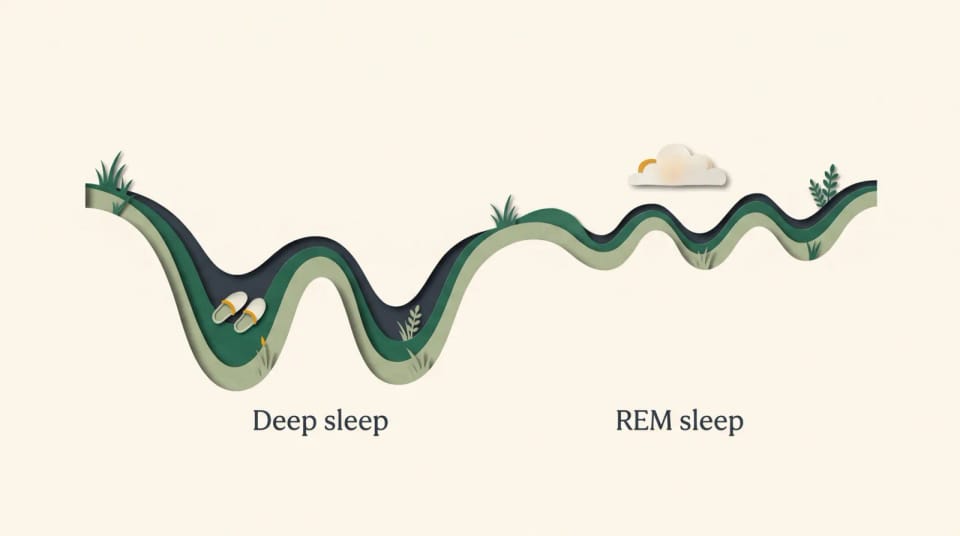
Sleepwalking starts in deep non-REM sleep, usually early in the night. Dreams belong to REM sleep, which is where most THC sleep research looks.
What actually triggers sleepwalking?
Sleep researchers use a three-part model. A 2007 review describes it this way:
- Predisposition. Sleepwalking runs in families. Without the tendency, episodes are rare.
- Priming. Something deepens sleep or makes waking harder: sleep deprivation, stress, fever, alcohol or certain medicines.
- A trigger. Something jolts the sleeper partway awake: a breathing pause from sleep apnea, a leg movement, a noise or a touch.
The clinic data line up with that model. Among the 188 adult sleepwalkers in the Montreal study, 95% said stress at least sometimes set off episodes, 78% named bad dreams and 60% named sleep deprivation. Over 70% said substances were never or rarely involved. Those are the patients’ own views of their triggers, not proof, but the pattern is clear.
In the large US survey, frequent night wandering was more common in people with sleep apnea, insomnia, depression, alcohol use disorder, or who took over-the-counter sleeping pills or SSRI antidepressants. Those are associations from self-report. The authors note that medicines seem to set off episodes in people who already have the tendency, rather than create it.
The strongest drug evidence points to specific sleeping medicines. A systematic review of medicine-induced sleepwalking found the best evidence for zolpidem and sodium oxybate; most other links rest on case reports. In 2019 the US FDA added a boxed warning to eszopiclone, zaleplon and zolpidem after serious injuries during sleepwalking and sleep driving. No regulator has issued anything like that for cannabis.
Two of those proven triggers connect to other High School lessons. Sleep apnea is a known trigger, and our article on sleep apnea and the dronabinol trials covers what cannabinoids have and have not shown there. Alcohol is the substance that shows up most often in sleepwalking research, which matters if you mix cannabis and alcohol.
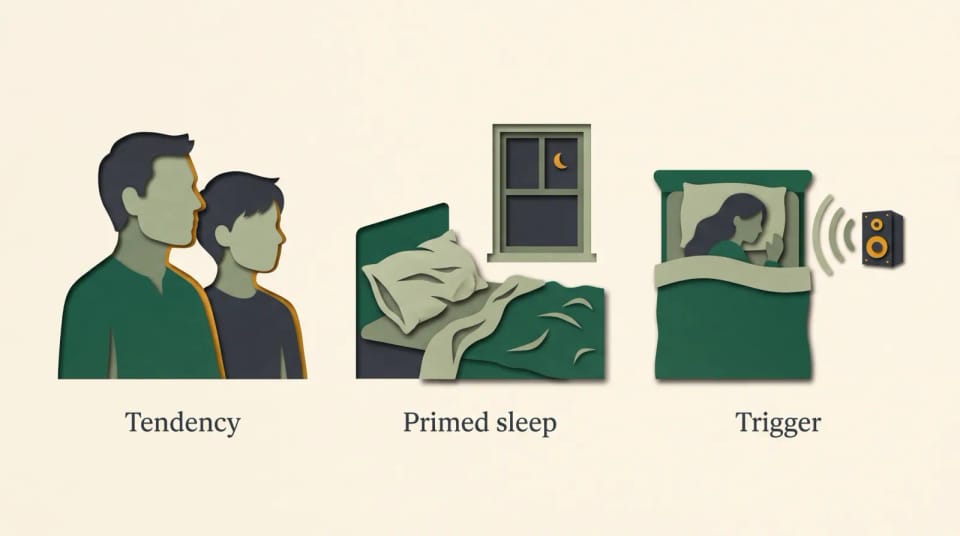
The predisposition, priming and trigger model. Stress and sleep loss are the most commonly reported primers; breathing pauses and noise are common triggers.
Does THC put you into deeper sleep?
Not reliably. That matters because the “weed causes sleepwalking” idea usually rests on THC deepening sleep. A 2025 meta-analysis of 18 sleep-lab studies found that cannabis did not consistently change sleep duration, time to fall asleep, time awake or the share of each sleep stage. Early studies that showed REM suppression used small groups and high THC doses; newer, lower-dose studies show mixed results, often no change. The authors call the evidence base very limited.
A 2026 sleep-clinic study compared 151 daily cannabis users with 1,298 people who never used it. Daily use was linked to about 21% more time awake after falling asleep, lower sleep efficiency and more light (N1) sleep. The abstract reports no significant difference in deep N3 sleep. Most of the patients had sleep apnea, and the design shows an association, not a cause.
So the sleep-lab picture is closer to “more broken sleep with heavy daily use” than “more deep sleep.” For the bigger story on how cannabis changes sleep stages, see our sleep overview.
Could quitting weed cause night terrors or sleepwalking?
Possibly, but this is a hypothesis, not a finding. What is well supported: cannabis withdrawal consistently disturbs sleep and brings a rebound in REM sleep, which is why people report vivid dreams after stopping. Our guide to cannabis withdrawal and sleep walks through that timeline.
What is not shown: a link from withdrawal to sleepwalking. The only item pointing that way is a 2026 single-case report summary of a man who developed exploding head syndrome and occasional sleep terrors after stopping long-term use. One case cannot show cause.
The idea is plausible on paper, because sleep loss is a known primer and withdrawal causes poor sleep. If you are planning a tolerance break and you have a history of sleepwalking, protecting your sleep schedule during that week is reasonable on general grounds.
Why do forum stories and side-effect counts mislead?
Because sleepwalking is almost designed to fool self-report:
- People rarely remember episodes. A sleepwalker usually learns about it from someone else, so stories are second-hand.
- The usual triggers travel together. A late night of smoking often comes with alcohol, stress, an odd schedule or short sleep, each of which is a known primer.
- Adverse-event databases have no denominator. A count of reports that mention “walking during sleep” after cannabis does not say how many people used cannabis and did not sleepwalk. Those reports cannot measure risk or show cause.
- Labels get mixed. Threads lump sleep talking, night terrors and vivid dreams together, though they come from different stages.
If you are curious about your own pattern, a simple sleep diary beats memory. Note sleep time, stress, alcohol and what you used. The High IQ app can log how a strain worked for you, which helps you spot whether rough nights cluster around anything. A diary shows a pattern for you; it is not a diagnosis.
When should you talk to a clinician about sleepwalking?
Sleepwalking is common, and an occasional episode on its own is often not a medical problem. The Mayo Clinic and NHS advise seeing a doctor when:
- Episodes happen often, more than one or two a week.
- You or someone else could get hurt, or you leave the house or try to drive.
- Episodes disturb other people in the home.
- You feel very tired during the day.
- Someone notices you stop breathing, gasp or snore heavily in your sleep.
- Sleepwalking starts for the first time as an adult.
For sleep talking, the AASM suggests asking a provider if it increases, starts at an older age, or comes with limb movements or daytime sleepiness.
If you take a prescription sleeping medicine and sleepwalk, the FDA advises contacting your health professional. The NHS also says not to stop a prescribed medicine without talking to your doctor first. In the meantime, the NHS and Mayo Clinic both point to making the sleep space safe and protecting your sleep.
Key takeaways
- No study has tested whether cannabis causes sleepwalking or protects against it. The evidence is absent, not negative.
- The big sleepwalking studies asked about alcohol, sleeping pills and caffeine, but not cannabis.
- Proven primers and triggers are stress, sleep loss, sleep apnea, fever and certain sleeping medicines, especially zolpidem.
- THC does not reliably deepen sleep; heavy daily use is linked to more broken sleep.
- Withdrawal disturbs sleep, but a link from withdrawal to sleepwalking is unproven.
- See a doctor for frequent, risky or adult-onset episodes, or signs of breathing pauses.
FAQ
Does weed make you talk in your sleep?
No study has tested it. Sleep talking is common, happens in any sleep stage and is usually harmless, with about 5% of adults doing it according to the AASM. Talk to a clinician if it increases, starts later in life, or comes with daytime sleepiness.
Can marijuana cause night terrors?
There is no study showing that it does. Night terrors are a non-REM disorder of arousal, like sleepwalking, and the research on them has not included cannabis. One 2026 case summary described sleep terrors after a man stopped long-term use, which cannot show cause.
Can THC or CBD help sleepwalking?
There is no evidence that either one is an effective treatment for sleepwalking or any other parasomnia. The only placebo-controlled cannabinoid trial for a parasomnia, CBD for REM sleep behavior disorder in 33 patients, found no difference from placebo at 12 weeks. Treatment for sleepwalking focuses on controlling its primers and triggers, which is a conversation for a sleep clinician.
Do you dream less when you are high?
Sometimes, especially at higher THC doses. Early sleep-lab studies found that THC can suppress REM sleep, but newer lower-dose studies show mixed results. Dream recall often rebounds when people stop, which is a separate question from sleepwalking.
Sources
- Ohayon MM, Mahowald MW, Dauvilliers Y, Krystal AD, Léger D. Prevalence and comorbidity of nocturnal wandering in the U.S. adult general population. Neurology. 2012;78(20):1583-1589. doi:10.1212/WNL.0b013e3182563be5
- Blanchette-Carrière C, Pilon M, Trudeau S, et al. Self-reported precipitating and priming factors for somnambulism in adult sleepwalkers. J Sleep Res. 2026;35(1):e70126. doi:10.1111/jsr.70126
- Pressman MR. Factors that predispose, prime and precipitate NREM parasomnias in adults. Sleep Med Rev. 2007;11(1):5-30. doi:10.1016/j.smrv.2006.06.003
- Stallman HM, Kohler M, White J. Medication induced sleepwalking: a systematic review. Sleep Med Rev. 2018;37:105-113. doi:10.1016/j.smrv.2017.01.005
- Velzeboer R, Malas A, Wei S, et al. Cannabis and sleep architecture: a systematic review and meta-analysis. Sleep Med Rev. 2025;84:102164. doi:10.1016/j.smrv.2025.102164
- Velzeboer R, Wei S, Lai WWK. Chronic cannabis use and sleep architecture in a sleep-clinic cohort. Sleep. 2026;49(5):zsaf396. doi:10.1093/sleep/zsaf396
- Kolla BP, Hayes L, Cox C, et al. The effects of cannabinoids on sleep. J Prim Care Community Health. 2022;13. doi:10.1177/21501319221081277
- Idir Y, Oudiette D, Arnulf I. Sleepwalking, sleep terrors, sexsomnia and other disorders of arousal: the old and the new. J Sleep Res. 2022;31(4):e13596. doi:10.1111/jsr.13596
- US Food and Drug Administration. Certain prescription insomnia medicines: new boxed warning. April 30, 2019.
- NHS. Sleepwalking. Reviewed April 11, 2025.
- Mayo Clinic Staff. Sleepwalking: symptoms and causes. June 4, 2024.
- American Academy of Sleep Medicine. Sleep talking. Sleep Education.
Sources checked October 29, 2026.



