

Cannabis Flavonoids: What the Research Looks at Beyond Terpenes
Cell studies look at cannabis flavonoids, including cannflavin A, in inflammation assays. A benefit from a typical joint is still debated.

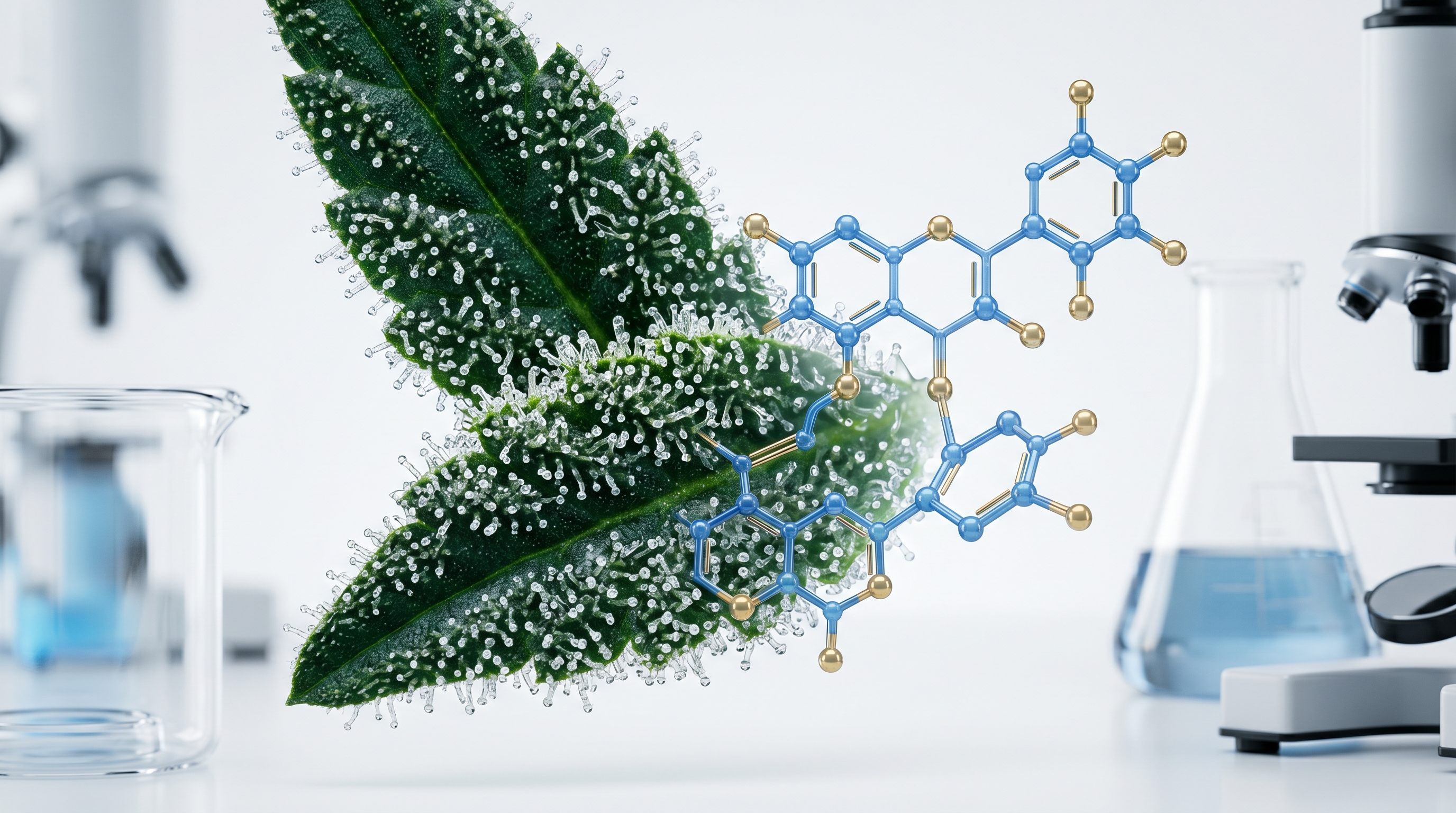
Cannabis flavonoids, including cannflavin A, are a third group of plant compounds besides cannabinoids and terpenes. Cell research on cannflavin A is strong, and a typical joint still delivers a modest amount.
Ask a cannabis consumer what’s in the plant and you’ll hear: cannabinoids and terpenes. Most of the entourage-effect literature is built on those two pillars. It’s also incomplete.
Cannabis produces a third category of bioactives that almost nobody talks about — even though one member was shown, in human rheumatoid synovial cells, to inhibit a key inflammatory mediator roughly thirty times more potently than aspirin. The compounds are flavonoids, and the cannabis-specific ones are called cannflavins. They were discovered in the 1980s, sat largely ignored for thirty years, and have re-emerged as one of the more interesting unsolved questions in cannabis pharmacology.
This is a serious look at what flavonoids are, what cannflavin A, B, and C actually do, why almost no consumer has heard of them, and what the practical pharmacology of flower really supports. The science is real, but the dose-from-a-joint reality is more modest than the headlines suggest. Both things can be true.
A note: Science article, not medical advice. If you are managing a chronic inflammatory condition, work with a clinician.
What Flavonoids Actually Are
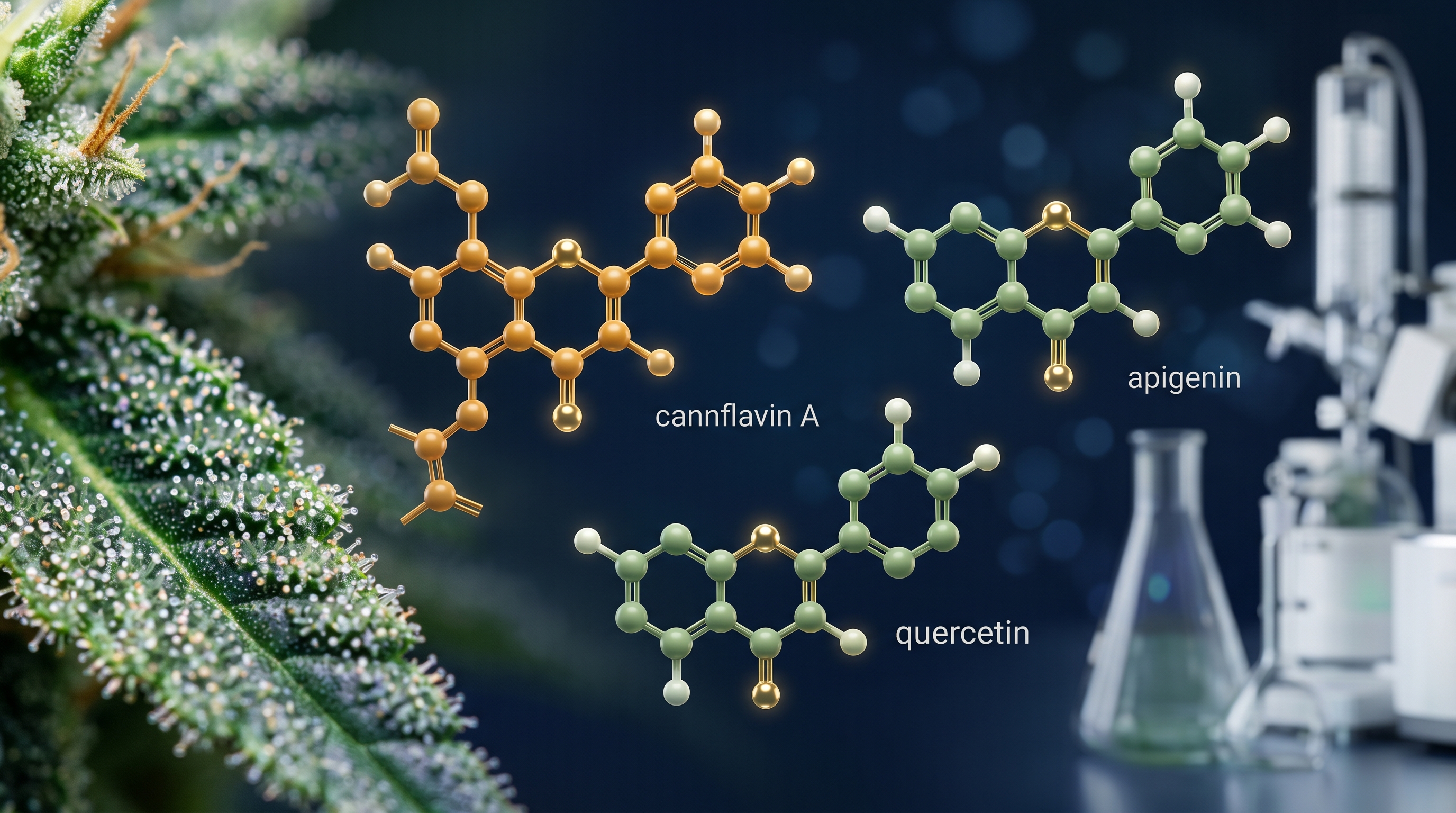
Flavonoids are a vast family of plant secondary metabolites — small polyphenolic molecules built around a 15-carbon, three-ring scaffold (the flavone backbone). Roughly 6,000 distinct flavonoids have been characterized across the plant kingdom, responsible for much of the color of fruits and flowers.
They also do interesting things in animal cells: antioxidant activity, modulation of inflammatory pathways, kinase effects, binding to a wide variety of enzymes and receptors. Their planar polyphenol structure fits the active sites of many enzymes that handle planar substrates — including several that drive inflammation.
In cannabis, more than 20 flavonoids have been identified. Most are common across the plant world: apigenin, luteolin, kaempferol, quercetin, vitexin, orientin, myricetin — molecules you eat every day in parsley, kale, onions, and tea.
What makes cannabis distinctive is a small subset of prenylated and geranylated flavones essentially unique to the plant: cannflavin A, cannflavin B, and cannflavin C. Prenylation hangs a small isoprene-derived tail off the flavone — the same kind of decoration that turns olivetolic acid into cannabinoids. For practical purposes, cannflavins are a cannabis signature.
Cannflavin A: The Flagship
The story starts in 1985. Marilyn Barrett, a PhD student at the School of Pharmacy in London, was working in Frank Evans’s lab on a simple question: which cannabis compound is responsible for the plant’s anti-inflammatory effect independent of the cannabinoids?
Her assay used synovial cells — the lining cells of the joint — harvested from rheumatoid-arthritis surgery patients. In culture, those cells spontaneously released prostaglandin E2 (PGE2), the lipid mediator your body makes when a joint is hot, swollen, and painful. Whatever blocked PGE2 release in that dish was doing something inflammation cared about.
Barrett took a cannabinoid-free alcohol extract, fractionated it, ran each fraction through the assay, and kept going until a single compound fell out. She called it Cannflavin [Barrett et al., 1985]. A year later, the structure resolved into two prenylated flavones, Cannflavin A and B [Barrett et al., 1986].
The numbers from that 1985 paper have echoed through every flavonoid review since:
- Cannflavin mean IC₅₀ for inhibiting TPA-induced PGE2 release: 31 ng/mL
- Aspirin in the same assay: 840 ng/mL
- Indomethacin: 1.7 ng/mL
- Dexamethasone: 0.27 ng/mL
So cannflavin was about 27–30× more potent than aspirin on a mass basis in that cell assay — the figure popular write-ups repeat. It was less potent than indomethacin and far less than dexamethasone. The assay did not test a smoked joint, and it did not show that a typical dose matches an over-the-counter pain tablet.
A second paper took the mechanism further. In purified enzyme assays, cannflavin A and B act on microsomal prostaglandin E synthase-1 (mPGES-1) — an inducible enzyme downstream of COX-2 selectively responsible for inflammatory PGE2 — and on 5-lipoxygenase (5-LOX), which makes leukotrienes [Werz et al., 2014]. IC₅₀ values fell in the low micromolar range. Critically, cannflavin A is only a weak inhibitor of COX-1 and COX-2 themselves — meaning it can quiet inducible inflammation without the gastric and renal side effects of long-term NSAID use. That is a more selective profile than an NSAID, closer to what a drug developer would design for a cleaner anti-inflammatory.
The 2019–2025 Reframing
Why did cannflavin sit on the shelf for thirty years? It is hard to extract, and prohibition kept cannabis pharmacology starved of funding through the 1990s and 2000s.
The modern revival started with a 2019 paper from the University of Guelph mapping the biosynthetic pathway to cannflavin A and B [Rea et al., 2019]. The team identified two enzymes — an O-methyltransferase (CsOMT21) and an aromatic prenyltransferase (CsPT3) — that take luteolin, methylate it to chrysoeriol, and attach either a geranyl group (cannflavin A) or a prenyl group (cannflavin B). That pathway opens a route to producing cannflavins in yeast, which solves the supply problem.
A 2020 Fitoterapia scoping review concluded the compounds had “promising therapeutic properties, most notably as an anti-inflammatory agent” [Erridge et al., 2020]. Since then, computational work has expanded the profile: cannflavin A binds the kinase TAK1 (a master regulator of inflammatory gene expression) with high predicted affinity, and the cannflavins dock favorably into the active site of the SARS-CoV-2 papain-like protease [Wanas et al., 2025]. These are not clinical claims — they are structural data that drug-discovery programs build on. A 2025 Journal of Cannabis Research paper also confirmed that cannflavin A and B dominate the prenylated-flavonoid profile in cultivated cannabis, with concentrations varying enormously by chemovar [Ceresa et al., 2025] — an opening for breeders to select for cannflavin-rich genetics the way they once selected for CBG and CBC.
The pharmaceutical pipeline is real but early: synthetic cannflavin analogs for arthritis and GI inflammation, fermentation production licensed by several companies. We are roughly where THC and CBD were in 1995 — chemistry mapped, biology promising, clinic still distant.
The Other Cannabis Flavonoids
Cannflavins get the press, but cannabis carries a wider flavonoid profile worth knowing:
- Apigenin — also in chamomile and parsley. Mild anxiolytic via partial benzodiazepine-receptor binding. The base flavone scaffold cannflavin biosynthesis branches from.
- Luteolin — a 3’-hydroxylated cousin of apigenin and the direct biosynthetic precursor to chrysoeriol → cannflavin A/B. Inhibits NF-κB activation.
- Kaempferol — a flavonol common in kale and onions. Antioxidant, kinase modulator.
- Quercetin — the heavyweight of dietary flavonoids. Mast-cell stabilizer, COX-2 modulator, broad antioxidant.
- Vitexin and orientin — C-glycosylated flavones (sugar attached carbon-to-carbon, unusually stable). Anxiolytic and anti-inflammatory in small animal models.
- Cannflavin C — identified in 2008 by ElSohly at the University of Mississippi. Less studied; preliminary antiparasitic activity (notably against Leishmania).
The thing to notice: most of the activity overlaps with what cannabis terpenes already do, but through different molecular machinery. Apigenin is anxiolytic at the benzodiazepine site; linalool is anxiolytic via GABA. Caryophyllene is anti-inflammatory at CB2; cannflavin A is anti-inflammatory at mPGES-1. Same direction, different doors into the cell — exactly the kind of redundancy that makes full-spectrum behave differently than the sum of isolates.
Why Almost Nobody Has Heard of Them
Three honest reasons.
Concentration. Cannabinoids dominate flower at 10–25% of dry weight. Terpenes come in around 1–3%. The entire flavonoid pool sits at 0.1–1%, and cannflavins specifically are a fraction of that — an order of magnitude less per gram than terpene, two orders of magnitude less than cannabinoid.
Heat. Combustion at 600–900 °C — the temperature inside a lit joint — is brutally destructive to plant secondary metabolites. A meaningful fraction of flavonoid mass in smoked flower does not make it past the cherry. Vaporization at 175–215 °C is gentler but still non-trivial; cold-process methods preserve far more.
Pharmacokinetics. Bioavailability of prenylated flavones in humans is poorly characterized but generally low — lipophilic, heavily glucuronidated in gut and liver, hitting systemic circulation at a small fraction of ingested dose. Same story as quercetin and apigenin. The eventual pharmaceutical play is most likely a synthetic analog or formulated delivery system, not raw extract.
Add those together: cannflavins are real and interesting, but the dose you extract from a bowl of flower is small. That is why practical pharmacology has lagged the chemistry.
What’s still debated about flavonoids and the entourage effect
The usual entourage-effect story says cannabinoids and terpenes do more together than alone. That story is a hypothesis with mixed evidence, and flavonoids do not close it.
What the cell work looks at is a layered set of targets:
- THC and CBD are studied at CB1/CB2 and at cytokine signals.
- Caryophyllene binds CB2.
- Limonene and myrcene show modest activity at other targets in lab work.
- Cannflavin A and B inhibit mPGES-1 and 5-LOX in enzyme assays — a different door from the cannabinoids.
- Apigenin and quercetin are studied for antioxidant and mast-cell activity.
No trial shows that adding flavonoids makes whole flower outperform an isolate in people. The gap between purified-cannabinoid trials and what people report from flower is still debated. For the inflammation papers, see the molecular science of cannabis and inflammation and the pain management guide.
Routes That Preserve Flavonoids
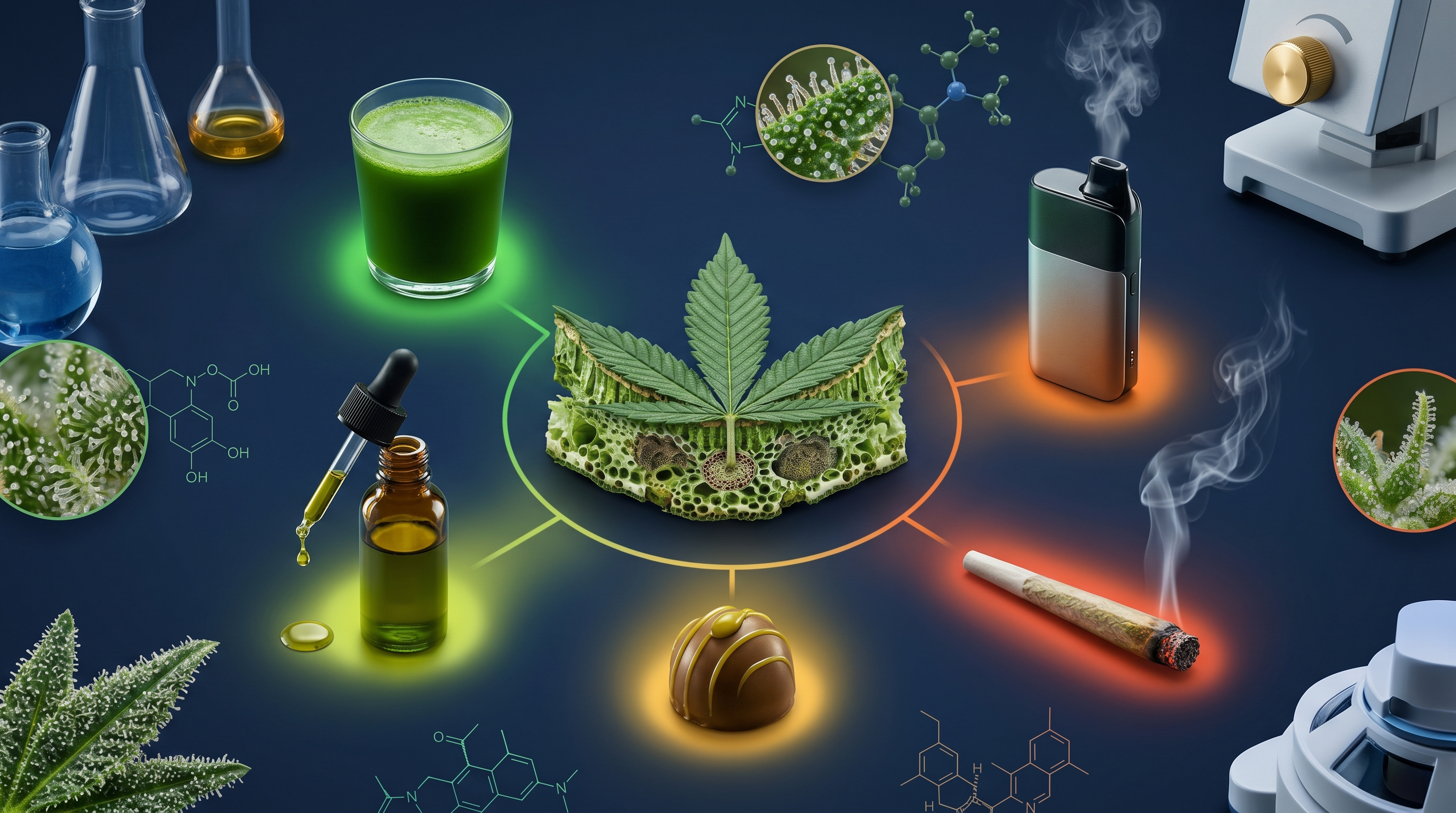
If flavonoids are part of why you reach for cannabis, route matters more than usual. In rough order of preservation:
- Fresh raw cannabis (juicing, salads) — highest theoretical preservation. No heat, full polyphenol load. Mostly limited to home growers.
- Cold-process tinctures (alcohol or glycerin) — preserve a substantial flavonoid fraction. Ethanol is a good solvent for prenylated flavones.
- Low-temperature edibles — long, gentle-heat extractions retain more than vaporization.
- Vaporization (175–215 °C) — preserves cannabinoids and terpenes; degrades a meaningful fraction of flavonoids at the higher end.
- Combustion (smoking) — worst for flavonoid preservation. The cherry destroys the bulk of the cannflavin pool.
This reframes the older “raw cannabis” advocacy — the Courtney protocol and similar — into something with clearer molecular logic. Track full-spectrum vs. isolate, and route vs. route, in the High IQ app once and the pattern in your own response gets visible.
Strain-Level Notes
Cannflavin content varies by chemovar more than most consumers appreciate, but the data remain incomplete. Two practical observations:
- High-CBD chemotypes like ACDC tend to have richer flavonoid profiles than THC-dominant lines, partly because metabolic flux into prenylation is not all locked up making cannabinoids.
- Indica-leaning, myrcene-rich chemotypes like Granddaddy Purple and Northern Lights often pair their terpene profile with a respectable flavonoid load, though quantitative data are sparse.
If you are choosing for the Relief or Balance High Family — the families most associated with chronic-inflammation use — the flavonoid argument is one more reason to favor whole-plant tinctures over isolate or smoked flower.
What This Means for Consumers
A few honest takeaways:
- Cannabis flavonoids are real, bioactive, and underexplored. Cannflavin A and B have a selectivity profile (mPGES-1 and 5-LOX over COX-1/COX-2) that drug developers find attractive.
- The “30× aspirin” line is technically correct but contextually limited. It is a 1985 cell-culture assay, mass basis, against a weak NSAID. It does not mean a joint hits like ibuprofen.
- The dose from flower is modest. Flavonoids are 0.1–1% of dry weight; cannflavins a fraction of that; combustion destroys a share; oral bioavailability is low.
- A flavonoid does not prove the entourage effect. Cannflavins hit a different enzyme in a dish. Whether that changes a joint is still debated.
- Route matters. Fresh, cold-process, and gentle-heat methods preserve substantially more flavonoid mass than smoking.
- The pharmaceutical pipeline is the watch-list. If a synthetic cannflavin analog reaches Phase 2 in arthritis or IBD, that is when this category gets its serious answer.
Cannabis has a third bioactive dimension. Small, fragile, and genuinely interesting. The chemistry is solid, the preclinical pharmacology promising, the practical contribution per dose real but modest — exactly the kind of underexplored territory that makes cannabis pharmacology worth following over the next decade.
For the broader picture — cannabinoids, terpenes that hit adenosine receptors, terpene synergy, and now flavonoids — start with our complete inflammation molecular science deep dive.
FAQ
What are cannabis flavonoids?
They are a third family of compounds in the plant, next to cannabinoids and terpenes. The cannabis-specific ones are cannflavins, including cannflavin A, B, and C. They were described in the 1980s and mostly ignored for decades.
Is cannflavin A stronger than aspirin?
In one lab system, human rheumatoid synovial cells, cannflavin A inhibited an inflammatory mediator about thirty times more potently than aspirin. That is a cell result, not a dose you get from a joint. This article is explicit that real-world flower doses are more modest than that headline.
Will smoking flower give me a flavonoid effect?
Probably not a meaningful one. Heat and the tiny amount in a typical puff are the practical limit this guide keeps repeating. Routes that do not burn the flower are the ones more likely to leave flavonoids intact, and even then the dose is small.
Why have I never heard of cannflavins?
Most consumer talk ends at THC, CBD, and terpenes. Cannflavins were a quiet pharmacology story until the 2019 to 2025 papers this article reviews. They are interesting chemistry, and they are not a reason to treat flower as an anti-inflammatory drug.
Sources
- Barrett, Gordon, & Evans (1985). Isolation from Cannabis sativa L. of cannflavin — a novel inhibitor of prostaglandin production. Biochem Pharmacol 34(11), 2019–2024. doi:10.1016/0006-2952(85)90325-9
- Barrett, Scutt, & Evans (1986). Cannflavin A and B, prenylated flavones from Cannabis sativa L. Experientia 42(4), 452–453. doi:10.1007/BF02118655
- Werz et al. (2014). Cannflavins from hemp sprouts target mPGES-1 and 5-LOX. PharmaNutrition 2(3), 53–60. doi:10.1016/j.phanu.2014.05.001
- Rea et al. (2019). Biosynthesis of cannflavins A and B from Cannabis sativa L. Phytochemistry 164, 162–171. doi:10.1016/j.phytochem.2019.05.009
- Bautista, Yu, & Tian (2021). Flavonoids in Cannabis sativa: Biosynthesis, bioactivities, and biotechnology. ACS Omega 6(8), 5119–5123. doi:10.1021/acsomega.1c00318
- Erridge et al. (2020). Cannflavins — From plant to patient: A scoping review. Fitoterapia 146, 104712. doi:10.1016/j.fitote.2020.104712
- Wanas et al. (2025). In silico investigation of cannflavins as anti-SARS-CoV-2 agents. Natural Product Research 39(5), 1081–1094. doi:10.1080/14786419.2023.2294111
- Ceresa et al. (2025). Targeting the antioxidant, antimicrobial and anti-inflammatory activity of non-psychotropic Cannabis sativa L.: a comparison with chemotype V. Journal of Cannabis Research 7(1). doi:10.1186/s42238-025-00336-1
- Chuanphongpanich et al. (2023). “Computational Assessment of Cannflavin A as a TAK1 Inhibitor: Implication as a Potential Therapeutic Target for Anti-Inflammation.” Scientia Pharmaceutica 91(3), 36. doi:10.3390/scipharm91030036


