

Can You Safely Can Cannabis Jam? A Sealed Jar Is Not Proof
Cannabis-infused jam does not inherit a tested canning process by default. Learn what a jar seal proves and why an added extract needs its own review.

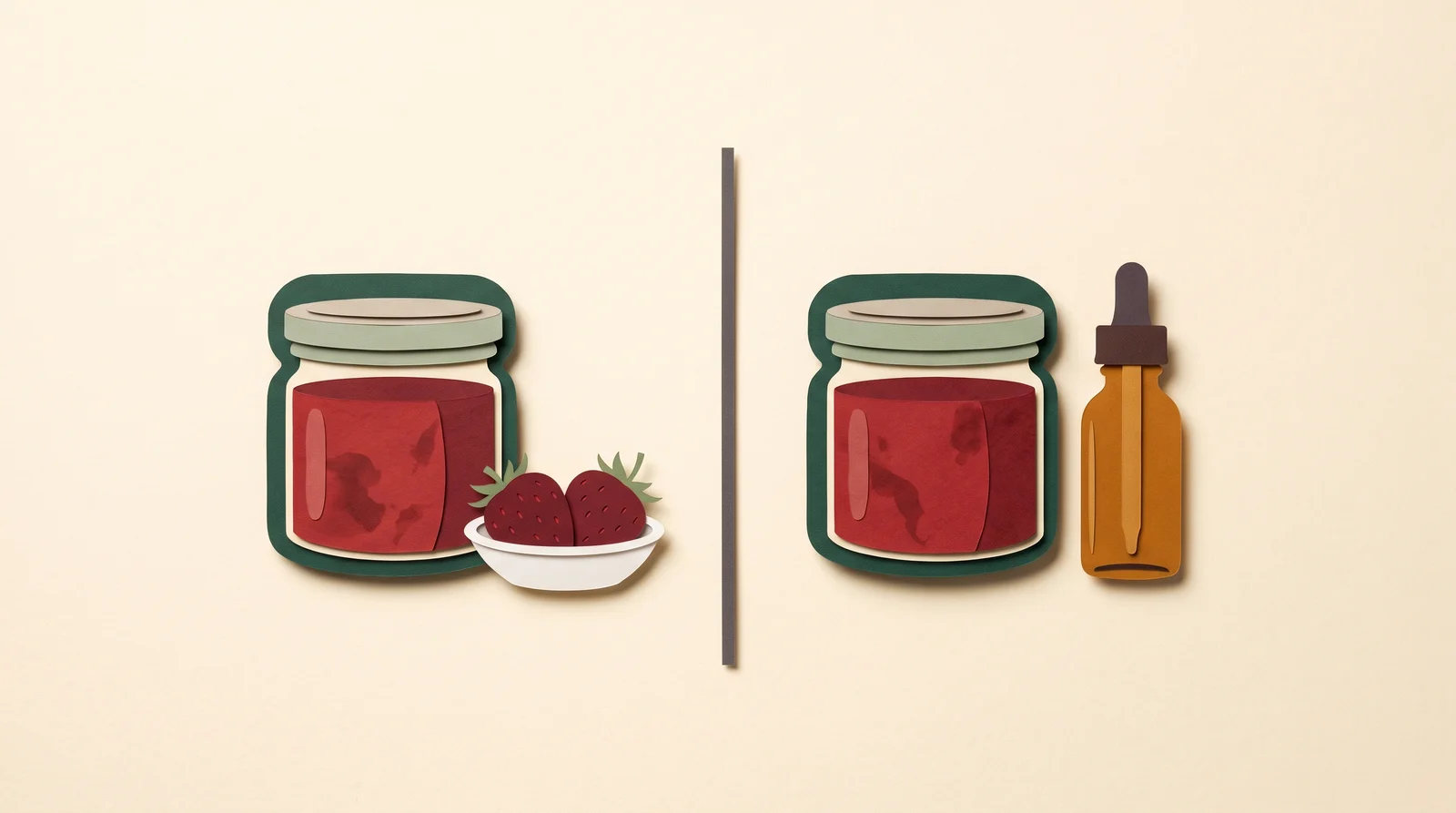
A sealed jar does not prove that cannabis jam is safe for the pantry. Adding an extract does not mean a tested jam recipe’s process still applies. Home-canning guidance covers a stated recipe and method. It permits some small changes. That is not blanket approval for cannabis oil, tincture, or infused honey. NCHFP, 2025
Here in High School, we separate two questions. Can you make a fruit spread? Can you prove that it can sit on a shelf? A lid, a gel, and a cannabis dose each answer a different question.
What does a tested jam recipe actually cover?
It covers more than a list of ingredients.
Safe canning depends on acidity and the heat process. Food thickness, the size of food pieces, and the jar can affect how heat reaches the food. A swap can change more than flavor. These are key points in the North Central Food Safety Extension Network’s guide to recipe changes. Blakeslee et al., 2024
For jam made with added pectin, NCHFP tells home cooks to use the stated ingredients and process. Its guidance accounts for jar size and elevation. It even allows a small amount of butter or margarine to reduce foam in that setting. That does not mean any amount of infused oil can take its place. NCHFP’s added-pectin guidance
The question to ask is: Does the reliable recipe or guidance account for this exact change? “It still looks like jam” cannot answer that.
Can I add cannabis oil, tincture, or infused honey?
Do not assume the original pantry process still applies.
NCHFP’s 2025 notice warns about untested low-acid additions. They can make a jam’s final acidity hard to predict. The notice also permits small flavor additions to tested fruit recipes. Its examples include basil and vanilla. Both points matter. The guidance is not a ban on every change. It is not a rule for adding any extract, either. NCHFP’s low-acid additions notice
The examples do not show that your cannabis mixture fits the exception. Nor do they measure what your oil or tincture does to the finished jam. You need evidence about that recipe. The word “herb” cannot settle it.
Our tincture guide and infusion-carrier lesson discuss different mixtures. Those product lessons do not prove that you can add them to a pantry preserve.
The Extension guide also sets terms for using honey in jam. Plain honey and a homemade infused mixture are not always the same swap. Ask your local Cooperative Extension food-preservation service if tested guidance covers the change. Do not assume it can approve any custom recipe. Extension’s substitution guidance
Why isn’t a popped lid enough?
A seal is one part of canning. It does not record everything that happened inside the jar.
NCHFP says to process home jams and jellies. Do not rely only on hot filling or turning jars upside down. Processing helps control mold spoilage and form a good vacuum. Commercial hot-fill systems may use other controlled methods. That does not prove a home shortcut is safe. NCHFP, 2018
| What you have | What it establishes | What remains unanswered |
|---|---|---|
| A tested recipe, followed with its specified process | A basis for that recipe’s preservation guidance | Whether a separate cannabis addition is covered |
| A recipe changed with an extract | A different mixture | Whether the original process still applies |
| A closed jar with a sealed lid | The jar has sealed | Whether its recipe and processing were suitable |
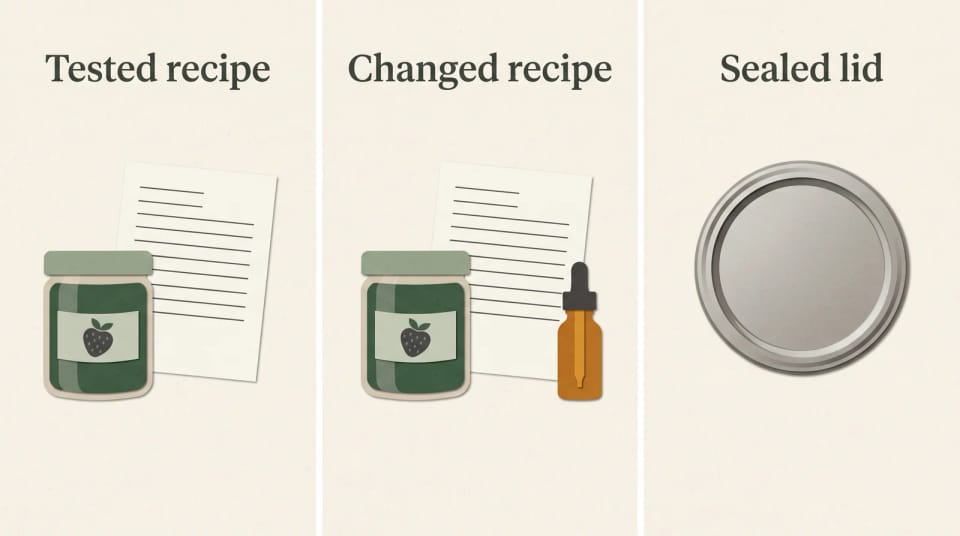
A tested recipe, a changed recipe, and a sealed lid supply different information. An added extract or a good seal does not fill a gap in process validation.
Can extra lemon juice or a pH reading settle it?
Neither supplies a complete custom canning process.
Acidity matters. So do the way heat reaches the food and the way you prepare it. A pH result alone cannot tell you that the food got the required treatment. Adding acid by guesswork is not the same as following a tested recipe. Extension’s guidance on acidity and heat
Likewise, “I’ll boil it longer” or “I’ll use a pressure canner” does not prove an unknown recipe is safe. This article gives no custom process time or acid adjustment for cannabis jam.
Does refrigeration make an unvalidated batch safe?
Refrigeration is not a promise of long-term safety, and it does not erase an unsafe storage history.
NCHFP’s advice for a failed seal has a key condition. The first attempt must have followed a current tested recipe. That is different from trying to rescue an untested recipe after it has sat on a shelf. Its FAQ says sealed and unsealed jars from an untested first attempt may be unsafe. It says to discard them. NCHFP’s general canning FAQ
A fresh spread kept in the fridge needs storage guidance for its actual recipe. The sources here do not give every oil-infused or tincture-infused jam a set fridge life. Keep pantry claims within the recipe and process that support them.
For a questionable shelf-stored jar, do not taste it to decide. CDC warns that you cannot see, smell, or taste botulinum toxin. A normal-looking lid or pleasant smell cannot clear that concern. CDC, 2024
What about THC strength and commercial cannabis jam?
Food preservation does not measure cannabinoids.
Our decarboxylation lesson explains how heat activates cannabinoids. That is a different question from a tested canning process. A jam that gels or seals has not shown how much THC remains after heating. Nor has it shown a measured amount in every spoonful.
Cannabinoid lab measurements and edible label accuracy answer chemical-content questions. They do not validate preservation. The sources here do not tell us how much THC moves into the jam. They give no measured dose per spoon or promise of potency for months.
Commercial rules do not bridge that gap. For example, Washington’s licensed cannabis processors need recipe approval. WAC 314-55-077 also restricts foods made shelf-stable by canning or retorting. It requires standardized recipes for scratch-made cannabis jams and jellies. Read those rules together. They are not permission to improvise a home water-bath recipe. This is a Washington commercial example, not a nationwide home-canning rule. WAC 314-55-077, especially (6), (10), and (11)
Any cannabis food also needs protection against accidental eating. FDA warns that THC edibles can be mistaken for ordinary food. It says to keep them out of children’s reach. Clearly identify an infused spread. Store it securely, apart from ordinary jam. A label helps prevent confusion. It does not prove food safety or potency. FDA, 2022
FAQ
Does this mean every small flavor addition is unsafe?
No. Canning experts allow some small additions to tested recipes. Their examples do not cover every cannabis mixture. Check the recipe and its guidance on changes.
Can I copy the canning time from an ordinary strawberry jam?
Not as proof for a changed mixture. The time belongs with the recipe, method, jar, and other stated conditions. An extract addition needs support that covers the change.
Does a refrigerated cannabis jam recipe prove pantry shelf life?
No. Steps that say to cool the jam and keep it in the fridge do not supply a tested pantry process. They also do not prove that other recipes can stay in the fridge without a time limit.
If my jam still feels potent, is it safe to eat?
Potency cannot establish food safety. Never taste a questionable canned food to test it. If you do not know whether safe canning guidance was followed, CDC advises discarding it. CDC
Key takeaways
- A seal does not validate an altered recipe.
- Limited flavor exceptions do not automatically cover cannabis extracts.
- Acidity, processing, THC content, and amount per spoon are separate questions.
- Refrigeration is not a universal rescue or a long-term shelf-life guarantee.
- Use preservation guidance that covers the actual recipe; do not invent a cannabis canning process.
Sources
- National Center for Home Food Preservation. August 2025. Low-acid additions can make your jams and jellies unsafe—Here’s why.
- Blakeslee, K., Garden-Robinson, J., Ingham, B., & Geiger, M. Revised March 2024. Play it Safe! Safe Changes and Substitutions to Tested Canning Recipes. North Central Food Safety Extension Network, FN2102. PDF.
- National Center for Home Food Preservation. General Canning FAQs.
- National Center for Home Food Preservation. May 2, 2018. Why do you recommend processing jams and jellies?.
- National Center for Home Food Preservation. Adapted from USDA guidance revised 2015. Making Jams and Jellies with added Pectin.
- Washington State Legislature. WAC 314-55-077: Cannabis processor license—Privileges, requirements, and fees. Current text accessed October 11, 2026.
- Centers for Disease Control and Prevention. April 25, 2024. Home-Canned Foods.
- U.S. Food and Drug Administration. June 16, 2022. FDA Warns Consumers About the Accidental Ingestion by Children of Food Products Containing THC.


