How to Decarb Cannabis Perfectly Every Time
Decarboxylation turns THCA into THC so your edibles actually work. The exact temps, times, and methods to activate cannabis perfectly every time.

If you have ever eaten a homemade edible and felt absolutely nothing, I want to reassure you: you probably did not have a low tolerance, and your weed was probably not weak. What most likely happened is that you skipped — or botched — a single quiet chemistry step called decarboxylation. Get it right, and a modest amount of flower can turn into a genuinely effective batch of cannabutter. Get it wrong, and you can grind up an ounce of premium bud and still end up with grassy-tasting brownies that do nothing.
This is the step that separates “I made edibles” from “I made edibles that work.” Let me walk you through exactly what is happening at the molecular level, the temperature and time numbers that the research actually supports, and the methods I trust to hit the target every single time.
What Decarboxylation Actually Is
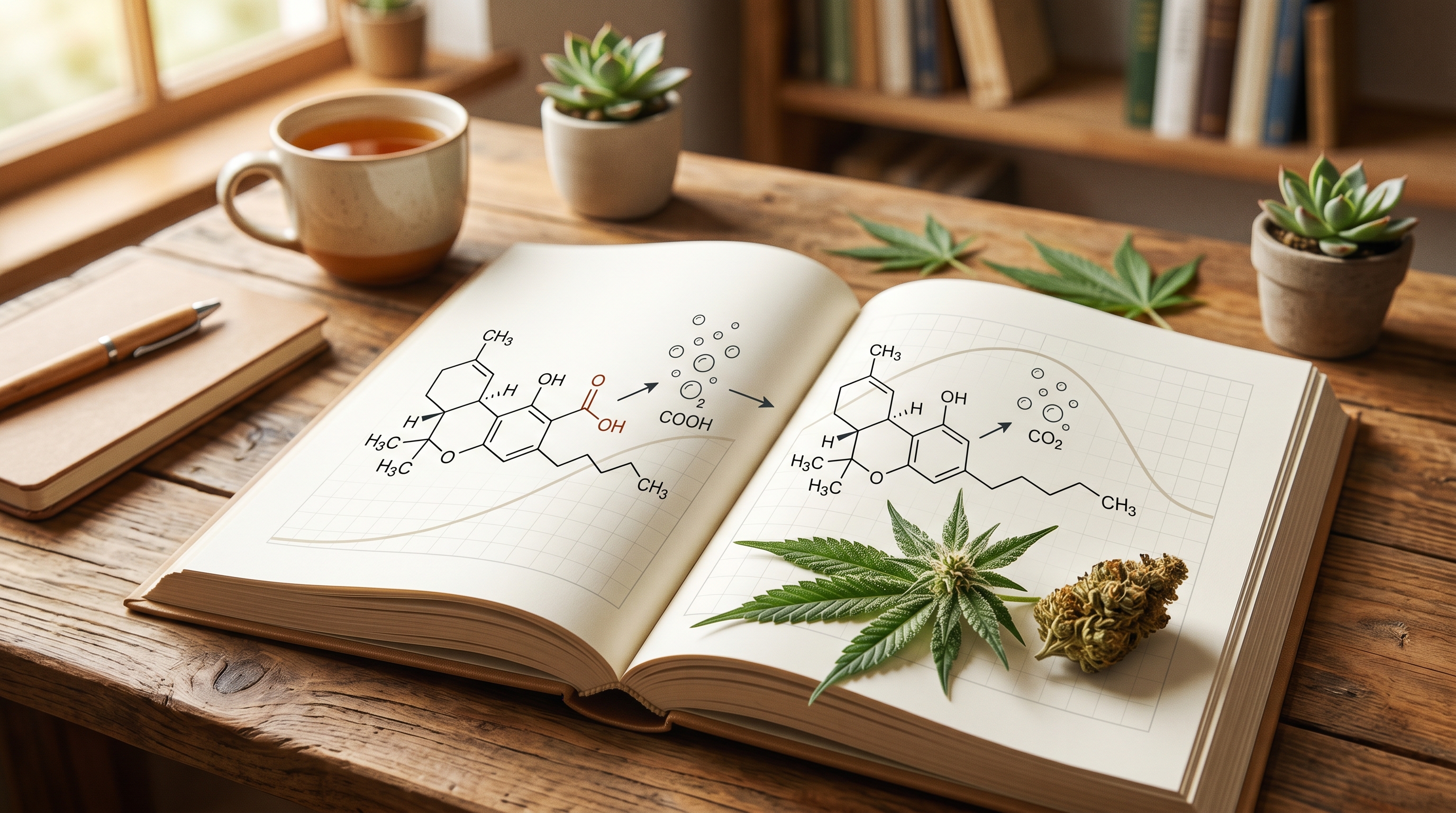
Raw cannabis does not contain much THC. It contains THCA — tetrahydrocannabinolic acid — the acidic precursor that the living plant produces. That little “A” at the end matters enormously. THCA carries an extra carboxyl group (a -COOH cluster of carbon, oxygen, and hydrogen) hanging off the molecule, and that group physically gets in the way of THCA binding cleanly to your CB1 receptors. In its raw form, THCA is generally considered non-intoxicating: you can eat raw flower and you are very unlikely to feel “high.”
Decarboxylation is the reaction that changes this. When you apply heat, that carboxyl group breaks off and leaves as carbon dioxide (you may even see tiny bubbles in an oil infusion). What remains is THC — the shape your endocannabinoid system recognizes. The same reaction converts CBDA into CBD, and other acidic cannabinoids into their active forms. No new magic compound is created; you are simply unlocking what was already there.
When you smoke or vaporize, this happens instantly — the flame or the hot air decarbs the flower in the moment you inhale. That is why a joint works without any prep. Edibles, tinctures, and topicals have no such heat at the moment of use, so you have to do the decarb deliberately and in advance. Skip it, and you are dosing yourself with mostly THCA, which is why so many first edibles flop. If you want the bigger picture on how ingested cannabis behaves once it is active, my guide to why edibles hit harder and the science of 11-OH-THC is a good companion read.
The Chemistry: First-Order Kinetics, in Plain English
You do not need a chemistry degree, but two ideas explain almost everything about decarbing.
It follows first-order kinetics. Researchers who have modeled cannabis decarboxylation describe it as a first-order reaction, meaning the conversion rate depends on how much THCA is still left and on temperature. Practically, that produces a curve: conversion is fast at first, then slows as the remaining THCA gets used up. A comparative kinetic study published in Industrial & Engineering Chemistry Research [Wang, 2021] put the activation energy for THCA decarboxylation in the neighborhood of 85 kJ/mol, and reported that the reaction rate roughly doubles for every 10°C increase in temperature. That is why small temperature changes have big effects.
Heat is a double-edged sword. The same energy that converts THCA into THC will, if you keep pushing, degrade THC further into CBN (cannabinol), a more sedating and far less intoxicating cannabinoid. Reports generally place meaningful THC-to-CBN degradation at sustained higher temperatures — roughly above 150°C (302°F) — where conversion happens in minutes but losses climb fast. There is a real “sweet spot” between under-activating and over-cooking, and that is the whole game. If the sleepy side of CBN intrigues you, I dig into it in CBN, the sleepy cannabinoid: facts vs fiction.
The Time and Temperature Table
Here is where most guides give one magic number and call it a day. The honest answer is that several temperature-and-time pairs work, and the right one depends on whether you care more about maximum potency or maximum flavor. These figures are drawn from kinetic studies and method comparisons; treat them as well-supported starting points, not laboratory guarantees, since home ovens run hot or cold.
| Method | Temperature | Time | Best For |
|---|---|---|---|
| Oven (standard) | 240°F / 115°C | 30–45 min | Reliable all-rounder, high THC retention |
| Oven (low & slow) | 220°F / 104°C | 60+ min | Better terpene preservation |
| Sous vide (water bath) | 203°F / 95°C | 90 min | Maximum terpene/flavor preservation |
| Mason jar (water bath) | ~212°F / 100°C | 60–90 min | Contained aroma, gentle heat ceiling |
| CBD-rich flower | 245–290°F / 118–143°C | 45–90 min | CBDA needs a bit more heat/time |
A few research-backed notes on this table. Oven decarboxylation at around 115°C (239°F) has been reported to retain close to 95% of THC content [Moreno, 2017] — which is why 240°F for 30–45 minutes is the workhorse standard. Lower-temperature, longer methods like sous vide trade a little speed for noticeably better terpene retention, because the volatile aromatic compounds that give each strain its character start evaporating well before the flower scorches. And uncontrolled, too-hot stovetop heating has been associated with THC losses exceeding 30%, which is exactly the failure mode you are trying to avoid.
Why Grinding and Spreading Matter
Before any heat touches your flower, two prep steps quietly decide how even your decarb will be.
Grind, but not to powder. A coarse-to-medium grind increases surface area so heat penetrates evenly, but flour-fine dust scorches and can burn off terpenes and even some cannabinoids at the edges. A consistent grind also means a consistent decarb, which downstream means a consistent dose. A good cannabis grinder earns its keep here more than people expect.
Spread it thin. Pile flower in a mound and the outside over-decarbs into CBN while the center barely converts. Spread it in a thin, even layer on parchment so every fragment sees roughly the same heat. If you are using an oven, a gentle stir at the halfway mark evens things out further.
These two habits are the difference between a batch where every gummy hits the same and a batch where one cookie does nothing and the next one flattens you. Evenness is the unsung hero of edible potency testing at home.
Step-by-Step: The Reliable Oven Method
This is the method I recommend for most people. It needs no special gear and lands consistently in the sweet spot.
- Preheat your oven to 240°F (115°C). Use an inexpensive oven thermometer — built-in dials are notoriously inaccurate, and a 25°F overshoot is the single most common reason home decarbs go wrong.
- Grind your flower to a coarse, even consistency (rice-grain-sized, not powder).
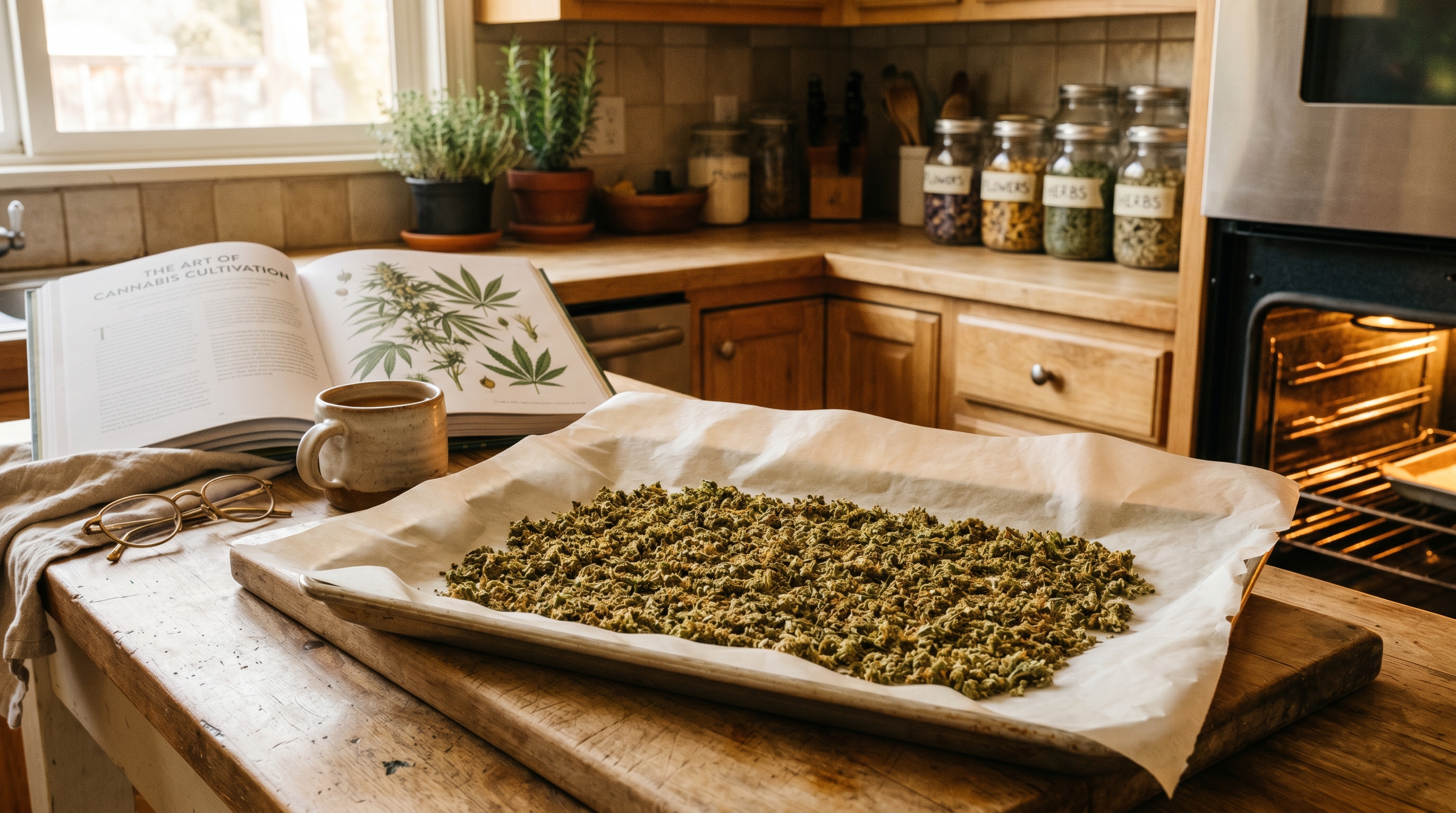
- Spread it in a thin, even layer on a parchment-lined baking sheet. Avoid clumps.
- Bake for 30–45 minutes. Around the halfway point, gently stir or rotate the tray for even exposure.
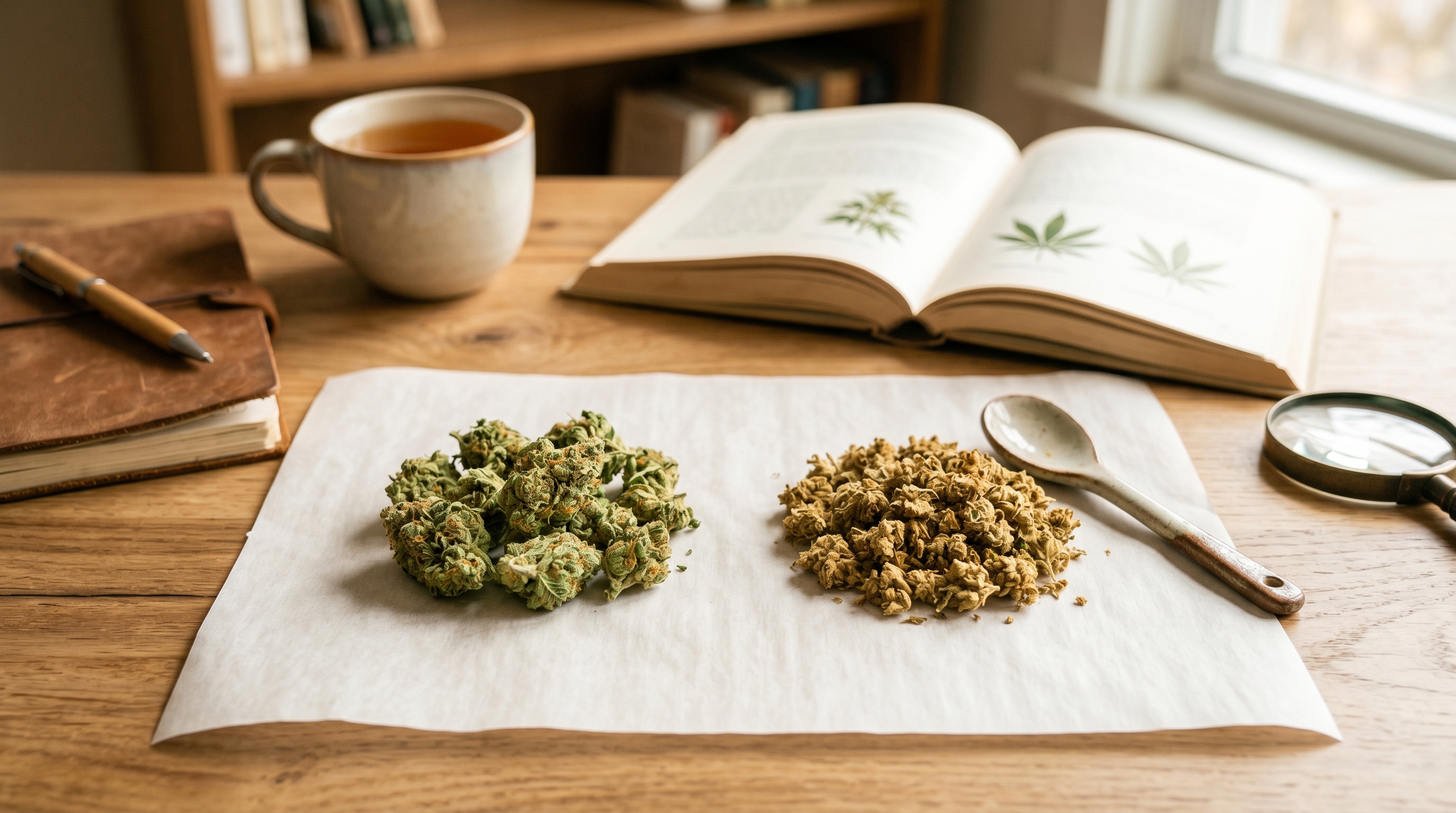
- Watch the color. Properly decarbed flower shifts from bright green to a light golden-brown. Deep brown or any smell of burning means you went too far.
- Cool completely before handling. The flower is brittle and slightly crumbly when done.
That is it. From here your activated flower is ready to infuse into cannabis butter or choose the right fat for your recipe.
The Other Methods, Briefly
Mason jar in a water bath. Seal ground flower in a jar and submerge it in gently simmering water (around 212°F / 100°C) for 60–90 minutes. Two advantages: water physically cannot exceed its boiling point at sea level, so you get a built-in temperature ceiling that makes scorching nearly impossible, and the sealed jar traps aromatic vapor that can reabsorb as it cools — better flavor, less smell in your kitchen. Add the jar to water that is warm, not already boiling, to reduce the risk of cracking.
Sous vide. If you own an immersion circulator, vacuum-seal your ground flower and hold it at about 203°F (95°C) for roughly 90 minutes. This is the gold standard for terpene and flavor preservation because the temperature is precise and never spikes. It is also the most discreet. The tradeoff is gear and a slightly longer time. This pairs beautifully with strain-forward cooking — see my notes on cannabis in fine dining.
Dedicated decarboxylators. Countertop devices automate the whole curve with one button and tend to post excellent conversion numbers. They cost money and do one job, but for high-volume or precision-minded cooks they remove the guesswork entirely.
Whichever you pick, the underlying chemistry is identical. You are just choosing how much control and flavor preservation you want.
How This Connects to Dose and Strain Choice
Decarbing is not just an on/off switch — it shapes the character of your edible. Push temperature high and long, and you will nudge more THC toward sedating CBN, which can be a feature if you are making a sleep gummy and a bug if you wanted something bright. Keep it low and slow, and you preserve more of the terpenes that steer the experience.
This is where strain selection compounds the effect. A limonene-forward strain like Super Lemon Haze or Tangie will carry brighter, mood-lifting notes into a gentle decarb, leaning into what I classify as the Uplift High. A myrcene-heavy choice such as Granddaddy Purple or Blue Cheese leans toward the Relax High and pairs naturally with a longer, sleepier decarb. If physical comfort is the goal, caryophyllene-rich GSC or Wedding Cake sit in Relieving High territory. For balanced, beginner-friendly batches, CBD-rich ACDC, Harlequin, or Cannatonic keep things in the Balancing High, and energizing classics like Durban Poison, Jack Herer, or Sour Diesel sit comfortably in the Energetic High.
The terpenes themselves explain a lot of this: myrcene tends toward relaxation, limonene toward elevated mood, caryophyllene toward physical relaxed and pain-relief effects, and linalool toward calm. Preserve them with a gentler decarb and you preserve the experience you actually wanted — whether that is feeling creative, euphoric, or simply sleepy.
Once your flower is activated, the next decision is dose, not heat. I would genuinely rather you nail decarb and then read the beginner edible dosing guide and the 2-hour rule and run the edible dosing math for home cooks than obsess over a perfect curve. Activation gets you to the starting line; dosing keeps the night enjoyable.
Common Mistakes (and Easy Fixes)
- Trusting the oven dial. Use a separate thermometer. This fixes the majority of failed batches on its own.
- Going too hot to save time. Above roughly 300°F you race past the sweet spot, burn off terpenes, and push THC toward CBN. Patience beats heat.
- Mounding the flower. Thin and even, every time. Stir at the halfway point.
- Grinding to dust. Coarse-to-medium only; powder scorches at the edges.
- Skipping it entirely. If your edibles “don’t work,” this is almost always why. THCA is not THC until you decarb.
The Professor’s Bottom Line
Decarboxylation is the least glamorous and most important step in the entire edibles process. Strip away the jargon and it is simply this: heat removes a carboxyl group, THCA becomes THC, and your edible finally has something active in it. Stay in the 240°F / 115°C for 30–45 minutes lane for reliability, drop to lower-and-slower or sous vide when flavor matters most, grind coarse, spread thin, and watch for that golden-brown color rather than the clock alone.
Do that, and you will never again wonder why your homemade batch did nothing. The chemistry is on your side — you just have to give it the right amount of heat. From here, the fun part begins: pick a strain whose terpene profile matches the mood you want, decarb it with intention, and dose it with respect.
Key Takeaways
- Decarbing converts THCA into THC (and CBDA into CBD) by removing a carboxyl group with heat. Without it, edibles are generally weak or inactive.
- 240°F / 115°C for 30–45 minutes is the reliable, research-supported standard, reportedly retaining close to 95% of THC.
- Lower and slower preserves terpenes; sous vide at ~203°F is the gold standard for flavor. Too hot (above ~150°C / 302°F sustained) pushes THC toward sedating CBN.
- Prep decides evenness: grind coarse-to-medium, spread thin, and stir at the halfway mark.
- Watch color, not just the clock — aim for light golden-brown, never deep brown or burnt.
- Activation is step one; dosing is step two. Match strain and terpene profile to the mood you want, then dose conservatively.
Sources
- Wang, M., et al. “Decarboxylation Study of Acidic Cannabinoids: A Novel Approach Using Ultra-High-Performance Supercritical Fluid Chromatography/Photodiode Array-Mass Spectrometry.” PMC. https://www.ncbi.nlm.nih.gov/pmc/articles/PMC5549281/
- “Cannabinoid Decarboxylation: A Comparative Kinetic Study.” Industrial & Engineering Chemistry Research. https://pubs.acs.org/doi/abs/10.1021/acs.iecr.0c03791
- “Optimization of the Decarboxylation of Cannabis for Commercial Applications.” Industrial & Engineering Chemistry Research. https://pubs.acs.org/doi/abs/10.1021/acs.iecr.2c00826
- Moreno, T., et al. “Can You Pass the Acid Test? Critical Review and Novel Therapeutic Perspectives of Δ9-Tetrahydrocannabinolic Acid A.” PMC. https://www.ncbi.nlm.nih.gov/pmc/articles/PMC5549534/
- “THC Decarboxylation Curve: Temperature and Time Factors.” Biology Insights. https://biologyinsights.com/thc-decarboxylation-curve-temperature-and-time-factors/
- “How to Decarboxylate Cannabis: 6 Methods Reviewed by Potency.” Ardent Cannabis. https://ardentcannabis.com/blog/how-to-decarboxylate-cannabis-6-methods-reviewed-by-potency/
- “Decarboxylation 101: How to decarb by sous vide.” Leafly. https://www.leafly.com/news/cannabis-101/decarboxylation-101-sous-vide
Educational content only. Cannabis affects everyone differently; start low, go slow, and follow the laws in your area.


