CBD Free Trial Charges: Cancel, Stop Payments, Dispute
A CBD free trial became a recurring charge? Separate cancellation, payment authorization and billing disputes, with US deadlines and records to keep.


An unexpected CBD trial charge can require three separate requests: cancel the subscription, stop future payments, and dispute the past charge. One request may not accomplish the other two. This guide covers US consumer routes checked on October 17, 2026.
The useful distinction is easy to miss: stopping a bank withdrawal does not itself cancel a contract or erase a valid debt. See the Consumer Financial Protection Bureau’s automatic-payment guidance.
Start with the order and payment records. What was in the bottle, what the seller offered and what you agreed to pay are separate questions.
What are you trying to stop or recover?
| Your goal | The request to make | What to check afterward |
|---|---|---|
| End the ongoing subscription | Tell the seller to cancel the plan and future shipments | Written confirmation and the effective cancellation date |
| Stop automatic bank-account withdrawals | Tell the company it no longer has permission to debit your account, and notify your bank | The bank’s required process and whether another debit appears |
| Challenge money already charged | Tell the card issuer or bank which charge you dispute and why | The records it needs, its deadlines and its decision |
For credit-card recurring charges, contact the issuer about stopping future payments as well as disputing the existing transaction. Do not assume the bank-account procedure below applies unchanged to every payment method. FTC subscription guidance.
Which records should you save first?
Keep the offer, checkout terms, order receipt and account statements. Save the seller’s steps for cancelling, your request and any reply. The FTC recommends keeping these records. FTC advice on unwanted subscriptions.
Make a short timeline in your own words:
- What you thought you were ordering and what the checkout actually said.
- The initial charge, each later charge and the merchant name shown beside it.
- When you requested cancellation, how you sent it and what happened next.
An ad may come from someone paid to promote the seller. Find the business behind the order before sending a request. Use your card issuer’s official app, website or the number on your card to discuss the payment. FTC free-trial advice.
Keep the CBD bottle’s label and order details together too. If “hemp oil” was sold as CBD, our hemp seed oil versus CBD oil guide explains the ingredient distinction. That is a separate question from whether you agreed to monthly billing.
How should you word the cancellation request?
Use the seller’s stated cancellation route and keep a copy. Make the scope clear. Here is editable wording, not a record of a real customer’s dispute:
Please cancel the subscription associated with order [number] and stop future shipments. Please confirm the cancellation date in writing. I also request a refund of the charge dated [date] for [amount], because [accurate reason].
The final sentence asks for a separate decision. A reply saying “subscription canceled” does not tell you whether an earlier charge will be refunded. Ask the seller to address both.
Describe what happened accurately. Did you never agree to recurring bills? Did a charge arrive after you cancelled, or appear twice? Did you agree to renew but later change your mind? Do not call a purchase fraud just because the product disappointed you. The CFPB notes that disputes over faulty goods can use a different process.
For an in-store California cannabis purchase, our returns and faulty-vape guide covers that separate retail situation. A store’s return policy does not answer an online subscription-billing dispute.
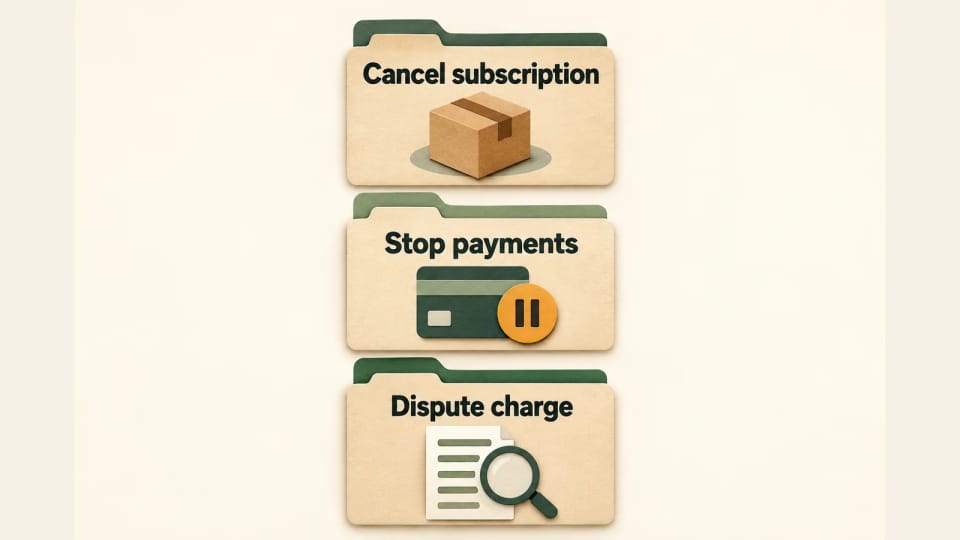
Three requests, three things to confirm. A cancellation acknowledgment is not a refund decision.
What if the charge is on a credit card?
Contact the issuer promptly. For the federal billing-error procedure, written notice must reach the disclosed billing-error address within 60 days after the issuer sends the first statement showing the alleged error. Do not let a slow seller response use up that window.
Give the account, charge date, amount and reason you believe there is an error. The issuer may accept written notices through a specific online process. Check its billing-rights statement for that option. An ordinary support chat is not automatically that process. Regulation Z, section 1026.13(b) and its interpretation.
You can dispute a charge you already paid. The issuer must still review the dispute; a refund is not automatic. Keep its replies and decision with your records. CFPB credit-card dispute guidance.
Tell the issuer exactly which amount is disputed. Continue handling unrelated balances; the billing-error protections do not turn the whole account into a payment holiday. Regulation Z, section 1026.13(d).
What if the seller debits your bank account?
Tell the company that you withdraw its permission to take automatic payments. Notify your bank or credit union too. Follow up in writing and keep copies. State separately whether you are also cancelling the plan. CFPB automatic-payment guidance.
For a scheduled preauthorized electronic transfer, Regulation E provides a stop-payment route with notice at least three business days before the transfer. The bank may require written confirmation within 14 days of an oral request. If it does, it must tell you about that requirement and where to send it. Section 1005.10(c).
Ask about fees and the exact instructions for your account. Report any debit you did not authorize, or a payment taken after revocation, promptly.
There is a separate process for an error in an electronic transfer. To use the ordinary Regulation E error process, the bank must receive your oral or written notice within 60 days after it sends the first statement showing the error. Give the account and explain the charge and problem. The bank may require written confirmation within 10 business days. It cannot wait for that writing before starting its review. Missing that requested letter can affect whether you receive temporary credit during the review. This differs from the 14-day stop-payment rule above. Section 1005.11(b)–(c).
Contact the bank even if you discover the problem later. Other rules may still limit what you owe for a transfer you did not authorize.
Do not rely on getting a replacement card as your entire cancellation plan. Ask the issuer how it will handle this merchant’s recurring payments, and verify the result on later statements.
Is the federal click-to-cancel rule in force?
A court struck down the FTC’s 2024 amended rule. The agency restored the earlier rule effective February 12, 2026. The FTC later opened another inquiry into changing the rule. That is not a new final rule. February 2026 final rule, FTC’s 2026 inquiry.
That does not remove every protection. The Restore Online Shoppers’ Confidence Act, or ROSCA, addresses online transactions with negative-option features: billing continues unless the consumer acts to stop it. Section 4 requires clear disclosure of material terms before collecting billing information, express informed consent before charging, and simple ways to stop recurring charges. Original statute, section 4.
State laws may add protections. For a specific dispute, the facts, payment method and applicable law matter more than a social-media claim that every cancellation must work in one click.
Have CBD trial charges led to actual enforcement?
Yes. In its Legion Media case, the FTC alleged that sellers used offers for “free” CBD and keto-related products to enroll people in unwanted recurring plans. The case record describes September 2024 settlements and a December 2025 refund distribution. FTC case record.
That case does not mean your seller broke the law or that you qualify for its refund program. Avoid anyone who turns an old case into a promise to recover your money for a fee.
Where should you report the problem?
For deceptive subscription practices, the FTC directs consumers to ReportFraud.ftc.gov and their state attorney general. A report helps document the conduct; keep pursuing the seller or payment provider’s process for your own charge. FTC reporting guidance.
If the problem is how a bank or card company handled your issue, you can complain to the CFPB. Include dates, amounts, messages and records that support your complaint. Filing there does not replace a timely billing-error notice to the issuer.
A product problem needs its own record. A matching cannabis lab report helps identify what was tested; measurement uncertainty explains why printed numbers need context. Neither establishes permission to bill you. For a suspected harmful reaction, use our cannabis and CBD adverse-event reporting guide; a financial complaint is not medical care or a product-safety report.
FAQ
Does paying shipping mean I agreed to a monthly CBD subscription?
The shipping payment alone does not settle what was disclosed or authorized. Check the checkout record. For online negative-option transactions, ROSCA requires material-term disclosure and express informed consent, not merely possession of your card details.
Will cancelling today automatically refund last month’s charge?
Do not assume so. Ask for cancellation and the disputed refund separately, then check the response to each. A valid renewal and an unauthorized charge may lead to different outcomes.
Should I wait for the CBD seller before calling my card issuer?
Do not let a merchant delay make you miss the issuer’s dispute deadline. Contact the issuer promptly, explain any seller discussions and follow its required notice process.
Is a lab-tested CBD product proof that the subscription is legitimate?
No. A laboratory report concerns a sample and its tests. It does not document what the checkout disclosed, whether you consented to recurring billing, or whether cancellation was handled correctly.
Key takeaways
- Identify the seller, payment method and specific disputed transactions.
- Track cancellation, future-payment permission and past-charge disputes separately.
- Preserve written records and act before the relevant payment deadline.
- Check current rules; an old click-to-cancel headline is not a complete statement of today’s law.