Hemp Seed Oil vs. CBD Oil: What the Label Really Means
Hemp seed oil and CBD oil are different products. Learn how to read ingredients, CBD milligrams, and lab reports before paying for the wrong bottle.

Professor High
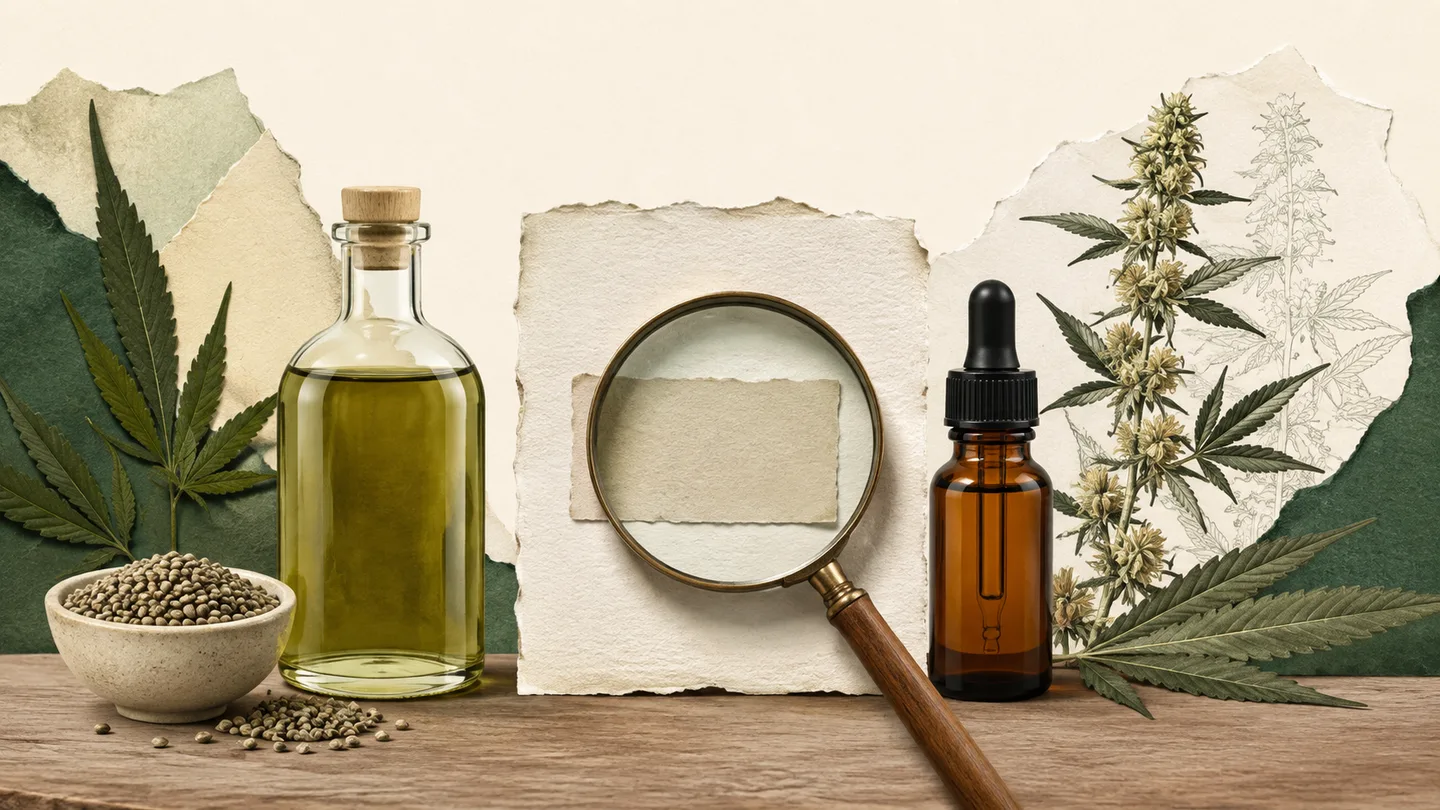
Two green bottles. Two cannabis leaves. One says hemp seed oil; the other says CBD oil. A third just says hemp oil, with an enormous milligram number on the front.
They might sit beside each other in a search result, but that does not make them interchangeable. The most useful question is surprisingly small: milligrams of what?
Hemp seed oil is an oil made from seeds. CBD oil is sold for its cannabidiol content, often mixed into another oil. A product can even contain both. The job is to identify the ingredients and the amount of CBD, rather than judge the bottle by its leaf artwork.
Here’s Professor High’s label-reading guide, including the detail that many quick comparisons miss: “not a natural source of CBD” is different from “every finished bottle contains absolutely zero cannabinoids.”
Hemp seed oil vs. CBD oil at a glance
| Label question | Plain hemp seed oil | A product sold as CBD oil |
|---|---|---|
| What is the product? | Oil obtained from hemp seeds | A formulation sold for its CBD content |
| What should I look for? | A clear seed-oil ingredient listing | An explicit CBD amount and the other ingredients |
| Does the oil amount tell me the CBD amount? | No | No, unless the number specifically refers to CBD |
| What does a leaf illustration establish? | Nothing about cannabinoid content | Nothing about cannabinoid content |
| What needs checking if CBD is the goal? | Whether CBD has actually been added or measured | Whether the batch report supports the stated amount |
This is a shopping distinction, not a ranking of which oil is “better.” A food ingredient can be exactly what someone wants. The problem starts when a shopper pays for it expecting a different ingredient.
Why the seed matters
The FDA explains that hemp seeds do not naturally contain THC or CBD. Small amounts can get onto seeds through contact with other plant parts during harvesting and processing. That distinction appears in its cannabis questions and answers.
Plant chemistry helps explain why. Cannabinoid-rich resin is associated with glandular structures on parts such as the flowering tops. Seeds can acquire resin on their surfaces. Pressing those seeds does not turn the seed itself into a CBD-producing structure.
In a laboratory study, Citti and colleagues examined 10 commercial organic hemp seed oils and found different cannabinoid profiles. The research supports a careful point: finished seed oils can contain cannabinoids, and their composition varies. It does not show that ordinary seed oil supplies a dependable CBD dose or treats a condition. This was chemical analysis, not a human treatment trial. Citti et al., 2019
For a shopper, the implication is practical. Neither a sweeping “all seed oil is CBD-free” claim nor a “seed oil contains CBD, so it works like CBD oil” claim is a sound shortcut. Read the actual product information.
The three label questions that resolve most confusion
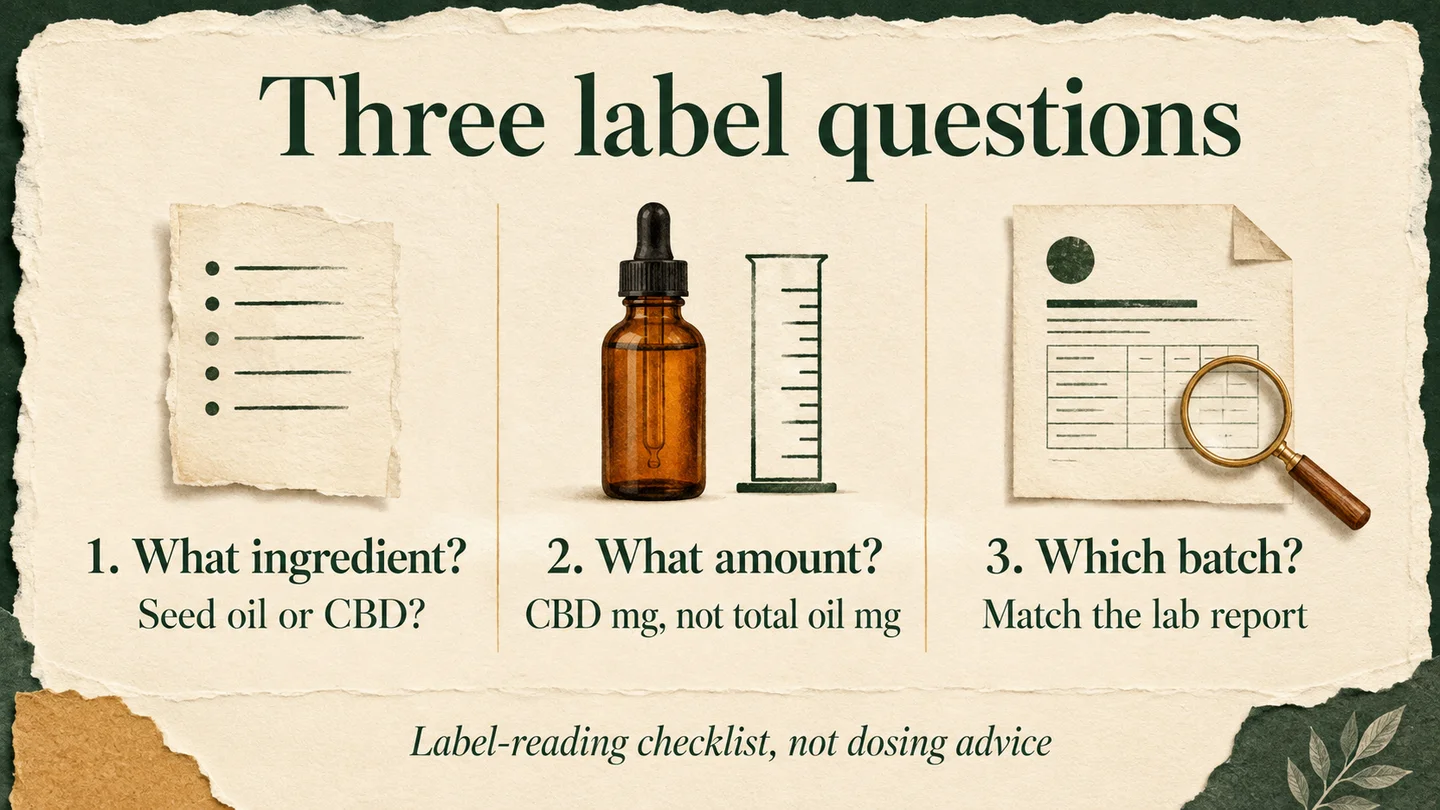
1. What ingredient am I buying?
Turn the bottle around. If the ingredients identify only hemp seed oil, that does not establish a deliberately formulated CBD product. If the label lists CBD or cannabidiol alongside a carrier oil, it is describing a different formulation.
The carrier is simply the oil that holds the added ingredient. In a hypothetical product containing hemp seed oil plus CBD, the seed oil and CBD have separate roles. Seeing seed oil in that ingredient list would not, by itself, prove that the CBD is missing.
Watch for an incomplete answer from a seller: “It’s all hemp.” That tells you the broad plant association, not the formulation. Ask a more specific question: Does this product contain added CBD, and how much CBD does the finished bottle contain?
“Extract” also needs context. A stated mass of hemp extract is not automatically the mass of CBD within it. If a company means CBD, it should be able to identify that number plainly.
2. What does the milligram number measure?
Imagine these three fictional front labels:
- 1,000 mg hemp seed oil per capsule
- 1,000 mg hemp extract per bottle
- 1,000 mg CBD per bottle
Those are three different statements. The first specifies oil mass. The second specifies extract mass without telling you its CBD fraction. The third explicitly claims a quantity of CBD.
You cannot compare them as if they were three CBD strengths. A large number can look impressive while answering the wrong question.
Now consider a clearly labeled hypothetical bottle: 600 mg CBD in 30 mL of finished oil. The stated concentration works out to 20 mg CBD per mL. That is arithmetic for interpreting a label, not a recommended serving. It also assumes the stated CBD amount is accurate, which is why the third question matters.
Keep the units attached. Milliliters describe volume; milligrams describe mass. A number per bottle is different from a number per serving. If two products use different bases, convert them to the same basis before comparing them.
Do not replace an unclear label with a guess about how much a dropper holds. Ask for the specified volume and the amount associated with it. A retailer that cannot explain its own numbers has not given you enough information to compare the product.
3. Which batch was tested?
A certificate of analysis, or COA, is a report about a tested sample. Start by matching the product name and batch identifier. A report for a different formulation or an old batch does not answer the question about the bottle in front of you.
New York’s Office of Cannabis Management includes ingredients, batch or lot numbers, and access to a COA in its consumer label checklist. That is a useful reading framework; it is not a claim that New York’s rules apply everywhere.
Open the actual report. A QR code that leads only to a home page or a generic “quality” statement has not yet shown you a result. Find the CBD measurement, the THC results, the units, the sample identity, and the testing date. If the bottle and report disagree, ask the seller to explain the mismatch before relying on the label.
For a fuller walkthrough, use our guide to reading cannabis lab results.
What a lab report can—and cannot—prove
A potency result answers a composition question within the limits of the test. It does not establish that a product helps sleep, relieves pain, or is appropriate for you.
It also matters what was tested. A CBD result alone tells you nothing about a contaminant that was never included in the analysis. Look at the actual panels rather than treating the words “lab tested” as a complete description.
Pay attention to the report’s definitions for ND, detection limits, and reporting limits. A nondetect is not a molecule-by-molecule guarantee of absolute zero. Analytical methods have practical limits; NIST’s explanation of detection limits describes that measurement principle. The report’s own method and legend determine how it applies to a particular result.
Tiny differences between printed numbers also deserve perspective. Our explanation of measurement uncertainty on cannabis reports covers why a decimal place is not a promise of perfect precision.
Keep a copy of the report with a photo of the bottle. That creates a useful record if you later need to ask about a discrepancy. Recheck when the batch changes; our guide to cannabis batch variation explains why one result need not describe every future purchase.
Are inaccurate CBD labels a real problem?
Yes, in tested samples—though no single survey can tell you the status of every product sold today.
Gidal and colleagues analyzed 202 commercial CBD products, including 100 tinctures, purchased online in late 2021. Published in 2024, the study found 74% fell outside its 90%–110% label-accuracy band. Some contained more CBD than claimed; others contained less. Gidal et al., 2024
The researchers tested one sample per product. The findings are not a random census of today’s entire market, and they are not a study of plain culinary seed oils. Jazz Pharmaceuticals funded the work and participated in its conduct; that disclosed commercial involvement belongs alongside the results.
The useful takeaway is modest: a printed claim can be wrong, so check supporting evidence. Similar questions arise with other formats, as our article on edible label accuracy explains.
The FDA seed-oil point sellers sometimes blur
In December 2018, the FDA responded to three notices covering hulled hemp seed, hemp seed protein powder, and hemp seed oil. It had no questions about the notifier’s conclusions that those ingredients were generally recognized as safe under the stated conditions of use. FDA GRAS notice update
That is a specific food-ingredient determination. It is not blanket FDA approval of CBD, every hemp-branded bottle, or a seller’s medical claims. Adding CBD does not let a product borrow the seed ingredient’s conclusion as proof that the finished formulation treats anything.
If a product page cites “FDA-recognized hemp ingredients,” ask which ingredient and which claim the citation actually supports. Matching a claim to its evidence matters just as much as matching a bottle to its lab report.
Choosing a product starts with choosing the question
If you want a food oil, evaluate a product clearly sold for that purpose, with its ingredients and directions available. There is no need to turn that purchase into a cannabinoid experiment.
If you are considering CBD for a health concern, identifying CBD is only the first step. The FDA warns about possible liver injury, interactions with medicines, and drowsiness. It recommends discussing CBD use with a healthcare provider. FDA consumer update
Bring the ingredient list and the proposed product, not just the word “hemp,” to that conversation. Our guide to CBD, THC, and prescription interactions provides background for asking informed questions.
You do not have to solve every question at the checkout page. An unclear formulation, missing batch report, or unexplained number is enough reason to pause the purchase and request better information.
FAQs
Is hemp oil the same as CBD oil?
The phrase “hemp oil” alone is ambiguous. It does not tell you whether the seller means seed oil or a cannabinoid-containing formulation. Read the ingredients and look for an explicit CBD quantity.
Can CBD oil contain hemp seed oil?
Yes. Seed oil can serve as the carrier for added CBD. The presence of the carrier does not settle whether CBD is present; the complete formulation and batch results do.
Does 10,000 mg of hemp oil mean 10,000 mg of CBD?
No. The number refers to whatever ingredient the label names. Without an explicit CBD amount, you cannot convert a total hemp-oil claim into a CBD claim.
Can the color or taste tell me whether it contains CBD?
Do not use either as your identification test. A visual impression cannot provide the measured CBD amount you need to compare labels. Ask for the ingredient information and matching report.
Does a lab-tested label mean the product works?
No. Chemical testing and evidence of a health benefit answer different questions. A report can help check composition without establishing that the product will achieve an advertised result.
Before you buy
Save three pieces of information: the ingredient list, the explicit CBD amount, and the matching batch report. If the seller cannot provide them, a leaf logo and a large number cannot fill the gap.
That habit makes the choice clearer whether you want a food ingredient, are comparing cannabinoid products, or are helping a friend figure out what they already bought.
Sources
- U.S. Food and Drug Administration. FDA Regulation of Cannabis and Cannabis-Derived Products, Including Cannabidiol (CBD). Seed composition and processing discussion; accessed September 6, 2026.
- Citti, C., et al. (2019). Cannabinoid Profiling of Hemp Seed Oil by Liquid Chromatography Coupled to High-Resolution Mass Spectrometry. Frontiers in Plant Science, 10, 120. DOI.
- Gidal, B. E., et al. (2024). Product labeling accuracy and contamination analysis of commercially available cannabidiol product samples. Frontiers in Pharmacology, 15, 1335441. DOI.
- New York State Office of Cannabis Management. Cannabinoid Hemp Consumers. Consumer label checklist; accessed September 6, 2026.
- National Institute of Standards and Technology. Limits of Detection. General analytical measurement explanation, not a CBD product certification.
- U.S. Food and Drug Administration. FDA Responds to Three GRAS Notices for Hemp Seed-Derived Ingredients for Use in Human Food. December 20, 2018.
- U.S. Food and Drug Administration. What You Need to Know About Products Containing Cannabis or Cannabis-derived Compounds, Including CBD. Consumer safety information; accessed September 6, 2026.
