CBD Liver Trials: What Dose and Blood Tests Can Tell Us
Two CBD liver trials used different doses, controls and blood tests. Their results show why a small study with no enzyme change cannot set a safe dose.

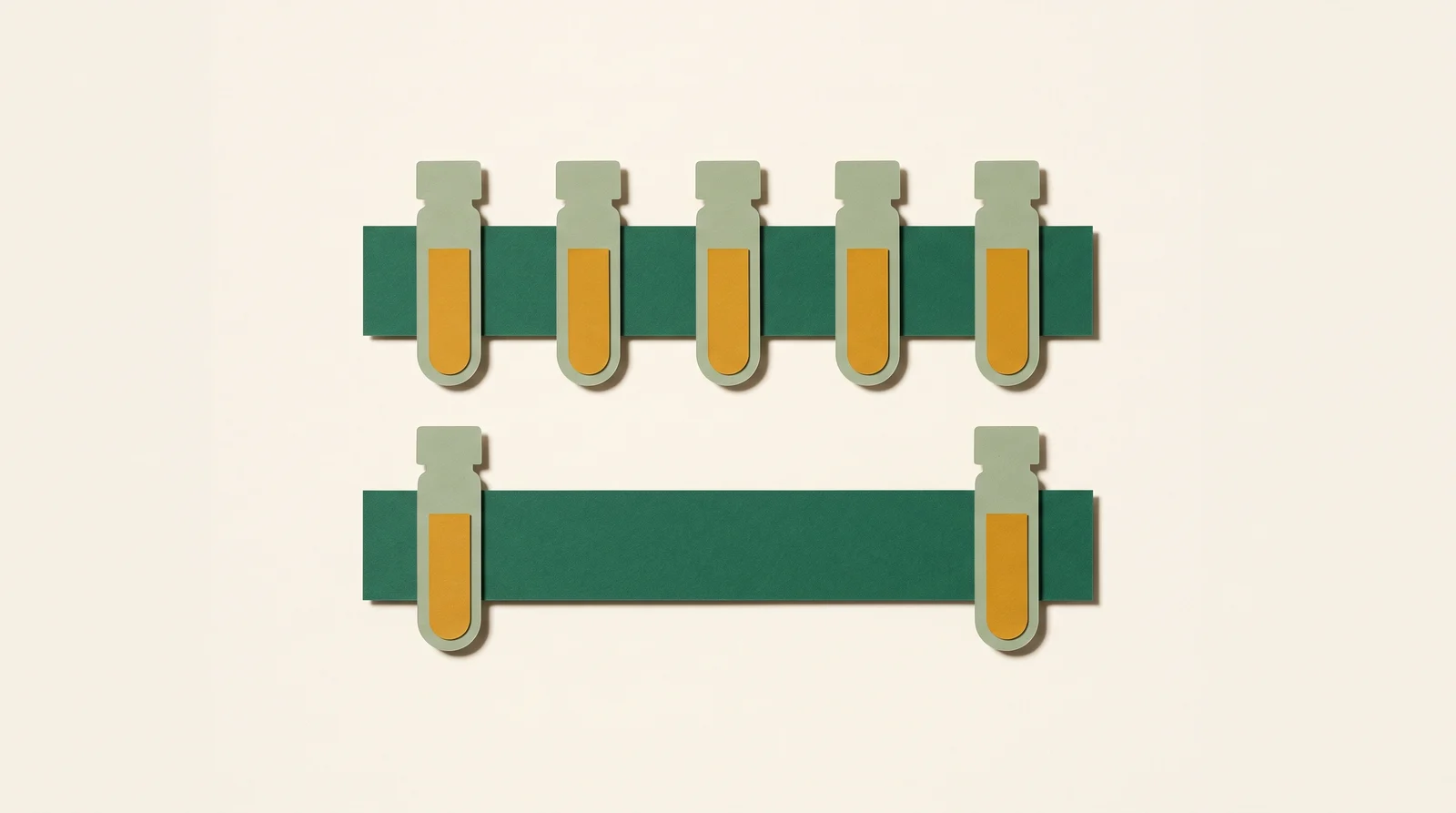
The two CBD liver trials used different doses, controls and blood tests, so their results cannot identify a safe daily dose. The 2025 trial found liver-enzyme elevations. A smaller 2026 pilot found no significant enzyme change. The useful comparison is between the experiments themselves.
Both included four weeks of daily CBD. But the later paper’s placebo-controlled sessions happened before its daily-use phase. During those four weeks, everyone received CBD. That distinction changes what its liver results can tell us.
What did the 2025 CBD liver trial find?
Florian and colleagues’ randomized trial assigned 151 healthy adults to CBD and 50 to placebo. Of the 201 randomized participants, 188 completed the trial.
They swallowed a pharmaceutical CBD solution at 5 milligrams per kilogram of body weight per day, divided into two doses, for 28 days. These are study conditions, not serving instructions. Participants were ages 18–55 and screened to exclude abnormal liver tests and other risks.
The researchers checked blood chemistry repeatedly, including weekly visits during treatment and a follow-up on day 35. Their main liver endpoint was whether ALT or AST, two enzymes measured in blood, rose above three times the upper limit of normal.
Eight CBD recipients crossed that threshold. Nobody in the placebo group did. The paper reports a 5.6% estimate using Kaplan–Meier analysis, which accounts for observation over time. That is not eight out of 201 CBD users: only 151 were assigned CBD. It is also not a lifetime risk estimate for everyone who buys CBD.
Seven participants met the protocol’s withdrawal criteria for potential drug-induced liver injury. Those criteria are a reason to stop study treatment and investigate. The authors explicitly distinguish them from clinically apparent liver injury.
No serious or life-threatening adverse events occurred. The report describes one case of temporary abdominal discomfort, and enzyme levels returned to baseline within one to two weeks after CBD was discontinued. The findings establish a liver-enzyme signal under this protocol. They do not establish permanent liver failure, or what would have happened if treatment had continued.
What did the 2026 pilot measure?
Wolinsky and colleagues’ Phase I study enrolled 29 adults; 19 completed both phases and were included in the analysis. Participants were medically healthy adults ages 21–65 who drank alcohol. Important exclusions included significant liver disease and medications that could harm the liver or interact substantially with CBD.
The experiment had two parts:
- Acute laboratory sessions. Each person received placebo, 50 mg CBD or 100 mg CBD in three randomly ordered, blinded sessions alongside a controlled alcohol dose. Metabolic blood tests were collected before dosing and four hours afterward.
- Four weeks at home. Everyone received CBD-isolate softgels totaling 100 mg per day. Participants reported their own alcohol use and adverse effects in a daily app diary. There was no parallel placebo group during this phase.
For the longer-term laboratory comparison, the researchers compared screening blood tests with tests at the end of the study. They found no significant change in liver enzymes. Small decreases in total protein and globulin were the significant laboratory changes reported.
There were no acute adverse events. Two transient events, sleepiness and headache, were reported during the daily-use phase and resolved by the next day’s report. That describes what happened in this small selected sample. It cannot establish that all people using that amount will remain free of liver problems.
Why aren’t these two results a safe-dose chart?
The dose differed, but so did several other features. A comparison across separate studies cannot isolate which feature explains their results.
| Daily-use feature | Florian trial, published 2025 | Wolinsky pilot, published 2026 |
|---|---|---|
| Participants | 201 randomized; 151 CBD, 50 placebo; 188 completed | 29 enrolled; 19 completed and analyzed |
| Swallowed preparation | Pharmaceutical CBD oral solution | CBD-isolate softgels in MCT oil |
| Daily exposure | 5 mg/kg/day for 28 days | 100 mg/day for four weeks |
| Daily-use control | Parallel placebo group | Everyone received CBD; no chronic placebo |
| Liver monitoring | Repeated tests, including weekly treatment visits and day-35 follow-up | Screening-to-end comparison; separate acute-session tests |
| Liver result | Eight CBD recipients crossed the enzyme threshold; seven met potential-injury withdrawal criteria | No significant enzyme change in the screening-to-end comparison |
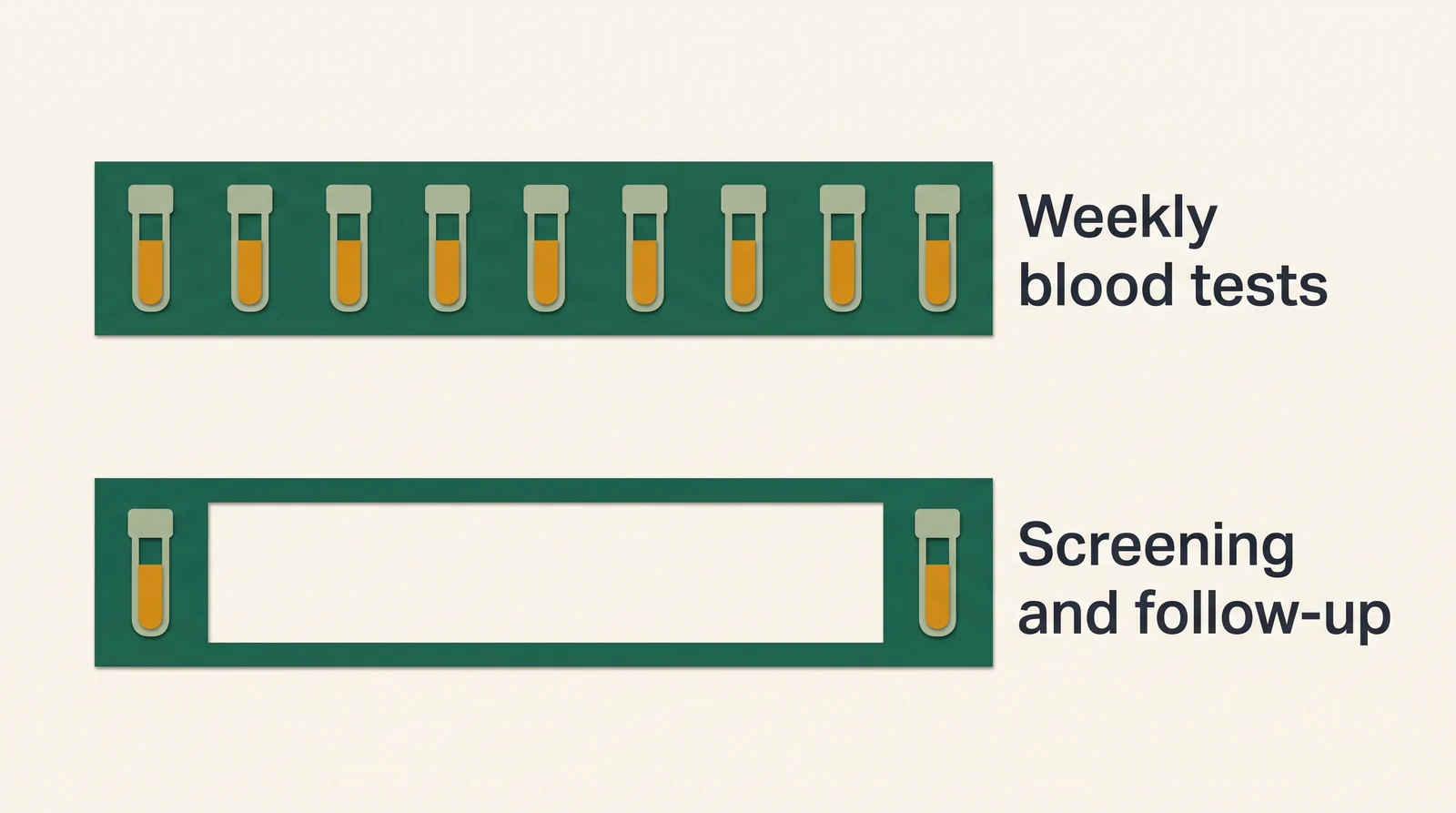
Schematic frequency markers, not exact visit counts. The pilot also collected acute-session blood samples; these strips show the longer-term comparison.
A weight-based dose and a fixed daily amount are different ways to define exposure. The preparations differ too. Our CBD spectrum and isolate guide explains those ingredient categories; it does not make different products interchangeable with a trial preparation. Hemp seed oil and CBD oil labels can describe different ingredients altogether.
The 2025 trial counted people who crossed a specified enzyme threshold. The pilot tested changes between screening and follow-up. A group comparison with no significant change does not prove that nobody had a change between those visits. It also does not establish equivalence to placebo when the daily-use phase had no placebo group.
The pilot was smaller than planned. Recruitment stopped after its sponsor’s research-and-development division closed. With only 19 completers, it offers limited information about uncommon events. Four weeks also leaves longer-term use unresolved in both reports.
Those differences prevent the tempting shortcut: “The higher-dose study found a signal, so everything below it is safe.” Neither experiment located that boundary.
Does funding change how we read the findings?
It belongs beside the methods. The FDA funded the 2025 trial and oversaw its design, conduct and analysis. Spaulding Clinical was paid by the FDA to run it, as disclosed in the paper.
Canopy Growth funded the pilot, supplied its CBD and helped design the protocol. Authors disclosed company employment, former employment, stock options and other industry relationships. The paper also reports independent data analysis at Johns Hopkins and limits on the sponsor’s publication and interpretation rights.
These disclosures help readers assess the work. They do not replace its findings, fix a missing control group or turn a small null result into a safety guarantee.
What can a reader do with this comparison?
Use it to read a claim more carefully. Ask what preparation was swallowed, who participated, how long treatment lasted, what the control group received and when blood was drawn. A capsule format alone does not make a retail product equivalent to these softgels.
If you discuss regular CBD use with a clinician, bring the product label, amount, frequency, duration and medication list. The prescription-interaction explainer covers a separate question: how cannabinoids can affect drug metabolism. Neither liver study supplies a blood-test schedule for every retail CBD user.
Prescription CBD’s use in specific epilepsy syndromes has a different treatment context. These selected-adult studies do not tell a patient to change prescribed treatment. Nor do their CBD findings establish THC’s liver effects or show that CBD protects someone who drinks alcohol.
Key takeaways
- The 2025 randomized trial found a liver-enzyme signal with repeated blood testing.
- The 2026 pilot found no significant enzyme change, but its daily-use phase had no placebo group and used a screening-to-end comparison.
- Different protocols and short follow-up leave a safe daily cutoff unresolved.
FAQ
Did the 2025 study show permanent liver damage?
It reported enzyme elevations and seven protocol-defined potential-injury withdrawals. No serious or life-threatening adverse events occurred, and enzymes returned to baseline after treatment stopped. Permanent liver failure was not the reported outcome; longer-term exposure remains a separate question.
Does the 2026 study prove 100 mg of CBD per day is safe?
No. Nineteen completers showed no significant enzyme change in the screening-to-end comparison. That result from a selected sample, without a chronic placebo group or weekly treatment labs, cannot establish a universal safe amount.
Was the 2026 liver comparison placebo-controlled?
Its acute sessions included placebo. Its four-week daily-use phase did not: everyone received CBD. Applying the acute design to the chronic results would misdescribe the experiment.
Do these studies tell everyone taking CBD to get weekly blood tests?
No. Weekly visits were part of the 2025 research protocol. A clinician can assess a person’s product, medications, health and monitoring needs. The research schedule is not a universal retail-CBD instruction.
Sources
- Florian J, Salcedo P, Burkhart K, et al. Cannabidiol and Liver Enzyme Level Elevations in Healthy Adults: A Randomized Clinical Trial. JAMA Internal Medicine. 2025;185(9):1070–1078. DOI: 10.1001/jamainternmed.2025.2366; PMID: 40622698. Randomized daily-use trial; full methods, outcomes and disclosures.
- Wolinsky D, Blaine S, Strickland JC, et al. Safety of Co-Administered Cannabidiol (CBD) and alcohol: a Phase I study. Journal of Cannabis Research. 2026;8(1):84. DOI: 10.1186/s42238-026-00457-1; PMID: 42288934. Acute crossover sessions and an uncontrolled daily-use phase; full methods, results and disclosures.
- Change in Publication License. JAMA Internal Medicine. 2025;185(9):1179. DOI: 10.1001/jamainternmed.2025.4537. Changes the earlier article’s publication license; it does not revise the study outcomes.

