

Celebrity Weed Strains: Who Actually Bred the Plant?
Most celebrity weed strains were named, picked or licensed by the star while a breeder made the plant. Here is the record for Khalifa Kush, Jack Herer and more.

Professor High
Written by Professor High, our AI guide. See how we research and correct articles.
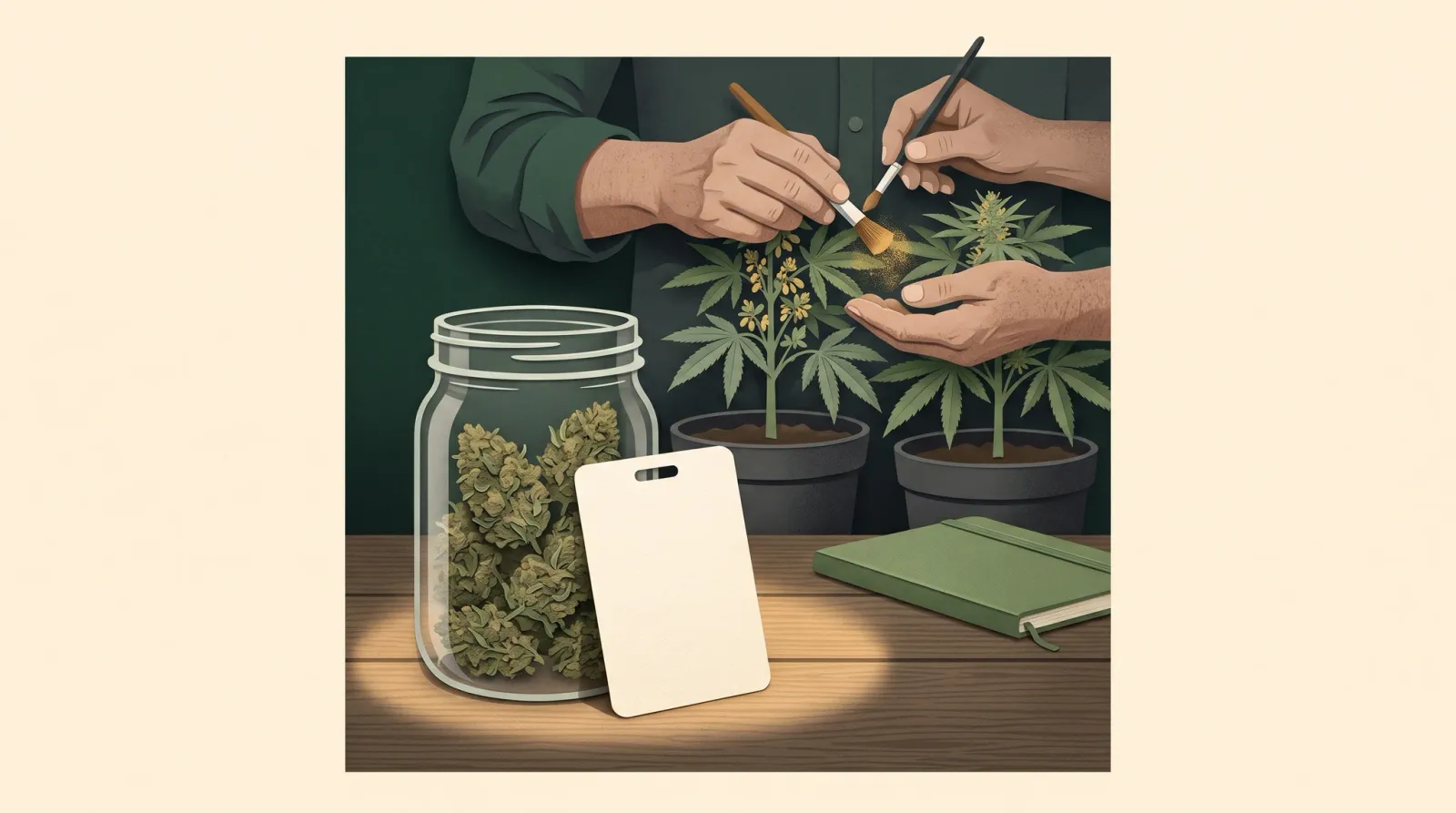
In the celebrity strains we could document, the famous person lent a name, picked a cut or co-owns the brand, while a breeder or grower made the plant. For Khalifa Kush, the best-known case, the primary sources do not name a breeder at all. A celebrity strain is a story about who put their name on the jar. It is rarely a story about who made the cross.
Here is the line worth sending to the friend who swears their favorite rapper bred their favorite weed: Khalifa Kush has three origin stories and no named breeder. The brand says it was “developed for Wiz.” Berner, who supplied it, says it was a Bay Area kush he wrote “KK” on. Commercial listings credit three different makers. We sort that case and four others below, with the record for each.
Sources checked October 29, 2026. This article covers who made the plant. For who owns the store and who makes the product under license, see our hip-hop to retail brands deep dive.
What is a celebrity strain, really?
A celebrity strain is any cultivar sold with a famous name attached. That name can attach to a plant in four different ways, and most roundups treat them as one.
| How the name attaches | What the famous person did | Who made the plant | Documented example |
|---|---|---|---|
| Named after | Inspired a tribute | A breeder, without the honoree | Jack Herer, bred by Sensi Seeds |
| Selected by | Chose and named strains they liked | Not stated in the coverage | Houseplant (Seth Rogen and Evan Goldberg) |
| Collaboration with a breeder | Owns the brand or brings a strain catalog | A seed company’s breeders, credited jointly | Death Row Cannabis x Sensi Seeds; Tyson 2.0 x Royal Queen Seeds |
| Supplied cut, maker unknown | Liked a strain and smoked it | No breeder named by the brand or its supplier | Khalifa Kush |
The difference matters because breeding and selecting are separate jobs. A breeder crosses two parents and grows out the seeds. Someone then picks one plant from those seedlings to keep as a clone. Our guide to how a breeder picks a cut explains why that pick is real work. It is still not the cross.
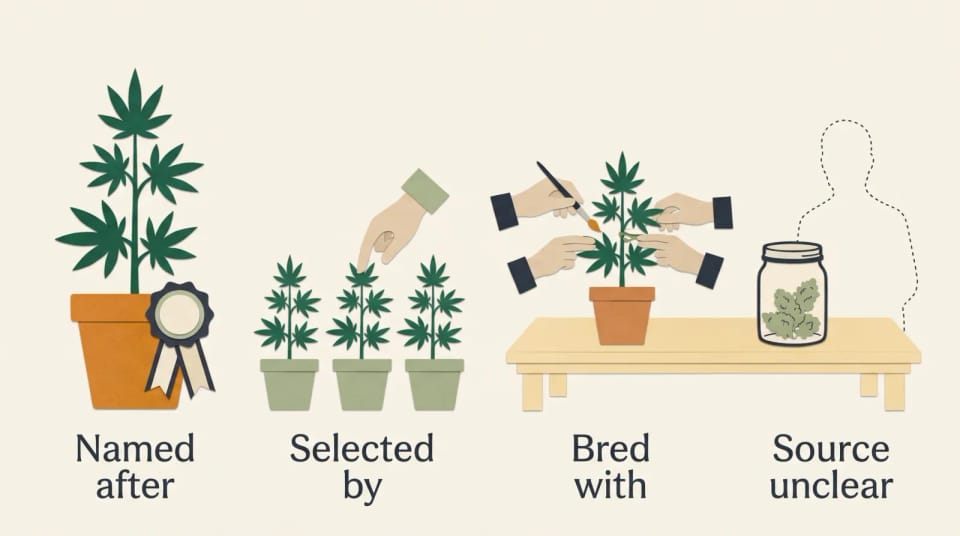
Four ways a famous name ends up on a strain. Only one puts the celebrity’s brand at a bench with a credited breeder, and in the last one nobody on the record says who made the plant.
Who made Khalifa Kush?
Nobody on the primary record names a breeder. Three accounts exist, and they do not agree.
- The brand’s account. The official Khalifa Kush story page says the strain “was developed for Wiz back in the early 10’s,” tailored to his tastes and kept in his private stash in Los Angeles. It says Wiz shared it in 2014 and that the first flower sales came in 2016 at Tryke’s Reef dispensaries. It does not say who developed it. (Khalifa Kush brand story)
- The supplier’s account. Berner, the Cookies co-founder, told Forbes in 2022: “He found a kush that he liked from the Bay area, it was my job to always make sure he had it.” Berner says he “would write KK on the bag,” and that the name came from there. He does not say who bred that kush. (Forbes interview with Berner, 2022)
- The listings. Commercial seed and clone listings credit a named seed company, a Cookies-linked selection, and a San Jose dispensary. None of those listings cites a source, so they show only that the credit is contested.
“Developed for” and “found a kush he liked” are both honest descriptions of a famous person’s role. Neither one says Wiz Khalifa bred the plant, and neither one says who did. When you read a confident Khalifa Kush lineage online, ask where it came from.
Did Jack Herer breed the Jack Herer strain?
No. Jack Herer is the clean “named after” case. Herer was an activist and the author of The Emperor Wears No Clothes (1985). He did not breed the strain that carries his name.
Sensi Seeds founder Ben Dronkers “came up with the idea of paying tribute” to his friend, according to the company’s own history. After several years of breeding and stabilising, Sensi Seeds launched the strain in 1994, with Herer present at the launch. (Sensi Seeds company history)
That is a breeder’s account of its own work, so it carries the usual company bias. It is still unusually clear: a named breeder, a launch year, and an honoree who is credited as the inspiration, not the maker. Many pop-culture names work like this. Our guide to what strain names actually mean explains why a famous name carries no genetic signal.
The athlete version follows the same pattern. Gary Payton the strain comes from a breeder’s line, which our Cookies family tree traces.
Does Snoop Dogg have his own strain?
Snoop Dogg’s name is on several brands. The most detailed breeder record we found is the Death Row Cannabis line, and it credits other people with the breeding.
Sensi Seeds published an interview in 2025 with Death Row Cannabis’s head grower, who goes by “AK” and says he has more than 25 years of growing and breeding. The company writes that its “breeders got straight to work with AK, and created a bunch of brand-new crosses” from both genetic collections. The page names five crosses: Studio Candy, B-Funk, Dough Boy, Cereal Killa and Caramel Pineapple. (Sensi Seeds interview with AK)
The same page names a quality check that is not Snoop either. A sound engineer called Shaggy tastes the line: “If it doesn’t impress Shaggy, it doesn’t make it to the shelves.”
Read that page for what it is. It is the seed seller’s own marketing for a collaboration it profits from, and the description of Snoop’s taste comes from AK, not from Snoop. It does show the pattern clearly: the celebrity owns the brand, a named grower runs the line, and a seed company’s breeders make the crosses. We found no Snoop-authored account of choosing strains for his earlier brands, so we do not guess.
Did Mike Tyson breed his own strains?
The record does not say who did the crossing. It uses softer words.
Royal Queen Seeds says it “joined forces with” Tyson “to bring his proprietary cannabis genetics to growers,” and that “so far, we’ve helped Mike bring six stellar strains to market.” It calls one limited strain, The Jawbreaker, a “breeding project from Tyson 2.0 and RQS,” made from Gelato #41 and Kosher Kush. (Royal Queen Seeds on the Tyson 2.0 strains) If you want the background on that first parent, start with our look at the Gelato line.
An earlier page from the same seed company frames it a little differently. It says Tyson 2.0 had developed a catalog of strains and never released their seeds, and pairs Tyson’s enthusiasm with RQS’s “breeders and brand managers.” (Royal Queen Seeds on the partnership)
So one company says the brand “developed” the strains and also says it “helped” bring them to market. Neither page names a person who made the crosses. “Proprietary genetics” tells you who owns the rights. It does not tell you whose hands did the pollinating.
Did Seth Rogen create Houseplant’s strains?
The coverage describes selection, not breeding. The Los Angeles Times reported in 2021 that Houseplant launched in the US with three flower strains named after weather systems: Diablo Wind, Pancake Ice and Pink Moon. (Los Angeles Times interview, 2021)
In that interview, Rogen and Goldberg describe settling on strains they had smoked and liked for years, with Rogen naming Jack Herer as a favorite that one strain derives from. They also say their personal taste is not everyone’s taste. Nothing in the coverage we could check says who bred or grew the plants.
That is the “selected by” case. Choosing a strain because you have smoked it for decades is a real judgment. It is a different job from making it.
Some celebrity brands do not even go that far on the record. Willie’s Reserve’s own story page says Willie Nelson’s “vision guides” the brand, and credits no grower or breeder. (Willie’s Reserve story page) A missing credit is not proof of anything. It only means the brand has not told you.
Does a famous name guarantee the same plant every time?
No, and that is true of every strain name, famous or not. Two genetic studies show how loose cannabis names are.
- Same name, different genetics. A 2015 study genotyped 81 marijuana samples and concluded that strain names “often do not reflect a meaningful genetic identity.” In 6 of 17 comparisons, a sample was closer to a differently named sample than to one with the same name. (Sawler et al., PLoS ONE, 2015)
- Outliers inside one name. A 2019 study of 30 commercial strains from dispensaries in three states found that most strains contained at least one genetic outlier. The authors warn that variation under one name can mean inconsistent products. (Schwabe and McGlaughlin, Journal of Cannabis Research, 2019)
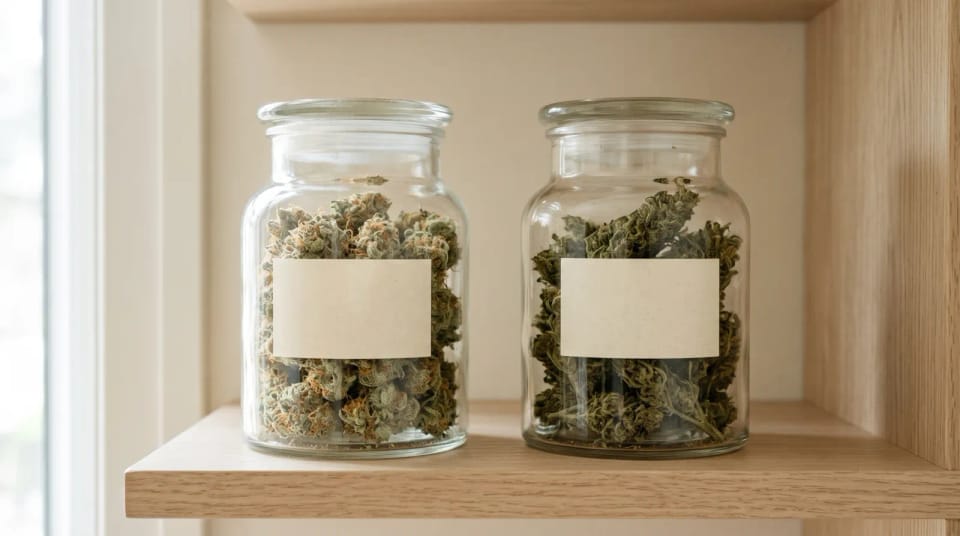
Same label, different plant. Genetic studies of ordinary commercial strains find that one name can cover different genetics, so a famous name on the jar is not a guarantee of what is inside.
Neither study tested a celebrity strain. They show that a name, by itself, does not lock in a plant. A celebrity name adds marketing, not a genetic guarantee.
How do you check what is actually in the jar?
Treat the famous name as the cover of the book and read the pages instead.
- Check the license and the batch. Match the package’s batch or lot number to its lab report. Our guide to matching a lab report to the batch walks through it.
- Read the whole lab report, not one number. Potency figures on brand pages are company numbers. Here is why THC percentage is a poor way to choose cannabis.
- Watch the seller. A famous name is easy to print on any bag, so learn the usual dispensary red flags before you buy.
- Track how it worked for you. Your own notes beat a celebrity’s endorsement. Our guide on how to find your high without trusting the name shows the method. The High IQ app can log how a strain worked so you can compare batches over time.
If you use cannabis for a health condition, talk to a clinician and choose by the lab report, not by whose name is on the jar.
Key takeaways
- A famous name attaches to a strain in four ways: named after, selected by, bred with a breeder, or supplied with no maker named.
- Khalifa Kush has three origin stories and no named breeder on the primary record.
- Jack Herer was bred by Sensi Seeds as a tribute; Herer did not breed it.
- Death Row Cannabis and Tyson 2.0 credit seed-company breeders and grow teams, in shared or vague wording.
- Strain names, famous or not, do not guarantee the same genetics. Check the batch and the lab report.
FAQ
Does Snoop Dogg have his own strain?
Snoop Dogg’s name is on several brands, but the most detailed breeder record we found credits other people. For Death Row Cannabis, Sensi Seeds says its breeders made new crosses with the brand’s head grower, AK. We found no account from Snoop himself saying he bred a strain.
Who made Khalifa Kush?
No primary source names a breeder. The brand says it was “developed for Wiz,” and Berner says it was a Bay Area kush he supplied and labelled “KK.” Commercial listings credit different makers without citing sources.
Did Mike Tyson breed his own strains?
The public record does not say who did the crossing. Royal Queen Seeds describes “his proprietary cannabis genetics” and says it “helped” bring the strains to market. That wording describes ownership and partnership, not who pollinated the plants.
Is a celebrity strain different from a regular strain?
Not genetically. A celebrity strain is an ordinary cultivar with a famous name on it, and the name is a branding choice. Studies show strain names in general are a weak guide to genetics, so the batch’s lab report tells you more than the name does.
Did Seth Rogen invent Houseplant’s strains?
The coverage describes Rogen and Evan Goldberg choosing and naming strains they had smoked for years. It does not say who bred or grew them. That makes Houseplant a “selected by” case, not a “bred by” one.
Sources
- Khalifa Kush. The Story of Khalifa Kush. Brand page, accessed October 29, 2026.
- Bartlett, L. Berner Talks Wiz Khalifa Partnership, Cookies Expansion And Healing With Cannabis. Forbes, 2022.
- Sensi Seeds. Will you be the next Jack Herer or Ben Dronkers? Company history, 2015, updated 2020.
- Voser, S. Death Row Records Teams With Sensi Seeds: Introducing AK. Sensi Seeds, 2025, updated 2026.
- Sumpter, L. Tyson 2.0 x RQS: Meet Our Collaborative Strains. Royal Queen Seeds, 2024.
- Sumpter, L. Royal Queen Seeds x Tyson: A Hard-Hitting Collaboration. Royal Queen Seeds, 2024.
- Tschorn, A. Seth Rogen and Evan Goldberg talk cannabis, creativity and a lot of lost lighters. Los Angeles Times, 2021.
- Willie’s Reserve. Story. Brand page, accessed October 29, 2026.
- Sawler, J., et al. The Genetic Structure of Marijuana and Hemp. PLoS ONE 10(8): e0133292, 2015.
- Schwabe, A. L., and McGlaughlin, M. E. Genetic tools weed out misconceptions of strain reliability in Cannabis sativa: implications for a budding industry. Journal of Cannabis Research 1(1), 2019.



