

CO₂, Ethanol, or Hydrocarbon Extraction: Which Makes Better Oil?
Compare CO₂, ethanol, and hydrocarbon cannabis extraction without a purity ranking. See why the full process and finished-batch tests matter.

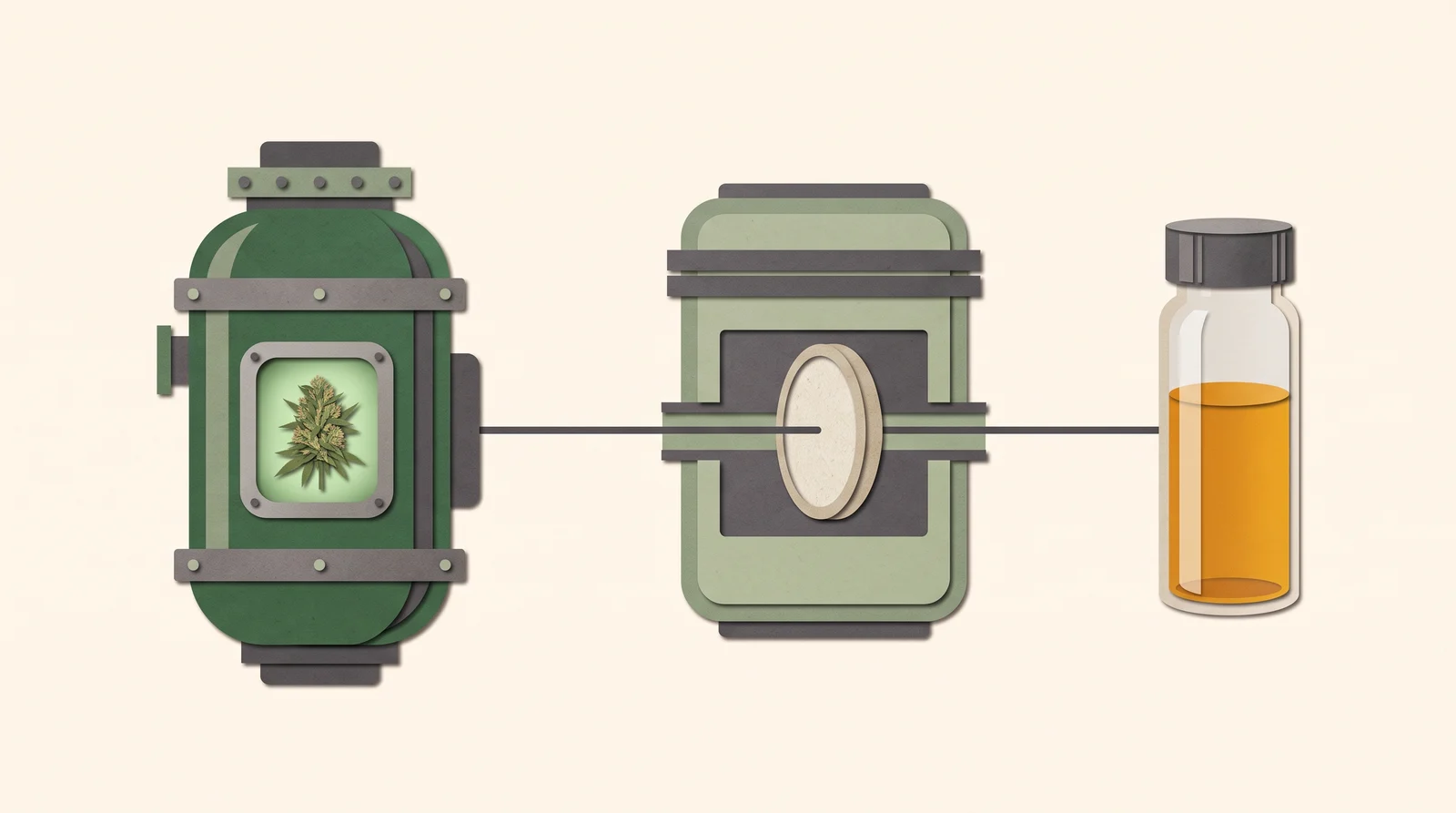
CO₂, ethanol, and hydrocarbon extraction use different solvents, but none of those names alone tells you which finished cannabis oil is better. Compare the plant material, the full processing history, and the tests on the final batch. “CO₂ extracted” is a process detail, not a purity score.
Here in High School, we will separate the extraction step from the oil you buy. That distinction helps with vape oils, oral oils, and concentrates. It does not make those products interchangeable.
What is the difference between the three methods?
All three use a solvent to help separate compounds from plant material. The solvent differs, and so do the conditions under which a processor uses it.
| Label | What it describes | What you still need to ask |
|---|---|---|
| CO₂ extraction | Carbon dioxide used as the extracting fluid, often under high pressure | Was another solvent used later? Was the extract heated or blended? |
| Ethanol extraction | Alcohol used to extract compounds from the plant | What temperature and contact time were used? What happened after extraction? |
| Hydrocarbon extraction | A process using hydrocarbons such as butane or propane | How was the solvent recovered, and what do final-batch tests show? |
California’s current rules name CO₂ and ethanol among extraction solvents. CO₂ and volatile-solvent extraction must use professional closed-loop systems. The rules also set solvent-purity requirements. They apply to California’s licensed system, not a global quality ranking. DCC regulations, §§17203–17206
Texture names answer a separate question. Wax, shatter, and badder describe forms you encounter; they are not three competing solvents. Our cannabis concentrates guide explains those names.
Why does the full process matter more than one solvent name?
Because extraction can be followed by cleanup, heating, or formulation. The word on the package may name only the first part of that history.
Consider a 2024 laboratory study by Chacon and colleagues. It compared CO₂ extraction, ethanol extraction, and hydrodistillation, which collects an aromatic oil through a water-and-distillation process. It used one CBD/CBG-dominant hemp cultivar from three field sources. There was no hydrocarbon arm. Chacon et al., 2024
The CO₂ extract then went through ethanol winterization, a cold cleanup step. The researchers filtered it, removed the ethanol, and added coconut oil. They then heated it at 95°C for one hour. The study’s “CO₂ extract” had a longer history than CO₂ extraction alone.
Its chemical profiles differed across procedures. But the CO₂ arm had also been decarboxylated, while the ethanol arm had not received that step. The authors identify that difference when discussing neutral versus acidic cannabinoids. The experiment compared complete protocols; it did not isolate the solvent as the only cause. Opened study methods and discussion
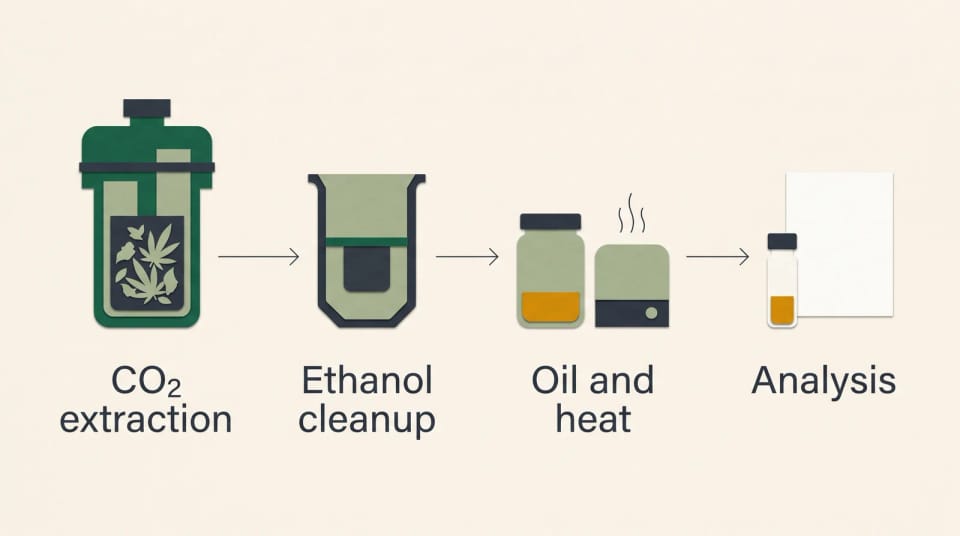
The CO₂ arm in this hemp study included ethanol cleanup, coconut-oil formulation, and heating before analysis. The solvent name describes only part of the protocol.
That is the detail to keep when someone shares a solvent winner chart: were the later steps the same? Our decarboxylation lesson explains the acid-to-neutral change. It is a different question from extraction recovery.
Does ethanol always lose the most terpenes?
You cannot answer that from the word “ethanol.” Temperature, time, and plant-to-solvent ratio are part of the method.
Addo and colleagues tested ethanol extraction using a mixed, freeze-dried cannabis sample. They varied contact time and solvent ratio at −40°C, −20°C, and room temperature. Their optimized models gave different terpene totals, with the highest at −40°C. Yet the predicted crude-extract yields did not differ significantly across temperatures. Addo et al., 2022
The endpoints matter: a terpene result and the mass of crude oil are different measurements. This lab study aimed to refine the process. It did not test consumer taste or compare hydrocarbon extraction. NSERC supported the work in partnership with EXKA. Several authors listed EXKA as their affiliation. The authors declared no conflicts of interest. Full methods and disclosures
Are yield, potency, and purity the same thing?
No. A processor can recover more crude extract without producing a higher cannabinoid percentage.
- Crude yield asks how much extract mass came from the starting material.
- Cannabinoid recovery asks how much of a target compound was recovered, using the study’s stated calculation.
- Potency asks how much cannabinoid is in a given amount of the finished product.
Addo’s study calculated crude yield from oil mass and calculated its extraction efficiency from THCA measurements. Those calculations answer different questions. Do not compare an extract-mass yield from one paper with a THC percentage from another as though both measure “best.”
Purity needs a target too. Do you mean a high cannabinoid fraction, few unwanted plant compounds, or low contaminant levels? A single word cannot replace those measurements. The same distinction matters when comparing rosin with distillate.
Which evidence matters for the finished oil?
Use the extraction label to ask about the process. Use a matching lab report to examine the product.
California’s §15718 requires residual-solvent results and a pass/fail decision against listed action levels, with product-specific exceptions. It does not substitute the extraction name for that analysis. Other jurisdictions set their own requirements. DCC residual-solvent testing rule
Ask for three things:
- A complete process description: What solvents and later steps were used? A CO₂ claim does not establish that ethanol never touched the extract.
- The final formulation: What ingredients are in the product, and what route of use is it made for?
- The right batch report: Does the COA match the package, and does it include the relevant tests?
Our guides to matching a COA to a batch and reading residual-solvent results handle the report details. A potency-only page cannot answer the solvent question.
Keep experience claims separate too. High Families is our product classification; an extraction solvent does not assign a family or prove a clinical effect.
FAQ
Is CO₂ extraction solventless?
No. CO₂ is the extracting solvent. That term also leaves open which substances were used during later processing.
Does a hydrocarbon extract always have worse purity?
The name does not establish that. Ask which property is being compared and check evidence from the finished batch. Neither study discussed here tested a hydrocarbon arm.
Can I use a hemp comparison to rank THC vape oils?
That would need separate evidence. The 2024 study used a CBD/CBG-dominant cultivar and did not include THC or THCA reference standards. It measured chemical profiles, not vape aerosols or effects in people.
Does the highest crude yield mean the strongest oil?
No. Yield measures recovered mass, while potency describes cannabinoid concentration. The final formulation and its test results are what matter for the strength of the product you buy.
Key takeaways
- The solvent name describes one part of a manufacturing history.
- Compare full protocols before assigning a difference to the solvent.
- Crude yield, cannabinoid recovery, potency, and contaminant results answer different questions.
- Check the finished product and matching batch report instead of buying a purity ranking.
Sources
- Chacon, F. T., Raup-Konsavage, W. M., Vrana, K. E., & Kellogg, J. J. (2024). Effect of Hemp Extraction Procedures on Cannabinoid and Terpenoid Composition. Plants, 13(16), 2222. DOI. Author-lab PDF.
- Addo, P. W., Sagili, S. U. K. R., Bilodeau, S. E., et al. (2022). Cold Ethanol Extraction of Cannabinoids and Terpenes from Cannabis Using Response Surface Methodology: Optimization and Comparative Study. Molecules, 27(24), 8780. DOI. NRC full text.
- California Department of Cannabis Control. Current regulatory text: §§17203–17206 and §15718.


