How to Read Residual Solvents on a Cannabis COA
Decode residual-solvent results on a cannabis COA, including ppm, ND, LOQ, action limits, pass/fail, product type, and state-rule differences.


A residual-solvents panel checks for volatile chemicals left behind after manufacturing. If a processor used butane, propane, ethanol, hexane, or another solvent, a matching COA can show whether the tested batch met applicable limits.
“ND” does not mean absolute zero. “Pass” does not mean universally safe. An action limit is not a personal exposure recommendation. Each term answers a narrower laboratory or regulatory question.
This guide will show you how to read that question correctly. It is a focused companion to our broader guide to cannabis lab results, not medical advice or a substitute for your state regulator.
What the Test Actually Measures
Residual solvents are organic volatile chemicals that remain after a manufacturing process. They are not the same as pesticides, heavy metals, microbes, intentionally added flavor ingredients, or every volatile compound that might appear when a product is heated.
Labs commonly analyze them with headspace gas chromatography. A sealed vial is warmed so volatile compounds move into the gas above the sample. The instrument separates that vapor, then a detector identifies or measures target solvents. Gas chromatography with mass spectrometry can add selectivity when compounds overlap.
The result still depends on sample preparation, matrix, calibration, and method performance. A viscous oil is not analytically identical to a liquid tincture. In a South African study of 279 submitted cannabis-based product samples, researchers used full-evaporation headspace GC-MS and reported that 37% failed the USP <467> specifications applied in that study [Viviers et al., 2022]. That finding does not estimate failure rates in your state.
An earlier study screened 57 California medical-market concentrates and found several residual solvents, with isopentane detected most often [Raber et al., 2015]. It shows why testing matters, not how today’s licensed market performs.
First, Make Sure It Is the Right COA
Before interpreting a single number, match the document to the product in your hand.
- Match the batch or lot number. A COA from another batch does not describe yours; batch chemistry can vary.
- Match the product and matrix. “Cannabis oil,” “vape cartridge,” “tincture,” and “concentrate” may follow different testing requirements or exceptions.
- Check the laboratory. Look for its name, license or accreditation information, report date, sample-received date, and analysis date.
- Identify the jurisdiction. The action limit must come from the rules that governed that batch when it was released.
- Confirm the full panel is present. A potency-only page is not evidence that residual solvents were tested.
A QR code is merely a path to a document, not authentication. If it lands on an undated image, a generic “passed” badge, or a mismatched batch, use our counterfeit vape-cart checklist.
The Six Columns That Matter
COA layouts vary, but a useful residual-solvents table usually gives you most of these fields:
| Field | What it means | What to check |
|---|---|---|
| Analyte | The target solvent | Is the required panel shown? |
| Result | What the lab reported | Numeric, ND, <LOD, or <LOQ? |
| Unit | Often ppm, µg/g, or mg/kg | Do result and limit share a basis? |
| LOD | Limit of detection | What is the method’s detection floor? |
| LOQ or MRL | Lowest reliable/reportable quantity | Is it below the action limit? |
| Action limit | The compliance boundary | Does it apply here and now? |
| Status | Pass, fail, or another disposition | Does it match result versus limit? |
New York’s 2026 laboratory quality standard defines the LOD as a statistically calculated minimum distinguishable from zero and the LOQ as the lowest concentration reportable within method accuracy and precision limits. It uses LOQ and MRL as synonymous reporting terms. Conventions elsewhere may differ.
ND, Below LOD, and Below LOQ Are Not Synonyms for Zero
This is the most important language lesson on the page.
ND or “not detected”
ND usually means the method did not detect the analyte at or above its stated threshold. It does not prove zero molecules. Translate it as: not detected by this method in this tested portion at its stated capability.
Less than LOD
<LOD means the signal was below the detection limit. The lab cannot confidently distinguish it from background. Printing “0.000” instead creates false precision.
Detected below LOQ
A signal can be detectable yet too low to quantify accurately and precisely. It may appear as <LOQ, “trace,” “detected, not quantified,” or an estimate. The report is not claiming a reliable concentration.
A numeric result
A number at or above the LOQ is a quantified concentration, still subject to method accuracy, precision, rounding, and uncertainty.
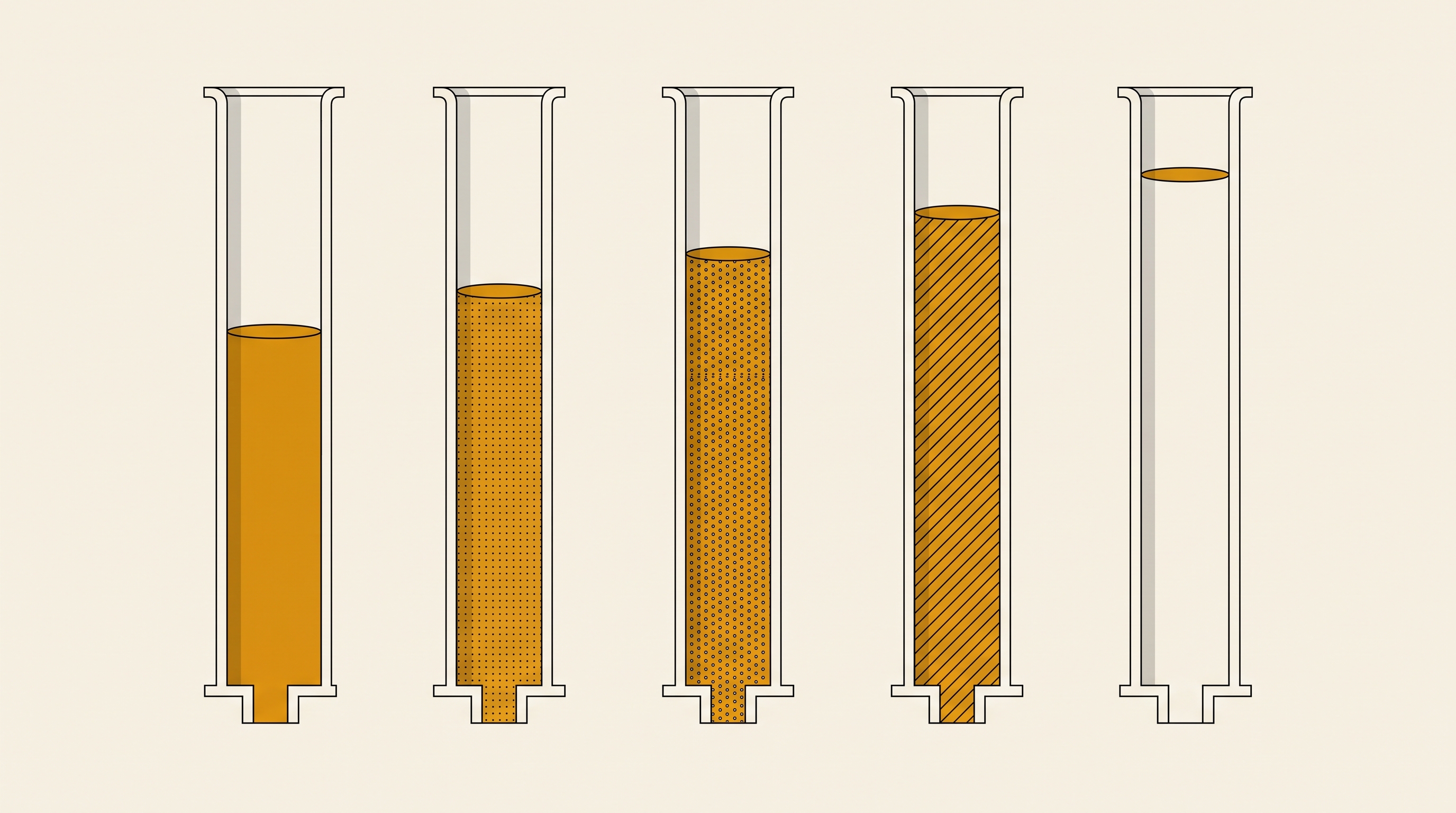
The order is usually:
lower concentration → below detection → detected but below quantitation → reliably quantifiable → action limit
The method’s LOQ should be low enough to decide compliance at the action limit. If it sits above the limit, ask how the lab could demonstrate compliance there.
How to Read ppm Without Getting Tricked
For a mass-based cannabis oil or concentrate:
- 1 ppm = 1 µg/g
- 1 ppm = 1 mg/kg
Those are equivalent mass ratios. But mg/L is a volume-based concentration. Do not convert it to mg/kg without knowing the product’s density and the report’s basis.
Now consider a fictional entry:
| Analyte | Result | LOD | LOQ | Action limit | Status |
|---|---|---|---|---|---|
| Butanes, total | 120 ppm | 2 ppm | 10 ppm | 5,000 ppm | Pass |
| Benzene | ND | 0.2 ppm | 0.5 ppm | 2 ppm | Pass |
| Hexanes, total | <LOQ | 1 ppm | 5 ppm | 290 ppm | Pass |
These values illustrate the reading process; they are not universal limits and are not from a real product.
- Butanes were quantified at 120 ppm, below this example’s 5,000 ppm action limit.
- Benzene was not detected at the method’s stated capability. Do not rewrite ND as zero.
- The hexanes line indicates a result below reliable quantitation. It does not support a precise number such as 2.4 ppm.
You can divide a result by its limit: 120 ÷ 5,000 = 2.4% of the limit. That means 2.4% of this compliance limit, not “2.4% toxic,” “97.6% safe,” or predicted health risk.
What “Pass” Really Means
For residual solvents, “Pass” generally means the tested sample did not exceed the applicable action levels for the analytes required by that jurisdiction and product category. It is a regulatory conclusion about a batch sample.
It does not mean:
- every possible solvent was tested;
- every analyte was absent;
- the product will affect every consumer the same way;
- the COA evaluated what forms after heating;
- another jurisdiction would reach the same result.
That narrower definition is not a reason to dismiss testing. It is how you use the result honestly. Our investigation of why cannabis testing standards can fail consumers covers sampling incentives and oversight issues beyond this panel.
Why State Limits Differ
There is no single U.S. federal cannabis COA standard that every state market uses. States select analyte lists, product categories, methods, reporting rules, and action limits through their own laws and rulemaking.
Compare two current official examples:
- Washington lists 2 µg/g for chloroform and 5,000 µg/g for the sum of butane isomers. Its rule also sets fallback failure levels for unlisted USP Class 1, 2, and 3 solvents.
- Vermont lists 60 ppm for chloroform and 0 ppm for butane. The zero is tied to Vermont’s statutory prohibition on butane extraction, not proof that another state’s 5,000 ppm represents a universal biological threshold. Vermont also exempts carrier ethanol in tinctures from its ordinary ethanol action limit.
Same chemical, different rule architecture.
Limits differ with regulators’ source frameworks, product definitions, permitted processes, analytical capabilities, exposure assumptions, and policy choices. The current ICH Q3C(R9) guideline classifies residual solvents for pharmaceuticals and describes permitted daily exposure concepts. Its scope is drug substances, excipients, and drug products—useful context, not a guarantee transferable to every inhaled cannabis concentrate.
When two COAs disagree, ask “which rule governed each product?” before asking which state has the “correct” number.
Inhalation and Ingestion Are Different Contexts
A concentration in the unopened product is not the same as the amount that reaches a person.
For an edible or tincture, exposure depends on concentration, serving size, and amount consumed. Some solvents can be intentional carriers. Vermont’s ethanol exception for tinctures shows why an ethanol carrier is not interpreted like a poorly purged extract.
For a vape or dab, the panel measures the unheated sample. Temperature, airflow, puff behavior, formulation, and heating chemistry affect the aerosol. A 2025 review found concentrate-vaping chemistry under-researched and described heat-created toxicants absent from the original liquid’s residual-solvent table [Munger et al., 2025].
So a passing panel is useful evidence about manufacturing residues. It does not certify the entire inhaled aerosol. Read it alongside our guides to dabbing basics, vape-cart shelf life, and heat-related ketene concerns from acetylated cannabinoids.
Eight Red Flags on a Residual-Solvents Panel
Pause before buying when you see any of these:
- The batch number does not match the package.
- The result has no unit or basis. “12” is not interpretable by itself.
- There is no action limit or regulatory status. You may have an informational screen, not compliance testing.
- Every line is printed as zero with no LOD or LOQ. That can hide the method’s real floor.
- The LOQ is higher than the action limit. The method may not support the required decision.
- A result exceeds the displayed limit but still says Pass. Rounding may explain a tiny apparent mismatch, but the lab should explain it.
- The panel is unexpectedly short. Compare it with the regulator’s required list for that product.
- The report is only a cropped brand image. Ask for the complete laboratory-issued COA.
Prioritize traceability: matching batch IDs, a complete report, clear units, visible method capability, and a jurisdiction-linked status. The same habits help when choosing among wax, shatter, rosin, and other concentrates or comparing rosin with distillate.

Professor High’s 60-Second COA Routine
At the counter, use this order:
- Match the package and COA batch numbers.
- Confirm the product type, test date, lab, and jurisdiction.
- Find the residual-solvents section—not just the overall Pass badge.
- Read the unit, LOD, LOQ or MRL, result, and action limit together.
- Translate ND as “not detected above the method’s threshold,” never “zero.”
- Confirm every numeric result is below its applicable limit.
- Check that the method can quantify below the limit.
- Save the COA with your product notes so you can compare batches later.
Our scanner can help you organize what you are considering, while Compare helps keep product and strain information side by side. After the compliance check, use the High Families framework for the separate question of likely experience. A residual-solvent result does not predict Uplift, Relax, Create, or any other effect profile; those are different layers of evidence. Save what you learn in the High IQ app so the next decision starts with your own record, not a marketing claim.
FAQs
Does ND mean there are no residual solvents?
No. ND means the analyte was not detected according to that laboratory method and its stated threshold. It is not proof of absolute zero.
Is below LOQ the same as ND?
Not necessarily. A lab may detect a signal below the level it can quantify with the required accuracy and precision. That can be reported as <LOQ, trace, or detected-not-quantified, depending on the reporting rules.
Is ppm the same as µg/g?
Yes for a mass-based result: 1 ppm equals 1 µg/g and 1 mg/kg. A volume-based unit such as mg/L is different and requires the report’s basis and, for conversion, product density.
Can a product pass with a detectable solvent result?
Yes. Many rules allow a numeric result below the applicable action limit. Pass does not mean every analyte was absent; it means the tested sample met the governing compliance criteria.
Why can one state allow a level that another state fails?
States adopt different analyte lists, process restrictions, product categories, source frameworks, and action limits. Always interpret a result under the jurisdiction, product type, and date printed on the COA.
Does a passing residual-solvents panel prove a vape is safe?
No. It addresses specified manufacturing residues in the tested sample. It does not cover every contaminant, individual health factor, device behavior, or compound created during heating.
Do solventless concentrates need this panel?
Testing requirements vary. Some jurisdictions do not require residual-solvent testing for mechanically separated products such as rosin, hash, or kief, while still requiring other contaminant tests. “Solventless” does not mean “testing-free”; see our solventless concentrate comparison.
Key Takeaways
Read a residual-solvents panel as a chain of evidence:
right batch → right product → right jurisdiction → right units → method capability → result → action limit → status
ND means not detected at a defined capability. LOQ marks reliable quantitation, not the beginning of existence. Pass means the tested sample met a particular rule, not that science has declared universal safety.
Keep those boundaries intact and the alphabet soup becomes useful. You can spot mismatched reports, compare results fairly, ask precise questions, and make a better-documented choice.
Sources
- Viviers, H. J., Petzer, A., & Gordon, R. (2022). An assessment of solvent residue contaminants related to cannabis-based products in the South African market. Journal of Cannabis Research, 4, 19. DOI
- Raber, J. C., Elzinga, S., & Kaplan, C. (2015). Understanding dabs: contamination concerns of cannabis concentrates and cannabinoid transfer during the act of dabbing. The Journal of Toxicological Sciences, 40(6), 797–803. DOI PubMed
- Munger, K. R., Anreise, K. M., & Strongin, R. M. (2025). Cannabis concentrate vaping chemistry. Frontiers in Toxicology, 7, 1568207. DOI
- Washington Administrative Code 314-55-102: Quality assurance and quality control
- Vermont Cannabis Control Board: Laboratory Testing Action Limits and Parameters Guidance, October 2025
- New York Office of Cannabis Management: Cannabis Laboratory Quality System Standard, February 2026
- ICH Q3C(R9): Impurities—Guideline for Residual Solvents

